Assessing Effectiveness of Climate Smart Activities: A Study from Rural Areas, Nepal- Juniper Publishers
Journal of Agriculture Research- Juniper Publishers

Abstract
This study was objectively carried out to assess the
trend of temperature and rainfall, evaluate the effectiveness of Climate
Smart Activities, find the impact of climate change on resources and
explore the climate smart policies and practices. The study was carried
out in three piloted and three non-piloted rural municipality from
Siraha, Gorkha and Kaski districts. Temperature and rainfall data for
forty years of these districts were collected from Department of
Hydrology and Meteorology [1]. The household survey, focus group
discussion, key informant interview and field observation were carried
out to collect data. The climate smart policies and practices were also
collected. In Gorkha, the highest precipitation was observed in 1995
i.e. 4063.9 mm while lowest precipitation was only 1418mm in 1969. The
highest minimum and maximum temperature was observed in 1969, 1970 and
2000 i.e. 25 ˚C and lowest was observed in 1979 and 2001 with 9 ˚C. The
climate change impacts like crop calendar changed and increment in
several diseases and pest in flora and fauna are observed. The water
sources have been drying and irregular. In Gakhu rural municipality
(RM)-6, the 100% people has adopted knowledge smart practices whereas
96.67% energy, carbon smart practices, 93.33% water smart practices, 70%
agriculture smart practices and 60% biodiversity smart practices. In
Dhangadimai-13 RM of Siraha, 89.99% people has adopted water smart
practices. Likewise, in Rupa-2 RM of Kaski, 61.29% people has adopted
carbon and energy smart practices. Mann-Kendel test tau b showed that
the significant differences in temperature and rainfall trend. Krusker-
Wallis test shows that there were significant differences of performance
of adaptation program among RMs because p value is less than 0.05. The
people of In Gakhu RM, the practices climate smart activities like 3
rooftop water harvesting, 46 water tanks, 1 water resource conservation
and 40 improved cattle house, 5 drip irrigation, 27 plastic tunnel and
57 improved cooking stoves. This research will be useful to adopt the
climate smart practices in other areas too.
Keywords: Climate smart village; Climate smart practices; Temperature; Rainfall
Abbreviations:
CSV: Climate Smart Villages; RM: Rural Municipalities; DoEnv:
Department of Environment; NAPA: National Adaptation Plan of Action;
DHM: Department of Hydrology and Meteorology
Introduction
Adaptation practices are action that are taken to
help communities and ecosystems to cope with changing climate condition
[2,3]. The climate change impacts are expected to be particularly severe
in the developing world and among marginalized communities because of
limited adaptive capacity [4,5]. Climate Smart Villages (CSV) are sites
where researchers from national and international organizations, farmers
cooperatives, local government leaders, private sector organizations
and key policy planners come together to identify which climate-smart
agriculture interventions are most appropriate to tackle the climate and
agriculture challenges in the village [6,7].
Climate Smart Village was first implemented in Kavre
District in Nepal by International Centre for Integrated Mountain
Development [8] in 2015 with 6 different interventions namely Nutrient,
Water, Crop, Future, ICT and Energy Smart Practices. More Climate Smart
Village has been implemented in Nawalparasi, Kaski
and Lamjung in 2015-16. In 2017, Department of Environment (DoEnv) has
implemented Climate Smart Village in 13 districts which has five
different interventions: water, Agricultural, Carbon and Energy,
Biodiversity and Knowledge Smart Practices.
This research was done for assessing the
effectiveness of the CSV program launched by Department of Environment
(DoEnv) in three different rural municipalities (RM) of three different
districts: Rupa RM Kaski, Gakhu RM Gorkha and Dhangadimai RM Siraha.
These districts were selected according vulnerability index as mentioned
by NAPA report, 2010 [9,10]. Out of which two districts Siraha and
Gorkha are highly climate vulnerable and one Kaski is moderately climate
vulnerable. The research was oriented on assessing the effect of
climate change in different sectors and their adaptation practices on
those districts. Climatic (temperature and rainfall) data from hydro
meteorological stations nearer to project location has been brought for
analyzing different trends of different time and seasons. This research
was
objectively carried out to show the trend of temperature and
rainfall, evaluate the effectiveness of Climate Smart Activities at
Rupa, Gakhu and Dhangadimai RM, assess the impact of climate
change on resources and explore the climate smart policies and
related practices.
Materials and Methods
Study area
Among the 13 rural municipalities (RM) implemented by
Department of Environment (DoEnv), three RM namely Rupa-2 of
Kaski, Gakhu-6 of Gorkha and Dhangadimai-13 of Siraha District
were selected for the study. These RMs was selected according
to the vulnerability ranking of NAPA (National adaptation plan
of action) reports 2010. Simultaneously these RM’s represent
the different climatic zones too. Dhangadimai-13 as Tropical
Climate Zone, Rupa-2 and Gakhu-6 as Sub-Tropical Climate Zone
respectively. From these RM’s, villages having climate smart
program were selected as a study site.
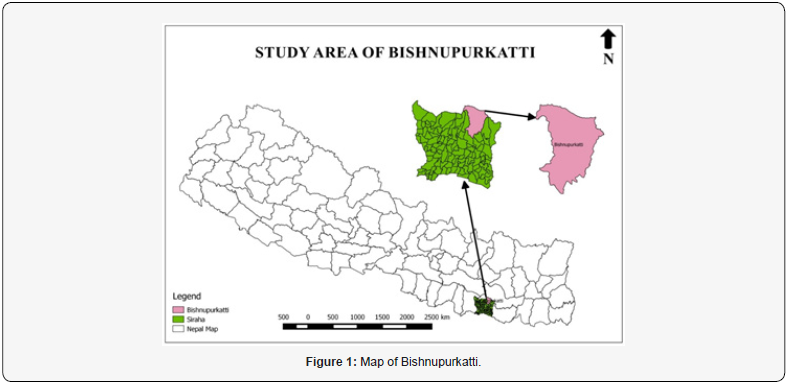
Siraha District lies in an altitude of 80m (260ft) from sea level
which has tropical climate zone and has latitude of 26°38’23.07”N
and longitude of 86°11’7.25” with elevation of 300-1000m
respectively. Nirmal Agricultural Group was selected as a
registered climate smart applier under DoEnv. According to NAPA
document 2010 Siraha was ranked as high (0.601- 0.786) to an
overall climate vulnerability index (Figure 1).
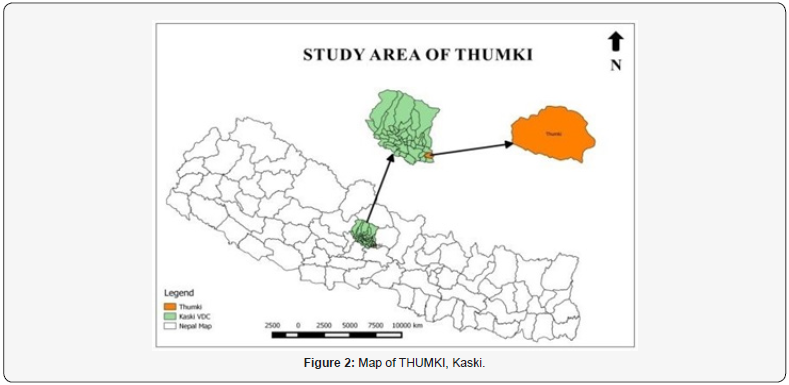
Kaski District lies in an altitude of 750m (2460.63ft) from
sea level which has Sub-tropical climate zone and has latitude
of 28°16′0.8″N & longitude of 83°58′6.64″ with elevation of
450-8091m respectively. Shree Jagriti Agricultural and Animal
Husbandry Group was selected as registered climate smart
applier under DoEnv. According to NAPA document 2010 Kaski
was ranked as moderate (0.356-0.600) to an overall climate
vulnerability index (Figure 2).
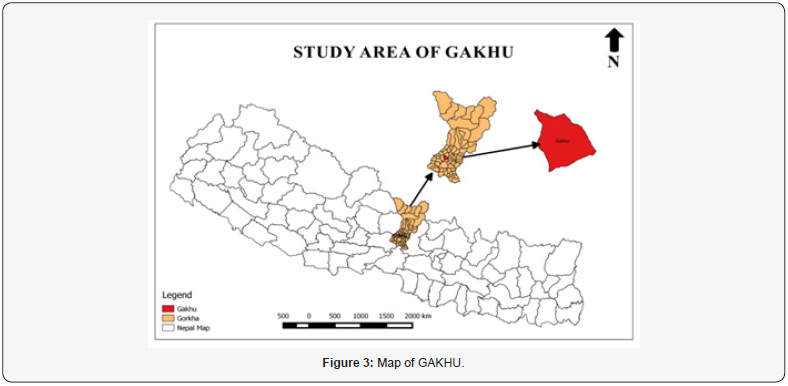
Gorkha District lies in an altitude of 1106m (3628.609ft) from
sea level which has Sub-tropical climate zone and has latitude of
28°3′.372″ N and longitude of 84°37′.432″ E with elevation of 488-
8166m respectively. Shree Hanumaan Multipurpose Agricultural
was selected as a registered climate smart applier under DoEnv.
According to NAPA document 2010 Gorkha was ranked as high
(0.601-0.786) to an overall climate vulnerability index (Figure 3).
House hold survey- The household questionnaire was
prepared and conducted for 180 households with 60 in each study
site. Altogether 3 FGD was conducted, One FGD in each study area
while altogether 15 KII was conducted 5 from each RM. In addition,
Climatic data of nearest meteorological station published by
Department of Hydrology and Meteorology (DHM) was collected
and analyzed. The data published by Central bureau of Statistics,
relevant researches, papers journals, relevant national policies,
available data from Rural Municipality, ancillary data sources
including available maps were studied. The collected data were
analyzed through Descriptive method, Statistical method such as
mean, standard deviation and Statistic Kruskal-Wallis-one-way
ANNOVA and Mann- Whitney. Climatic data were analyzed using
Mann Kendal’s tau-b test.
Results and Discussion
Trend of temperature and rainfall at Kaski, Gorkha and Siraha
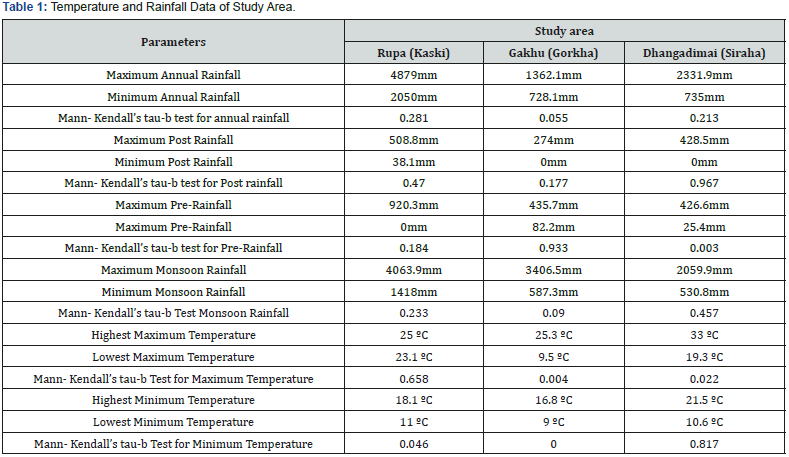
The result shows that annual maximum and minimum
temperature trend is increasing in Rupa and Gakhu while
decreasing in Dhangadimai RM. The trend of total monsoon
temperature was increasing in Rupa and Dhangadimai but it
was decreasing in Gakhu. The altitude of Rupa and Gakhu are
886m and 1106m respectively, comparatively which lies in
higher altitude than Dhangadimai showing increasing trend of
the annual temperature. So, the study is quite similar the study
done by Government of Nepal 2015 which shows the average
trend of mean annual maximum temperature over Nepal is 0.06
˚C/yr. Moreover, study conducted by Nayaju et al. [11] shows
annual mean temperature of country is rising at the rate of 0.41
˚C per decade. Dhangadimai lies in as lower altitude of 80m
which shows decreasing trend of annual minimum and maximum
temperature. According to DHM [1], the magnitude of winter
maximum temperature trend is negative or lowest positive in
the southernmost districts (Tarai districts) and the magnitude
increases towards north with elevation (Table 1).
The trend of annual rainfall pattern shows increasing which
is similar to 10.673mm per annum, studied done by Baidya et al.
[12]. According to him, there was increasing trend in precipitation
below 1500m elevation, while it was decreasing trend above
1500m [13]. According to MoPE [10], the Gorkha district lies in
drought prone area and the study of Gakhu shows decreasing
trend of annual rainfall pattern.
Effectiveness of climate smart activities in Rupa-2, Gakhu-6 and Dhangadimai-13 RM
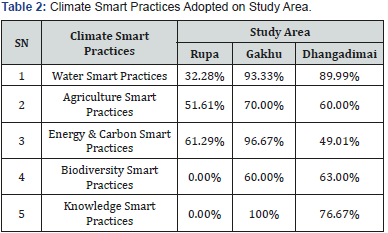
Effectiveness of climate smart practices was done in three RM
Rupa, Gakhu and Dhangadimai of Kaski, Gorkha and Siraha District
respectively (Table 2). The result shows that, the overall climate
smart practices was the most benefited community in Gakhu,
second in Dhangadimai and lowest in Rupa RM. According to MoPE
[10] document the Gorkha district was ranked in high vulnerability
index due to erratic rainfall and rise in temperature which causing
recurring natural disaster like flash flood, landslide, drought and
increase in pest. The performance of Gakhu RM is higher, it might
be due to implementation of climate smart practices, capable of
coping with the changing climate and the community adopts new
interventions [14]. It might be due to occasional events such as
earthquake in Gorkha 2015 which cause massive destruction,
from the event people were mostly affected in their livelihood
and socio-economic condition. Affected community was always in
search of such new implementation, meanwhile in this time the
programme was implemented in the community and people were
most willing to implement the program to cope with the situations
in a sustainable way. The success study is similar to the Climate
Smart Village in Haryana, India where climate smart agricultural
practice was more focused such as ICT service to access weather,
zero-tillage, laser land leveling, residual management, crop
diversification, agro-forestry, precision nutrient management
[15,16].
Dhangadimai is second benefited community, in general
expectation the people in the community lies in the medium index
and their source of income is agriculture as a major occupation;
these practices are familiar to adopt and cope with the extreme
event. Though the crop farming is the mainstay of the people in
Tarai, every household are involved in farming and raising livestock
and the Climate Smart Village programme is very supportive to
enhance the agricultural production, cope with water scarcity
and safe guarding the natural resources as well as help in socioeconomic
condition of the community. In occasional expectation
it might be due to occasional events such as flood, Siraha is very
prone to flood and drought and the event will severely affect
the socio-economic condition of the community as well loss in
agricultural production.
According to NAPA 2010 document, the areas of Kaski was
ranked as moderate in vulnerability index [10]. The erratic
rainfall and rise in temperature causing frequent natural disaster
such as flash flood, landslide, earthquake and increase in pest
in the agriculture are the common impact. After the devastating
earthquake of 2015 has dried almost all the water sources which
has lead, sever impact in settlement and in socio economic
condition. This unhygienic settlement might lead to lower in
performance in the community. The Knowledge Smart Practices
and Biodiversity Smart Practices were not implemented in the
community so that they do not have proper knowledge about the adaptation programme and how to implement it in a sustainable
way. Due to simple, affordable and replicable technologies in Kavre
District the pilot Climate Smart Village has develop 500 household
reached nutrient smart, 100 reach ICT smart, 180 reach Future
smart and 400 farmers reach water smart practices with the
performance higher [8].
Non- climate smart practices in Rupa-2, Gakhu-6 and Dhangadimai-13 RM
The respondents of non- climate smart practice have been
practicing water smart practice, agriculture smart practice,
carbon and energy smart practice, biodiversity smart practice and
knowledge smart practice. The result has been presented on the
table below (Table 3).
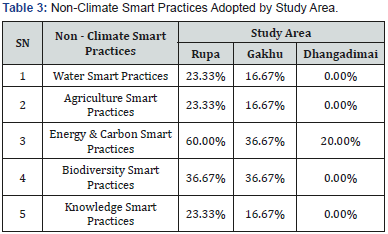
The performance was the higher in Rupa and much lower in
Gakhu and Dhangadimai RM in non-climate smart village. Only
20% people were benefited in the community in Rupa from local
organization, Red Cross and Environment friendly organization.
In Dhangadimai, it was only 15% benefited community. Due to
lack of proper adaptation programme and climate smart village
implementation in all community the people are facing water
scarcity, lower in agricultural yield, increase in pest and disease,
more consumption of fuel wood and improper cattle dung which
cause increase in the epidemics also people are unaware of the
changing climate and how to cope with it.
Statistical comparison of climate smart practices
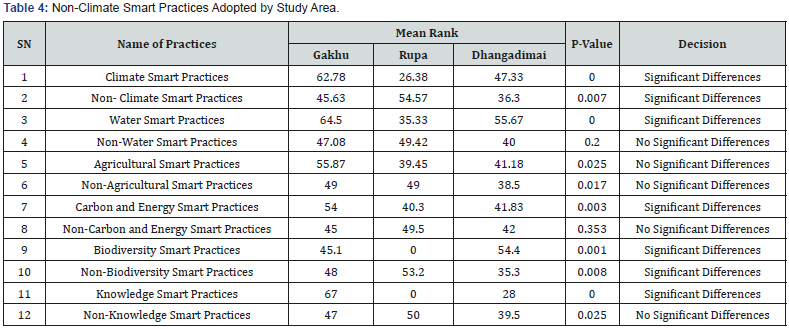
The Kruskal-Wallis test shows that there was no significant
difference for p-value higher than 0.05 and significant difference
for p-value less than 0.05 for the performance of adaptation
program among RM’s. The result has been presented on the table
below (Table 4).
Comparison between climate smart and non-climate practices
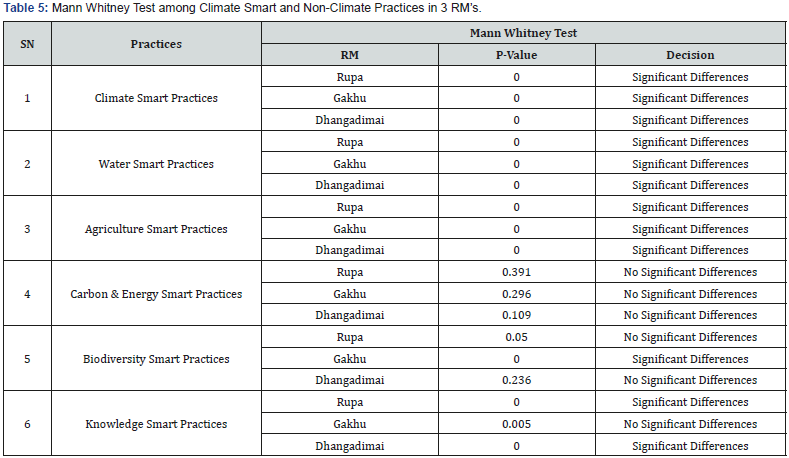
The Mann Whitney test showed that there was significance
differences in climate smart practices, water smart practices,
agriculture and energy practice between inside the pilot and
outside pilot area. However, some practices were not significance
difference. More detail is the in Table 5.
Impact of climate change on resources in Rupa-2, Gakhu-6 and Dhangadimai-13 RM
The increment or decrement in number of wild animals might
be due to the lack of adaptation to the environment and its rising
temperature. The rate of decreasing of indigenous species is very
high as well emerging rate of invasive species was seen higher in
Gakhu then in Rupa and in Dhangadimai. The extinction rate of
flora and fauna was seen higher in all community [17,18].
Some of forest plants are dying due to several diseases.
There was increasing number of pest, insects and disease such
as Anthracnose fungus in mango and yellowing in Sissoo by
microfungal Polyporaceae, ant, caterpillar, scorpion, centipedes in
forest.
There was change in flowering or blooming period of
the
majority of vegetables, fruits or an agronomical crops. The
flowering and blooming period has been shifted by one month
earlier in Dhangadimai and fifteen days earlier in Gakhu and Rupa RM.
The overall respondent has noticed that decline in the seed
quality. The present seeds are smaller in size as well as tasteless in
comparison to past. Increasing number of pests such as Alternaria
alternata fungus in potato, Panama wilt in banana, Anthracnose
fungus in tomato, Caterpillar in cabbage and cauliflower,
Anthracnose fungus in tomato, Mosaic in papaya and Vine Red
disease in pointed gourd were found in the study area. Similarly,
all respondent has cultivated different crops such as tomato, black
eyes bean, brinjal, yard long beans, pointed gourd and hybrid of
tomato, string beans, radish, cauliflower, broccoli and hybrid of
grains and maize in agricultural crops.
Dixit et al. [19] and Agrawal et al. [20] reported that most of the
people experienced that unavailability of water for irrigation and
unfavorable distribution of rainfall and increasing temperature
were the key factors for the decreasing in the amount of crop
yield. Higher temperatures and droughts will reduce agricultural
productivity. More than 80% farmers felt the occurrence of
pests and weed has increase in agricultural production with
unknown species of pest and insects including weeds like Raunde,
Bande, Chinijhar (Scoparia dulcis), Bikashe, Chitlange, Banmara
(Eupatorium odoratum), Aankhlejhar (Equisetum debile). Also,
the increase in insect population leads to demand for more use of
pesticides, which unknowingly may cause lots of harm to ecosystem
as well as human society. Incidence of pest and diseases would be
most severe in tropical region due to climate change and which is
gradually shifting to the hills and mountains. According to IPCC’s
Fourth Assessment Report, 1 ˚C to 3 ˚C global man temperature
increased by 2100 (relative to the 1990–2000 average level).
This may lead to productivity decreases for some cereals in low
latitudes, and productivity increases in high latitudes with the
increase in the temperature and change in rainfall pattern, people
have experienced new crop diseases, pest, and weeds.
According to the survey from the study area, majority of
respondent has experience in decreasing level of water resources
as well as water resources has polluted due to low rainfall,
diversion, high temperature, more water consumption and
deforestation. Majority of respondent has managed water scarcity
by storage, rainwater harvesting and by efficient use of water to
cope with this water problem. According to IPCC projection, by the
2050s, the area of land subject to increasing water stress due to
climate change will be more than double that will decrease water
stress. Increase in the drought period and decrease in rainfall had
caused problem to the people as they need to spend their much
time in fetching the water in past years. Almost 95% sources
were dried out in the three RM and some are still in phase of
drying out. This situation causes more water stressed. Also due
to Earthquake 2015 and upgrading road construction has cause
change in the diversion of water channel which cause more sever
in water problem in the community. In order to adapt with climate
change impact, villagers have made arrangement of plastic ponds,
rainwater harvesting, water tank for storage, power drill and
water source conservation for irrigation and livestock with the
support of DoEnv and Local organization.
In order to adapt with the climate change impact, villagers
had made arrangement of plastic ponds, rainwater harvesting,
water tank for storage, power drill and water source conservation
for irrigation and livestock with the support of DoEnv and Local organization. Majority of respondent has adopted cooking and
lighting practice such as fuel wood, LPG, electricity, improved
cooking stove, bio-gas and solar for cooking and lighting practices
in the community. Increment in the fuel wood consumption of the
rural people lead to deforestation and in long-term basis cause
drought in that area. To cope with the impact of changing climate in
the energy sector people have to adopt to new technologies. Those
who adopted energy related new technologies such as electricity,
LPG, improved cooking stove and bio-gas has achieved advantage
of time saving form the collection of fuel wood, good health and
clean environment. Similar practices have been adopted Africa as
well [21,22].
The respondents in the Rupa, Gakhu and Dhangadimai RM
were observed to have adopted different practices to cope with
impacts of climate change. DoEnv has implemented Climate Smart
Programs with monitoring activities and with the help of local
communities by preparing community-based strategies to make
community sustainable environmentally and socio-economically.
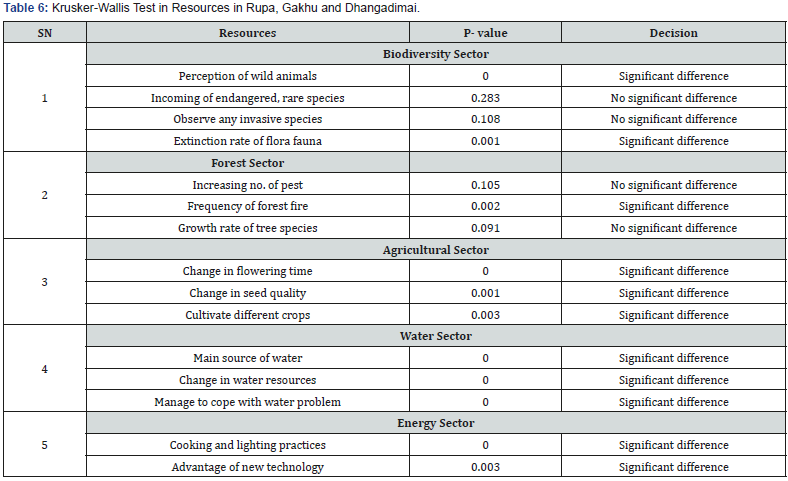
Statistical comparison of impacts of climate change on different
resources. The calculation was done in three different RMs, Rupa,
Gakhu and Dhangadimai. The result has been presented on the
Table 6 below.
Policies and practices related to climate smart program at Rupa-2, Gakhu-6 and Dhangadimai-13 RM
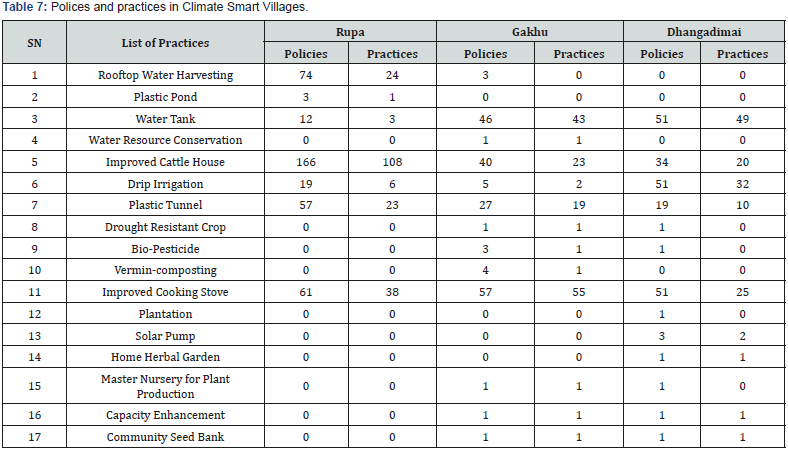
According to the Climate Smart Village Working Schedule 2016,
these three RM’s were selected according to the NAPA 2010 report
vulnerability index and LAPA report to cope with the changing
climate by reduce its impacts and increasing the adaptive capacity
of affected community. The result from the study area of the gap
between the policies and practices of climate smart programme
presented in the table below (Table 7). Similar policies have been
developed and applied in other countries as well [23,24].
Conflicts of interest
The present study attempted to know the effectiveness of
climate smart activities including climate change impact on
resources with trend analysis of temperature and rainfall of
Rupa (Kaski), Gakhu (Gorkha) and Dhangadimai (Siraha) RM
of Nepal. From the people’s perception and field observation
the effectiveness was performed higher in Gakhu, medium in
Dhangadimai and lowers in Rupa in climate smart village and
in non-climate smart practices Rupa performs higher in the
practices. Impact of climate change on different resources raise
different issues and communities are already facing different
problems due to the impacts of climate change such as decrease
in agricultural production, loss in biodiversity, dry spell, drying of
water resources, more consumption of fuel wood cause increase
in GHG emission and infestation by new variety of pests and
weeds. Among climate smart practices; water smart practices
and agricultural smart practices were seen more fruitful to the
community. For adaptation measures all practices of climate smart
village should be implemented in the community and should be
upgraded. Climate Smart Village Program should be need based
rather than demand based.
To know more about Journal of Agriculture Research- https://juniperpublishers.com/artoaj/index.php
To know more about open access journal publishers click on Juniper publishers


Comments
Post a Comment