Assessing Effectiveness of Climate Smart Activities: A Study from Rural Areas, Nepal-Juniper Publishers
Journal of Agriculture Research- Juniper Publishers

Abstract
The White mango scale (WMS) distribution, population
dynamics and severity status was conducted in southwestern part of
Ethiopia. Purposive sampling was used to select districts growing
mangos. The existence of the WMS was confirmed by visual assessment in
the field and using a stereo microscope in the laboratory. The
population dynamics of the WMS was studied in two locations in west
Welega zone (Didesa Valley and Uke farms) and one location in west shoa
zone (Bako tibe district). Leaf samples were collected from the four
cardinal directions of the mid canopy of five tagged trees every month
for 12 consecutive months. The number of eggs, crawlers, male’s colonies
and females were recorded using stereo microscope. High to very-high
infestations were recorded in all the surveyed areas while exceptionally
low populations were observed in some districts of Jimma, Kafa and
Ilu-Abba bora and west Welega. Population dynamics of WMS reach the
maximum peak in April in Didesa and Green focus sites while at Bako site
the population reached its climax in May. The correlation study showed
that the populations of the WMS are except maximum temperature
positively correlated with weather factors. During study we recorded
more WMS population density in south and west directions. Therefore,
management interventions should be planned accordingly to coincide with
the peak population periods and distribution directionality. This study
has indicated that the WMS problem is serious in southwestern Ethiopia..
Keywords: White mango scale; Distribution; Severity status; Population dynamics
Abbreviations: WMS:
White Mango Scale; Spp: Species; CV: Coefficient of Variation; LSD:
Least Significance Difference; EIAR: Ethiopian Institute of Agricultural
Research; SNNP: Sothern Nations Nationalities and Peoples; APPRC: Ambo
Plant Protection Research Center
Introduction
The white mango scale (WMS) (Aulacaspis tubercularis)
originated in Asia and was later distributed all over the world, is
currently constraining the cultivation of mangos worldwide. CABI
distribution map of pests show that A. tubercularis occurs in several
countries of West Africa and several Sub-Saharan African countries [1].
In Ethiopia, the WMS was first reported in east Welega zone of the
Oromia region in August, 2010 at a private farm (Green Focus Ethiopia
Ltd). The pest can attack crops such as citrus, papaya, avocado, ginger,
cinnamon, and pumpkin [2].
The study of the distribution and severity status of
the WMS in east and west Welega zones and confirmed that maximum air
distance covered by the WMS was 67km to the west (Gimbi district- Jogir
kebele), on the way from Nekemte to Asossa, and 58km to the east (Gobu
Sayo district-Sombo Kejo kebele), on the way from Nekemte it make
reference from the WMS insect original
infestation place at Guto Gida district (Loko Adiministrative kebele)
[3]. There are no other recent studies on the distribution and severity
status of the WMS in the south western part of Ethiopia. Knowledge of
pest fluctuations in their ecology is very important along with weather
factors that influence their population. However, there is no detail
data concerning white mango scale population dynamics in Ethiopia.
Therefore, these studies aimed at determining the distribution, severity
status and the population dynamics of the WMS in south western
Ethiopia.
Materials and Methods
Study area
Surveys were undertaken in south -western parts of
Ethiopia during the 2016/2017 cropping season to study the distribution
and severity status of the WMS (Aulacaspis tubercularis). The survey
covered four major mango producing regions, viz: Sothern Nations,
Nationalities, and Peoples (SNNP), Oromia, Gambella and Benshul-Gumuz.
This survey was carried out in ten (10) Zones,
43 districts and 97 sites. The survey started from east Welega
zone, Guto-Gida district where the WMS was first reported in
Ethiopia. Purposive sampling was used to select sampling sites
depending on availability of mango farms/trees along road side
at 5 to 10km intervals and leaf samples were collected. From
each sampling site 5 mango plants were randomly selected, and
sixteen leaves were collected from the mid canopy of the trees
from four cardinal directions (North, South, West and East). In
the case of the population dynamics studies, studies were carried
out in western Oromia; east Welega (Didesa valley and Uke farm
(Currently, Raj Agro-industry) and west Shoa (Bako-Tibe). Five
mango trees similar in size and age were selected and marked at
each site for this study. Samples were collected monthly during
the period from October 2017 to September 2018. From each tree
20 leaves were collected from cardinal directions (North, South
east and West) of the tree (four leaves per direction). Geographic
data (Longitude, Latitude and Altitude) of each sampling site
were recorded using a GPS. Weather factors such as maximum,
minimum and mean of both temperature and relative humidity
Results and Discussion
Distribution and severity status
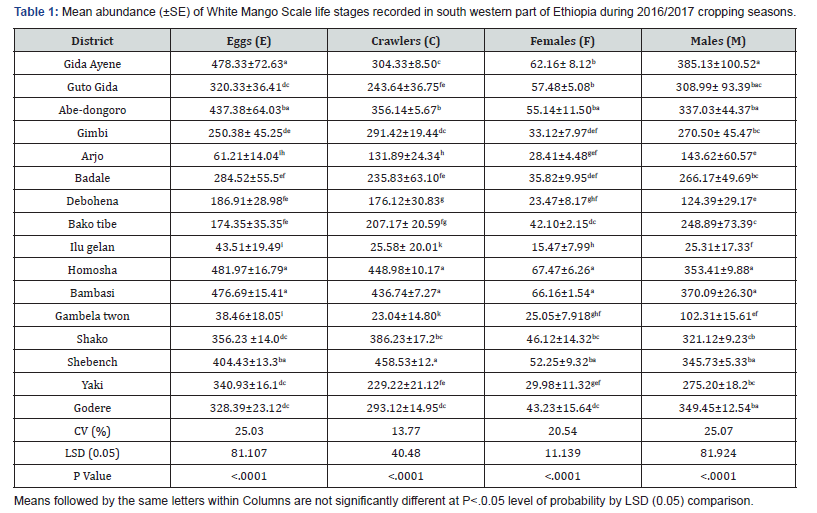
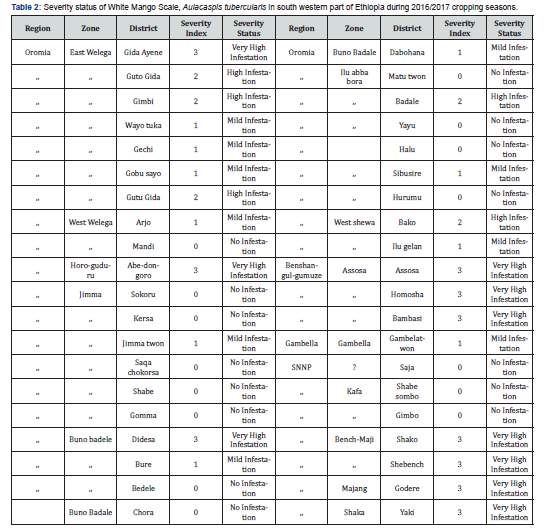
The present survey revealed that there were irregular
patterns of white mango scale distribution and severity in south
western party of Ethiopia. The pest was observed causing various
degrees of severity in all surveyed areas (Table 1&2). Except some
district of Jimma, Ilu-abba bora and west Welega, high to very
high infestations were recorded in all surveyed areas with high
numbers of white mango scale life stages (Table 1&2). During the
survey WMS free mangos were recorded at Jimma zone (Sokoru,Saka, Shabe, Gumma, districts), Ilu-abba bora zone (Halu district)
and west wellega (Mandi and Najo districts) (Table 3). There was
significant difference in WMS life stages population densities
recorded among the different districts. Population density of
WMS life stages recorded at East Welega: High population density
of White mango scale in these Zones resulted in high to very high
severity status on mango trees in these particular zones (Table 3).
Researchers reported that the white mango scale has the potential
to devastate mango trees in Ethiopia [3,6].
Severely infested mango trees were observed with dry leaves
and small sized fruits mostly infested by female white scales
which usually drop early. Currently it has been reported that
under heavy infestation premature fruit drop and smaller size
is common [7]. The variations in population density recorded in
the various administrative zones is probably caused by varietal
difference, ecological variation, cultural practices of the individual
farmers, elevation of the area, mango tree population scattered
over surveyed areas and time of arrival of white mango scale to
the area. According to Sunji (Personal communication) severity
of white mango scale at Green focus (Raji agro-industry) varied
across the different mango varieties in the farm. According to Sunji, the varieties Alphanso, Kent, Tommy Atkins and Dodo are
susceptible to white mango scale. In contrast the varieties Apple
and Keit are more tolerant to this pest.
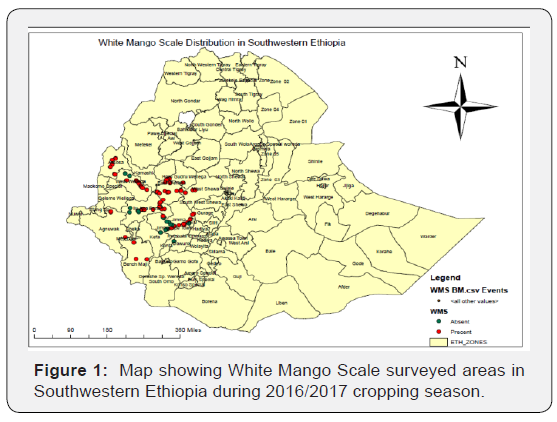
This survey result indicates that spread of this insect is
expanding to all western part of the country. The distribution
of white mango scale probably facilitated by wind which may
transports nymphal (crawlers) stage to neighboring plants.
The report showed that white mango scale can move with the
help of external forces like wind, birds and insect pests [8]. The
WMS female is flightless insect but is mobile only at nymphal
(crawler) stage. In addition to this long-distance dispersal of
white mango scale life stages is also possible if infested planting
materials (Leaves, twigs, fruits) and contaminated containers are
transported within or outside infested areas (Figure 1).
Population dynamics
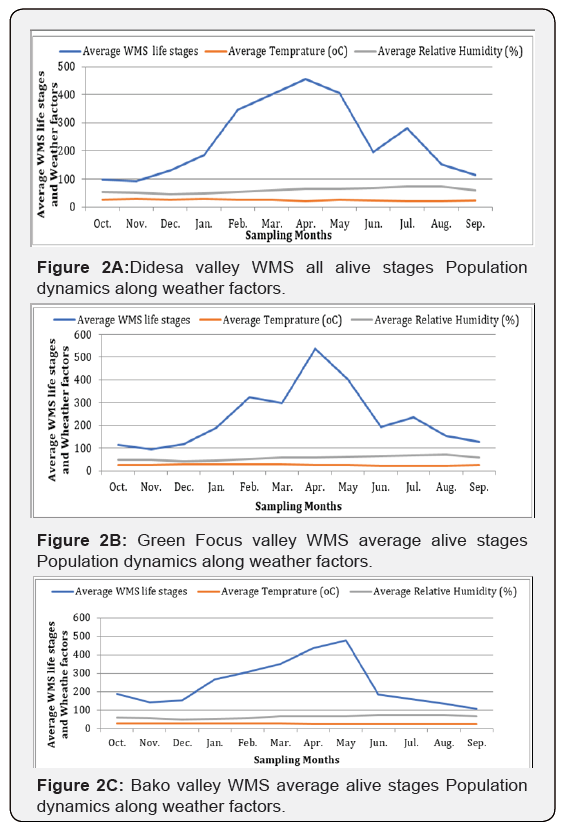
The WMS population data from October 2016 to September,
2017 indicates that, in all the three surveyed area, the population
dynamics follow almost the same pattern. The number of WMS
recorded was exponentially increased from October to March
and reach the maximum peak in April in Didesa and Green
focus sites (Figure 2A, 2B & 2C). After the month of April, the
population dramatically declined through May and June, and then
slightly increased in July. In case of Bako site, the population of
WMS increased from October to April and reached the climax
in May and declined through June to September. Similar report
with this finding, three peaks per year in Egypt was recorded
[9]. Similarly, the groups stated that the population peaks of
the pest occurred during different periods of the year [10]. At
Didesa valley the correlation analysis revealed that WMS life
stage population showed that a very weak positive correlation with mean temperature (r=0.059), weak negative correlation
with maximum temperature and weak positive correlation with
relative humidity respectively recorded. At Green focus very
weak positive correlation with mean temperature and moderate
correlation with Maximum temperature and strong positive
correlation with maximum relative humidity were recorded.
In case of Bako site very weak positive correlation with mean
relative humidity and moderate negative maximum temperature
were recorded (Table 3). Data in table showed that in all sites
Maximum temperature recorded with negative correlation with
white mango scale population. WMS population peaks mainly
depend on temperature and relative humidity of that locality [10].
Whether factors particularly the effect of temperature on insect
biological behavior such as distribution and reproduction of
insects, population size and sex ratio [11].
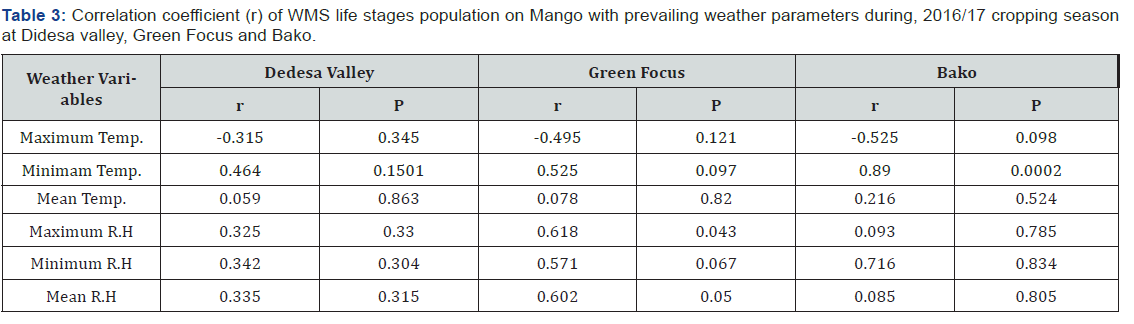
*Correlation is significant at the 0.05 level, **Correlation is significant at the 0.01 level
Note: Absolute value of r: .00-.19 “very
weak”, 0.20-.39 “weak”, 0 .40-.59 “moderate”, 0 .60-.79 “strong” and 0
.80-1.0 “very strong” (Evans (1996).
Distribution within a tree
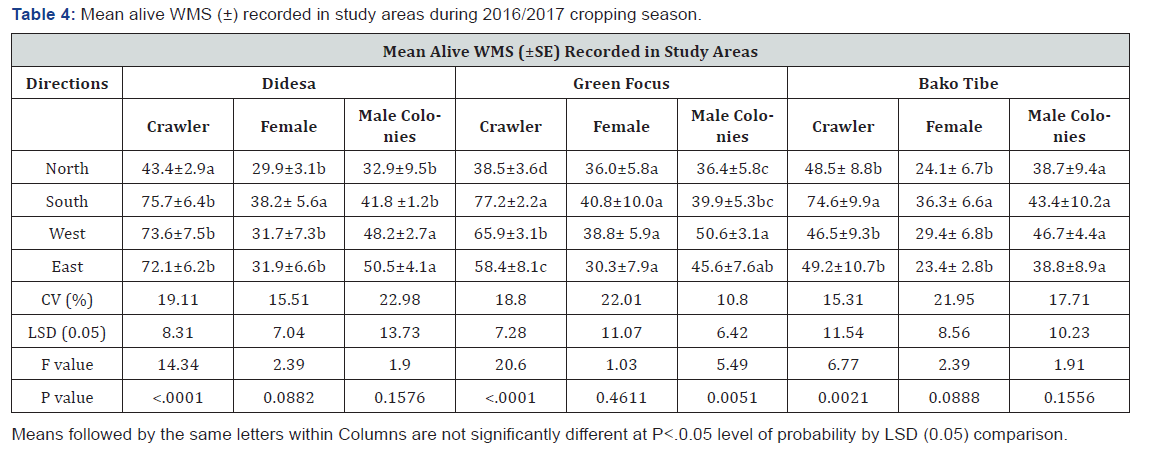
Didesa valley site: The distribution of the WMS significantly
differences among the different cardinal directions. High numbers
of WMS individuals per leaf were recorded in the South direction
while lowest population was recorded in East direction and
North direction. At Green focus except female all show significant
difference among all direction. At this site we recorded high
populations of individual per leaf in south and west direction
(Table 2). At Bako site crawlers and females show significant
difference in all direction. In current study we recorded high
individuals per leaf in south and west direction respectively. The
WMS life stage variation observed in present study probably
caused by directional variation in weather factors such as wind
force that may directly resist crawler establishment and indirectly
increases evaporation that reduce moisture level, temperature
difference, light intensity that may cause mortality during dry
seasons. Labuschagne and his colleague’s demonstration showed
that south face is more prone than other face due weather factors
differences (Table 4) [10].
Conclusion
The current survey showed that WMS distribution is expanding
to all southwestern part of Ethiopia and considerably threatening
mongo tree production and productivity. We observed very low
population density (severity status) and white WMS free mango at
Jimma zone (Sokoru, Saka, Shabe, Gumma, Gumayit district), Iluabba
bora Zone (Halu district) and West welega (Mandi and Najo
district). Population dynamics of WMS increased from October to
March and reach the maximum peak in April in Didesa and Green
focus sites. In case of Bako site, the population of WMS increased
from October to April and reached the climax in May. In current
study we recommend that during chemical spray emphasis need
to be taken in south and west directions. From current study we
recommend that regulatory measures, information dissemination
need to be regularly updated though surveillance and monitoring
activity to keep the population below economic threshold level
particularly where infestation is low.
Coordination system among farmers, plant extension groups,
healthy clinic, and professional expert should be facilitated and
strengthen to minimize the risk. Movement of infested plants
and plant products (fruit) from infested districts need to be
prohibited through regular inspection. Management options
such as conservation, unproductive large mango trees (source of
inoculation) replacement, enhancing tolerant and manageable
size mango variety, clustering mango potential zones, developing
mango production package should be initiated by governmental
intervention. IPM such as pruning, burn heavily infested branches,
systemic insecticide, improving chemical application methods
(soil drench, tree injection, modifying spraying mechanism
for larger canopy of mango tree), enhancing native natural
enemies population build up through rearing and re-inoculation,
introduction of exotic natural enemies such as parasitoid need
to be design as soon as possible for highly infested area such as
Bench-Maji, East Wellega, West shoa zone and Assosa region to
minimize the population size of white mango scale.
Acknowledgement
The author expresses sincere thanks to Green Focus private
farm for their permission during insect record. We acknowledge
Ato Dejene Hordefa (technical assistant) for his support during
data collection. The study was financially supported by the
Ethiopian Institute of Agricultural Research (EIAR).
To know more about Journal of Agriculture Research- https://juniperpublishers.com/artoaj/index.php
To know more about open access journal publishers click on Juniper publishers


Comments
Post a Comment