The Effect of Removing Mineral Fertilizers from the Roots on Plant Productivity-Juniper Publishers
Journal of Agriculture Research- Juniper Publishers

Abstract
As is known, in the course of selection many new
highly productive breeds were created in the 20th century. But this
process resulted in cultivated plants’ root system reduction, that’s why
they became non-resistant to unfavorable environment factors (primarily
drought). It was explained by the fact, that mostly favourable
conditions were created to plants and there was no need for them to
develop extensive root system. At the same time, it’s quite evident that
drought resistance, for example, is determined, first of all, by the
ability of water-conducting roots to to reach water going deep into the
soil. It is worth to note that to produce1 g of dry matter, a plant in
the process of photosynthesis will have to spend hundred - thousand-fold
water volume. The only way out is the formation of an extensive
water-conducting root system and prevention of a break between a plant
roots and water going deep into the soil.
Keywords: Soil; Plant roots; Environment factors; Photosynthetic products; Fertilizers
Introduction
Our research of different drought-hardiness varieties
of barley showed that in the early stages of ontogenesis resistant
plants have twice the size of the root system [1]. Experimental
variation of photosynthetic products mass (removal of part of the
leaves) or inhibition of their export from the leaves (increased nitrate
level) have revealed that this process can be regulated. Further
experiments with the level of mineral nutrition in the soil and washed
sand showed the possibility of increasing root growth by 1.5-2 times
[2]. An additional effect (up to three-fold) of root growth stimulation
is obtained by spraying plants with complex compounds of copper and zinc
(ammonia) [3].Our research of different drought-hardiness varieties of
barley showed that in the early stages of ontogenesis resistant plants
have twice the size of the root system [1]. Experimental variation of
photosynthetic products mass (removal of part of the leaves) or
inhibition of their export from the leaves (increased nitrate level)
have revealed that this process can be regulated. Further experiments
with the level of mineral nutrition in the soil and washed sand showed
the possibility of increasing root growth by 1.5-2 times [2]. An
additional effect (up to three-fold) of root growth stimulation is
obtained by spraying plants with complex compounds of copper and zinc
(ammonia) [3].
Special test, revealed that when barley plants were
sown in boxes with grey forest soil (size 60x60x60cm), it was enough to
place the seeds in a sowing furrow of 5 x 5cm to increase their
root-coverage almost twice Data reported in this work showed that
separation of seed and fertilizer flows during sowing is an important
condition for the development of water-conducting root system. This
report presents the results of first full-scale tests, in which an
attempt was made to separate the flows on a farm scale.
Methods
The tests were carried out on industrial seeding of
Nur-R3 barley variety. Since an appropriate seeder with the separation
of seed and fertilizer flows for crops has not yet been available, we
decided to use a standard seeder СЗС-3,6, but modified it as follows
(Figure 1).
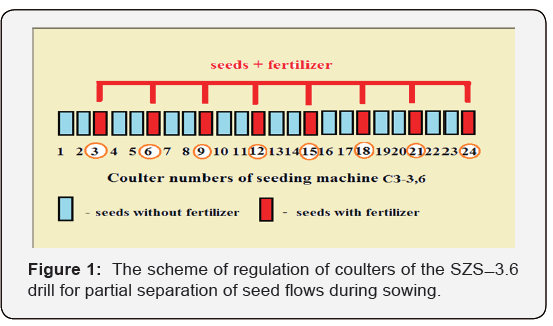
This seeder has 24 openers, each supplies seeds from
one box, and mineral fertilizers from the other through corrugated
plastic tubes. Both flows can be regulated and even completely blocked
by latches (in the case of fertilizers). Therefore, we left one opener
unchanged (where both seeds and fertilizers are supplied), in two next
openers the flow of fertilizers was blocked by special latches. As a
result, eight openers of the seeder worked in a regular mode. In these
openers seeds were sown together with fertilizers, and the remaining
sixteen ones (two after each regular one) sowed only seeds. As a result,
the fertilizers per planting area
unit decreased three-fold, while the total number of seeds sown
remained unchanged.
Thus, each opener without fertilizers was located near an
opener with fertilizers. Therefore, the initial stage of development
of seeds sown in sixteen openers was in a fertilizer-free
environment. But later on these plants could get the required
quantity of mineral nutrition from the next row. Thus, the
efficiency of fertilizers use was to increase.
Due to the cold weather, spring sowing was done only on
May 9, which is a week later than usual. Because of the cold,
the emergence was late, too. On May 30, 2018, we have tested
the number of sprouts in different seeding rows. Since it was
impossible to determine in the field, which row of plants refers
to which opener (with or without fertilizers), we adopted the
following method. We selected a levelled area in the field with
uniform shoots. Then a meter ruler was placed along one row
and the number of sprouts per linear meter was calculated. After
that, the number of plants per linear meter in the next row was
calculated. And so, moving a ruler across the rows of sowing to
the right (each time on one row), the number of plants in seveneight
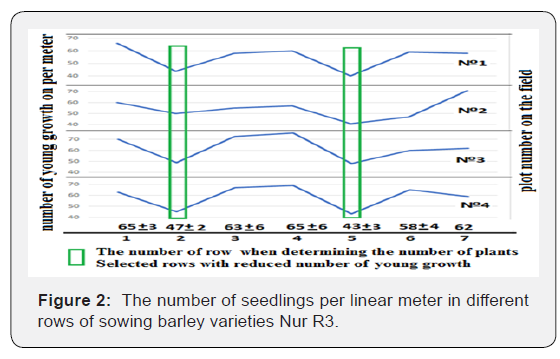
rows was calculated. We revealed that a row with a lower
number of shoots was found every two rows. Next, moving in the
sowing along the rows ahead, the next levelled area of the field
was selected and this procedure was repeated. Thus, four curves
were obtained, in each of which (regardless of the sampling area)
a row with a decreased number of shoots was found at regular
intervals of two rows (Figure 2).
On June 5, 2018, plants were sprayed with solution of
ammonium compounds (10-4М concentration) at a levelled
planting area (3 x 7m). Then, at the end of tillering on June 16,
samples of plants from different roes were collected (including
those sprayed with ammonia) to assess the degree of tilling
capacity, mass of roots and shoots. The sampling procedure was
the same, moving from the original row to the right, sequentially,
one after the other, collected samples from each next row. Samples
of control plants (untreated with ammonia) were sampled from
the same rows as the samples of plants processed by ammonium
compounds. Thereat the total number of plants in each of the
options in the test was 12-15 (for fertilized options) and 18-24 for
the unfertilized ones. The tables show the average statistical data
with a standard error.
Results
The calculation of the number of plants per meter in the
neighboring rows showed explicit dependence on availability of
fertilizers in the soil near the seeds (Figure 2). Where there were
fertilizers, sprouts were in a smaller quantity. At some plots, the
number of plants per meter was calculated for more than seven
rows. However, the pattern of decrease in the number of shoots
repeated in every two rows. These facts confirm the depressing
effect of mineral fertilizers on germination of seeds. Therefore, by
dividing the flows of seeds and fertilizers at sowing, it is possible
to save expensive seed material.
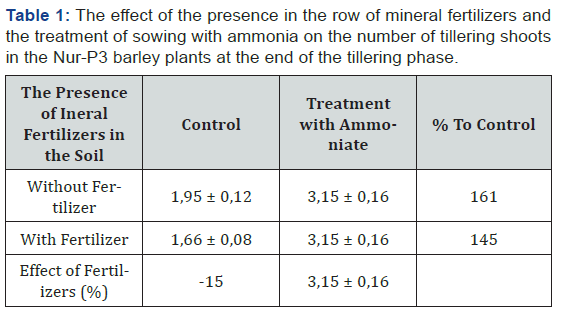
The subsequent analysis of morphometric indices of test
barley showed their reliable dependence both on presence
of fertilizers in soil, and on treatment of plants by complex
ammonium compounds. These effects had an impact on sprout
formation (Table 1). Fertilizers reduced tilling capacity both in the
control plants (without ammonium treatment), and in the treated
ones. It should be noted that the effect of ammonium compounds
on tilling capacity manifested to a greater extent in the absence
of mineral fertilizers. This shows some antagonism effects of
fertilizers and ammonia on the metabolism of plants.
Our previous research [4,5] of the effect of mineral fertilizers
(particularly nitrates) and ammonia on photosynthesis allow
to assume that they effect mainly through the change of
photosynthetic metabolism and transport of the main final
product of photosynthesis - saccharose from leaves. The change
of extracellular (cell-wall) invertase activity is also involved in this
mechanism. When ammonia increase the Ph of the extracellular
aquatic environment of leaves, invertase decreases its activity,
since this enzyme is active only in the acid medium. Sucrose is not
hydrolyzed. The absence of saccharose hydrolysis contributes to
its successful load into the phloem vessels and export from the
leaf. In addition, there is a decrease in osmolality of extracellular
aquatic environment, since due to sucrose hydrolysis to molecules
are formed of a one (glucose + fructose). The reduction of
osmolality near the guard cells opens them and thus increases the
flow of carbon dioxide into the leaf (and hence its photosynthetic
digestion).
The study of photosynthetic metabolism direction [5] showed
its dependence on the activity of photosynthesis products use
by the acceptors, which depends on the level of nitrate nutrition
[6,7]. But in terms of a lower nitrate feeding, when the use of
carbohydrate products of photosynthesis in synthetic processes of
new tissues is complicated, sugars can be used only for synthesis of
cellular walls cellulose. The latter is only possible for the synthesis
of the roots cell walls, as these cells are highly vacuolated and
cellulose is the basis of their dry weight.
Hence, it follows that to increase the roots mass it is required
to sow crops in the unfertilized soil (primarily refers to nitrates).
But at the same time fertilizers should be near for the following
development of the above-ground organs of the plant (including
the economically important ones). By the time the waterconducting
roots are well-developed, the feeding roots will reach
the nearby mineral fertilizers and they will be able to produce
rich yield. The symbiosis of plants with soil microorganisms is of
great importance. The above mentioned process created the wellknown
chernozemic (black) soils. But mineral fertilizers suppress
microorganism activity. Therefore, it is believed that in the course
of cultural farming for the last 100 years, half of the organic matter
of our black soils were lost [8].
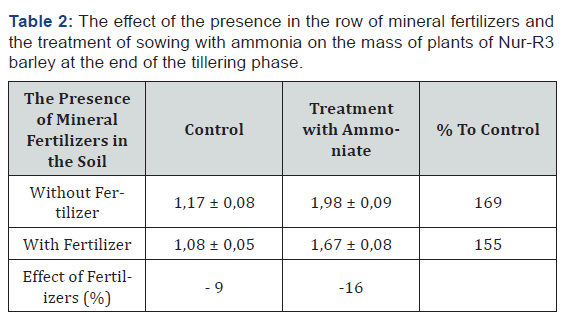
Similar effects of these factors were found in the analysis of
dry mass of plants (Table 2). However, in this case, the effect of
ammonia with present mineral fertilizers was less significant. This
allows us to make a conclusion about the possibility of further
intensification of root formation process after studying details of
this mechanism.
Conclusion
The tests clearly signify the need to divide the flows of seeds
and fertilizers in the sowing process. This will significantly reduce
the use of mineral fertilizers in agriculture and increase their
efficiency. The plants root system free of high level of nitrates in
the zone of their activity will be more actively interacting with
the soil microflora, which would supply the required amount of
nitrogen due to microbiological absorption of air nitrogen.
Finally, mankind should adopt agricultural practices which
will allow to intensify development of cultivated plants root
system to a degree which will gradually exclude the use of
mineral fertilizers completely. Assessment of the evolutionary
development of nature over the last billion years makes it quite
obvious that it is perfectly possible. After all, our black soils rich in
nutrients (for plants) were formed by nature without any mineral
fertilizers. And it is our task to live in harmony with nature. The
increased root mass will serve the basis for accumulation of soil
organic mass which, in due course, will increase its fertility. It
requires the efforts of agricultural researchers and scientists to
search the ways to maximize the root mass. It is worth to note
that symbiotic microorganisms work in drought, too. One may
have probably observed, that if to dig out a plant from soil in
drought, it is possible to see roots covered with a 2-3cm layer of
soil balls. While around is dehydrated medium. These are the free
symbiote microbes. They absorb nitrogen of air getting water and
sugar from a plant. This process is controlled by the plant. The
plant gives microorganisms as many sugars as it needs nitrogen.
Microorganisms also protect the plant from water loss, as they
isolate a wet root from excessive water loss. Lower rain-wash of
mineral fertilizers from soil will reduce their transfer to rivers,
which would improve the ecological situation in nearshore.
Since the development and serial production of a new seeder
which would separate the flows of seed and fertilizer in the course
of sowing will take time and will require additional pilot testing,
the first step in the development of this technology, perhaps, in
the next vegetation year will be an extended testing, and then
application of the above technology using the old seeder in
probable drought areas (and not only).
To know more about Journal of Agriculture Research- https://juniperpublishers.com/artoaj/index.php
To know more about open access journal publishers click on Juniper publishers


Comments
Post a Comment