Green Manuring: An approach to Improve Soil Fertility and Crop Production
Journal of Agriculture Research- Juniper Publishers

Abstract
The importance of green manuring in crop production
has been known since ancient time. In recent years its importance is
also increasing continuously because of high cost of chemical
fertilizers, increased risk of environmental pollution, and need of
sustainable cropping systems. Green manure crop absorbs the nutrient
from lower layer and leave them in surface when ploughed. However, green
manuring can improve soil fertility and consequently crop yields. Green
manuring is low cost-effective technology in minimizing cost of
fertilizers and safe guarding productivity.
Keywords: Green manuring; Legume; Soil fertility; Crop production; Environmental pollution
Introduction
Presently, India has achieved food sufficiency level
by increased fertilizer use with subsidized prices. Inorganic
fertilizers are becoming more expensive; therefore, sustainability of
soil productivity has become a question. Hence, alternate sources to
supplement inorganic fertilizers are thought. Green manures crops grown
for the benefit of the soil. The use of green manure crops in
traditional agriculture for thousands of years are more common but
conventional farming systems largely rejected them. Importance of this
soil ameliorating practice is increasing in recent years because of high
cost of chemical fertilizers, increased risk of environmental
pollution, and need of sustainable cropping systems. Healthy soils lead
to healthy plants. Maintaining such soils and increase crop production
is a huge task for farmers. Green manures are a gift from nature, being a
suitable alternative to increase the organic matter content of the soil
and fulfilled the task of farmers to improve soil productivity and crop
production. Green manuring is an effective technology in minimising
cost of fertilizers and safe guarding productivity. Green manure crop
absorb the nutrient from lower layer and leave them in surface when
ploughed [1].
Green manuring
Green manuring is the practice of ploughing under or
turning in to soil, any green manure crops, tender twigs or leaves while
they are green or soon after they flower. Green manures are forage or
leguminous crops that are grown for their leafy materials needed for
soil nutrient conservation and to add organic matter in the soil. “The
value of green manuring lies in the fact that they add the organic
matter into the soil”. The organic matter in the soil is recognized as
being one of its most valuable constituents for real soil fertility. In
general, in green manuring two types of green manure crops used [1].
Legumes: Used for their ability to fix nitrogen from the air and add it to the soil.
Examples: Sun hemp, sesbania, sweet clovers, guar, lupins, vetches, alfalfa, peas, beans, soybeans.
Non-legumes: Mainly serve as cover crops and enrich soils of organic matter.
Examples: Berseem, buckwheat, chicory, mustard, turnips, ryegrass, oats, barley and rye.
Practice of green manuring
Use of Green manure crops in cropping system is called ‘Green Manuring’. There are two approaches of Green Manuring.
In-situ green manuring: In the in-situ method, green
manure crops are grown in a field prior to crop cultivation and then cut
and buried when approximately 50 percent of all plants are flowering.
For green manuring, legumes are preferred because of their
ability to fix nitrogen from the air. The use of sun hemp (Crotalaria
juncea) is popular and well-practiced by most of the farmers.
Because of its ability to grow fast and its efficient nitrogen fixing
capacity, these plants are grown and sacrificed to improve the
living condition of the main crop. Green manuring with legumes
(Sesbania, cowpea, green gram, clovers, lentils, cluster bean
etc.) is called legume green manuring. It is a viable alternative to
conventional lean period fallowing and can reduce the amount of
nitrogen fertilizer required. This crop has to be turned under the
soil before the plants set seed. Legumes crops are used as a
greenmanures
or as forage crops has became, an important practice for
maintaining soil fertility and productivity.
Green leaf manuring: In this practice the foliages of the shrub
and herb type of weeds that are grow along the roadside, riverside
and lake bunds and leaves and twigs of trees that are grown along
the boundaries of the farm and along the main bunds of the fields
were collected and incorporated in the existing crop field. In this
there will be more variety of species.
The commonly used weeds species as a green leaf manures
are as follows:
a. Pungamia pinnata
b. Cassia auriculata
c. Calatropis gigantea
d. Ipomoea sps
e. Eichornea
The commonly used tree species are as follows:
a. Azadiracta indica
b. Pungamia pinnata
c. Glyricidia sps
d. Thespesia populina
e. Cassia seamia
f. Cassia auriculata
Characteristics of legume green manure crops [2]
a. Short duration, fast growing, and high nutrient
accumulation ability.
b. High N accumulation rates.
c. Highly efficient in use of water.
d. Wide ecological adaptability.
e. Tolerance to shade; flood, drought and adverse
temperatures.
g. Produce abundant and succulent tops.
h. Photoperiod insensitivity.
i. High seed production.
j. High seed viability.
k. Ease in incorporation.
l. Pest and disease resistant.
m. They should have high biomass production.
Objectives of green manuring
d. Legume are grown for taking cutting of green fodder for
cattle in early stages and later as green manure. Pillipesara
seeds can be broadcasted in the standing rice crop.
Advantages of green manuring
a. Improves the soil fertility.
b. Provision of nutrients and organic carbon of soil.
c. Prevention of erosion.
d. Improves the soil structure.
e. Improves soil aeration.
f. Reducing pest and disease problems.
g. Promotes habitat for natural enemies.
h. Suppressing weeds.
i. Lower fertilizer N requirements for succeeding crops.
j. Providing supplementary animal forage.
k. Increase the yield of crop 10-15%.
A number of disadvantages can also be identified
a. Direct costs of seed and extra cultivations.
b. Extra work at busy times of the year.
c. Lost opportunities for cash cropping.
How green manuring improve the fertility of soil [3]
a. Green manure crop absorb the nutrient from lower layer
and leave them in surface when ploughed.
b. Prevent leaching of nutrient to lower layers.
c. Harbour N fixing bacteria, rhizobium in root nodules and
fix atmospheric nitrogen.
d. Increase solubility of lime phosphate, trace element etc.,
through the activity of soil micro-organism and by producing
organic acids during decomposition.
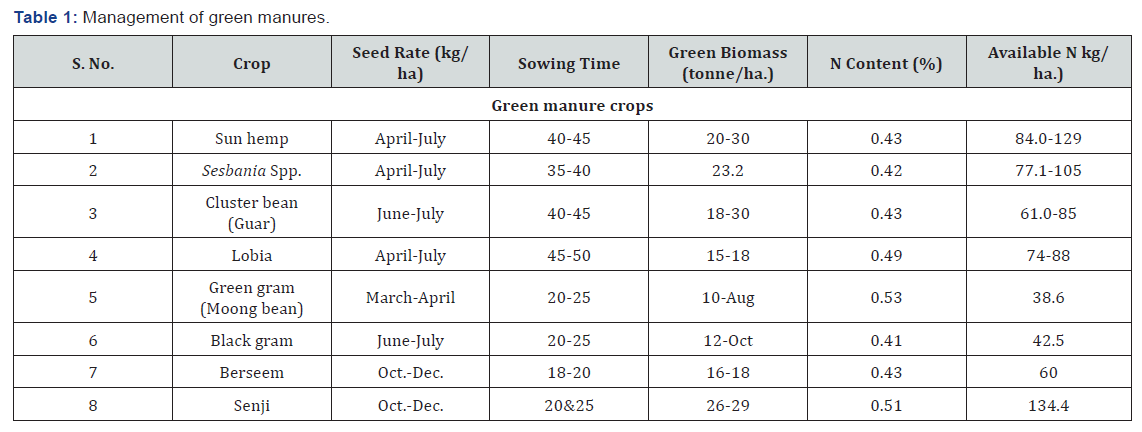
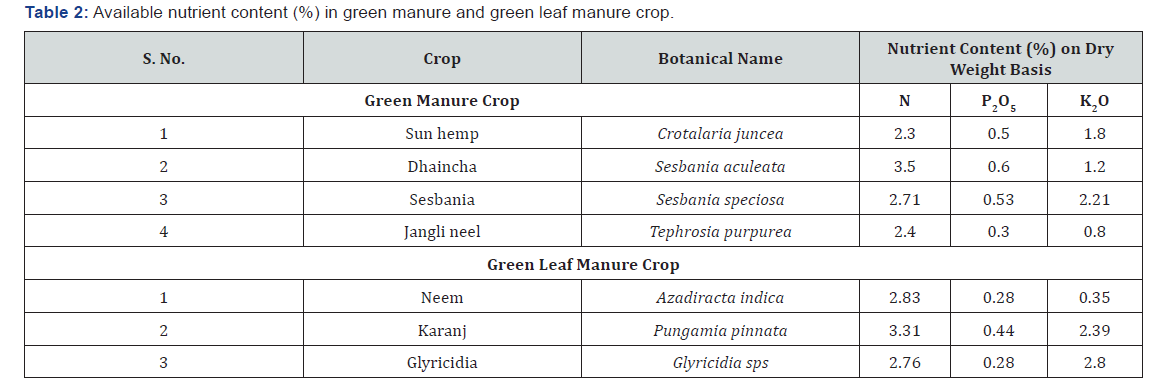
Management of green manures: Management of green
manures will depend on the type of green manure, the duration
of the crop spp., and the nature of the farming system in which
green manure crop used. The key management practices for some
common species of green manure are summarized in (Table 1-3).

Preparation of seed bed
A seedbed for green manure crop should be prepared using
standard techniques by loosening the soil with a fork to break
up any clods to a reasonable depth. The earlier development of
effective root systems is play a vital role for overall performance
of the green manure crop. This is particularly important for the
shorter-term green manures. The broken of compaction of soil
depend on the size of seed and it is particularly important that
small seeds such as clover is sown into a fine, well-firmed seedbed.
Although it may seem obvious there should be adequate moisture
in the seedbed prior to sowing.
Sowing techniques: Green manure crops are sown by
broadcasting and drilling. In practice the choice is often
determined by what machinery is available. Even distribution of
seed and uniform sowing depth are the prime requirements for
successful establishment in conjunction with a fine firm seedbed.
Mowing: Most of short-duration green manure crops are
grown to generate bulk and this is turned in soil after flowering
time or before the crop has set seed. Longer duration green
manures need proper management if they are grown to generate
the required benefits.
Incorporation of green manure crop: Effective incorporation
of the green manure crop is as important as the growing of the
crop. Green material of incorporated crop should breakdown
quickly and this will depend on good mixing of the green manure
crop and proper aeration of the soil. It is also important that the
green manure has not become too mature and woody at the time
of incorporation. Before incorporation, the top growth should
ideally be wilted. If there is a lot of bulk a topper should be used
to chop the growth, which is then wilted for up to 7 days before
incorporation. To chop the green material into the soil surface, an
alternative approach is uses disc harrows or a shallow rotavator.
To know more about Journal of Agriculture Research- https://juniperpublishers.com/artoaj/index.php
To know more about open access journal publishers click on Juniper publishers


Comments
Post a Comment