Opportunities and Challenges of adopting Home garden Agroforestry Practices in Ethiopia: A Review- Juniper Publishers
Journal of Agriculture Research- Juniper Publishers

Abstract
Home garden enables farmers to secure their food
availability, mitigate environmental change, increase consistency of
social-cultural value and protect species provenance. In other hands, it
conserves biodiversity and sequesters carbon and improves a
biogeochemical process even if the home garden has multifunctional value
for the country, it has yet given special consideration from neither
decision makers nor scientific front. The objective of the review is to
identify the factors hindering the adoption of home garden agroforestry
practice in non-adopted part of Ethiopia the second is to show existing
opportunities to scale-up the practice with advocating the dual purpose
that is socioeconomic and climate change mitigation system. Although
biodiversity has been reduced in Ethiopia, there are potential suitable
agro-ecological zones that can minimize the frequency of degradation to
deal with the influence of climate change due to EI Niño and its effect
on food crises.
The dominant species in various home gardens are
economically appreciated as they have prevailed up to fulfill their
demand. Women are more engaged than men for home garden activity which
creates job opportunities and other social acceptance. There is also
available indigenous and scientific knowledge that has to managed and
administered by concerned stakeholders. Many researchers found that
there were high species diversity, suitable environment, good
experience, available products, willingness of women participation, and
important component interdependence with flexible arrangement but,
narrow farm size and discouraged land and tree tenure. The government
and responsible body should do is that promoting community service and
researches conducted on home garden agroforestry. To improve sustainable
home garden production system in the country, government should have to
undertake positive actions like agroforestry awareness creation, scale
up appropriate home garden components combination based on
agro-ecological zone elsewhere in the country or outside, provide
support with good and multipurpose hybrid varieties, and formulate
policy and strategy that encourage farmers to take home garden as an
alternative to secure food stability.
Keywords: Home garden; Carbon sequestration; Socio economic; Gender; Species diversity; Policy and strategy
Introduction
The definition, structural and functional of home
garden varies from place to place according to the local physical
environment, ecological characteristics, socioeconomic and cultural
factors [1]. Home garden agroforestry is a special category of
agroforestry that deals with the cultivation of multipurpose and
multi-storied trees, crops and animal husbandry around homestead [2,3].
The home garden helps to connect the livelihood income and conserved
natural ecosystems by linking marketable cultivated species with
conserving species diversity and genetic diversity [4]. Species found in
home gardens do not show a pre-determined spatial arrangement and the
location of plants species are random and conveniently determined by the
farmer’s needs. Species density is variable depending on the household
and market demand [5].
Traditional knowledge is mainly activated in the
rural area of Ethiopia, especially where agroforestry practices are
performed conveniently [6-8]. From those practices, home garden
agroforestry practice is the one that farmers are using to sustain their
livelihood [9-11].
When we show the adaptation level of the home garden
in the country, almost all works of literature are reviews about the
southern part of the country. The home garden is prominently well known
in Ethiopia, in general, and in southern and southwestern part of the
country in particular Since Catha edulles, coffee and inset are
dominantly cultivated for economic value [12] most researches deep
looking on such species. Despite the fact that the practice has
attracted researchers to study home garden well adAbstract opted area of
Oromo and SNNP regions, it has also been adopted
by the rest or Amhara, Benishangul gumuz and Tigray regions
of the country. Around the Amhara region only one research has
conducted that found appreciable value of species evenness, that
is one [13], which indicates that the type of species is occurred
equally in number. The next two regions have potential resource
to adopt it. However, yet no provision of consideration for them as
far as the prepared document impacts the scientific community.
Generally, the main objective of this review is to show the contribution
of home garden regarding socioeconomic importance
especially gender mainstreaming perspective particularly climate
mitigation strategy and its hindrance factor to adopt in a different
part of Ethiopia. This review may help the government body, scientific
researchers, and students who have a big interest in this
very important land use system. The review could answers which
scientific breakthroughs/milestones led to substantial/critical
changes in home garden agroforestry practices in Ethiopia?
Methods to Review
The review is trying to focus on the benefit of home garden
agroforestry on the socioeconomic, gender and environmental resilience
and its challenges to adopt in Ethiopia. Existing extensive
kinds of literature which are concentrating on Agroforestry home
garden and related documents were reviewed. Other main sources
were books, journals, online materials, reports and other relevant
published documents. Google was also the keyway of carried out
to access other relevant publications. In addition, materials from
the libraries of Debre Markos University were reviewed. Several
authorities were consulted through personal Communication
Historical Background of the Home Garden in Ethiopia
Agriculture was developed step by step along with agroforestry.
The so-called agroforestry was not named scientifically. After it
is named as agroforestry the prominent explanatory practice was
home garden agroforestry since it combines all components of
agroforestry and it was well adapted by the cultivars. In Ethiopia,
conserving medicinal plant in the home garden was started for a
long period even though the effort is minimal. Accordingly, it can
occur in all strata of the garden [6,14-17]. Monasteries and other
Traditional spiritual healers grow or gather these plants in their
home garden [18].
All types of layer and family in the home garden comprises
different species which can become the most important sites for
in-situ conservation [3]. It is also a means of motivation to participate
farmers to plant trees in a social forestry. The home garden
has taken as a strategy for food security [3,19,20] plus it is used for
environmental protection purpose [3,20-22] including promoting
the resilience or adaptation to climate change [11,23,24].
Agro Climactic Zone of Home Garden in Ethiopia
As a result of different researchers prefer to carry out their
study regarding the study area where it is suitable and potential
of agroforestry home garden these are located SNNP and Oromo
regions and some are in Amhara which indicates that the suitable
agro ecological zone is in the Southern part of Ethiopia. As Kumar
BM & Nair [25] shows from their figure of global distribution of
home garden-like structures, the moderate shade of the extent
covers all most all part of Ethiopia. Thus, Ethiopia is the country
that home garden agroforestry practice is dominantly or moderately
practiced relative to world’s countries. Home gardens in central,
eastern, western and southern Ethiopia are characterized as
backyards, front-yards, side-yards and enclosing yards [26].
Species Diversity
Almost all research findings in Ethiopia related to home garden
agroforestry practice are more concentrate on species diversity
with their role that resulting for development of the practice.
Tropical home gardens contain high diversity of trees, shrubs, vegetables
and crop species, animals, including in the spatial arrangement
of these components [26].
Even though the study area of [22], in Wolayta Zone, has a rich
source of useful plant species agro-ecosystem, it is affected by various
factors. Such as, socio-economic status, soil fertility, garden
size, rainfall pattern, distance from home, management system,
proximity to market and roads, cultural preferences and personal
preferences/perception have their own influence.
In Ethiopian high land, many literatures stated that there is
high species diversity [13,15,17,22,27-29] as compare with other
practices, as if there is adoption of home garden agroforestry practice
in their study area. Since the home garden land size shortage
per farmer and available of irrigation water, farmers more preferred
a tree which have extended root type species and high market
value species than indigenous species [5,30].
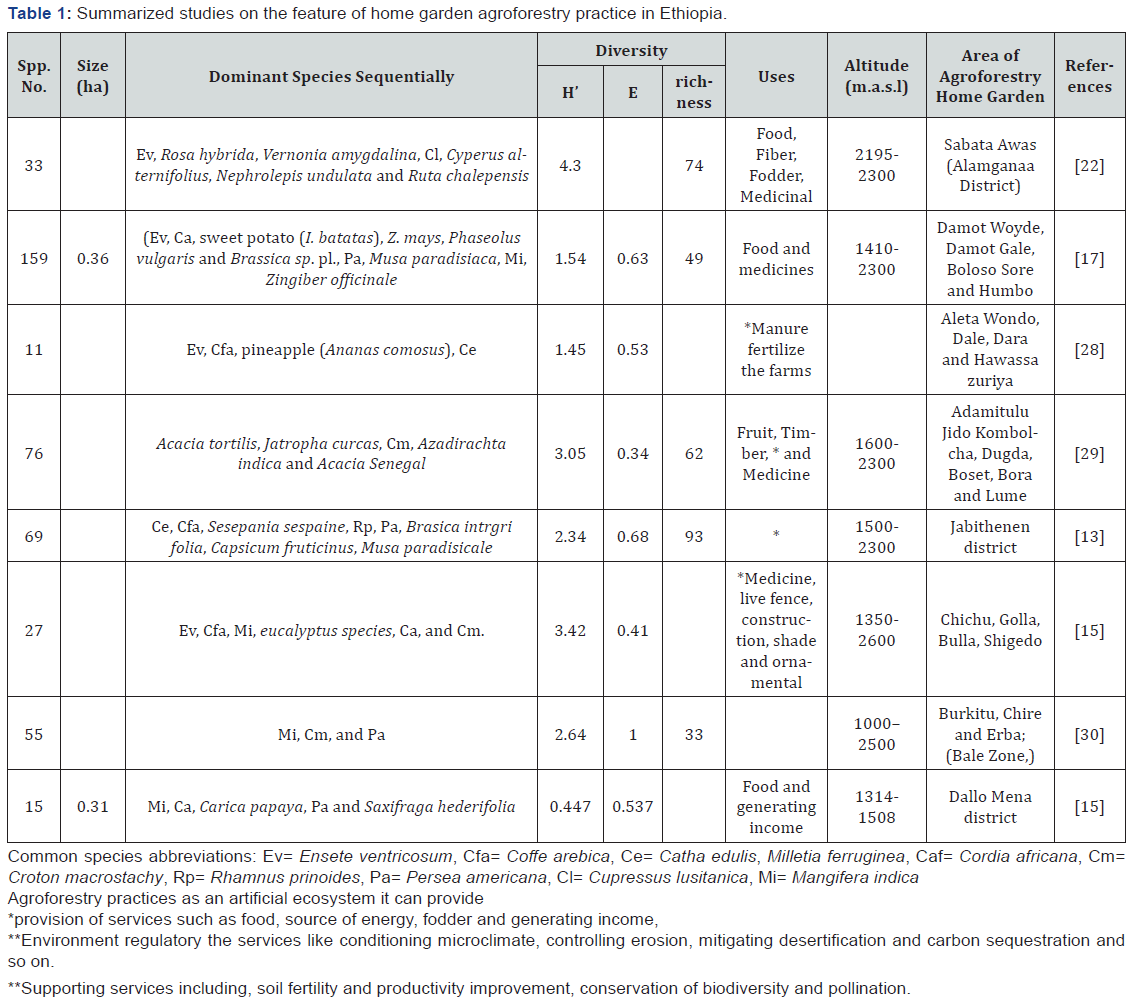
According to result; it reveals that the number of native species
that are grown in home garden agroforestry is more than the
exotic species (i.e. 53.3% and 46.7%, respectively). As listed in
table 1, the use of a home garden has many roles. However, this
practice in different studies has not been considered as a means of
diversifying of tree species and climate change mitigation by farmers
since they do not take it in to account this view as if it could
not generate income and produce food. So that, they prefer the
exotic species which have high fruit production efficiency species
that lead to a reduction of indigenous tree species diversity. The
attitude of farmers on climate mitigation by tree requires change.
In this table also Shannon index evenness and richness show
the level of species diversity Shannon index is more explanatory
than Simpson index and richness so the value of Shannon index
can express highly and low diversity respectively when the value
between 4.5 and 1.4. So that, the lower Shannon index value of
0.44 and the higher value of 4.3 which indicates lower and higher
species diversity in the area respectively. The evenness indicates
how much tree species are distributed equally through the surveyed
area. The mean evenness value of one [15] indicated that
each species is equally distributed throughout the study area. In
other words, there is no dominant species in the area. However,
the evenness value between 0.34- 0.68, in the table, indicates their
corresponding dominant species has covered the studied garden.
Plant species with the mean evenness value of 0.4 corresponds to
the home gardens in EloErasho where E. ventricosum and I. batatas
mainly cover the garden. In general, the relative evenness value
of the whole population of the most useful plant species in the
study sites was 63%. In another study Maize, chat and pineapple
are sequentially a predominant species in Southern home gardens
[13,15,17,22,27-29,31] (Table 1).
Indigenous Knowledge
In the tropical and sub-tropical countries many farmers
have several traditional knowledge and practices conserving agricultural
ecosystem and a means of integrated land use system
[27,32]. Traditional socio-cultural and ecological knowledge often
permits the farmer to decide the species choice and the spatial and
time sequence of its growing [33]. Farmers manage the tree inside
the home garden to reduce light computation by means of pruning.
Farmers use the excretion of cattle and human to the garden
to fertile and productive while they want to keep their sanitation
[16,22,26].
C. africana, Erythrina brucei, and Millettia ferruginea are the
species that the farmer preferred to the garden to have fertile soil.
Ninety-eight percent of respondents produce plants of different
use values mainly for home consumption and they harvest whenever
they need it throughout the year. The prominent species that
occur in SNNP region home gardens is Ensete ventricosum which
provide food with steady state as an appropriate management system
[34].
In Southern Ethiopia, women are the only labor to do the processing
and preparing food from the plant which is dominant in the home garden that is inset even though men have other harder
works [35,36]. This indicates that women are the only person who
has been processing the food which could eat when food shortage
has occurred. The food has taken long-term to prepare and requires
care and experience or indigenous knowledge. Yet there is
no research had been undertaken over how to prepare and interact
with scientific knowledge, particularly with human nutrition.
In different research findings farmers are identifying and familiarized
with their preferred species which is used for food and
other purposes like [5,28,31,37] finding showed that in average
59 species are familiarized by farmers, also 25 number of species
preferred for the purpose of food, 21 species for medicine, sell,
live fence, building or home materials,, shade and ornamental and
38 species for fuel purpose. Home gardens in the area produce a
significant amount of the food needed by the family in addition
to minor and supplementary products. Of the 60 households interviewed,
59 Plant species which were listed as most important
food crops by the local people are listed in Table 3 in their order
of preferences. However, there is loss of traditional knowledge of
different management practices [38].
Marketed and Marketable Home Garden Products
Its surplus product can sold to the market when the market
distance seems to closer to farmer’s garden which helps them to
get money from marketed products. The income which is obtained
from the marketed product will help them to purchase another
food type to satisfy their food utilization. Some researchers found
that the major cash crops which grow in the country’s home garden
are cabbage, enset, lumen, orange, papaya, mango, and avocado
etc. some other also found like Coffe arebica, Catha edulis, Milletia
ferruginea, Cordia africana, Croton macrostachy, etc. are trees
those are more useful for improving soil fertility and capability to
conserve soil moisture [19,38,39]. In Mekonen et al. [38] study
Catha edulis, Rosmarinus officinalis and Rhamnus prinoides were
the most preferred marketable plant in Sebeta-Awas area. They
use powders which obtained from C. macrostachyus that serve as
a preservation method to store crop seeds and tubers are buried
under the soil for short period for future use in its shortage. Local
markets (qoccaa) and markets are closer to towns have a great
contribution to selling their product. Contrary, species richness
is negatively affected by proximity to markets and access of road
[27].
Gender
The country Ethiopia has different nation and nationalities
which have varied in their custom and culture which resulting
mainly from religion. Hence, usually, the women inferiority and
men superiority has been shown [9,40]. In the home garden, women
are frequently engaged to cultivate it while men need to change
the land used to cash crop production.
Agriculture is the main activity of men in the country. However,
women play their own role towards the management of home
gardens and also of the farm fields. For instance, carrying animal
manure to the farm land, soil preparation, weeding, and harvesting
are some of the activities of which women had direct involvement.
Work division for male and female is the way that farmers
manage their human resources like crop selection the majority
agricultural activities are given for male, transporting animal manure,
site preparation, weeding and harvesting are responsible
for female [3,9,40]. Despite the fact that women are aware of the
use of plants and the means of maintaining them, they can manage
together with identifying local varieties and managing mainly
minor plants like vegetables, spices, tasty varieties and plants of
medicinal value.
Home gardens are prevalent in the highlands of Ethiopia and
accommodate supplementary fruits and vegetables as a principal
means of livelihood for households and sites that have been considered
as a sign of prestige and pride [22]. Women play great role
towards the management of home gardens and also of the farm
fields. Aggregate data show that women contain about 43 percent
of the agricultural labour force globally and in developing countries
[41]. In all aspect of women participation is important for
the development of the community particularly involvement in a
broad range of home gardens management activities is leading to
beneficial for their own socio-economic well-being, but also imperative
for sustaining the livelihoods of their communities and
for preserving the agro-biodiversity [21]. [42] recorded that in
about 60% of total number of small home gardens (<0.4ha) women
contribute significantly for the management. They also reported
that only in 22% and 12% respectively of total number of medium
sized home gardens (0.41- 0.12ha) and large home gardens
(>1.2ha) the role of women in garden management is significant
[33,42,43]. The marginalization process would facilitate by which
the community has lost a profit and desired need for cash to meet
family needs. Women contribution for cultural and traditional
practices would no longer evoke respect when the need is supplied
by the market and the authority of women undercut [44].
A research conducted in Sidama zone reveal that [40] women’s
access to land, market, and trading, the decision-making process
has been restricted Institutionally at the household and community
levels. The reason is the majority of farm women are illiterate,
little knowhow about the techniques of farming, face dominance
by males and restricted mobility due to several cultural taboos
[41]. But the proclamation Ethiopian Rural Development Policy
and Strategies says that “Women, who want to engage in agriculture,
shall have the right to get and use rural land” (Proclamation,
No. 456/2005).
Component Interaction
In home garden animal, tree and crop have symbiotic relationship
between them.
Tree vs. crops
Trees are the dominant component of home garden which
holds and ties different ecosystem components like soil,
insects,microorganisms and dead parts. So that trees used as an input to
have high production capacity for the soil by providing decomposition
materials, its decomposer or soil fauna and being as a host.
Trees help to regulate microclimate to wet that is suitable for
crops to use water efficiently as it reduces evaporation. The more
diversity of trees in home garden provides fertile soil in it through
fixation of nitrogen [3,19,28]. On the other hand, crop residue also
the one which is used as a material input for decomposition.
Animal vs. crop/tree
Fodder for livestock can bring from remnant trees and farmers
use trees for construction materials that help to make animal
shade. In other hands, livestock manure provides compost for
crops and trees get essential elements [3].
Farm size
As the area of the garden is narrower the activities under taken
inside the garden could minimal. Because, number of species
is lower in number to manage. So that it is recommended to have
large area in order to engage high number of laborers, diversify
tree and crop species and increase number of products as per the
income. The proportionality of home garden size accessed with
those family members has been wider. However, different parts of
the region have various agricultural systems. The average size of a
home garden, in several tropical and sub-tropical regions, is much
less than a hectare [31,39,42,45].
Mesfin et al. [16] stated that the maximum and minimum
size of home gardens encountered is between 0.05ha and 0.25ha
and the average size is 0.06 and /or [32] 0.7ha. [46] also classify
south-central highlands of Ethiopia its size is 0.35, 0.27 and 0.12
hectare for rich, medium and poor households, respectively. A
study for the Food and Agriculture Organization of the United Nations
(FAO) estimated that to grow three to five trees, a household
would need at least 167m2 of land. It may mentioned here is that
very often such small sized land use system with subsistence level
of mono-cropping is not viable, particularly in the rural ecosystems
[47]. The author’s [17] study in Wolyta home garden. The
garden provide different practice is declining like shade as well as
suitable places for conducting ceremonies and get-togethers for
the villagers during social gatherings and religious holidays where
coffee and snacks (of roasted grains) and bread may serve due to
the consequent decrease in land holdings.
Gebrehiwot [9] study in Sedama zone reveals that the income
that generated from the home garden as the laborers are females
and the earned many has been governed by themselves. However,
while the land use change from home garden to crop production
the generated income will used by males since the labor force
to produce crop typically by the male. To get a marriage female
should show their ability to manage the home garden in their
home. so that, if they have not home garden, they will not get the
opportunity to get marriage [9,36,40]. Simultaneously the species
diversity will go to reduce by its rate of change of home garden to
monoculture crop production land use system. Decision makers
and other related stakeholders have to take the issue in to account
to state the policies and strategies.
Even though the income that getting from sold cash crop product
is contributing to spending for goods besides food, the household
members could not get sufficient access to food. On the other
hand, the Plants [17] study describes the surplus product that as
got from the garden will sell to the market to satisfy a balanced
diet for household members.
People’s intention to have a wider farm size garden has not
been yet studied. Even though in some part of the country this
agroforestry practice is adopted well, dispersing it to other parts
those has potential on adopting experience and suitable environment.
The way to adopt or scale up as a new technology for others
can introduced by means of integrating it with other concerning
stakeholder’s programs to deal with poor living status of farmer
in Ethiopia [48].
Function and Arrangement of Home Garden
Function of home garden
The function of home garden like other agricultural activities
has to taking into account the sustainable utilization of its products
as if the next generation needs suitable environment to have
the soil potential to produce quality food for access. According to
[49], the term sustainability is often used only referring to present
and stable conditions, but the changing needs of future generations
and social dynamics should considered. Consequently, a
sustainable agro-ecosystem should, in addition, able to respond/
adjust to changes in environmental and socio-economic conditions
[50].
Fertility of home garden can improved by application of animals,
one of the components of home garden, manure, wastes of
humans who live in the house managing the home garden and the
tree/crop itself which fixes nutrients like carbon and nitrogen,
meanwhile, all components provides ecosystem service through
carbon sequestration by which farmers are not get income and the
government is not considering it and gives incentives. To advocate
this thought research should conducted which shows the amount
of carbon stoked in the garden or by the garden and increase farmers’
attitude towards how the practice stores a carbon in it.
Socioeconomic function
From the above table ‘Table 1’ the function of trees in the
home garden is typically used for Food security, Fuel wood, Agricultural
improvement, Constriction, Fodder medicine and income
generation. Most of the time the rural part of Ethiopia residents
are farmers no study is concerned about the relationship between
rural people and urban people based on their cultural, costume
exchange which leads the economic development of both areas.
Contribution for food security: Home gardens play significant
role as a source of minerals and nutrients [51]. In addition,
the diverse products available year-round contribute to food security especially during dry seasons [3]. When there is reduction
of production of crop field, home garden uses as a supplementary
food supply for household members; prominent experience that
uses of inset food for starvation period in SNNP region Ethiopia.
A large number of fruits producing trees are integral parts of
traditional home gardens and no chemical inputs are used, the
products from such home gardens can expected to of superior
quality. Although several of these fruit trees have not been studied
scientifically and are thus under-exploited and little known outside
their habitat, they make significant contributions to food and
nutritional security [3].
Enhance livelihood income: Product diversification from
the home gardens through value addition is an area of utmost priority
in meeting the market challenges. For instance, the diverse
bamboo species in Awi zone with nursery or seedling production
plus animals specially Horse (used for plowing) and caw which is
not studied yet. Home gardens in the highlands of Ethiopia collectively
house a large diversity of plant types that range from staple
food crops to ornamental plants [32]. Home gardens also offer
economic stability to farmers and provide a significant amount
(30-50%) of household income [11,52].
Increase spices and medicinal plant product: Most spice
plants are used as a medicinal plant in the home garden [14] this
help farmers to grow this plant as a multipurpose tree, used as a
source of income as well.
Creating a job opportunity: Specially, women are highly engaged
with the activity, since they are the prominent participant
in the home and home related works like home garden. Household
members will get more benefit as they have more resource in the
garden to manage, however, the less active participation of female
in the garden [21] during the narrow size of garden, the water
availability of the area, introduction of environmentally sound
and productive variety of tree, crop and livestock and awareness
on the capability of the garden to avail the food for all members of
the household.
Agro-ecosystem function
As a climate change mitigation and adaptation measure:
Agroforestry attracted special attention as a C sequestration
strategy following its recognition under the afforestation and reforestation
activities of the Kyoto Protocol mechanisms of Joint
Implementation (JI), Clean Development Mechanism (CDM) and
Emissions Trading (ET), only CDM is relevant to developing countries.
This was in recognition of the perceived advantages of the
large volume of aboveground biomass and deep root systems of
trees in accomplishing that task [53]. The amount of carbon in the
above ground and below ground biomass of an agroforestry system
is generally much higher than in an equivalent land use system
without trees [54]. The estimates range from 0.29 to 15.21Mg
ha-1 yr-1 above ground, and 30-300Mg C ha-1 up to 1meter depth
in the soil [55]. Average aboveground standing stocks of C ranged
from 16 to 36Mg ha-1, with small home gardens having higher C
stocks on unit area basis than large and medium sized ones [1].
There is projected 630 million hectares potential area for agroforestry
system, which could sequester 0.586 million tons C per year
by 2040 [55].
The above-ground biomass stock of the gardens ranged from 1
to 56Mg C ha-1. The smallest gardens, which were the most densely
planted and most biodiversity, had the highest carbon stocks,
averaging 26Mg C ha-1, while the gardens over 1ha that were sampled
averaged only 8Mg C ha-1.
To some extent, C substitution by reducing fossil-fuel burning
through promotion of wood fuel production is advisable. Most reports
indicated that addition of a large proportion of the relatively
high quantity of plant materials produced in a system will increase
C stock in soils [24]. Therefore, it is reasonable to surmise that
home gardens will help substantially in C sequestration [11,25].
Hence, scopes are high, opportunities are exciting, however, international
level interventions are necessary to simplify the methodological
complexities in smallholder CDM till then the rural poor
will beyond the reach of the benefits of CDM. The Indian’s experience
should intensify here to undertake in Ethiopia. Most C sequestration
reports also have disclaimers and caveats that lack of
reliable inventories/estimates and uncertainties in the methods of
estimation presents serious difficulties [25]. Thus, as in the case of
intangible and difficult to measure benefits and services, C sequestration
of home gardens, remains one of the potential sources of
income that have not been even quantified or the owners. In other
words, paying for the amount of carbon stored in agroforestry
home garden has been in question.
As an environmental conservation measure: One of the determinant
factors for stainable agricultural productivity is reducing
soil quality due to contamination with toxic metal, nom-metal,
salts and organic pollutant which is mainly urban and industrial
outlets [33]. The ecological benefits rendered by the perennial
trees in the home gardens such as nutrient cycling, litter dynamics
like inset [31], safety net role, nutrient pumping by deep roots are
prominent among the drivers of biophysical sustainability [57,58].
The central factors that help maintain home gardens as low input
systems is the availability of cost-effective nutrient sources such
as turnover through litter route [3]. Evidences of productivity
enhancement in home gardens with inherent nutrient turnover
pathways and also using such technologies as mulching for residue
management are also reported [59]. Again, nutrient turnover
is strongly influenced by the species composition and biomass of
the tree components [1,58].
Unlike monoculture or dual component systems, the
multi-species, multi-strata composition of home gardens permits
the enhancement in resource acquisition efficiency. Manna, Jha,
Ghosh, & Acharya [57] revealed that multispecies land use systems
such as agro-horticultural, agro-pastoral and agro-silvipasture are
more effective for soil organic matter restoration than non-agroforestry
system. Yet another advantage is the potential to contain
nutrient loss from the system through role of root system. This is
particularly true in high rainfall upland regions [1,42]. The high
tree density and variable belowground stratification allows deeper
displacement of tree functional roots and efficient capturing of
leached nutrients and/or horizontal transfer of nutrients to rhizosphere
of other trees [42]. Such density induced plasticity in root
spread has been reported for Acacia mangium, a prominent tree
component of home gardens of Kerala [60]. The efficient use of
subsoil resources by deep rooted trees often function as nutrient
hydraulic lifts/pumps [33]. Similarly, the soil remains insulated
from direct sun and litter cover prevent soil from surface erosion.
Arrangements of home garden
Analysis of area occupied by canopy cover of different constituents
indicated that in tradition home gardens, which are not less
than 40-45-year-old, the crown to land ratio ranged from 210 to
88% [39]. Several studies in Ethiopia indicated that with commercialization,
often a gradual change from subsistence to commercial
crops occurs in home gardens, while the crop diversity decreases
[17].
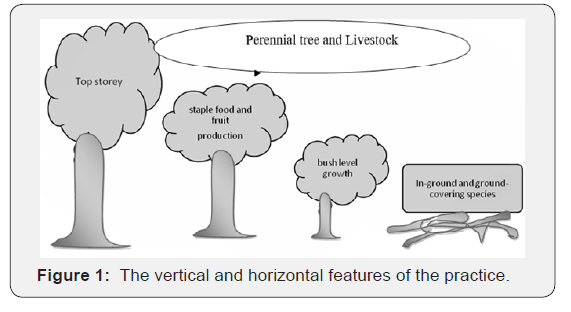
Spatial arrangement: Tropical home gardens are characterized
by vegetation layers (stories), imitating the tropical forest
structure. The top story consists of a canopy of tall trees which
reduces radiation and mechanical impact of rainfall, creates a relatively
constant micro-climate in the lower layers and through leaf
fall contributes to the maintenance of soil fertility. The lower layer
features staple food and fruit production followed by bush level
growth in the third layer. In-ground and ground-covering species,
the last layer, lower stories even though it lacks order and pattern
[31].
Vertical arrangement: (Figure 1) (Table 2).

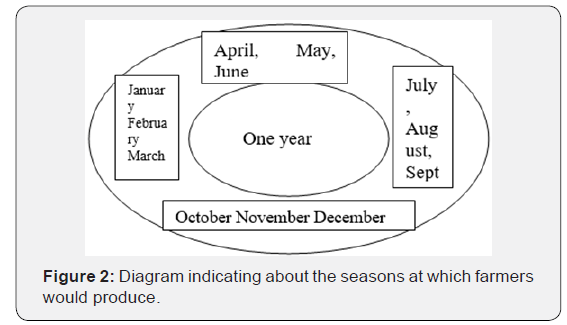
Temporal arrangement: The food type supplied from the
home garden has periodically unlike so that it’s behaved that farmers
manage their production and harvesting schedule. It is the arrangement
of home garden plant species or animals that are planted
and rare as per the time at which households requires available
food to sustain food security. Throughout the year there are different
components that are providing access to food for household
members like fruit, milk and grain. When household members use
the garden product to sustain food security, they conveniently partition
the months of a year. Accordingly, the month has classified in
to four, let we show each class by mean of the diagram (Figure 2).
The three months July, August and September are a season of
production since farmers are cultivating by rain water and the next
October, November and December months through which marketable
products could shown. Other the rest January February and
March are months at which farmers use available products for
feeding and selling. Know days, home garden cultivation has been
influenced its structure which could changed from more diverse
to monoculture cropping strategy that caused by high population
pressure shortage of farm land concentrating on high income generating
plants like Catha edulis (khat) and eucalyptus species.
Classification of Home Garden
These systems have also been described as a small-scale ‘supplementary’
food production system using ‘marginal land and
marginal labor’ [10]. As indicated in the above description, home
gardens often are part of a more complex farming system which
also includes other cropping systems. This, however, is not always
the case. Two types of home gardens can recognized on the basis
of their species composition and contribution to the welfare of
households.
The first one category of home gardens is ‘’monoculture home
garden’’ which extends including a wide range of rural, semi-urban and urban gardens. Most of the time the home garden area was
covered with different species composition latter on renowned
home gardens that supplement monoculture production like
khat and eucalyptus [9,25,61] and most home gardens from Latin
America [25] belong to this category. Even thought species diversity
is reduced and this wonderful system is faced future threat,
still it is an agroforestry home garden. Farmers are thinking it as
subsidiary task or providing their effort in addition to the main
work and its outcome also used as a feed and shelter [31]. Urban
gardens used to produce vegetables and ornamentals to supplement
non-agricultural income of owners also fall in this category.
The second categories of home gardens are extended farm
fields around houses that form the principal means of livelihood
for farming households. Most of the home gardens in the highlands
of Eastern Africa [3,25] belong to this category. Here, the
farmers have no additional land, or it is small and supplementary
to the home gardens. Home gardens are found throughout the
tropics, but they are more common in the humid lowlands. In
addition, they occur also in several tropical highland regions. An
overview of the agro-ecological and geographical distribution of
most home gardens in the tropics is given in table 1. Ethiopia is
one of the tropical countries where home gardens are prevalent
in the highlands. In this country, both types of home gardens exist.
In the cereal-crop based farming systems, staple food crops such
as tef (Eragrostis tef (Zucc.) Trotter), barley (Hordeum vulgare L.),
wheat (Triticum sativum L.) and Sorghum (Sorghum bicolor L.) are
grown in outer farm fields [29,36,48], while supplementary vegetables,
fruits and spices are grown in home gardens. Such gardens
are also common in most of the urban areas in Ethiopia.
The second category of home gardens is common in the perennial-
crop based farming systems [26] of the south and south-western
highlands. Which is the so called ‘’ally cropping home garden’’
Here, staple food crops (inset and maize) as well as other cash and
food crops are grown in the home gardens and these garden farms
make the principal means of livelihood for almost all the households
[36].
Policy and Strategy of the Country
To meet future challenges of land and water scarcity, and
to ensure food security as a result of adverse effects of climate
change, future mitigation and adaptation strategies that can used
by local land users through effective support by stakeholders and
policymakers need further attention [54].
The evidence suggests that policy plays an important role in
distinguishing countries and regions which have benefited greatly
from agroforestry from those who have not. Three policy areas
appear to most important. The first concerns essential long-term
private property rights over land and trees [9,40]. Where these
have been absent or contested, tree planting and management by
farmers has been limited. Second, policies related to tree germplasm
multiplication and dissemination are important in facilitating
the expansion of agroforestry [3,62]. Finally, the recognition of
agroforestry as an attractive investment area within agricultural
institutions and programmes is also important.
The adoption or lack of adoption of agroforestry is influenced
by a variety of factors. Some have relatively little to do with policy
[3,11,63] -- including climate conditions (e.g. rainfall), household
and farm characteristics (e.g. resource endowment, size of household),
and attributes of the particular agroforestry technology
(e.g. time lag between costs and benefits) [64]. However, a number
of important factors are directly linked to policy.
Land tenure systems and tree ownership one of the critical
factors to determining the potential acceptability of agroforestry.
Bishaw [65] gave the assertion that to have acceptable and scaling
up new or the already agroforestry technology land tenure systems
is a critical factor. Lack of land ownership and usage rights is
the priority determinant factor to adopt it [3,30].
The policies that stated on tenure and related discipline discourages
tree planting around homestead the by regulating harvesting,
cutting or sale of tree products and certain tree species.
It is restricting the harvesting, cutting or selling of tree products
[30,34,62,64]. Although sometimes well intentioned, such protective
policies, when applied to agricultural landscapes, discourage
farmers from planting and protecting new seedlings that emerge.
The way of changing home garden to other system requires
decision makers who has able to recall cutting tree is illegal activity
not the right to use the land and tree itself [6,62]. Family
members has a responsibility to participate in all case of farm activity
including women, like on the cases of species selection and
with what labor input are important, farming input, marketable
products, financial income with its distribution throughout the
members, land use change and including power division [9,22].
However, the inclusiveness has not observed yet in Ethiopia, as if
the decision-making process is powered for men.
Conclusion
From the categorization of agroforestry, the one which is
traditionally practiced in Ethiopia is agroforestry home garden.
There are prospects of the home garden for climate change mitigation,
gender participation in decision making, its marketable
products, and food availability and accessibility for the wellbeing
of the community. It means that it has socioeconomic, cultural, environmental
importance.
In other hands, the hindrance actions which obstruct to scale
up this potential land use type are community perception on
women empowerment, biodiversity degradation, retain income
from complimentary tree carbon storage and balanced diet. There
are week activities to providing support through an extension to
disseminate the new technology, germplasm, and ideas with considering
policy on the proportionality of farm size to the number
of family members. On station, research hasn’t been undertaken
over home gardens of the country.
To know more about Journal of Agriculture Research- https://juniperpublishers.com/artoaj/index.php
To know more about open access journal publishers click on Juniper publishers


Comments
Post a Comment