Contribution of Climate Change to Soil Carbon and Nitrogen Storages in Three Parent Materials in Akwa Ibom State, Nigeria- Juniper Publishers
Journal of Agriculture Research- Juniper Publishers

Abstract
A study was conducted to examine the effects of
climate change on the Carbon and Nitrogen storages of soils derived from
Coastal Plain Sands (CPS), Beach Ridge Sands (BRS) and Sand Stone/Shale
(SSS) parent materials in Akwa Ibom State. Secondary soil data of
organic carbon, and bulk density as well as climatic data of 2004 to
2014 were used. Organic C stock and SON were calculated as product of
soil organic carbon (or total N) contents, bulk density and soil depth.
Data were analysed using descriptive statistics, regression analysis and
ANOVA at α0.05. Organic C stocks on the surface (0-15cm) soil depth
were 44.13±15.91, 43.89±17.39 and 52.40±18.02Mg C ha-1 for CPS, BRS and
SSS, respectively. The corresponding values for subsurface depth
(15-30cm) were 28.30±9.58, 24.83±8.93 and 26.37±5.74Mg C ha-1. However, N
stocks at 0-15cm soil depth were 3.37±0.90, 3.19±0.94 and 3.56±1.00Mg N
ha-1 for CPS, BRS and SSS, respectively. Whereas in the 15-30cm soil
depth, SON were 2.07±0.55, 2.00±0.58 and 2.04±0.56Mg N ha-1 for the
respective parent materials. Highly significant SOC stock of 78.90Mg C
ha-1 occurred in 2005 in SSS, while the least stock of 23.71Mg C ha-1
occurred in 2007 CPS. Across the parent materials, organic C stocks
increased as rainfall decreases. Whereas, in. N stocks increased as
relative humidity decreases. Change in climate significantly affected
soil organic carbon and nitrogen storages.
Keywords: Parent materials; Climate change; Carbon and nitrogen stocks; Rainfall
Abbreviations:
CPS: Coastal Plain Sands; BRS: Beach Ridge Sands; SSS: Sand
Stone/Shale; SOC: Soil Organic Carbon; SON: Soil Organic Nitrogen; SOM:
Soil Organic Matter
Introduction
Climate change refers to a long-term shift in weather
conditions. It is measured by changes in a variety of climatic
indicators such as temperature, precipitation, and wind. Climate change
can be the result of natural processes and/or human activity [1,2]. Like
all soils the world over, ultisol found in Akwa Ibom State, Nigeria are
strongly affected by climatic gradients in temperature and moisture
which in turn affects the storage of soil organic carbon (SOC) and soil
organic nitrogen (SON) content. Therefore, to maintain stable carbon (C)
and nitrogen (N) stocks within the soils of this vast region, it
requires a balance between plant primary productivity and decomposition.
This balance is affected by carbon dioxide (CO2), temperature, and soil
moisture, which is further modified by soil texture [3]. Vegetation
drives maximum C input to the soil and varies across ecosystems
primarily with moisture gradients [4,5]. Consequently, SOC and SON
stocks are also highly related to temperature and precipitation
gradients [6-
8]. Temperature and moisture control soil organic matter (SOM)
decomposition and CO2 respiration driving both global and regional
patterns of SOC [4,6].
Soils with greater silt and clay content typically
have greater SOC stocks due to physical protection of organic minerals
[9,10]. Climate change scenarios predict a 2.2 °C to 3.6 °C (4 °F to 6.5
°F) increase in temperature and increased variability in precipitation
across most of the United States by 2040 to 2059 according to Marschner
and Bredow [11], will likely alter the distribution and composition of
plant biomass. Initial plant responses to changes in temperature and CO2
observed by Hinzman [12] may not reflect long-term SOC dynamics since
increased plant C inputs can lead to increased decomposition [9].
In Nigeria, it is obvious that climate change is
equally resulting in variations in temperature and precipitations with
its attendant effects on the vegetation. However, evidence of the
effects
of changes in SOC and SON stocks documentation such as those
ascribed to climate change in ultisol is scanty. This study, therefore,
attempts to examine the effects of climate change on the soil
organic carbon and nitrogen storage of soils on three parent materials
in Akwa Ibom State, Nigeria over a ten-year period.
Materials and Methods
Site information
The study was conducted in Akwa Ibom State, Southeastern
Nigeria. The State is located between latitudes 4°30′ and 5°30′
N and longitudes 7°27′ and 8°27′E and is characterised by a uniformly
hot wet and humid tropical climate [13]. The climate is
characterised by two seasons; the wet and dry seasons. The wet or
rain season lasts between the months of April and October, during
which the rains are heavy and of high intensity. The pattern of
rainfall is bimodal with peaks in July and September. The mean
annual rainfall varies from 2500 - 4000mm. The dry season lasts
from November to March. The average daily temperature varies
from 26 °C to 28 °C. Solar radiation falls within 6 to 15mm/day.
Relative humidity ranges from 75 to 95%, while evapotranspiration
ranges from 4.11 to 4.95mm, partly because of the high values
of insolation and temperature.
Vegetation and land use
The hot humid climate favours the luxuriant tropical rainforest
[12], which has however been almost completely replaced by
secondary forest of predominantly wild palm trees, woody shrubs
and various grasses undergrowth [11]. Poor management and
improper land use coupled with human population pressure has
led to forest depletion with attendant soil degradation and low
productivity [10,14-15]. Mangrove ecosystem extends into the
estuaries and flood plains of the Imo River at Ikot Abasi, the Qua
River at Eket and the Cross River at Mbo and Oron. Large tracts
of Riverine Swamp and flood plain environments with wetland
characteristics flank the Qua Iboe River valley through Etinan and
Abak L.G.A. Farming is very restricted on the beach ridge sands,
while agriculture and road network are adversely affected on the
narrow-crested sandstone ridges with steep-sided hills and valley
which cover much of Itu, Ibiono Ibom, Ikono and Ini L.G.A. The predominant
land use is the bush fallow cropping system operated
with low productive farming tools. This cropping system leaves
more than 80% of the soil surface bare. And this exposed the soil
to high intensity rainfall erosivity that is common to this area [5].
Data collection
Secondary soil data spanning from 2004 to 2014 were used.
Data were collated from three major parent materials in the area
viz: Coastal Plain Sands (CPS), Sand Stone Shale (SSS) and Beach
Ridge Sands (BRS). Soil data for each of the three parent materials
since 2004 were considered for the study and soil samples of 0-15
and 15-30cm depths were used. The soil data were pulled together
and were considered as representative of each parent materials
for the years under study.
Procedure for determining soil organic carbon (SOC)
stock: Calculating SOC stocks for a given depth consists of summing
SOC Stocks by layer determined as a product of bulk density
(Db) [16], organic carbon (OC) concentration, and layer thickness
for an individual profile with n layers15. Organic carbon stock was
determined by the following equation [7].

where, SOC = soil carbon (Mg ha-1); Db = Bulk density (Mg m-3);
Ci = Organic carbon content of depth i (g kg-1); Di = soil depth i
Procedure for determining soil nitrogen (SON) stock: Soil
Nitrogen carbon stock was determined by the following equation:

where, SON = soil nitrogen (Mg ha-1); Db = Bulk density (Mgm-
3); Ni = soil total N of depth i (g kg-1); Di = soil depth i
Statistical analysis
Data were analysed using descriptive statistics and ANOVA at
α0.05. The regression analysis was used to determine the association
of the climatic variables [8,14] (rainfall, temperature and relative
humidity) with SOC and SON over the periods
Results and Discussion
Trend of temperature and rainfall at Kaski, Gorkha and Siraha

Results of the soil properties affected by change in
climatic
factors are summarized in Tables 1-3. Mean bulk density (BD) on
the surface soil of CPS, BRS and SSS were 1.47±0.05, 1.46±0.07
and 1.56±0.05 Mg m-3, respectively. The corresponding values
in the sub surface were 1.59±0.06, 1.58±0.05 and 1.66±0.04 Mg
m-3, (Table 1). The trend of soil compaction on both soil surfaces
among the three parent materials was SSS > CPS > BRS. The shale
which associated with sandstone consistently characterized with
high bulk density. Relatively, bulk density was moderately high on
the surface soil compared with subsurface depth. This according
to Agbede [17] and Hamarshid [18] is attributed to the organic
matter content on the surface soil that promotes good soil aggregation,
thus lowering bulk density of the soil [19,20].
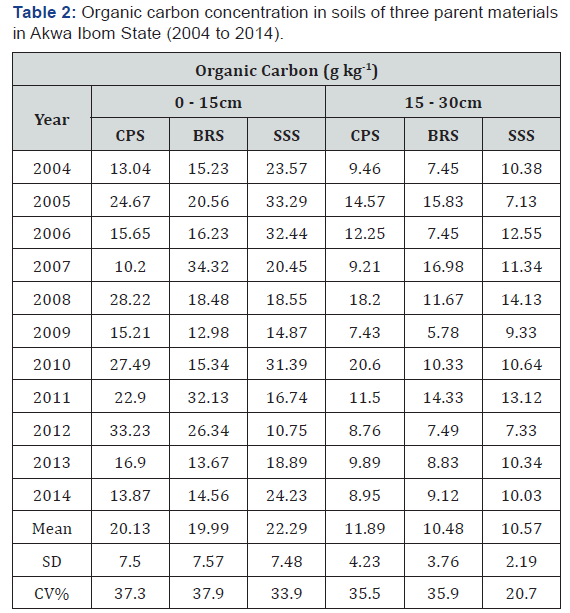
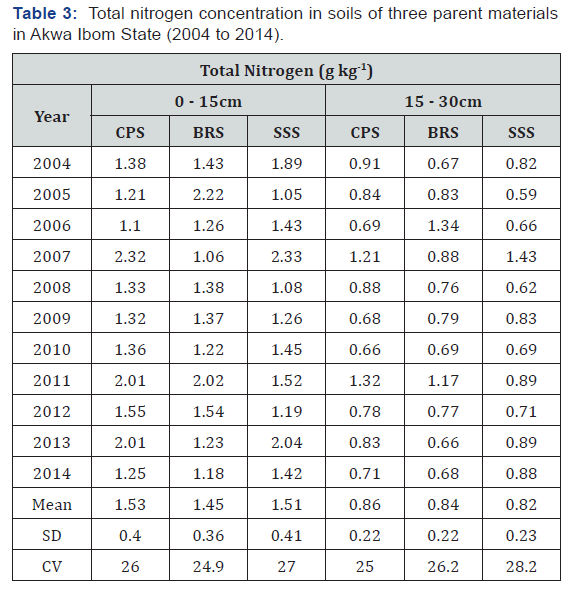
Organic C content of 20.13±7.50, 19.99±7.59 and 22.29±7.48
gkg1 on the surface soil of CPS, BRS and SSS were significantly higher
compared to 11.89±4.23, 10.48±3.76 and 10.57±2.19gkg-1 in
the subsurface soil, respectively. The corresponding values for soil
nitrogen content were 1.53±0.40, 1.45±0.36 and 1.51±0.41gkg-1
on the surface, while soil nitrogen content in the subsurface were
0.86±0.22, 0.84±0.22 and 0.82±0.23gkg-1, respectively. However,
SSS parent material recorded significantly high SOC than the other
parent materials on the surface, whereas high SOC in the subsurface
was noticed in CPS parent material. This result is consistent
with the earlier report of Marschner and Bredow [11]. Organic
carbon was highly varied (>35%) in both the 0-15 and 15-30cm
soil depths of CPS and BRS, but moderately varied in both depth
of SSS. Harris [7] noted this high variable distribution of SOC at
the field scale both horizontally and vertically. Accordingly, level
of SOC variability was attributed to differences in vegetative cover,
geomorphic soil position and thermal diffusivity of the soil.
Annual trends of climatic elements in akwa ibom statefrom

The respective yearly rainfall and temperature data are presented
in Figures 1 and 2. Significantly high annual rainfall of
319.2mm in the study area was recorded in 2012 while the least
annual rainfall of 153.4mm was recorded in 2008. Figure 1 revealed
fluctuations in rainfall pattern with stupendous rising in
2012 and significantly drop in 2013 and 2014. Although, the rainfall
pattern in 2013 and 2014 were significantly higher compared
to the periods preceding 2012.
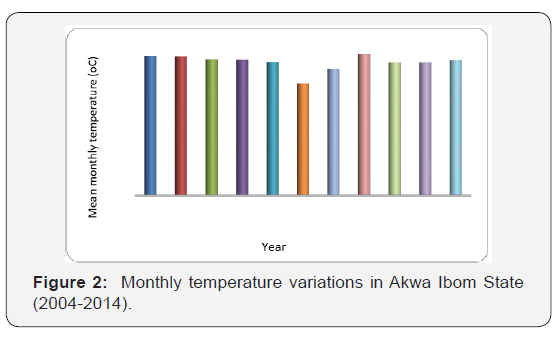
On the other hand, high annual temperature above 26.5 ˚C was
constantly recorded between 2004 and 2008. Conversely, the high temperature regime dropped to 21.8 ˚C in 2009 and subsequently
increased above 26 ˚C in 2010 and climaxed at 27.5 ˚C in 2011.
From the forgoing, year 2011 was the hottest period and the peak
period for water demand for decomposition of organic materials.
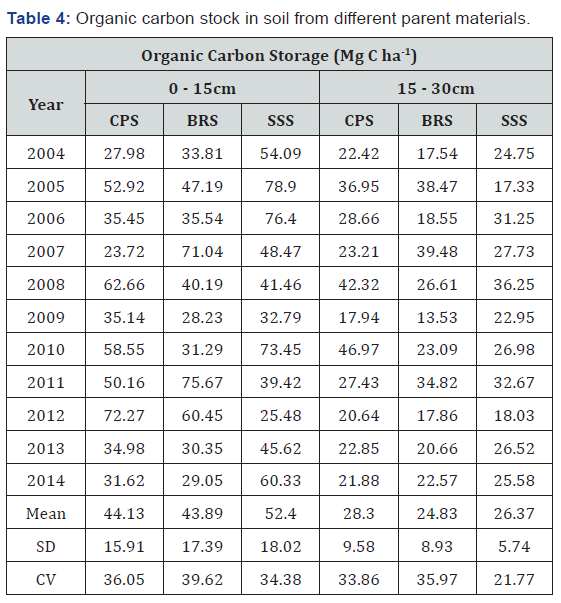
Organic C stocks of 44.13±15.91, 43.89±17.39 and 52.40±18.02
Mg C ha-1 on the surface soil depth of CPS, BRS and SSS, respectively,
were significantly higher than 28.30±9.58, 24.83±8.93 and
26.37±5.74Mg C ha-1 recorded in the subsurface soil depth (Table
4). On the surface soil, organic C stocks decreased in the order of
SSS > CPS > BRS. Whereas, in the subsurface depth, it decreased in
the order of CPS > SSS > BRS. Consistently, BRS stored the lowest
C content in the soil. According to Hashamoto and Suzuki [21], differences
in biomass production, cropping systems, land use types
and soil types could greatly contribute to the variation in SOC
stock at an annual time scale.
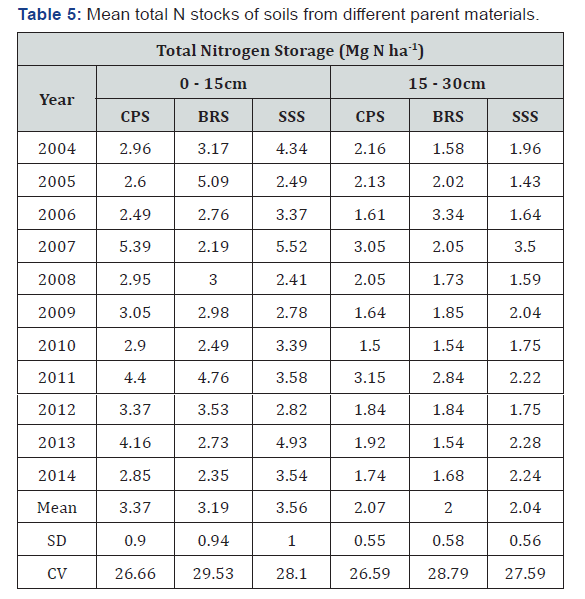
Similarly, total N stocks of 3.37±0.90, 3.19±0.94 and
3.56±1.00Mg N ha-1on the surface soil depth of CPS, BRS and SSS,
respectively, were significantly higher than 2.07±0.55, 2.00±0.58
and 2.04±0.56Mg N ha-1 recorded in the subsurface soil depth of
the corresponding parent material (Table 5). Total N stocks in the
0-15cm depth decreased in the order of SSS > CPS > BRS while in
the 0-30cm depth, it decreased from CPS > SSS > BRS. The highest
total N stocks of 5.22Mg N ha-1 recorded on the surface soil of SSS
was in 2007, while the least storage of 2.19Mg N ha-1 was recorded
in CPS of the same year (Table 5).
Effect of climate on carbon and nitrogen storages
The effects of climate on C and N storage among CPS, BRS
and SSS parent materials were assessed using rainfall and soil
temperature. In CPS, BRS and SSS, organic C stock increased with
reduction in the amount of rainfall by 30.1, 12.6 and 54.2%, respectively.
Organic C stock was highest in SSS parent material
and least in the BRS. Hector et al. [22] equally found an increased
SOC to the total SOC pool in low rainfall soils. On the other hand,
Hinzman [12] reported that soil organic C levels increased with a
corresponding increase in mean annual precipitation. This is true
for soils with coarse textures soil such as BRS [23]. The significant
increase in soil C stock with decreasing rainfalls especially in SSS
soil, is therefore, linked to moderation of the biomass loss effects
with high decomposition rates in fine textured soil. However, the
relationships of organic C stocks and rainfall for CPS (0.301) and
BRS (0.126) were not significant. The rainfall effects on N stock
in CPS and SSS were significant and directly related, whereas
the effect in BRS was inversely related. Across the parent materials,
200mm of monthly rainfall was found to be the peak rainfall
amount that contributed to the storage of large quantity of N
(4.5Mg N ha-1) in the soil. However, temperature with highest N
stock in CPS, BRS and SSS were 26 (4.5Mg N ha-1), 27 ˚C (4.0Mg N
ha-1) and 28 ˚C (4.7Mg N ha-1), respectively.
Conclusion
It is evident from the study that organic C stock in the surface
soil decreased in the order of sand stone/shale > coastal plain sand
> beach ridge sand. However, soil nitrogen stock did not follow a
definite trend as the organic C stocks obtained in the surface depth.
Comparing the three parent materials, organic C stocks in coastal
plain sand and sand stone/shale only increased with decrease
in rainfall as the temperature increased, whereas in beach ridge
sand parent material, N stock increased as rainfall amount
decreases. Among the years examined, highest total N stock was obtained in 2007 from sand stone/shale parent material and the
least from coastal plain sand. High temperature rate reduced the
level of organic carbon and nitrogen storages. Therefore, climatic
factors contribute significantly to the variability of soil carbon and
nitrogen storages among the three parent materials in Akwa Ibom
State, Nigeria.
To know more about Journal of Agriculture Research- https://juniperpublishers.com/artoaj/index.php
To know more about open access journal publishers click on Juniper publishers


Comments
Post a Comment