Cultivation Practices and Waning Production of Saffron in Jammu & Kashmir- Juniper Publishers
Journal of Agriculture Research- Juniper Publishers

Abstract
This study aims at studying the cultivating
practices, different factors which are responsible for declining the
production of Saffron (Crocus sativus) in Jammu & Kashmir. Kashmir
is famous for the cultivation of quality Saffron from about 750 A.D and
is one of the major Saffron producing areas of the world. Unfortunately,
from last couple of decades the production of Saffron in Kashmir has
been severely affected and has shown a declining trend. Here, the study
is about discussing the problems like non-availability of quality
planting material, absence of irrigation facilities, lack of disease
control pests, non-availability of suitable markets and reasonable
profits to cultivators. Here, it is also been discussed that
precipitation in valley has an impact on the productivity and yield of
Saffron produce.
Keywords: Cultivation; Saffron; Irrigation facilities; Glycosylated apocarotenoids
Introduction
Saffron (Crocus sativus), originating from the Arabic
word ‘Zafaran’ which comes from the Persian word ‘Zarparan’ meaning
“flowers of golden petals”. Its secrets stem from the dried red stigmas
which accumulate large amounts of three glycosylated apocarotenoids,
namely crocin, picro crocin and safranal, which, among the more than 150
volatile and aroma yielding compounds, contribute to the colour, bitter
flavour and aroma so typical of saffron. The spice is used as
flavouring and colouring agent in food and is a vital part of the dye,
perfumery and flavouring industries. Saffron also has countless
biological properties like anticancer, antimutagenic and antioxidant. As
a result, saffron fetches the highest price as a spice in the world,
depending upon the country of its production. Its production is
typically favoured in countries where labour is cheap, such as Iran and
Azerbaijan, but is also produced in countries like Greece, Spain,
Argentina or the USA and newer areas being brought under its
cultivation, viz. China and Japan [1]. Iran, Spain and Kashmir are the
major saffron producing regions of the world.
Botanical Classification
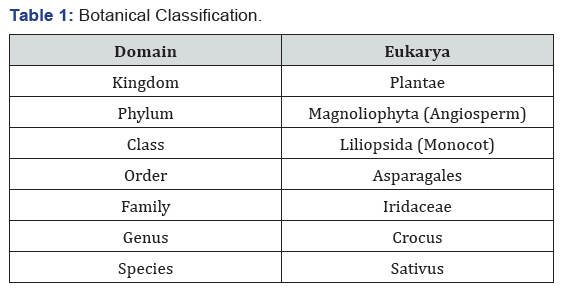
Saffron is classified into Domain Eukarya, Kingdom
Plantae, Phylum Magnoliophyta (Angiosperm), Class Liliopsida (Monocot),
Order Asparagales, Family Iridaceae, Genus Crocus and Species C.
sativus. Crocus consists of 9 species, Crocus cartwrightianus and its
derivatives, C. sativus, moabiticus, oreocreticus, pallasii, thomasii,
badriaticus, asumaniae and mathewii. Saffron with sub-hys
teranthous behavior is a perennial herbaceous plant attaining a height
of 25 to 40cm. Corm, foliar structure and floral organs constitute main
parts of saffron plants. Corms consist of nodes and are internally made
up of starch-containing parenchyma cells. These corms are 3 to 5cm in
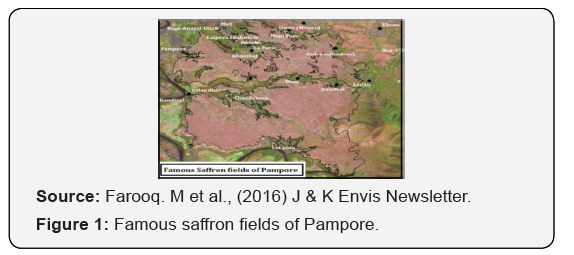
diameter and are covered by tunics [2] (Table 1 & Figure 1).
Crown in the Karewas of Kashmir and Bhaderwah (Jammu
Division), it is an important cash crop providing employment to
about 5 per cent of the total rural workforce in Valley of Kashmir
[3]. This “golden” spice is known as ‘Kum Kum’ and ‘Kesar’ in Sanskrit,
and ‘Koung’ in Kashmiri language. It is being said that Saffron
in Valley originated from the Takshak spring located in Zewan
village, almost 11km. away from Srinagar and then from there it
had spread to its adjoining areas. Kashmir is the second largest
contributor of saffron to the global market [2]. Kashmir’s Tehsil of
Pampore is the center of saffron cultivation in Valley and is located
at 34° 1’ N, 74° 56’ E, with an average alleviation of 1574mtrs
(AMSL). Khunmoh, Zewan, Balhama, Sampora, Ladhoo, Chandhara,
Woyan, Khrew, Shar Konibal, Dussu, Namblabal, Kadlabal, Hatiwara,
Samboora and Lethpora are prominent saffron villages of
Tehsil Pampore where this cultivation is being practiced. Saffron is
being grown in the Pampore Karewa of Kashmir from very ancient
times.
It is not known when the cultivation of saffron was started in
Kashmir, but Saffron is being reported to have been an important
ingredient of the prescriptions of Veghbhatta and Sustratta who
practiced medicine about 500 B.C. Its cultivation was in vogue
Pampore (Padam-pure) even when Kalidas wrote his literary masterpiece
Shakuntala and Meghdoot. Kalhan, the well-known historian
of Kashmir started in Rajterangani that saffron was under cultivation
in Kashmir even before the regime of Lalitadatiya during
725 A.D. Abul Fazal in his Ain-in-Akbari says that the saffron fields
in blossom afford a prospect that would enchant those who were
most difficult to please. Despite all these stories and beliefs, it is
not clear when the saffron cultivation was started in the Valley of
Kashmir [3].
Cultivation Practices of Saffron in Jammu & Kashmir
Saffron in the Valley is being cultivated in the Karewas of
Pampore and Bhaderwah district of Jammu and Kashmir & the
places where we can find the loamy soils which suits the growth of
Saffron. Saffron is a perennial crop, lasting for about 10-15 years
after sowing [3]. A new cultivator who has a plan to go for Saffron
cultivation starts preparing the land one year before the sowing of
corms (seeds of saffron). This process needs a lot of labour force
and financial support, as the farmer has to prepare his land for
good growth of Saffron. Farmers optioned that, before going for
Saffron cultivation, the land should be cultivated by oilseeds, in a
year before sowing Saffron corms. As it is good for growth of Saffron
corms in the succeeding year.
When the spring season (South) in the Valley starts, the concrete
preparations for the Saffron cultivation also gets started, by
ploughing the land in the starting month of spring season (March
or April). Moreover, it also depends upon the weather conditions,
if rains or more then the ploughing process is delayed for sometimes
as more moisture soils are not good for corms as it can effect
the health of corms and the land will not be ploughed efficiently
as needed for good cultivation. After ploughing, a good quantity
of green manure (farmyard manure) is applied (30-40tonnes per
hectare). If the weather conditions are good, that is, field has not
plenty of moisture, then the field is ploughed continuously for
about 20 days to get the fine tilth (fine soil got from continuous
tillage). The farmers are continuously engaged in their fields to get
the better results. From the field observations, the farmers believe
that at the end of month of June, it is necessary to again plough
the land, so that any unwanted plants (weeds) are removed from
the fields. Continuously, after 15 to 20 days the field is repeatedly
ploughed again upto the time of sowing of corms, i.e., nearly mid
of the August, as experienced farmers believe that the good time
for sowing of corms is after first week of August upto first week of
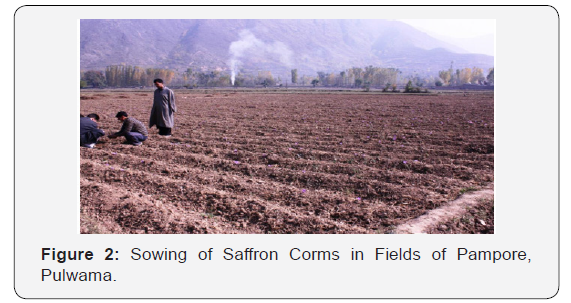
September (Figure 2).
Late sowing as well as early sowing of seeds is not recommended
in the Saffron cultivation. The seeds are generally being
sown at the depth of about 8cm to 11cm (4 to 6 inches), however,
there is not any strict rule for the planting of seed corms. A
distance of about 7cm to 16cm is in between of corms is said to
be good for the better yield of crop as when the plant grows it
produces a number of baby plants as its outgrowth, so farmer has
to left ample space for these outgrowths of the parent plant. The
sowing is done by two methods, either by ploughing method or
by zoon method. Plough method is practiced by the large number
of farmers as it is easy and less expensive method because labour
force needed in sowing gets expensive. The corms are sown
in rows, and the field is laid out in square beds by providing the
drainage channels outside the beds to drain out the excess amount
of water after natural showers (rains) or artificial sprinkler or irrigation,
so that corms may not get damaged. The bed of Saffron
seeds is called as “Poshaware” in Kashmiri. Then after the successful
sowing of corms, the field needs time to time water showers,
till the time of flowering, as the flowering will do start in the very
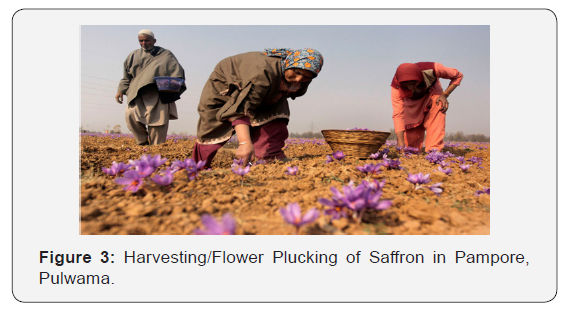
first year, if properly managed and practiced (Figure 3).
After the plucking of flowers in very first year of cultivation,
the Saffron fields are being left untouched upto the advent of new
spring (March/April). The fields are again being prepared for
yielding of crop. This time only hoeing is done, i.e., operation of
providing aeration to the soil, this is considered very useful for
the development of corms. Followed by second hoeing in the mid
of August, considered to be very much important for good yield of
Saffron. The last hoeing is done in September, about 30 to 35 days
before the flowering of crop and the repairing of Saffron beds and
drainage channels is also finalized. These operations of hoeings
are very much useful for the growth and health of corms and for
the good yield of Saffron as it provides the aeration to the soil and
corms and through which the delicate stems of flowers emerge on
the surface.
It may be noted that the corms may last upto about 7 to 8 years
after being sown. However, the lifespan of corms depends mostly
upon the type of soil and presence of moisture content in the soil.
Adequate moisture content may result in the long lasting of corms,
as it has been experienced that the corms may have a lifespan of
about 13 to 15 years in certain places. Here, it gives us the intension
that for the cultivation of Saffron crop particular soil and favourable
moisture content in soil is needed.
The flower picking or harvesting season of Saffron crop is a
very short season, as it starts nearly in first week of November
upto 20th November. At the time of plucking of flowers an optimum
number of labour force is required, farmers also engage
their family members in this work and also it needs the skillful
labour to pluck the flower from the stem of plant which is done
by the fingernails. Farmers also engage their children in this work
by providing them knowledge about plucking as they have soft
hands. A person who is engaged in the plucking of flowers has to
take care of the flowers and move through drainage channels and
by stretching their hands and by bending for collecting the flowers
so that the blooming flowers do not get blemished. The plucking
time starts after the dew drops have disappeared. A good flower
collector can collect as much as 3000 flowers a day and these flowers
are collected in special kind of baskets made of willow. The
plucking is done on alternate days or after every 2 days, depending
upon the production and yield.
Production and Distribution of Saffron
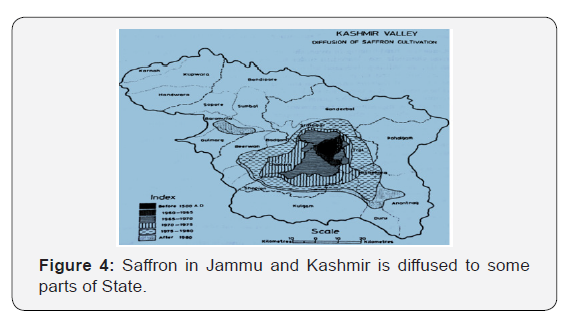
As we know that the Kashmiri Saffron is famous for its quality.
The production of Saffron had been witnessed from very ancient
times. The cultivation of Saffron is confined to a certain-places in
the Valley. Pampore area of Pulwama district is considered as the
center for its production, it cultivation is distributed to the adjoining
areas of Pampore. Its cultivation was diffused to other areas
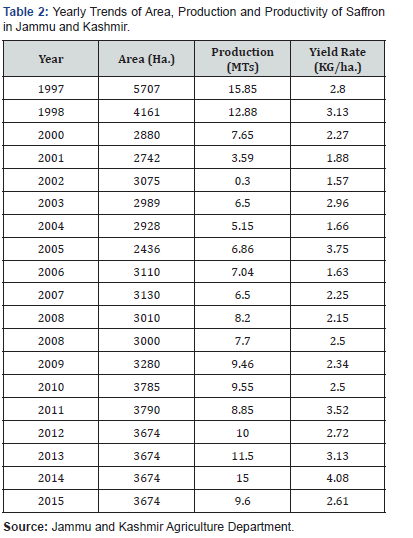
outside Pampore in 1960’s. In 2015, the area under Saffron crop
was 3674 hectares and production was 9.6 million tonnes with the
yield rate of 2.61kg/ha. (Jammu and Kashmir, Department of Agriculture,
2015) (Table 2 & Figure 4).
The above map shows that the Saffron in Jammu and Kashmir
is diffused to some parts of State and when it had been started
cultivating in these areas. Pampore area of District Pulwama has
highest area under saffron and was the center of Saffron cultivation
before 1500 A.D, followed by the areas of adjoining to Pampore
after 1960’s and at present it is being cultivated mainly in districts
of Srinagar, Shopian, Anantnag and Budgam.
Waning of Saffron Production in Jammu and Kashmir
The area under Saffron crop in 1997 was 5707
hectares, production
was 15.85 million tonnes and yield per hectare was about
2.8 kilograms and in 2015 the area under thus crop is just 3674
hectares, production has gone down to just 9.6 million tonnes and
yield per hectare is as low as 2.61 kilograms, according to the data
sources of Department of Agriculture, state of Jammu and Kashmir
(Table 2). From the last couple of decades, we have witnessed a
declining trend of Saffron production in the valley of Jammu and
Kashmir as the data also reveals. The land under this famous cash
crop of state has also shown a waning trend from the past years
and the farmers are also now moving out of this cultivation. There
are a number of reasons due to which production has shown a
waning trend and the people who were engaged in the cultivation
of this ‘Golden Spice’ are now not showing much of the interest in
it. Some of the reasons behind this waning trend of Saffron in State
of Jammu and Kashmir are given under:
Non-availability of good quality corms
The Saffron plant being triploid, fails to set seeds, and thus
is propagated vegetatively through corms. Good quality and disease-
free corms result in the good production of crop. A flowering
corm contains 10-12 buds and each sprouting bud produces a cormel.
Pandy et. al. [4] found larger corms produced more flowers
and leaves. In Kashmir the corm seeds which are sown mostly in
the fields are of about 2cm in diameter and 10g in weight. Here the
farmers have non-availability of sound quality corms that is why
they go for the low standard corms. Due to which the yield from
these corms is low. It is also seen that if the good quality corms
are available then they have high rates which a small farmer is not
able to buy them. Government also provided the facilities to farmers
to buy the corms at subsided rates, but the majority was much
away from getting these benefits. Small corms do not have the
potential to produce flowers in the first year [5], while as corms
larger than 2.5cm in diameter only flower in the very first year [6].
Therefore, quality of the corms matters a lot in the production of
Saffron crop. These corms have very high rates and government
should try to make available good quality corms for these farmers
at reasonable rates.
Lack of adequate irrigation facilities
From the very beginning, the Saffron fields were completely
dependent on the rain and if there were no rain there was no production,
that rains have direct relationship with the production of
Saffron. Saffron crop needs the time to time showers and mostly
the crop has need of water during its initial stages. Srivastava
[7] reported that areas receiving 100-150cm of well distributed
rainfall with snow in the winters are best suited for Saffron cultivation,
and rains in September are essential for meeting the water
requirements of corms for good flower yields. The State of Jammu
and Kashmir faced an acute drought in 1999-2003 [8], and during
this period productivity was reduced from 3.12kg/ha to 1.57kg/
ha. However, in 2004-05, favourable rainfall improved the productivity
also to 2.96 kg/ha.
So, for getting better productivity there is a need of providing
artificial irrigation to the fields but, at ground levels it also seems
that there is no facility to the farmer to provide their fields an
adequate irrigation. Government under the National Saffron Mission,
set up in 2010, to rejuvenate Saffron cultivation in Jammu
and Kashmir, assured the farmers to provide the irrigation facility
at their fields but a little of their intension was seen. Therefore,
cultivators were left with no choice to switch to high-density
crops such as apple, walnut and garlic, etc. While most farmers
complained of inaction, some were reportedly obstructive in the
laying of pipelines, fearing land damage. Tired of waiting for the
sprinklers to become functional, a handful of enterprising individuals
even set up their own irrigation facilities.
Lack of technology
The world is fastly going industrialized and use of technology
is seen in every sector. Here the Saffron is being grown by indigenous
technique. To improve the yield and productivity this sector
also need the latest technology for improvement. We can see the
countries were Saffron is being cultivated do use of technological
tools in sowing, harvesting and in post harvesting process. Here,
the farmers are lacking the new technologies and machinery to get
benefitted from them. The outdated technology is also considered
as the cause of fertility loss of soil and in decrease in production.
There is also the need of educating and awaring the farmers about
the post harvesting methods and use of techniques for storing of
the crop. There is a high percentage of Crocin (14-17%) in the
fresh stigmas of Kashmiri Saffron [9]. The Crocin content present
in stigmas of Kashmiri Saffron is found to be decreased (9-11.5%)
after harvesting and storing process because of unawareness
about the postharvest handling, right time and right stage of separating
the stigma from style, popularizing the use of solar dryers,
branding, etc. Kashmir is lacking in terms of production, with an
average yield of 2.23kg/ha as compared to 8.24kg/ha in Spain and
10. 0kg/ha in Italy [10]. So, it is obvious to add it here that with
the help of modern techno tools the production can be increased,
and the farmer will get benefit from it and will make cultivation
economically viable and ecologically sustainable.
Absence of good fertilizers and disease control pests
The intensive cultivation and monoculture of Saffron in saffron-
growing areas of Kashmir valley, together with the continual
use of diseased material has resulted in the frequent occurrence of
corm rot diseases caused by pathogens such as, Fusarium moniliforme
var. intermedium, a non-sporulating basidiomycetous fungus
[11], Macrophominia phaseolina [12], Fusarium oxysporum, F.
solani, Fusarium moniliforme [13]. Out of these diseases, corm rot
of Saffron caused by F. oxysporum and F. solani is considered to be
most destructive in Kashmir [13]. These diseases directly effect
the corms of saffron. If the corm seeds are injured there are maximum,
chances of that the corms will get damaged. With the result
the farmer has to go for new seed corms or has to use the particular
and good quality fertilizers and pesticides for controlling
these diseases. In Kashmir it is seen that almost every year these
diseases effect the cultivation and ample proportion of produce
gets reduced. Dhar [11] observed that although none of the Saffron-
growing areas of Kashmir valley were free from disease (almost
100% disease incidence). Nehvi [14], however, reported the incidence of corm rot as 46% in traditional saffron-growing areas
of Pampore. These studies reveal that there is a need of providing
the quality fertilizers and pesticides for the control of these diseases.
The application of different doses of Carbendazim against
corm rot of Saffron can result in better flowering yields [10]. Under
the Saffron Mission 2010, Government provided the facility
centers at many places in the saffron growing areas, but from the
empirical observation, it revealed that at ground level it was seen
as a failed mission or benefitted at a negligible rate.
Lack of optimum profit for cultivators
As discussed above, the farmer suffers from these problems
yet he continues with the cultivation of Saffron, but he does not
earn optimum profit to enjoy the good life. After a conversation
with the cultivator, namely Farooq Ahmad Wani [3], Saffron Cultivator,
1:00pm Pampore, District Pulwama, Jammu and Kashmir,
India, told that, “at certain times we don’t get a suitable rates for
our products as we are lacking the facility of an authorized market
where we can sell our products an get the optimum profits even
sometimes we have to sell our final good quality products on very
low rates because of the Dalals (middlemen), as they have to earn
their own share or commission from our product”. As the marketing
of Saffron is mainly in the hands of these Dalas and marketing
firms. The price of the Saffron in State is generally determined by
these firms and Dalas. Due to this reason they are moving towards
a period where they have to stop cultivating this golden spice and
switch to any other farming or any other work. Government has
also not taken any concrete steps towards providing some incentives
or creating any market where they can sell their product on
suitable rates. Under Saffron Mission 2010, the government of
state started a programme but was not strictly implemented, and
only those persons got benefitted who had any connections to the
higher authorities or who had any links with the marketing firms
in state or outside state which take their product to the national
and international markets. The small farmers just sell their production
to these big firms and middlemen to clear their debts, and
under these conditions farmer sell their produce at very cheap
rates and gets negligible profit. There are very few farmers who
sell their produce directly to the dealers in national markets, like
Delhi, Mumbai, Kolkata, Amritsar, etc.
Apart from the above problems, there is major reason of climate
change in the Valley which has affected its production and
yield. The livelihood of the society can be badly affected directly
or indirectly due to the climatic changes. Climate change has
emerged as an important issue ever to confront mankind. The
prolonged dry spell in the months in which Saffron has a need of
showers left the farmers worried. In Kashmir, the Saffron crop is
mainly dependent on rains and if rains are received at the sprouting
and pre-flowering stages, flowering is optimum and saffron
yield is good. Due to insufficient rainfall, the state has seen the
lowest productivity in the past 2 to 3 decades. It was seen in the
State of Jammu and Kashmir which faced an acute drought in
1999-2003 [8], and during this period productivity was reduced
from 3.12kg/ha to 1.57kg/ha. However, in 2004-05, favourable
rainfall improved the productivity also to 2.96 kg/ha. It means
that without rainfall the productivity of Saffron experiences a severe
downfall. The variations in the time of precipitations in valley
has been connected with waning trend of Saffron as experienced
by the farmers that if there is less snowfall in the winter season it
effects directly the productivity and yield in the succeeding year.
As in winter season snow covers the saffron fields and provides
moisture to the corms continuously upto the next spring season
and corms do not get effected and remain healthy. It is necessary
that corms have optimum moisture level during the winter (dormant)
season otherwise corms get infected and don’t produce
the outgrowth. In the spring season when first hoeing is done the
soil gets aerated and after the first hoeing the fields need time to
time rain showers upto the time of flowering. For precipitation,
mountainous parts of valley have shown a drastic decrease in precipitation
(10.3mm/year) while as flood plains have shown relatively
less rate of decrease of 3.6mm/year and with foothills and
Karewa’s having moderate rate of decrease 6.3 and 5.8mm/year,
respectively [15].
Conclusion
In Kashmir, the cultivation of saffron has been started from the
very ancient times nearly from about 750 A.D. The study revealed
that Kashmiri Saffron had lost its quality and had shown a waning
trend in the productivity and yield from last 20 to 25 years. Saffron
is being cultivated mainly in the Karewas of Pampore and its adjoining
areas. Soil in the Karewas has also lost some of its fertility
due to the old techniques used by farmers in their fields. Other factors
responsible for decline in production are non-availability of
some basic facilities to farmers. Variation in precipitation level has
also added a fuel in the waning trend of Saffron produce. Finally,
we can say that by providing the basic facilities to the cultivators
which have been discussed here can result in the increase of production
of the crop.
To know more about Journal of Agriculture Research- https://juniperpublishers.com/artoaj/index.php
To know more about open access journal publishers click on Juniper publishers


Comments
Post a Comment