Effect of Integrated Nitrogen Management on Growth and Yield of Banana on Inceptisol-Juniper Publishers
Journal of Agriculture Research- Juniper Publishers

Effect of integrated nitrogen management on growth
and yield of banana on Inceptisol soil was studied by conducting an
experiment at Post Graduate Institute Farm of Mahatma Phule Agricultural
University, Dist: Ahmednagar. An experiment was laid out with ten
nitrogen substitution treatments through FYM, neem cake and vermicompost
in different proportions (25%, 50% and equal nitrogen from these
sources) replicated thrice in randomized block design. The recommended
dose of banana as 200:40:200g plant-1 with seven splits of nitrogen and
basal application P2O5 and K2O at planting was carried out for this
experiment. The number of functional leaves up to 180 DAP were not
significantly influenced by integrated nitrogen management treatments
but at later growth stages, substitution of nitrogen either @ 25 or 50%
through FYM recorded higher number of functional leaves throughout crop
duration period. Application of 50% N: FYM + 50% N: RDF recorded
significantly highest pseudostem height while substitution @ 25% N
through FYM along with 75% N: RDF recorded significantly higher
psedostem girth and leaf area index of banana. Nitrogen substation @ 25%
either through FYM, neem cake or vermicompost induced early shooting
(flowering) of banana by 14 to 18 days. However, application of 50% N:
through neem cake +50% N: RDF recorded significantly less duration from
shooting to harvest or for bunch development of banana. Significantly
higher yield of banana was recorded with the application of 25% N
through FYM along with 75% N: RDF than rest of the treatments.
Keywords: Banana; Nitrogen; FYM; Neem cake; Vermicompost; Growth and yield
Abbreviations: INM: Integrated Nutrient Management; RBD: Randomized Block Design; LAI: Leaf Area Index
Introduction
Integrated nutrient management (INM) system has now
assumed great importance firstly because of the present negative
nutrient balance and secondly neither the chemical fertilizers alone nor
organic sources can achieve the production sustainability of soils as
well as crops under highly intensive cropping systems. Integrated and
balanced fertilization is the key to enhance nutrient use efficiency of
applied nutrients. The meaning of integrated fertilization is embedded
in the concept of balanced fertilization because if it is fertilizer and
(+) manure, then it is complementary use, but integration is a function
of all the factors involved. Conceptually, balanced fertilization would
essentially mean rational use of fertilizers and organic manures for
supply of plant nutrients in such a manner that would ensure:
a. Efficiency of fertilization.
b. Harnessing best possible positive and synergistic interactions among various other factors of production (seed, water etc).
c. Least adverse effects on environment (leaching, denitrification etc).
d. Minimum nutrient losses.
e. Maintaining high yields commensurate with the
biological potential of all the crop variety under the unique
soil-climate-agro-ecological set up [1]. Nitrogen is unique among the
major nutrients as it originated from the atmosphere and its
transformations and transport in the pedosphere and hydrosphere are
mediated almost entirely by biological processes.
Nitrogen undergoes various transformation processes
in soil. Nitrogen can escape in atmosphere through volatilization,
denitrification, leaching from soil-plant system to water bodies causing
pollution. The main loss pathways are:
a. Leaching dominantly as NO3 but also occasionally NH3 and soluble organic N
b. Dentrification as N2O, NO and N2.
c. NH3 volatilization.
Banana being an exhaustive crops, it is paramount to
maintain high degree of soil fertility to ensure high yield of superior
quality fruits. Banana is a shallow feeder as it removes substantial
amount of nitrogen (300-450kgha-1), phosphorus (50-60kgha-1)
and potassium (350-450kgha-1). Banana is of important fruit crop
whose growth and productivity are greatly influenced by nitrogen
and soil moisture. The choice of fertilizer along with manure, their
doses and time of application varies widely with respect to soil
type, genotype and agro-climatic region. The growth of banana is
positively correlated with yield. [2]. India is the largest producer
of banana in the world contributing about 20.54 per cent to the
global production. Banana contributes 37 per cent of the total fruit
production in India. Southern parts of India are leading in banana
production due to presence of suitable conditions. Maharashtra
is the second leading state in country after Tamil Nadu with 0.73
lack hectare area, 4.61 million tomes production and productivity
ranging from 13.5 to 62.97t ha-1 Babu and Sharma [3]. Apart
from the availability of genetically high yield potential verities,
the lower productivity of banana is the major issue in many parts
of Maharashtra. The soil moisture availability, imbalanced fertilization
and its management and disease pest infestation are the
major reasons for lower productivity in Jalgaon, Dhule, Nandurbar
districts of North and Nanded, Parbhani and Hingoli districts of
Marathwada region. Therefore, to assess the location wise available
manure sources for the substitution of nitrogen with its feasible
proportion this experiment was conducted on Inceptisol soils.
Materials and Methods
The present investigations were carried out to assess the ‘effect
of integrated nitrogen management on growth and yield of
banana on Inceptisol by conducting a field experiment at Post
Graduate Institute, Department of Soil Science & Agricultural
Chemistry, Mahatma Phule Krishi Agricultural University, Rahuri
during 2005-06. Agro-climatically, the area falls under scarcity
zone of Maharashtra with annual average rainfall of 520mm.
The soil of experimental area was Inceptisol order belonging to
Pather (Sawargaon) soil series and Vertic Haplustepts family. The
experimental plot with medium black clay soil having uniform
level and texture was clayee with 20.38% coarse sand, 27.80%
silt and 51.40% clay with medium depth. The soil is calcareous
(free CaCO3: 12.58%) in nature with alkaline pH: 8.68, EC: 0.17
d Sm-1 and organic carbon: 0.66%. The alkaline KMnO4-N, Olsen’s
P and NH4OAC-K in the experimental soil was 163.70, 15.28 and
571.20kg ha-1 respectively.
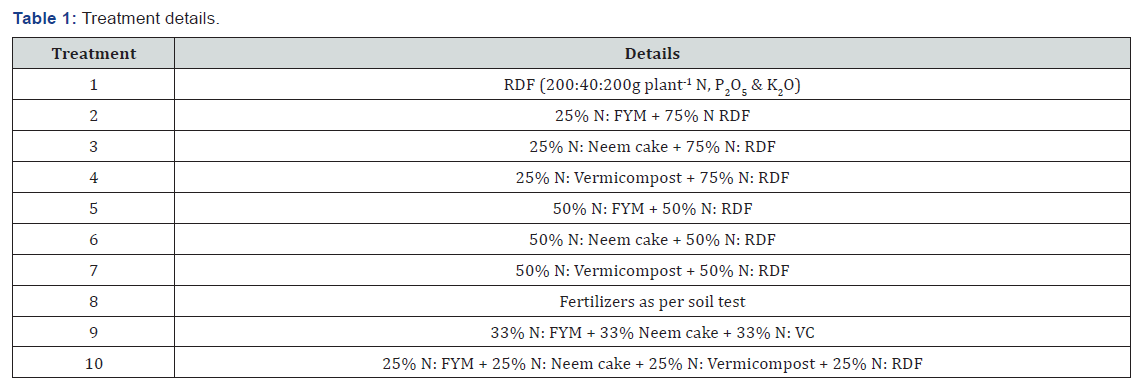
The experiment was carried out in Randomized Block Design
(RBD) with ten integrated nitrogen management treatments replicated
thrice with 147 plants under each treatment. The details of
treatment are mentioned in Table 1. The tissue cultured (60 days
hardened) banana plantlets of variety Grand nine were planted at
a spacing of 1.5 X 1.5m. There were total 30 plots each having area
of 110.25m2 comprising 49 plants per plot. Each plot of individual
treatment was confined with strong bunds from all the sides to
avoid the mixing of manures and fertilizers. The shevri was sown
immediately after the plantation of banana along with the South-
North and West direction of experimental field as wind break. The
recommended dose of banana as 200:40:200 g plant-1 with seven
splits of nitrogen and basal application P2O5 and K2O at planting
was carried out for this experiment. The fertilizer nitrogen as per
the treatment was applied in seven splits; 75% of N was applied
in 4 splits at vegetative and remaining 25% applied in three splits
at reproductive stage through urea while the recommended P2O5
and K2O was applied as basal dose at planting through single super
phosphate and muriate of potash.
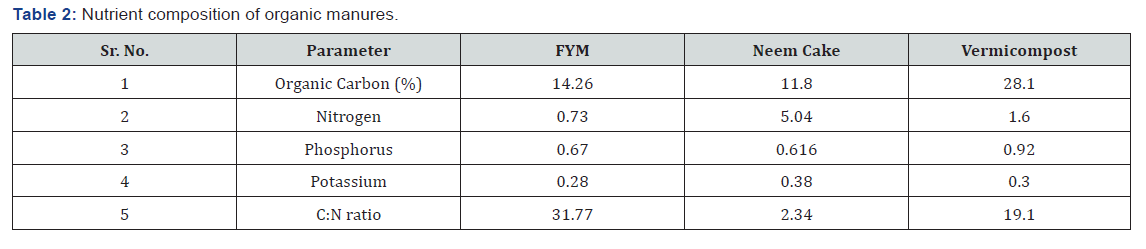
FYM, neem cake and vermicompost were applied to banana on
the basis of their nitrogen content as per the treatment. The organic
manures used were analyzed for total nitrogen by H2SO4 digestion
mixture using macro-kjeldhal’s method [4] while phosphorus
and potassium were estimated by digesting 1g dry manure sample
with 10ml triacid mixture (9:3:1 HNO3:HClO4:H2SO4) at 180-200
˚C. The nutrient composition of organic manures was mentioned
in Table 2. Five plants were selected randomly by taking due care
for maintaining uniform symmetry in each plot and tagged permanently
for recording biometric observations. The biometric observations
viz., number of functional leaves, pseudostem height and
girth, leaf area was recorded periodically at 60, 120, 180, 240, 300
days after planting and at harvest (360 DAP). The length & width
of fully opened third functional leaf from top for five randomly
selected plants were recorded as per the International reference
method (MEIR) proposed by Martin-Prevel [5]. The leaf area was
calculated by multiplying length and width of leaf with 0.8 factor
which was calibrated with the planimeter measurements and
showed within +2 per cent accuracy [6]. The leaf area index was
calculated by dividing leaf area of plant by the ground area covered
by each banana plant. Days required for shooting (flowering)
and for shooting to harvest were counted from the day of planting
for all the treatment from each plot and average quoted.
Results and Discussion
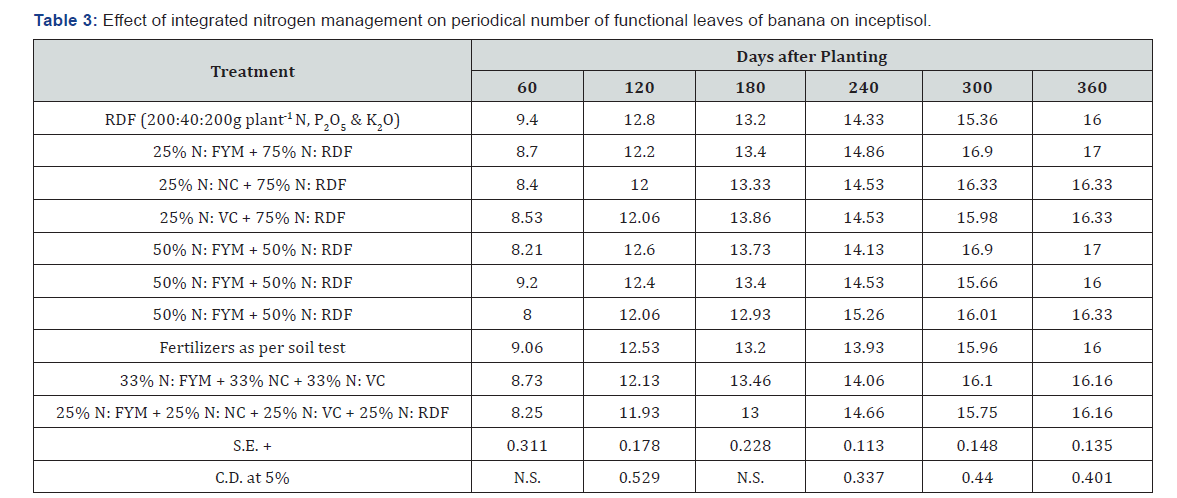
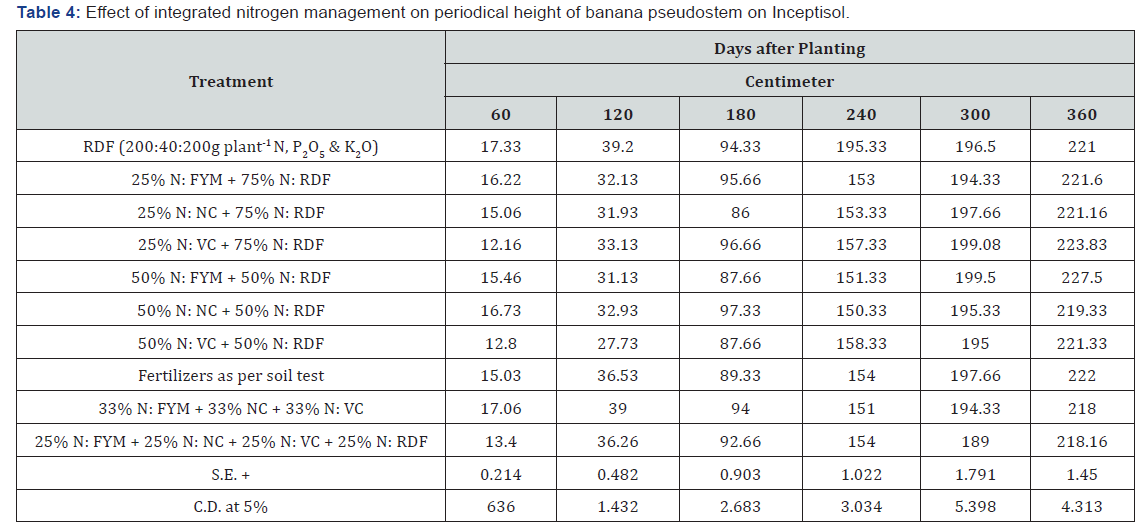
The number of functional leaves, pseudostem height and girth
and leaf area index of banana as influenced by integrated nitrogen
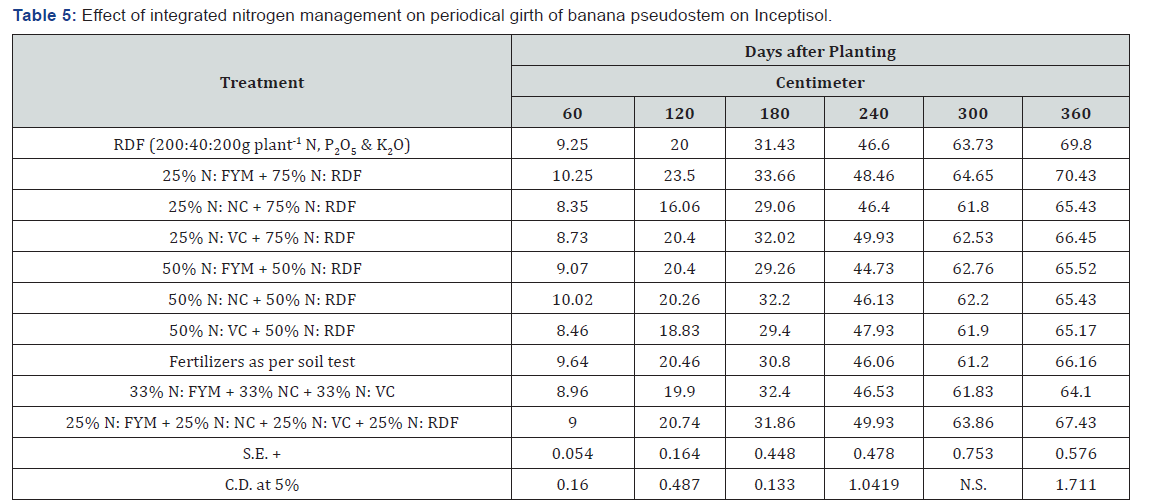
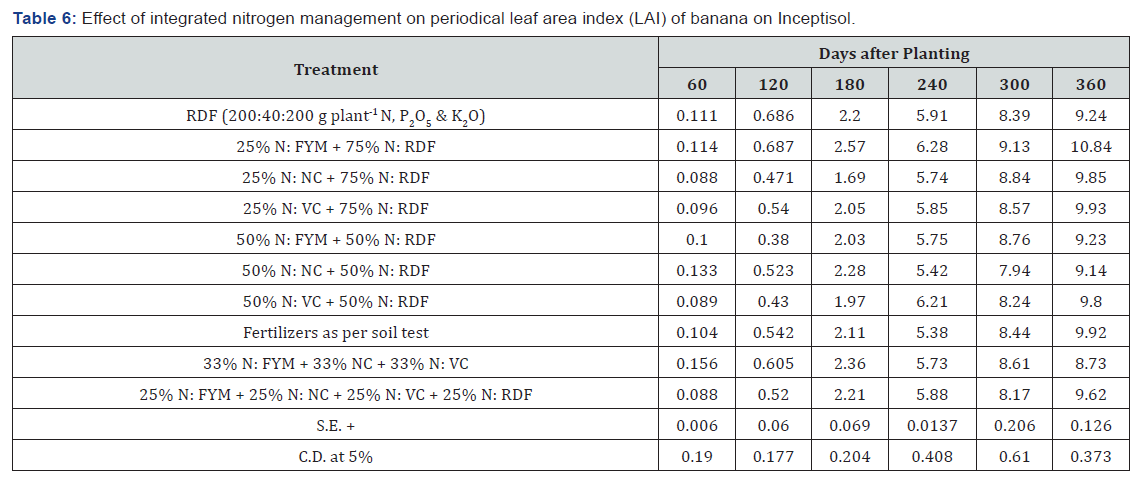
management are mentioned in Table 3, 4, 5 and 6. The number of
functional leaves at 60,120 and 180 DAP were not responded significantly to the substitution of N through organic and inorganic
sources. But at later growth stages (ie) after 240,300 and at harvest
the number of functional leaves were significantly influenced
by integrated nitrogen management treatments. The combination
25% N: FYM + 75% N: RDF and 50% N: FYM + 50% N: RDF recorded
significantly higher and same number of functional leaves
(16.90 and 17.00) at 300 and 360 DAP respectively. Both these
treatments recorded highest number of functional leaves in total
crop duration period while lower number of leaves were recorded
with 25% N: FYM + 25% N: NC + 25% N: VC + 25% N: RDF. The
non-significant differences for number of functional leaves at early
growth stages of banana may be due to slow uptake pattern. Tirkey
et al. [7] have also observed the non-significant responses of
growth parameters at initial stage of banana may be due to lower
requirements of nutrients for plant growth at initial stage.
The magnitude of increase in pseudostem height and girth
of banana were increased steadily up to 180 DAP and rapidly
between 180 to 240 DAP. However, the magnitude of increase
was found to be reduced up to harvest in all the treatments. The
magnitude of increase in height and girth of pseudostem at initial
growth stage was prominent in inorganic nitrogen application
treatment organic or manure N treatments. Substitution of 50%
N: FYM + 50% N: RDF recorded significantly highest pseudostem
height at 300 DAP (199.50cm) and 360 DAP or at harvest (224.50)
than rest of the treatments. Similar results pertaining to rpid increase
in plant height was also reported by Reddy [8], Kavino et al.
[9,10], Babu and Sharma [3].
The rapid increase in girth of pseudostem of banana was
pronounced in inorganic N- replaced treatments at initial growth
stage than organic or manure n substituted treatments. The application
of 25% N: FYM + 75% N: RDF recorded highest pseudostem
girth at 300 DAP (64.65cm) and 360 DAP or at harvest (70.43).The addition of organic manures for substitution of nitrogen may
have an immobilization effect on nutrients there by leads to slower
nutrient availability. Reddy et al. [8] reported the stem girth of
banana increased rapidly up to 180 and later marginally up to 360
DAP. Similar trend of results was also quoted by Tirkey et al. [7],
Kavino et al. [10] and Babu and Sharma [3].
The leaf area index (LAI) of banana was found significantly
influenced by integrated nitrogen management treatments. The
magnitude of increase in the LAI of banana was almost more than
three times from 60 DAP to 240 DAP in all the integrated nitrogen
management treatments. The application of 25% N: FYM + 75% N:
RDF recorded significantly higher LAI (10.84) followed by 25% N:
VC + 75% N: RDF (9.93) which was found statistically at par with
inorganic fertilizer application as per soil test (9.92). The lower
LAI (8.73) was recorded with the application of equal proportion
of nitrogen through FYM, neem cake and vermicompost. The
25% substitution of nitrogen through FYM along with 75% N RDF
might have played important role for increasing the nutrient use
efficiency of other nutrients. The correlation analysis of morphological
characters of banana as influenced by organic mulches and
summarized that the total number of leaves, pseudostem girth and
leaf area index were positively correlated with bunch weight and
yield of banana. Similar results were also reported by Jaybaskaran
et al. [11], Shakila and Manivannan [12] and Kavino et al. [9].
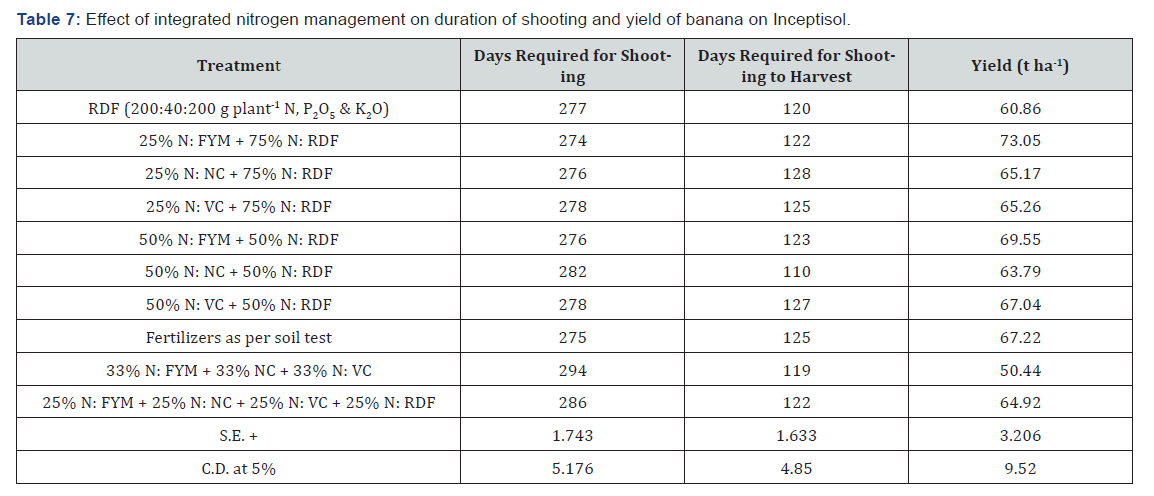
The integrated nitrogen management to banana significantly
affected the days required for shooting and shooting to harvest or
bunch development (Table 7). The variations in the days required
for shooting of banana due to integrated nitrogen management
treatment were 18 days. However, less number of days were required
for shooting with 25% N: FYM + 75% N: RDF (274) followed
by the treatments of inorganic nitrogen application based
on soil test (275), 25% N: neem cake + 75% N: RDF (276), 50%
N: FYM + 50% N: RDF (276) and RDF (277). Which were statistically
at par with each other. Further, significantly higher days for
shooting of banana were reported in 33% N: FYM + 33% N: NC +
33% N: VC (294) followed by 25% N: FYM + 25% N: NC + 25% N:
VC + 25% N: RDF (286) and 50% N: NC + 50% N: RDF (282). The
application of nitrogen through FYM or neem cake or vermicompost
in the proportion of 25% along with 75% recommended dose
of fertilizers induced early shooting by 14 to 18 days than other
treatment. This might be attributed to the addition of mineral nitrogen
along with organic sources narrowed the C:N ratio of organic
manures enhanced mineralization resulting in rapid release
of nutrients. Further, the stable and consistent supply of nitrogen
leads to the early flowering. However, addition of 75 or 100 % nitrogen
through FYM, neem cake and vermicompost in equal proportion
to banana delayed the shooting by 14-18 days than rest of
the treatment. The delay in shooting of banana due to the addition
of nitrogen through only organic sources might be ascribed due
to the higher quantity of organic manure application leads to the
immobilization of soil available nutrients.
The days required for shooting to harvest was ranged between
110-128 days while, total crop duration was 370 to 412 days. An
application of 50% N: NC + 50% N: RDF required significantly less
period (110) for shooting to harvest followed by the 33% N: NC
+ 33% N: NC + 33% N: VC (119) and 25% N: FYM + 25% N: NC +
25% N: VC + 25% N: RDF (121). However, all other nitrogen management
treatment was found statistically at par with each other
for bunch development. Kavino et al. [9] reported the substantial
variations in crop duration due to fertilizer treatments Tirkey et
al. [13] concluded that application of 250g N plant-1 produced the
earliest shooting followed by 300g N plant with dwarf Cavendish
banana cultivar.
The integrated nitrogen management treatment significantly
influenced the banana yield (Table 6). The nitrogen management
as 25% N: FYM + 75% N: RDF reported significantly higher yield
of banana (73.05t ha-1) followed by 50% N: FYM + 50% N: RDF
(69.55t ha-1) and inorganic fertilizer application based on soil test
(67.22t ha-1), 50% N:VC + 50% N: RDF (67.04t ha-1), 25% N:VC +
75% N: RDF (65.26t ha-1), 25% N: NC + 75% N: RDF (50.44t ha-1)
and RDF (60.86t ha-1). The application of nitrogen through FYM or
vermicompost or neem cake in the proportion of either 25 or 50
per cent reported higher yield of banana. This might be because
of adequate supply of both macronutrients and micronutrients to
banana. The inadequacy of micronutrients may show some hidden
deficiency symptoms in crop plants and become constraint in
exploiting higher yield potential. This constraint was overcome by
inclusion of organic manure (FYM, vermicompost and neem cake)
in the nitrogen management of banana. The incorporation of organic
matter into the soil helped to keep soil porous and reduce
moisture saturation ultimately improved soil physical, chemical
and biological environment. Further, the addition of organic manures
enhanced the microbial population and higher enzyme activity
which plays a vital role in nutrient transformation, recycling
and availability of various nutrients. The yield increase was largely
as consequences of higher leaf area index which leads to enhanced
growth parameters in turn resulted in higher Yield. The integrated
effect resulted on profuse growth of banana leads to the higher
synthesis of photosynthates and biomass accumulation. Similar
trend of results was also recorded by Meena and Somasundaram
[14], Jaybaskaran et al. [11], Tirky et al. [7,13], and Lahav [15].
Ray and Yadav [16] noticed consistently higher banana yield
for plant crop (70.70t ha-1), ratoon I (74.00t ha-1) and ratoon II
(70.60t ha-1) with the combination of 25% FYM + 75% inorganic
fertilizers. While Ushakumari et al. [17] obtained higher yield
of banana (66.6t ha-1) with recommended dose of fertilizers
(200:200:400g N, P2O5 and K2O plant-1) along with 10kg FYM
plant-1. The application of poultry manure or FYM or press mud
along with recommended dose of inorganic fertilizer obtained
equally higher yield of banana. Jaybaskaran et al. [11]. The results
are in accordance with Arumugam and Manivannan [18-20], Kivino
et al. [10], Tirkey et al. [7,13], Reddy et al. [8].
To know more about Journal of Agriculture Research- https://juniperpublishers.com/artoaj/index.php
To know more about open access journal publishers click on Juniper publishers


Comments
Post a Comment