Estimation of DPT by Empirical and SVM-FA Models-Juniper Publishers
Journal of Agriculture Research- Juniper Publishers

Abstract
Dew Point Temperature (DPT) estimation is a critical
issue in water stress managements. This study tries to investigate
suitability and usefulness of a hybrid model of the firefly algorithm
(FA) and support vector machine (SVM) techniques (SVM-FA) over two
empirical models namely Magnus and Lawrence for prediction of DPT. To
this end, daily DPT data measured during 2012 and 2015 at three climatic
stations over Isfahan, Mashhad and Tabriz catchment areas located in
Iran were used. The performance of SVM-FA model is evaluated in
comparision of two empirical models. The results obtained in this study
showed that in all three stations Lawrence model predicts DPT
inaccurately. The DPTs were accurately estimated by SVM-FA hybrid model
in three stations with RMSE values of 0.36, 0.55 and 0.22 for Isfahan,
Mashhad and Tabriz station respectively. As SVM-FA shows the least error
and the highest correlation coefficient (0.99), hybridization of
support vector machine in Firefly algorithm has been successful.
Furthermore, Lawrence experimental model results in the highest error
and the lowest correlation coefficient (0.54). The results obtained
indicated that the integration of SVM model with FA algorithm, gives
better results than modeling with the SVM alone and empirical models.
This study proved the suitability of the proposed SVM-FA model for DPT
estimation.
Keywords: Empirical models; Firefly algorithm; Dew point; Hybrid model; Support vector machine
Abbreviations:
DPT: Dew Point Temperature; FA: Firefly Algorithm; SVM: Support Vector
Machine; WT: Wavelet Transform; ELM: Extreme Learning Machine; MAE: Mean
Absolute Error; RMSE: Root Mean Square Errors
Introduction
Hypothermia and frostbite from the harmful effects
environment generally occur suddenly and brings great harm to the
agricultural economy. Damage both chilling and freezing phenomenon
usually when there is a minimum (before sunrise) reaches its peak. The
weather conditions and ambient temperatures are lower than the optimal
temperature for growth [1,2]. When the frostbite occurred the plant
tissues are strained, but not so cold that ice formation generally leads
to the destruction of plant tissues. Although the effects of
hypothermia differs between plant species when the air temperature is
between 0 and 10 °C, unplanned stresses occur in the plants [1].
The temperature which the water in the air is
distilled at a constant barometric pressure with the same evaporation
rate it is defined as the dew point [3]. The temperature of the dew
point is a temperature that the humid air needs to completely cool until
it is saturated. Also, when the saturation pressure and the actual
vapor pressure are alike, it is define as the thermal temperature [4].
In an arid environment, especially with infrequent precipitation the DPT
would be actually vital for plant [5].
The meticulous DPT prediction would be of essential
importance for a wide range of targets. DPT and relative humidity (RH)
are usually used to identify the rate of air moisture. Moreover, it may
be utilized in junction with the wet bulb-temperature for temperature
calculation, which prevents frost and loss of product [5,6]. When
moisture is low, the DPT becomes an important parameter for snow or rain
forecasting. Mainly DPT with relative humidity is used to measure the
amount of air moisture [7]. In many agricultural and hydrological
models, the DPT for assessment of evaporation and evapotranspiration is
necessary as a key input parameter [2]. Dew point is of great interest
to meteorologists because it is a fundamental measure of the state of
the atmosphere in terms of how much water vapor is present [8].
To estimate the next day’s low temperature as under
certain conditions it will end up pretty close to the dew point at the
time of maximum temperature the day before it will be a reliable and
important starting point [5,8]. So far, many studies have been conducted
to estimate the DPT [3,9-11] and to calculate the DPT relationships
based on average air temperature and humidity by Magnus and Lawrence
method [7,12]. In the past years, with
the entering of artificial intelligence models into sciences such as
agriculture and meteorology, use of model such as support vector
machine applied to estimate the DPT [13]. Hamidi et al. [14]
modeled monthly rainfall in Hamedan, Iran in an efficient way
using SVM and ANN methods. More accurate outputs have been
achieved via SVM method, with. Demonstrated superior efficiency
in comparison to the ANN method. Therefore, SVM was famous
as an effective method for rainfall modeling. Shiri et al. [10] applied
GEP and ANN algorithms to estimate DPT with 8 years daily
dataset of a couple of climatic stations located in Korea. The dataset
includes wind speed, down welling solar energy, temperature,
pressure, RH, and DPT. They concluded that the GEP is better than
ANN for prediction of daily values of DPT [10]. Amirmojadedi et al.
[15], used a hybrid model of wavelet transform (WT) and extreme
learning machine (ELM), called ELM-WT for the estimation of the
daily DPT average air temperature, RH and atmospheric pressure,
pertaining to the south coastal of Iran were considered as input
elements. They reported that their proposed hybrid model is able
to outperform other examined techniques. Although, qualification
of a model for prediction of DPT is of point of interest in
agro-ecosystem
[15].
In this study we aimed to predict DPT through support vector
machine and integration with hybrid Firefly algorithm.one of the
most important algorithms to determine the optimal parameters
of support vector machine is the Firefly algorithm (FFA). Although
Firefly algorithm (FA) has been used successfully in different
fields, but the most appropriate result obtained for the DPT estimation.
For the reason to demonstrate the compatibility of the
hybrid SVM-FA approach, its performance is compared with the
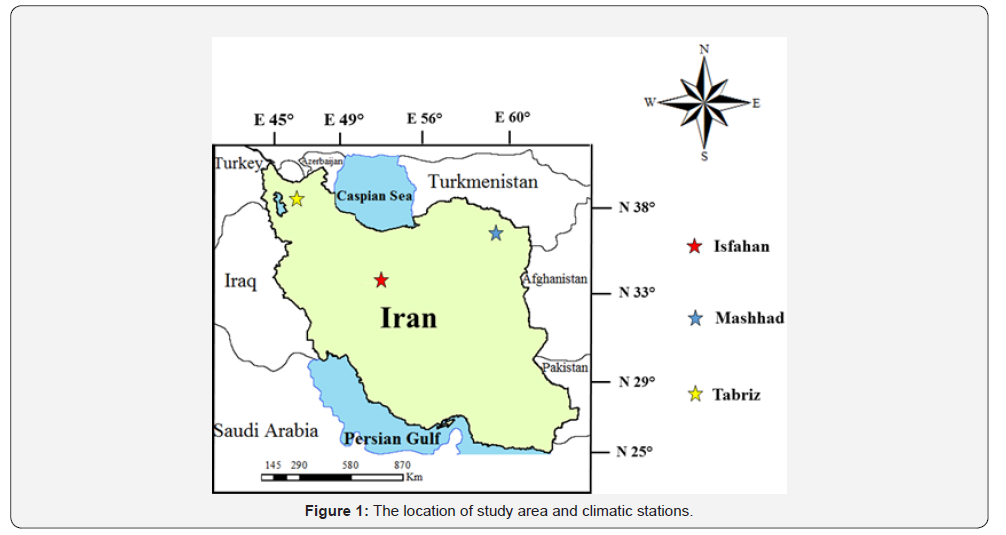
SVM and empirical techniques (Lawrence and Magnus). Three
stations located in north of Iran was selected as a case study and
daily DPT data sets from three climatic stations during 2012-2015
years over the catchment were utilized.
Materials and Methods
Study area and dataset
Methods
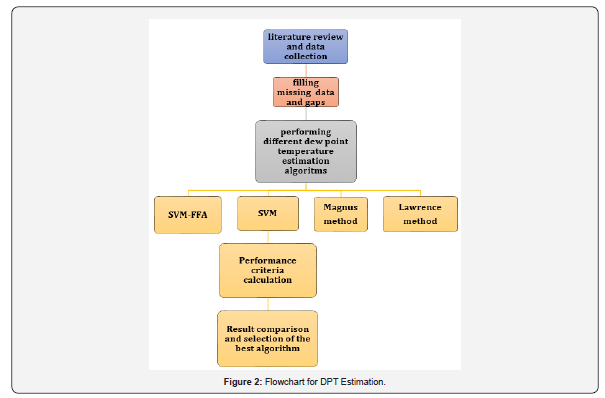
The methodology adopted in this research work is shown Figure
2. All collected data were corrected for their probable gaps or
missing measurements through statistical analysis. Results are
shown in Table 2. DPT modelling is performed through different
algorithms discussed earlier in previous section. For the reason of
evaluation of the models, mean absolute error (MAE), the Nash–
Sutcliffe coefficient, and root mean square errors (RMSE), have
been used. A brief description of scientific background of SVM,
firefly algorithms and empirical methods used to estimate DPT is
provided in the following sections.
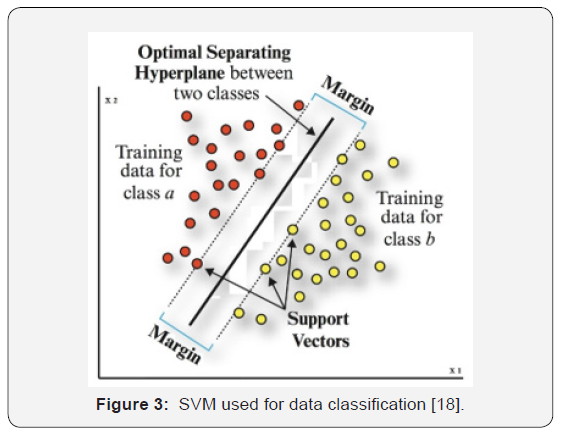
Support vector machines (SVM): Support vector machines
is a set of supervised learning methods used for classification
and regression analysis. Introduced by Chervonenkis in 1971 and founded upon statistical learning theory, this method is based
on dual classification in the arbitrary feature space and hence is
well-suited for prediction problems [16,17]. It is an efficient learning
system based on constrained optimization theory, which uses
the inductive principle of structural risk minimization and leads to
an overall optimal solution. The SVM structure is shown in Figure
3 [18]. To implement this algorithm on present data, a program
named Support Vector Machines was developed in MATLAB environment
package [19].
Firefly algorithm: Xin-She Yang [20] introduced the fundamental
behind firefly algorithm. Different steps involved in this
algorithm have been summarized by Tighzert et al. [21] as follows
[21,22]:
a. Brightness: presenting the distance between the atmospheric
absorption coefficient and fireflies calculated as:


Where I is the intensity of the light, ɣ is the absorption coefficient,
r is the distance between the two fireflies and 0 I is the intensity
of the light source when r = 0.
b. Attractiveness: it can be expressed by:

Where 0 þ
is the attractiveness of the firefly when r = 0.
The moving step, for the entire population and for each pair of
fireflies, the less fit firefly is moved toward the cost-efficient ones,
using the following model:

Where α is the mutation coefficient which is generally a
self-adaptive parameter decreasing through iterations and randm
(−0.5, 0.5) is a normal randomized number between [−0.5, 0.5].
Empirical methods: Two important climatic parameters, the
RH and ambient temperature are the bases for the empirical methods.
The DPT, the temperature of the cooling needs due to water
vapor in the air condenses out as dew point on surfaces. While
there are many ways in which to estimate the DPT, Lawrence with
RH [7] derived this formula based on the empirical formula by
Magnus [23].
Lawrence: Indicators that, the amount of moisture in the air
to estimate are, the RH (RH) and the DPT (td) [7].
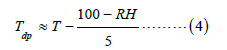
Where t and td are in degrees Celsius and RH is in percent.
Magnus: Equations 5 and 6 shows the relationship between
saturation vapor pressure over water or ice as a function of absolute
temperature [23];

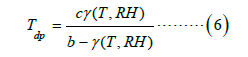
This is known as Magnus formula. α= 6.112 milliard; b= 17.67;
c= 243.5 ˚C
Performance criteria
In order to evaluate the models for the effectiveness of fit, the
fallowing two statistical indicators are used:
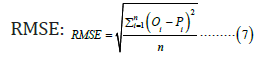


Where n is the total number of data; and i O
and i P
are the observed
and predicted DPT data, respectively.
Taylor diagrams: To understand the behavior of two data sets
graphically in respect to their correlation coefficient, standard deviation
and RMSE Taylor diagrams are used. Taylor diagrams have
primarily been used to evaluate models designed to study climate
and other aspects of Earth’s environment [24]. In such mathematical
diagrams the goodness of data produced by different models
are compared to observations data set. Taylor graph is for a set
of points is dispersed on a polar plot designed to graphically indicate
which of several approximate representations (or models)
of a system, process, or phenomenon is most realistic. In Taylor
representation, the correlation coefficient between the predicted
and observed data is shown by an azimuth angle. Radial distance
from the origin represents the ratio of the normalized standard
deviation (SD) of the simulation to that of the observation.
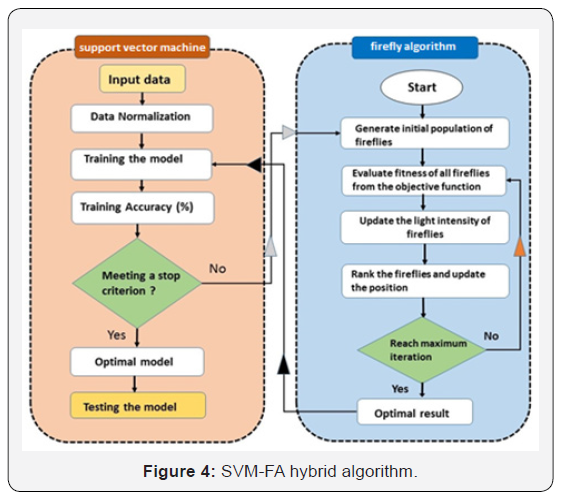
VM-FFA hybrid model: Here, to determine the optimal parameters
for support vector machine a FFA model is used. Figure 4
indicates how the designed strategy (i.e. hybrid SVM-FFA model)
does this in practice. A toolbox has been developed as an interface
to connect SVM script to FFA program in Matlab environment.
Results and Discussion
In this study, for evaluating the models performances two different
combinations of average air temperature and RH were considered
as the models inputs (Table 1).
Results of implementing the SVM model
There are two basic steps for significance of SVM model:
a. The choice of the kernel function.
b. The recognition of the particular parameters of the kernel
function, i.e. ∁ and ε. In this research using radial basis functions
(RBF) and three function. ∁, ε, and γ was done. The RMSE criterion
was used to obtain optimal values of these parameters. The results
indicated that the SVM model with kernel parameters values (γ)
of 54.25 (Isfahan), 75.06 (Mashhad) and 66.82 (Tabriz) performs
successfully. According to Table 3, the SVM model estimates DPT
more or less precisely for three stations.
The SVM-FA model
In the SVM-FA hybrid model, the optimal values of the SVM
parameters were determined using the Firefly Algorithm. Figure
5, shows schematically input and output form in the hybrid model.
The results indicated that the optimal parameters of the SVM
model determined by the FA are equal to 32.04, 48.12 and 36.54
for Isfahan, Mashhad and Tabriz respectively.
Comparison of the models
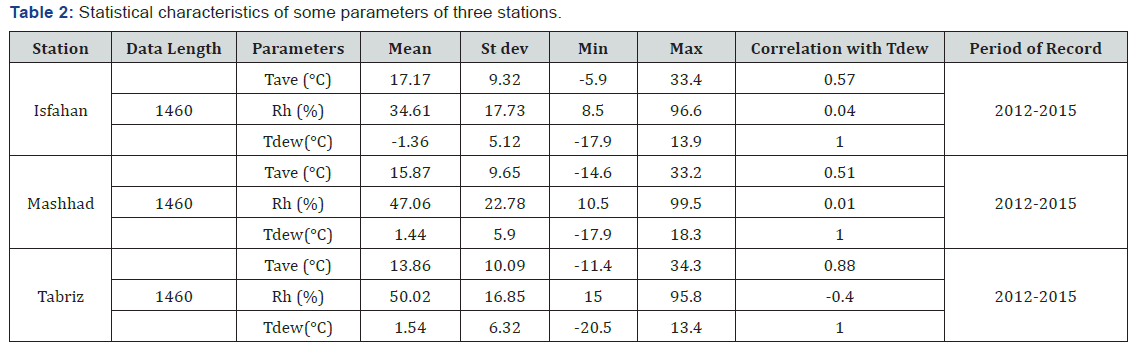
The Table 2 includes the performances of the SVM, Lawrence,
SVM-FA and Magnus models and compares them using the statis tical measures. Accordingly, the performance of all the methods is
acceptable for DPT estimation. However, accuracy of the SVM-FA
model is significantly higher than the SVM, Lawrence and Magnus
models. This proves the high ability of the FA optimization algorithm
in calibrating the SVM model. The SVM technique performs
similarly and there is not significantly difference between their
accuracy of simulating based on values of the statistical measures.
However, the SVM-FA model indicates some more ability than the
SVM, Lawrence and Magnus in DPT estimation. This is because of
higher accuracy according to Table 3.


In Isfahan site, between SVM, SVM-FA, the best smart model
was SVM with test data RMSE of 0.36 ˚C. Besides, with test data
RMSE of 1.38 ˚C, Magnus was the best experimental model, compared
to Lawrence. However, in Mashhad site the best model was
SVM-FA with test data RMSE of 0.55 ˚C and, the best experimental
model was Magnus with test data RMES of 1.64 ˚C. In addition to
that, the best model was SVM-FA with test data RMSE of 0.22 ˚C in
Tabriz site, while the best experimental model was Magnus with
test data RMES of 1.35 ˚C.
Scatter diagram of the points that have been observed and
estimated by the models in Isfahan site is shown in Figure 6. On
the whole, artificial intelligence models have been more successful
than experimental ones. Concurrently, correlation coefficient of
Magnus experimental model is significantly close to SVM artificial
intelligence model. As SVM-FA shows the least error and the highest
correlation coefficient (0.99), hybridization of support vector
machine in Firefly algorithm has been successful. Furthermore,
Lawrence experimental model results in the highest error and the
lowest correlation coefficient (0.54).


The same diagram of observed and estimated points in Mashhad
site is depicted in Figure 7. It can be seen that; SVM-FA model
shows the highest correlation coefficient which is 0.99. Furthermore,
the Lawrence model with correlation coefficient of 0.56
has the lowest correlation coefficient among all utilized models.
Despite the other sites, correlation coefficient of Magnus experimental
model in Mashhad is 0.97. It is higher than smart model of
SVM, which is 0.96. It can be a sign of the compatibility of a, b and
c factors in Magnus equations (Eq.5 and 6) with Mashhad site’s
climate in dew point evaluation.
Moreover, scatter diagram of observed and estimated values
in Tabriz site shows that SVM-FA, SVM, Magnus and Lawrence
have been able to estimate dew point with correlation coefficient
of 0.99, 0.985, 0.98 and 0.82, in respect (Figure 8).

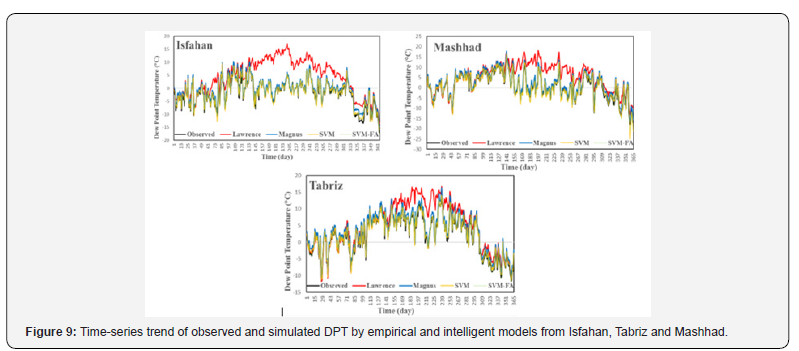
Time-series of dew point estimated values, in comparison
with observed values, shows that, in all 3 sites Lawrence model
has the largest deviation from observed values (Figure 9). However,
deviation from Lawrence model observed mainly during autumn.
According to the equation (9), Lawrence model has direct
correlation with RH and is affected by humidity which suggests
that such deviation in autumn is due to higher RH. This indicates
that Lawrence is not the appropriate model for prediction of DPT
in autumn or any regions with high relative moisture e.g. tropics.
SVM-FA shows the best fitness with observed values. It indicates
a better performance of the SVM-FA model in dew point
evaluation. Magnus and SVM models had adequate performance
so that they show slight deviation from observed values. They had
poor performance in comparison with SVM-FA model, though.
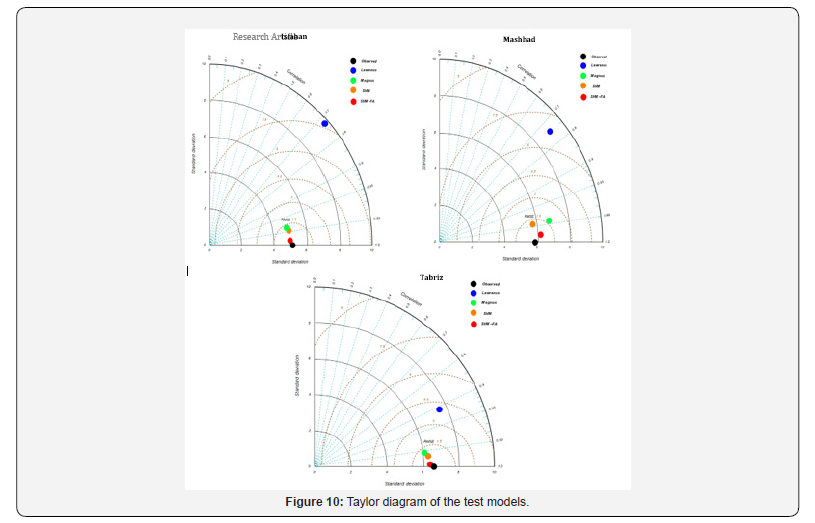
Taylor diagrams were plotted for all three stations (Figure 10).
In this diagram each model that is closer to the observation point
has higher accuracy, and the one that is far from the point of observation
is a weaker model. While for all three stations nearest point
to the reference model is. SVM-FA and the far point is Lawrence.
Thus, SVM-FA is the best model and Lawrence model is the weakest.
The other two models Magnus and SVM are very close to each
other and SVM model is superior to Magnus by a small margin.
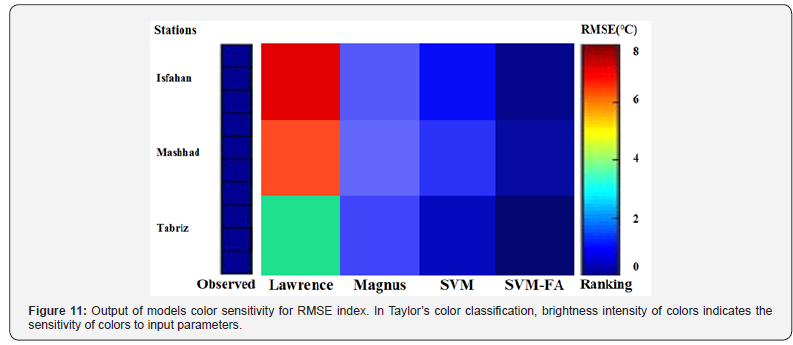
Finally, Taylor diagram was used to show the intensity of output
sensitivity to Mean Squared Error criterion (Figure 11). In
Taylor’s color classification, brightness intensity of colors indicates
the sensitivity of colors to input parameters. In Figure 11,
which is related to the Taylor classification of the test data at three
stations in Isfahan, Mashhad and Tabriz, it is observed that in the
SVM-FA, SVM and Magnus models, the color change rate is horizontally
lower than each other and the colors which are more homogenous
and closer, have more similar results, suggesting that
SVM-FA, SVM and Magnus models have similar results and have
almost the same behavior in DPT modeling. Studying the change
rate of colors vertically for three mentioned models shows that
Isfahan and Tabriz stations have behaved exactly the same; this
fact is related to the climate of these stations indicating that SVMFA,
SVM and Magnus models have exactly the same behavior in
Isfahan and Tabriz stations. The results of Lawrence model show
that this model has different colors than other models which indicate
that the results of this model are very different from other ones. Generally, the results of Lawrence model were weaker than
the other three models. The results of this model were better at
Tabriz than Mashhad and Isfahan stations. The results were much
weaker in Isfahan.
Conclusion
Altogether, in this study, performances of the new hybrid SVMFA
model were evaluated for DPT estimation and compared with
the SVM, Lawrence and Magnus in the three catchments in Iran. In
SVM-FA model, the FA algorithm was used to determine the optimal
parameters of the SVM. As it was expected, the results showed
successful performance of the SVM-FA model compared to the
SVM, Lawrence and Magnus for DPT modeling.
The results showed that in all three stations Lawrence model
accurately predicts little DPT as well as model SVM-FA have three
stations with the highest DPT accuracy of the estimate, RMSE values
respectively related to the testing station in Isfahan, Mashhad
and Tabriz to 0.36, 0.55 and 0.22, respectively. Thus, certainly the
hybrid algorithm (SVM-FA) in all three stations was qualified as
“Best Model”. Overall the relative air humidity, DPT and the average
temperature smart models are more successful than experimental
models. Combining firefly algorithm with vector machine
model has been successful and SVM-FA hybrid model could accurately
estimate the DPT.
Utilizing Firefly optimization algorithm and its combination
with artificial intelligence estimators can improve the accuracy of
the results of modeling. By taking into consideration the importance
of dew point in environmental planning and management,
employing SVM-FA model, which has higher accuracy in dew point
estimation, is suggested as a replacement for experimental models.
Finally, we conclude that;
a. Integration of Firefly algorithm and support-vector machine
is an appropriate tool to estimate dew point, so that Firefly-
hybrid algorithm (SVM-FA) is more successful than vector machine,
and Magnus and Lawrence experimental models.
b. In all 3 sites (Isfahan, Mashhad and Tabriz) SVM-FA is the
superior model and Lawrence is the inferior one.
To know more about Journal of Agriculture Research- https://juniperpublishers.com/artoaj/index.php
To know more about open access journal publishers click on Juniper publishers


Comments
Post a Comment