Evaluating Sorghum Stem Borer Chilo partellus (Swinhoe) Lepidoptera: Crambidae) Management Alternatives in Eastern Ethiopia-Juniper Publishers
Journal of Agriculture Research- Juniper Publishers

The study was conducted to find out best sorghum stem
borer management option for agro-pastoralist in eastern Ethiopia.
Treatments were T1 (no management), T2 (foliar spray of Karate 5 EC at
30 and 60 DAE), T3 (only sorghum intercropping with cowpea), T4 (foliar
spray of Karate 5 EC at 50 DAE + intercropping with cowpea), T5
(Push-pull), T6 (Diazinon 10 G at 50 DAE + intercropping with cowpea)
and T7 (Diazinon 10 G at 30 and 60 DAE). Treatments were arranged in
RCBD design and replicated in three. The result showed that stem borer
infestation significantly decreased in all treatments compared to the
control (T1) at P<0.05. The number of larvae/plants decreased across
treatments 83.8, 81.73, 40.17, 69.21 30.95, 74.26% on T7, T6, T5, T4, T3
and T2. Tunnel length also reduced by 55 and 65% in T7 and T6 also 25
to 39 % in T3 and T5 respectively. The number of non-productive
tillers/plants was decreased by 83.25, 91.75, 66.75 and 58.75% on T7,
T6, T2 and T4 respectively. Foliar damage indices reduced by 74.4,
55.13, 11.21, 70.16, and 61.3 % in T7, T6, T5, T4 and T2 respectively
compared to the control. Grain yield increased by 70.96 and 68.69%
respectively in T7 and T6 were as in T2 and T4 increased by 67 and 59%
respectively compared to the control.
Keywords: Sorghum; Stem borer; Insecticide; Push-pull; Infestation; Grain yield
Introduction
Cereals, especially sorghum is the most important
field crops grown in resource-poor small-scale farmers in Eastern
Ethiopia [1]. The yield and quality of these crops are affected by a
wide array of biotic (pests and diseases) and drought stresses. Of the
various insect pests attacking cereal including sorghum in Africa,
lepidopteran stem borers are by far the most injurious on cultivated
maize and sorghum [2,3]. They are generally considered to be the most
damaging insect pests of maize and sorghum in Africa [4]. Stem borers
can cause severe damage at different growth stages of the crop from
seedling to maturity. When infestation is severe, there is a
physiological disruption of plant growth, and panicle emergence and
grain formation are severely affected, resulting in reduction in kernel
number and mass.
Seventeen species of stem borers in two families
Pyralidae and Noctuidae have been found to attack sorghum and maize in
various parts of the country [2]. Feeding and stem tunneling by borer
larvae on plants results in crop losses as a consequence of the
destruction of the growing point. Yield losses in areas with severe
borer problems vary between 10-70% [2]. Up to 80% yield loss in sorghum
by Chilo partellus were also reported in sorghum growing localities in
eastern Ethiopia [1].
According to studies made on management of cereal
stem borer, manipulation of crop ecosystem can significantly reduce
infestation and increase crop yield [5]. There are also numerous reports
indicating that using different insecticide resulted in good control of
stem borer increased grain yield [5-7].
Currently no easily applicable means for sorghum stem
borer management technique is available in eastern Ethiopia to
recommend to the sorghum farming community [1]. Else were different
sorghum stem borer management techniques have been reported including
intercropping [6], use of insecticide and push-pull reported to be
effective [5,8,9]. Therefore, it is important to evaluate different stem
borer management approaches that had been reported to be effective
elsewhere before recommending to the farming community in the current
study area. Therefore, the study was conducted to find out best
management approaches for stem borer occurring in sorghum in a Fafen
administrative zone of East Ethiopia.
Materials and Methods
Description of study area
A field experiment was conducted in a district
located in the Ethiopian Somali region Fafen administrative namely
Tulugulled were sorghum is grown as the primary crop. This
area is characterized traditional sorghum production area as
mono cropping by Agro pastoralist. The climate of the study
area is a bimodal rainfall pattern and it is characterized by quasi
double maxima with a small peak in April and the main peak
in August. It belongs to the warm semi-arid to cool and humid
agro-climatic zone with the altitude of 1550m.a.s.l. The average
annual temperature ranges from 18-27.5 0C. The average annual
rainfall ranges from 200 to 1400mm. It is bounded between the
geographical coordinates of 912,270–1,058,809.8 UTM north and
877,449.1-975,927.2 UTM East [1].
Treatment and experimental design
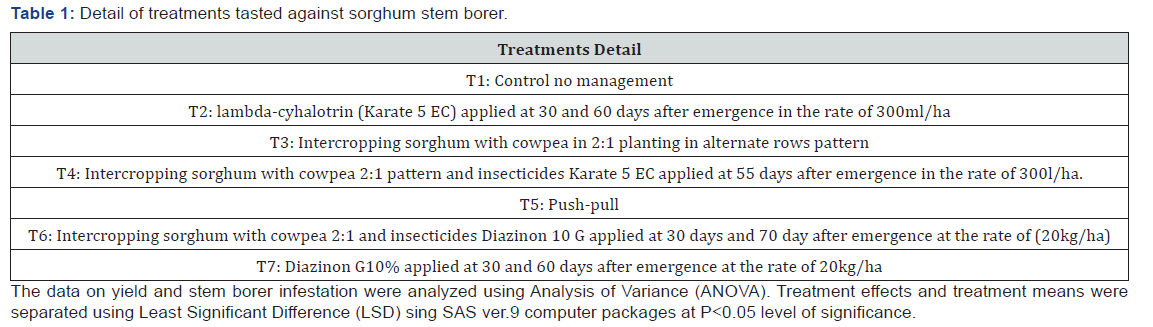
Seven different cereal stem borer management approaches
were evaluated in farmers’ field with a high infestation history of
stem borer. Each seven treatments were replicated in three and
arranged in RCBD. There were 1 and 1.5m between plots and
blocks and each plot had a size of 12m2, sorghum seeds variety
Teshale planted on plots prepared in 30cm x 70cm spacing in 6
rows/plot.
Method of data collection and data analysis
Sampling of stem borer infestation was started at fourth weeks
after emergence and was repeated every two weeks interval until
physiological maturity of the plants. Prior to data collection 10
plants from two central rows were randomly selected and tagged.
All necessary data were collected from pre tagged ten plants.
During the final stage, destructive sampling was made on ten
plants/plot to measure and count tunnel length, number holes/
stalk, percent of plants with dead heart and number of larvae
(Table 1).
Result and Discussion

The result revealed that all the treatments were found
significantly superior over the untreated control in reducing the
infestation of C. partellus. The result from the study indicated that
all insect pest infestation parameters significantly responded
to the treatment at (P<0.05). According to the result in (Table
2) there were significant difference in number of larvae/plant
(NL/P), plant height (PH), tunnel length (TL) and number of nonproductive
tillers/plant (NNPT/P) at (P<0.05). Similarly, percent
of plants with dead heart (PPDH), number of eggs/egg bache
(NE/EB) and number of exit hole/plant (NEH) also significantly
affected by treatments effect.
Effect of treatments against pest population
According to the result in the (Table 2) the highest number of
larvae/plant (NL/P) was recovered from control treatment (T1)
followed by T3 and T5. The lowest NL/P was recorded from those
treatments received insecticide Karate 5 EC and Diazinon 10G with
or without intercropping (T7 and T2). Compared to control and other treatments the NL/P reduced by 83.8% in T7 followed by T2
74.26%. There were also remarkable NL/P reduction on T6 and T4
in these treatments it was reduced by 81.73, 69.21% respectively.
NL/P reduction observed on T5 and T3 were moderate and
found to be 40.17, 30.95% respectively. The decrease in larval
number/each plant in T2, T4, T6 and T7 could be attributed to
the insecticide along with habitat management. Similar result
was reported by Neupane et al. [10] indicted that conventional
insecticide significantly reduced infestation compared to control
stem borer in maize.
The number of egg batch (NEB) and number eggs/egg batch
(NE/EB) over the season showed significant variations at P<0.05
among treatments. Lowest egg batch was recorded on T2 and T7
in these treatments number of egg batches reduced by 79.4 and
78.86% similarly number of eggs/egg batch reduced by 64.33 and
56.2% respectively. The reduction in the NEB and NE/EB could
be due to the deleterious effect of insecticide and pest confusion
due to habitat manipulation resulted from intercropping and
push-pull. The present findings can also be compared with those
of [8,11,12]. When single round insecticide application integrated
with intercropping (T6 and T4) reduced NEB by 35.28 and 49.4%
as well as NE/EB batch 64.37, 50.4% respectively. Push-pull
and intercropping (T5 and T3) resulted in 36.42% reduction in
number of egg batches compared to the control treatment.
Effect treatments against crop damage
According to the result in (Table 2) there were significance
difference at P<0.05 among treatments on foliar damage indices
(FDI), number of exit holes/stem (NEH), number of nonproductive
tillers/plant (NPT/P) and percent of plants with dead
herart (%PDH). Significant reduction in the FDI, NEH, NPT/P and
%PDH was recorded from T6, T7 and T4 and T2. Compared to
the T1 FDI reduced by 74.4 and 70.88% in T7 and T4 flowed by
T6 55.13% and T4 60.33%. There was also moderate reduction
in T5 and T3 the FDI amounted to be 35.08, 30.78% respectively.
Maximum NEH was recorded from T1 and the minimum was
recorded from T7. NEH also moderately reduced in T5 and T3
reduction was found to be 40.11 and 45.55% respectively. Kavita
and Manjunatha [13] reported les number exit holes/plant when
sorghum intercropped with cowpea.
The lowest tunnel length was recorded from insecticide treated
plots T2, T4, T6 and T7 respectively. Tunnel length reduced by
69.5 and 65% in T7, T6 respectively and also 25 to 39 % in T3 and
T5 compared to the control. Conformity with [7], reported lowest
foliar damage and stem tunneling on plots treated with insecticide
compared to control. Average number of non-productive tillers/
plant (NPT/P) were significantly higher in control treatment T1
followed by T3 and T5. The same finding was confirmed by [7]
that successful infestation of stem borers into plants, and their
feeding may cause death of growing points reduction in number
of harvestable ears.
Insecticide received treatment (T2, T4, T6 and T7) produced
less NPT/P. The result in the (Table 2) showed that higher proportion
of plants with dead heart was recorded from T1, followed by T3
and T5. All treatments received insecticides had resulted in low
%PDH. Similar result was reported by [11] indicting insecticides
showed better control of maize stem borer and reduction of
dead heart in maize stem borer. Accordingly, treatments received
Diazinon 10 G (T6 and T7) resulted in significantly low %PDH
13.47 and 14.22%. Similarly, Karate 5 EC treated plots (T2 and T4)
showed reduction 19.78 and 17.26% respectively compared to the
control but it was not effective as Dizinone 10 G. this could be due
to the fact that foliar insecticide are not effective as the granular
insecticide [6,7]. The result may also corroborate with Manzooret
et al. [14] whom indicated that compared to the check, insecticide
treated plots showed reduce infestation and crop damage. In this
study manipulating crop environment using intercropping and
push-pull showed remarkable reduction on infestation though
the result is not comparable with insecticides treatment. Current
finding is in agreement with Degri et al. [5] whom reported that
intercropping pattern of 1:2 ratio and 1:1 ratio had significantly
lowered number of infested plants than the sole crop (1:0 ratio).
methods on grain yield

The result in (Figure 1) revealed that there were significant
differences on total grain yield and 100 seed weight at P<0.05.
Accordingly compared to all treatment, those plots treated
with insecticide (T2, T6 and T7) had relatively higher 100 seed
weight. The lowest seed weight was recorded from T1 were as
the highest was recorded from T7 followed by T6. Compared to
control treatment, T7 and T6 increased 100 seed weight by 67.0,
62.0% respectively. Similarly, T2 and T4 resulted in 58.74 and 55.1
% seed weight increment. Both sorghum intercropping (T3) and
push pull (T5) increased 100 seed weight by 35.71% on average.
Hegde et al. [13] found that maximum grain and fodder yield when
maize intercropped with cowpea compared to sole crop on maize
infested with stem borer.
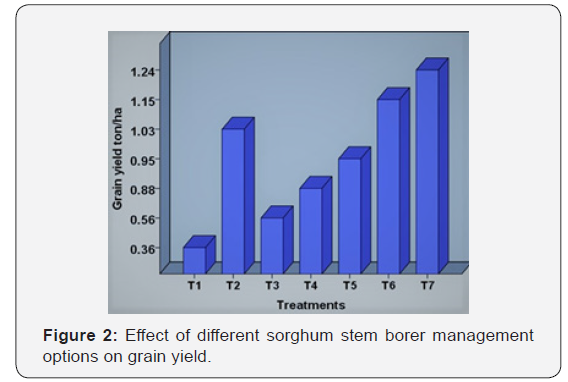
Maximum grain yield was obtained when sorghum treated
with insecticide (T7, T6 and T2) and followed by the T5 and T3
(Figure 2). Compared to insecticide treatment (T2, T4, T6 and
T7) push-pull (T5) and intercropping (T3) showed reduced grain yield. According to the result in there was no statistically
significance differences were observed between intercropping
and push pull treatments. Total grain yield increased by 70.96 and
68.69% respectively in T7 and T6 compared to the control. Were
as Karate 5 EC application twice (T2) and intercropping + Karate
5 EC once foliar spray (T4) increased grain yield by 67 and 59%
respectively compared to control (T1). Effectiveness of insecticide
treatment against stem borer reported on maize and sorghum in
several areas. According Adamu et al. [7] insecticide treated maize
plants recorded the highest grain weigh. Compared to control T1
sorghum intercropping with cowpea T3 and push pull (T5) also
resulted in grain yield increment amounted to be 35.17% for both
treatments on average.
A number of study report indicated that intercropping
cereal and legume can reduce the pest infestation and increase
grain yield. Ayisi et al. [15] reported that intercropping reduced
C. partelus infestation and increased grain yield in mixed and
alternate intercropping systems, relative to the sole cultures.
Similarly, Ampong et al. [16] indicted that when sorghum planted
in intercropping manner with cowpea resulted in reduced stem
borer infestations and increased grain yield compared to the sole
sorghum.
Conclusion
Among all tested treatments against stem borer insecticide
application found to supper effective in reducing infestations
and increasing grain yield. Moreover, the finding also revealed
that by integrating reduced insecticide application frequency
+ intercropping produced comparable result with repeated
insecticide use. Accordingly, the result obtained from push-pull
treatment showed appropriate grain yield increment. Though
grain yield obtained from insecticide treated plots had wide yield
gap it may not be reasonable to relay on insecticide completely.
Therefore, we recommend push-pull approaches for sustainable
stem borer management by putting insecticide + intercropping
option on the table as alternative strategy.
To know more about Journal of Agriculture Research- https://juniperpublishers.com/artoaj/index.php
To know more about open access journal publishers click on Juniper publishers


Comments
Post a Comment