Biomass Yield and Nutritional Quality of Different Oat Varieties (Avena sativa) Grown Under Irrigation Condition in Sodo Zuriya District, Wolaita Zone, Ethiopia-Juniper Publishers
Journal of Agriculture Research- Juniper Publishers

The objective of this study was to evaluate the
performance of five forage oat varieties (CI- 8237, Lampton, CI- 8235,
CV-SRCP X 80Ab 2291 and CV-SRCP X 80Ab 2806) under irrigation condition
in Wolaita Zone, Sodo Zuriya Worda, at Kokate Farmers association,
during off season in the year 2017. The experiment was laid out in a
randomized complete block design with three replications. Data were
collected at 50% flowering stage. The major data recorded were date of
emergence, plant height, number of leaves per tiller, number of leaves
per plant, number of tillers per plant, fodder yield and chemical
composition at 50% flowering stage respectively and grain and straw
yield at maturity stage. The varieties differed in yield and yield
related parameters. The varieties showed variations in terms of number
of leaves per tiller, number of tillers per plant, number of leaves per
plant, fodder and dry matter yield at 50% flowering stage and straw
yield. Variety CV-SRCP X 80Ab 2291 produced lower (p < 0.05) number
of leaves per plant, number of leaves per tiller and plant height than
the rest of the varieties. However, CV-SRCP X 80Ab 2291 produced
significantly higher (p < 0.05) amount of green forage (42.4t ha-1)
and dry matter (12.2t ha-1) yield at 50% flowering stage. All tested oat
varieties had similar grain and straw yield. CV-SRCP X 80Ab 2806 had
lower NDF (41.6%), ADF (22.1%) and ADL (1.98g per kg) concentrations and
the highest CP (15.3%) and IVDMD (73.9%) content. Therefore, it is
concluded that, CV-SRCP X 80Ab 2806 and CV-SRCP X 80Ab 2291 were
recommended to use in the upper parts of midland and highland areas due
to reasonably higher nutritional (CP) value and better forage yield,
respectively.
Keywords: Biomass yield; Chemical composition; Lampton; Yield parameters
Abbreviations:
DM: Dry Matter; CP: Crude Protein; EE: Ether Extract; ADL: Acid
Detergent Lignin; ADF: Acid Detergent Fiber; NDF: Neutral Detergent
Fiber; IVDMD: In Vitro Dry Matter Digestibility
Introduction
In Ethiopia, the livestock sub-sector has significant
contribution to the national income [1] and for the livelihoods of
rural and urban communities. However, productivity of animals remained
at low level due to feed shortage and nutritionally unbalanced supply of
feeds [2]. A large proportion of livestock feed resources in Ethiopia
comes from natural pastures, crop residues and aftermath grazing [3,4],
but such feed resources cannot promote increased animal productivity due
to their nutritional limitations (such as low crude protein, mineral,
vitamins and higher fiber content), lower intake and digestibility [5].
The major problems with livestock feeding occur in developing countries
like Ethiopia, particularly during the long dry season, when there is
insufficient
plant biomass carried over from the wet season to support domestic
livestock species [6].
According to Mulualem and Molla [7] when improved
forages are integrated and developed at household level in a sustainable
manner, animal productivity would be increased. Currently, there has
been a rapid governmental dedication which has been implemented through
changing livestock improvement strategies to bring a paradigm shift in
livestock industry. The strategy promotes enhancing livestock
productivity through improving availability and quality of feed
resources [1].
Different strategies can be employed to boost feed
availability and improve nutritional deficiencies of local feed
resources. One of such strategies that receiving attention and has been
considered as best options is use of improved forage species for animal
feeding [1]. However, the adoption rate of improved forages introduced
to farmers level in Ethiopia is usually low and unsatisfactory
due to forage seed and land shortage in crop-livestock
mixed agriculture [8], reluctance of some smallholder farmers in
forage production [1], technical problems such as managing the
seedlings, insect damage and poor extension services. Information
is also limited on agronomic practices, biomass production, and
nutritive value of various improved forage varieties, including oat
crop at the farmer’s level. CSA [9] report indicated that the
contribution
of improved forage to livestock feed source is about 0.22%.
Effort in extension and research work and strengthening producers’
capacity through continuous training on cultivated fodder
crops and improved grass species such as oats are not common
and well adopted even in highland areas where feed shortage is a
crucial problem [8].
Oats (Avena sativa L.) is one of the well-adapted and important
fodder crops grown in the highlands of Ethiopia, mainly under
rain fed conditions. It is also one of the important fodder crops
widely grown during the winter season when livestock face green
fodder shortage and majority of the feed start declining and finally
drying [10]. It is also ranked as sixth in world’s cereal production
following wheat, maize, rice, barley and sorghum. However, it has
been tested under irrigation conditions because rainfall is not reliable
most of the years.
Improved varieties of oat can produce a three-fold green fodder
60 to 80t ha-1. This amount can feed double number of animals
per unit area compared with the traditional fodder production
practices [11]. Straw of oat is soft and its grains are also valuable
feeds for dairy cows, horses, young breeding animals and poultry.
It can be fed in many forms like green forage or silage to animals.
Oat grains have high content of proteins, which is relatively better
in quality, compared to other cereals. The contents of Mg, Fe, P, Ca,
and vitamins E and B1 are also higher in oats compared with other
cereals [12].
Wolaita Zone in general and Sodo Zuriya specifically is known
with high human population and small and fragmented land size,
thus there is high feed shortage, which has resulted in decreased
livestock production and productivity. Cultivation of improved forages
like oats is important mainly in highlands and in areas where
market-oriented livestock production is practiced supporting the
livestock sector through improved production of high amount of
feed from small area of land. Furthermore, there is no adequate information
on comparative productivity and performance of different
oat varieties under Wolaita situation. Therefore, the objective
of this study was to evaluate Agronomic performances, yield and
Nutritional Quality (chemical composition) of five oat varieties
under irrigation condition in the highlands of Sodo Zuriya Woreda,
Wolaita Zone, Ethiopia.
Materials and Methods
Description of study area
The experiment was conducted in Wolaita Zone, Kokate Farmers
administrations, Ethiopia. The site is situated at a latitude and
longitude of 39º 36’ S and 61º 64’ W, respectively, with an altitude
of 1916m.a.s.l. The agro-ecology of the district is 5% Dega and
95% Woyna Dega. The mean annual temperature ranges between
18 ºC - 28 ºC. The annual rainfall ranges between 1200-1300mm.
Rainfall occurs in two distinct rainy seasons, ‘Kiremt’ (heavy rainy
season) occurs in summer (June, July and August) and ‘Belg’ rain
(light rainy season) occurs in spring (from mid - January to mid
- May). The major soil type of the area is sandy - loam with pH value
of 6.70. The organic matter percentage (1.52%), total nitrogen
content (0.22%) and available phosphorus content (6.33) ppm
were also reported.
Treatments and experimental design
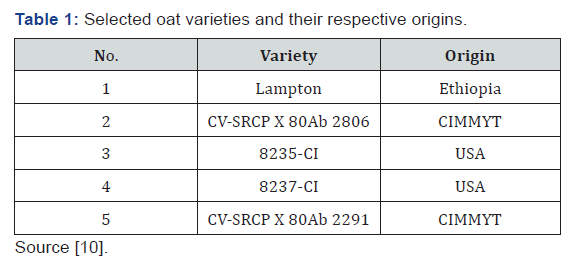
The experiment consisted of five treatments of oat varieties
namely Lampton, CV-SRCP X 80Ab 2806 (called Acc 2806), 8235-
CI, 8237-CI and CV-SRCP X 80Ab 2291 (called Acc 2291) (Table 1).
The varieties were selected due to the adaptability and availability
of seeds in the area. The experiments were laid out in randomized
complete block design (RCBD) with three replications on well
prepared seedbed. The plot size was 2m x 3m. The blocks were
separated by a space of 1m and plots were spaced 0.50m apart.
Each plot had 10 rows spaced 20cm apart and data were collected
by 0.25m2 quadrant. The seed rate used was 100kg ha-1 and drill
method of sowing was used. NPS fertilizer was applied at sowing
time at a rate of 100kg ha-1, respectively [13,14].
Land preparation, management and irrigation practice
The varieties were sown on 28th of December 2016 at the beginning
of the light rainy season. Land was ploughed three times
before the start of the field experiment. The seed was obtained
from Agricultural Research Center and checked for weed seeds
and other dead irregular shapes to increase the germination
percentage. Then the plots were uniformly fertilized with NPS at
a rate of 100kg ha-1 (60g of NPS per plot) at the time of sowing
[15,16]. Weeding was conducted three times from sowing up to
maturity stage. The experimental plots were uniformly irrigated
starting from sowing date up to maturity. Two times a day; morning
at 12:00 - 1:30hrs and afternoon 11:00 - 12:30hrs were applied
up to emergence. After emergence, application of water decreased
and applied every two days.
Antifungal resistance
Physiological and agronomic data
a. Growth: The developmental process such as days to emergence,
days to 50% flowering and maturity stage were recorded.
b. Plant height (cm): The average plant height was measured
from ground to the tip of the main stem. The measurement
was done by taking ten random plants at 50% flowering stage
from each plot [17].
c. Number: Counts of plant number, number of leaves per tiller,
number of tillers per plant and number of leaves per plant
were recorded at 50% flowering stage. Ten plants from each
plot in a quadrant (0.25m2) were taken to measure number
of tillers per plant, number of leaves per plant and number
of leaves per tiller. Average results from each measurement
were recorded to evaluate the performance [18].
d. Biomass yield: The vegetation from each plot was sampled
using a quadrant of 0.25m2 (0.5m x 0.5m) sizes during a
predetermined sampling period (50% flowering stage). The
quadrant was randomly thrown on a plot and the average
weight of ten plants from the quadrant was used to determine
the biomass yield. The average weight of the fresh fodder was
used and extrapolated into dry matter yield per hectare (t
ha-1). Three adjacent rows from the center of each plot were
taken at 50% flowering stage for fodder yield evaluation [19].
The fresh harvested biomass was chopped into small pieces
using sickle and a sub-sample of 400 g was taken and partially
dried in an oven at 60 ˚C for 48hrs for further dry matter
analysis [18].

Where:
10 = Constant for conversion of yields in kg/m2 to t/ha
TFW = Total fresh weight from harvesting area (kg)
SSDW = Sub-sample dry weight (g)
HA = Harvest area (m2)
SSFW = Sub-sample fresh weight (g)
e. Grain and straw yield: Grain and straw yield were determined
at full maturity (100% seed maturity) stage. Plants in a
quadrant (0.25m2) size were taken as a whole tied, dried and
straws and grains collected separately. Then grain and straw
obtained from each quadrant were measured and converted
to tones per hectare [20].

Where:
Z = Yield obtained from sampling area (kg/m2)
Y= Area of sampling site in m2
Chemical composition and in vitro dry matter digestibility:
The collected and partially dried oat varieties green forage
(50% flowering stage) was transported to Hawassa College of Agriculture
Animal Nutrition Laboratory for chemical analysis. The
samples were dried to a constant dry weight in an oven at 100 ± 5
˚C overnight to determine percent dry weight before any analytical
procedures [21]. Then the dried samples were ground to 1mm
mesh size using Willy mill, packed into paper bags and stored
pending to further laboratory works. Chemical composition (Dry
matter (DM), Crude protein (CP), Ash, Ether Extract (EE), Acid detergent
lignin (ADL), Acid detergent fiber (ADF), neutral detergent
fiber (NDF) and in vitro dry matter digestibility (IVDMD)) of the
forage samples were analyzed. Nitrogen content was determined
using Kjeldhal method [21] and then CP content was calculated
as N x 5.7 for grain yield. The ash content of the samples was determined
by complete burning in a muffle furnace at 550 ˚C for 3
hours [21]. The NDF, ADF and ADL were determined according to
procedures of Van Soest and Robertson [22].
IVDMD of oat was estimated using a Daisy II Incubator on a
dry matter basis. Sample of 0.5g from each replication were taken
and dried at 39 ˚C for 48 hours. The dried and ground samples of
oat were placed in ANKOM tubes filter bags (F57) made from polyester/
polyethylene/extruded filaments. Weigh each F57 filter bag
and record weight (W1). Zero the balance and weigh sample (W2)
directly into filter bag. Heat seal bag closed and place in the Daisy
II Incubator digestion jar (ANKOM Technology Method 3, ANKOM
Technology -08/05).
Statistical analysis
Generated data were analyzed using the General Linear Model
procedure of statistical analysis system [23]. Means were separated
using Least Significant Difference (LSD) at 5% significance
level.
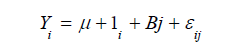
Where Yi = The response variable (i. is agronomic parameters,
yield and chemical composition)
μ = Overall mean
li = The ith effect of variety (i= 1, 2, 3,4,5)
li = The ith effect of variety (i= 1, 2, 3,4,5)
εij= Random error
Results and Discussion
Physiological and agronomic data
Days to emergence, 50% flowering and maturity stages:
The
emergence date was relatively similar for all treatments and it
took around 14- 21 days in all plots. Relatively prolonged days to
emergence in this study was most likely due to sowing season, high
temperature and lack of enough moisture. Average emergences of
the varieties were 60% at first week and above 95% at second
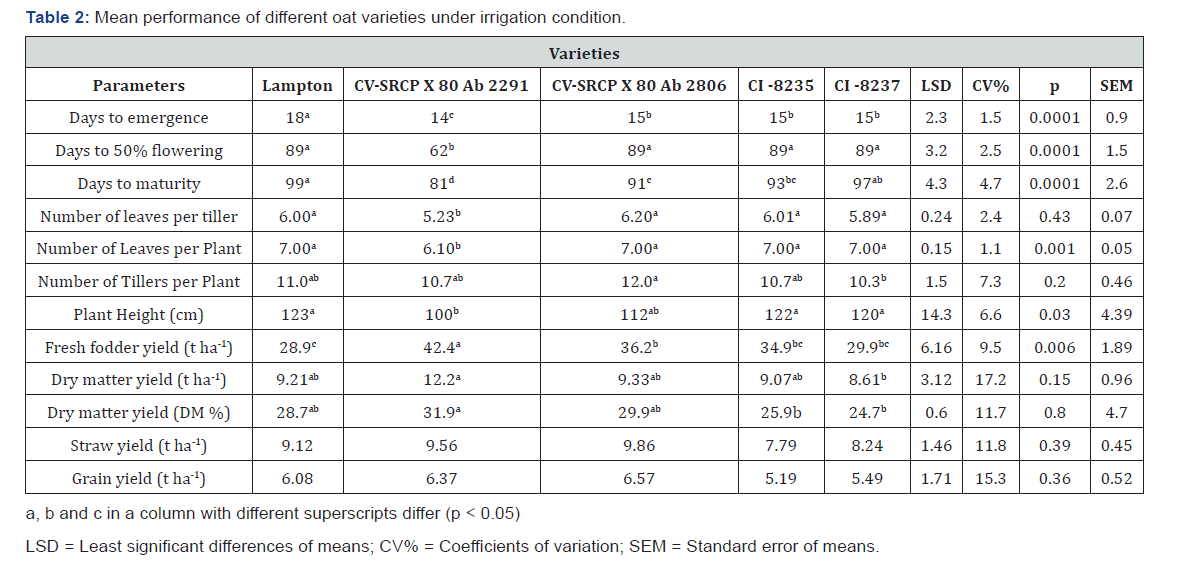
week. Only one variety (CV-SRCP X 80Ab 2291) (p < 0.05) reached
50% flowering stage at 62 days than the rest varsities (89 days
after sawing). CV-SRCP X 80Ab 2291 variety reached to full maturity
early (81 days) as compared to other oat varieties (91 - 99
days) (Table 2). The grain filling period in the present experiment
ranged from 81 to 99 days however, the same varieties in previous
study [16] reached between 64-80 days, which was shorter than
current studied varieties due to differences in sowing season and lack
of moisture content in the area. Hellewell et al. [24], attested
that the major difference in maturity among oat cultivars related
to differences in the length of the vegetative growth stage, not the
grain filling period and thus the fast growth of early maturing
cultivars
is explained in terms of a shortened vegetative growth stage
rather than a shortened grain filling period. Late maturing varieties
tended to have comparatively shorter grain filling period than
early maturing varieties as reported by Feyissa [16].
Number of leaves per tiller: Number of leaves per tiller at
50% flowering stage is shown in Table 2. Variety CV-SRCP X 80Ab
2291 had statistically lower number of leaves per tiller (p < 0.05)
than CV-SRCP X 80Ab 2806, CI-8237, CI-8235 and Lampton at
50% flowering stage. This might be due to the early maturity of
CV-SRCP X 80Ab 2291 as compared to the rest varieties, the earlier
to reach maturity the lower the number of leaves per plant as well.
According to Gebremedhn et al. [17], the number of leaves per tiller
varied from 6.89 to 4.89 at 50% flowering stage where as in
current study it varied from 6-5 which were agreed. Oat varieties,
Sargodha-2011 and PD2LV65 produced 6.62 and 5.37 number of
leaves [20] per tiller at 50% flowering stage respectively which
were comparable with the current findings.
Number of leaves per plant: The number of leaves play vital
role in growth and development of plant. The increase or decrease
in number of leaves per plant has a direct effect on the yield
of forage crops. Significant (p < 0.05) variation in the number of
leaves per plant was observed at 50% flowering stage (Table 2).
The number of leaves per plant at 50% flowering stage were higher
for the varieties CV-SRCP X 80Ab 2806, Lampton, CI-8235 and
CI-8237, and statistically lower number was recorded for the variety
SRCP X 80Ab 2291 (6.10). Varieties that produced maximum
number of leaves per plant differed by 15% from the variety (CVSRCP
X 80 Ab 2291) that produced minimum number of leaves
per plant. According to Khan et al. [18], the oat varieties; SGD-40,
SGD-2011 and SGD-37 produced 7.50, 7.13 and 6.99 numbers of
leaves per plant at 50% flowering stage, respectively, which were
comparable with the current findings.
Number of tillers per plant: At 50% flowering stage CV-SRCP
X 80Ab 2806 produced the highest number of tillers per plant
(12.0) followed by Lampton (11.0), CI-8235 (10.7) and CV-SRCP
X 80Ab 2291 (10.7) and the lowest was recorded for the variety
CI-8237 (10.3) (Table 2). CV-SRCP X 80Ab 2806 variety produced
16.5% more tillers per plant than variety CI-8237 that produced
minimum (10.3) number of tiller per plant. In previous study [17],
Lampton showed highest number of tillers per plant (14.2) followed
by 8237-CI (13.30 tillers per plant) at 50% flowering stage
which were higher than the current observations. These results
are in line with the finding [17,25] who reported that variation in
environmental conditions and genetic makeup cause the variation
in plant height and number of tiller per plant. However, currently
studied varieties showed better performance than 80-SA-130 variety
which produced 9.25 tillers per plant at 50% flowering stage
[17]. Varieties F-411 and DN-8 were found to have similar tillering
capacity (12 and 11 tillers per plant) respectively [26], which are
agreed with the current observations. However, varieties, SGD-3,
SGD-50, F-408 and F-301 produced 6.67, 6.33, 7.00 and 7.03 number
of tiller per plant at 50% flowering stage, respectively, which
were lower than the current varieties [18].
Plant height (cm): Plant height is one of the yield components
contributes to green fodder and dry matter yield [27]. Plant
height at 50% flowering stage are shown in Table 2. CV-SRCP X
80Ab 2291 had significantly (p < 0.05) shorter height than the
rest varieties at 50% flowering stage. Lampton produced maximum
height (123cm) at 50% flowering stage. In previous studies
[17], Lampton produced the maximum height (178cm) followed by 8237-CI (170cm). The shorter height in the current observation
might be due to difference in environmental condition and
the sowing season [28]. However, varieties PD2LV65 (124cm),
No.725 (118cm) [29] and SGD-46 (119cm) [18] produced similar
result with the present observations at 50% flowering stage. Other
varieties such as UPO 2005-1 (135cm), JO 2003 -78 (126cm),
OS -6 (126cm), Kent (125cm), JHO-822 (123cm) and SGD Oat-
2011(130cm) showed more or less similar results with the current
observations [26,30].
Green forage and dry matter yield
The green forage yield is one of the most important traits and
the ultimate goal of forage production is to obtain a high biomass
with a reasonable quality. The green forage yield (t ha-1) of the varieties
were statistically significant (p < 0.05) to each other at 50%
flowering stage (Table 2). Variety CV-SRCP X 80Ab 2291 produced
the highest (p < 0.05) green forage yield (42.7t ha-1) followed by
CV-SRCP X 80 Ab 2806 (36.2t ha-1) and the lowest was recorded for
Lampton (28.9t ha-1). Variety that produced higher green forage
yield (CV-SRCP X 80 Ab 2291) was 31.8% higher than lower green
forage yield (Lampton) variety. The highest green forage yield of
variety CV-SRCP X 80 Ab 2291 might be due to the thick size of the
steam than the other tested oat varieties. In previous studies the
maximum (47.6t ha-1) and minimum green forage yield 33.3t ha-1
were obtained from the oat varieties No.725 and CK1, respectively
[29] which were in agreement with the current finding. Relatively
higher amount (67.2t ha-1) of Lampton green forage yield
than the current observation was reported by Gebremedhn et al.
[17] at 50% flowering stage. Similarly, Saleem et al. [20] recorded
maximum green forage yield from Sargodha-2011 (72.7t ha-1) and
lowest green fodder yield from Varity PD2LV65 (62.4t ha-1). The
lowest fodder yield observed as compared to previous findings
might be due to environmental influence such as sowing month
variation and high temperature during practical field work in the
area. But, current study was in agreement with Muhammad et al.
[31] which produced PD2LV65 (41.0t ha-1) and F-411 (45.9t ha-1)
green forage yields.
Similarly, the maximum dry matter yield was produced by the
variety CV-SRCP X 80Ab 2291 (12.2t ha-1) (P < 0.05) than CI-8237
(8.61t ha-1) at 50% flowering stage (Table 2). According to Khan
et al. [18], the dry matter yield of SGD-3 (9.73t ha-1) were agreed
with current CI-8237, CI-8235, Lampton and CV-SRCP X 80Ab
2806 varieties. Varieties Avoni, Ravi, CK-1, F-311 and F-411 also
produced 10.5, 10.1, 10.9, 11.1 and 9.1t ha-1 [31] which were similar
with the present observations.
Grain and straw yield
Grain and straw yield of oat varieties were presented in Table
2. The grain and straw yield among oat varieties were not statistically
different (P > 0.05). However, numerically the highest grain
and straw yield was recorded for the variety CV-SRCP X 80Ab 2806
(6.57t ha-1 and 9.86t ha-1), respectively which relatively produce
26.6% and 17.5% more grain and straw yield than the lowest
grain and straw producing variety CI-8235 (5.19t ha-1 grain and
7.79t ha-1 straw). According to Feyissa et al. [16], Coker SR res 80
SA 130 gave exceptionally higher grain yield (10.6t ha-1) than CVSRCP
X 80 Ab 2291 (8.64t ha-1) and CV-SRCP X 80 Ab 2806 (8.60t
ha-1) varieties which were higher than the current observation.
The variation might be due to sowing season, where the current
experiment was conducted on the dry season in irrigation bases
while the previous once was in the main rainy season. The varieties
Lampton, CI-8235 and CI-8237 that were produced 6.52, 6.68
and 6.84t ha-1 grain yield in previous studies [16] was in agreement
with the current study. Whereas, according to Siloriya et al.
[30] varieties NDO-1 and Kent produced 3.64t ha-1 and 3.52t ha-1,
respectively, which were lower than the current grain yield.
According to Feyissa et al. [16], relatively higher straw yield
than the current finding were observed by CI-8235, CV- SRCP X 80
Ab 2806, CI-8237, Lampton and CV- SRCP X 80 Ab 2291 varieties
which were 14.1t ha-1, 14.1t ha-1, 12.7t ha-1, 12.7t ha-1 and 13.1t
ha-1 respectively. Variety OS-6 (10.6t ha-1) followed by JO 2003 -78
(10.2t ha-1) also produced higher straw yields [30]. The variations
in grain and straw yield might be due to differences in planting
seasons, plant height and number of tillers per plant. Whereas,
varieties 79 Ab 382 (TX) (80 SA 94), SRCP X 80 Ab 2764 and PI-
338517 produced 9.95t ha-1, 9.90t ha-1 and 9.86t ha-1 straw yield
[16] were in agreement with current observations. According to
Nazakat et al. [32], varieties PD2LV65, Swan, Tibour and Scott
produced 2.44, 2.40, 1.11 and 0.81t ha-1 grain yields respectively,
which were lower than the current finding.
Chemical Composition and in vitro dry matter digestibility
Table 3 indicates chemical composition of five oat varieties.
The highest mean (P < 0.05) DM percentage were obtained in CI-
8235 (93.3%), CI-8237 (93.2%), Lampton (93.1%) and CV-SRCP
X 80Ab 2291 (92.8%) and the lowest was recorded for CV-SRCP X
80 Ab 2806 (91.5%). Variety CV-SRCP X 80 Ab 2291 possessed the
highest ash contents (p < 0.05) as compared to the rest tested varieties.
Variation in concentration of minerals might be affected by
factors like varieties Gezahegn et al. [33], growth stage, morphological
fractions, climatic conditions, soil characteristics, seasonal
conditions McDonald et al. [34] and fertilization regime.
Crude protein (CP) content is one of the very important criteria
in forage quality evaluation Khan et al. [18]. The mean CP content
ranged from 11.78% to 15.3% (Table 3). Variety CV-SRCP X 80
Ab 2806 showed better CP (15.3%) content followed by Lampton
(13.3%) than CV-SRCP X 80 Ab 2291, CI-8237 and CI-8237 varieties.
According to Saleem et al. [20] maximum CP was recorded in
variety Sargodha-2011 (10.38%) followed by Avon (9.09%) which
were lower than CV-SRCP X 80 Ab 2806 in the current study. Relatively
lower CP content was also reported in previous studies for
the varieties Scott (9.86%), Avon (7.80%) and Ravi (6.7%), Muhammad
et al. [31].
Neutral detergent fiber (NDF) content varied between
41.6
and 51.4% (Table 3). The result showed that the NDF content
were significantly affected by varietal difference. The highest and
lowest NDF contents were recorded for CV-8235 (51.4%) and CVSRCP
X 80 Ab 2806 (41.6%), respectively. Geleti [35] indicated
that the NDF contents above the critical value of 60% results in
decreased
voluntary feed intake, feed conversion efficiency and longer
rumination time. According to Van soest Robertson [22] the
critical level of NDF which limits intake was reported to be 55%.
However, the NDF content of all the treatments were observed to
be below this threshold level which indicates no effect on digestibility
and intake.
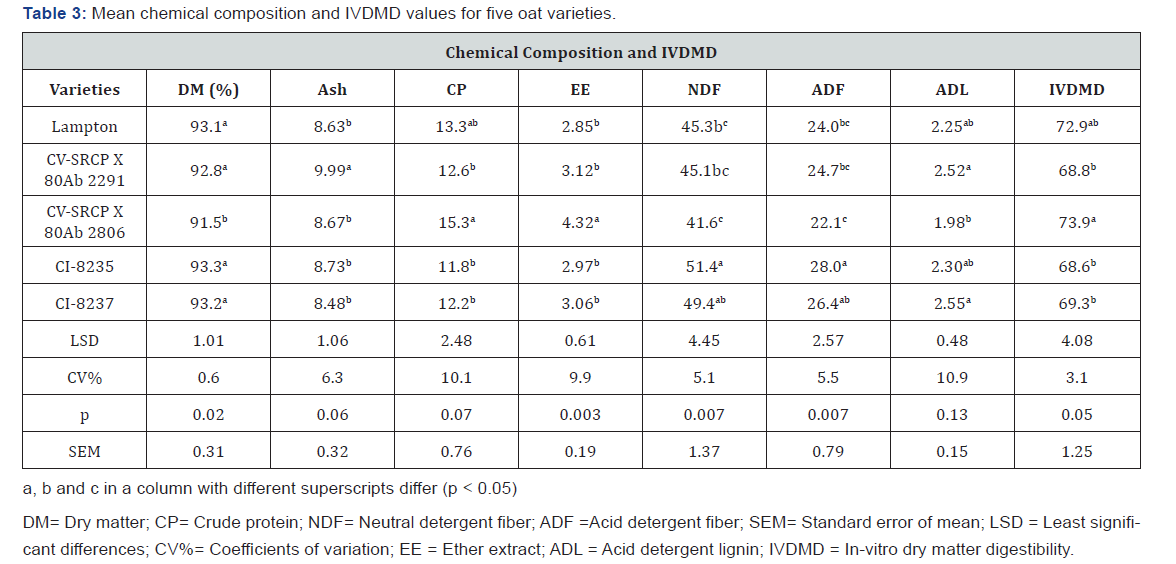
Acid detergent lignin (ADL) content ranged from 1.98 to 2.55g
per kg DM. The mean ADL content of CV-SRCP X 80 Ab 2806 was
significantly (P < 0.05) lower (1.98g per kg DM) than CI-8237
(2.55g per kg DM) and CV-SRCP X 80 Ab 2291 (2.52g per kg DM)
varieties. The higher the ADL content, the lower will be the digestibility
of the feed.
Acid detergent fiber (ADF) is the percentage of indigestible
and slowly digestible material in a feed or forage [34]. This fraction
includes cellulose, lignin and pectin. Acid detergent fiber
has a positive relationship with the ages of the plant [36]. In the
present study ADF content of CV-SRCP X 80 Ab 2806 was lower
(22.1%) and the highest was observed in CI-8235 (28.0%) and CI-
8237 (26.39%) varieties. The lower ADF content indicates that it
is more digestible and more desirable, which agrees with previous
report of Negash et al. [37] that observed 23.7% of CV-SRCP X 80
Ab 2806 variety. Digestibility decreased as age advanced and this
could be linked to the increased fiber concentration in plant tissue
and increased lignifications during plant development [38]. Kellems
and Church [39] characterized roughages with less than 40%
ADF as high quality and above 40% as low quality. Hence, current
varieties were comparatively lower value of ADF values, this could
be indicative of its better digestibility.
The in vitro dry matter digestibility values (IVDMD) had greater
than 65% indicated good nutritive value, and values below this
level result in reduced intake due to lowered digestibility [40].
Hence, the IVDMD values of studied oat varieties were higher than
65% value. Variety CV-SRCP X 80Ab 2806 (73.85%) produced
maximum IVTDMD and CI-8235 (68.55%) relatively minimum
IVDMD yield.
Conclusion and Recommendation
High human population and the associated land shortage and
feed scarcity both in quality and quantity is one of the challenges
for livestock production in Wolaita Zone. Cultivation of improved
forages with high biomass yield with reasonable quality that can
reach to maturity within a short period of time is essential. The
findings of the present study indicated that the studied varieties
had significantly different (p<0.05) number of leaves per plant,
number of leaves per tiller, number of tiller per plant, green and
dry matter yield at 50% flowering stage. CV-SRCP X 80 Ab 2291
variety had yield variations in number of leaves per tiller and
number of leaves per plant from the rest varieties at 50% flowering
stage. Grain and straw yield of all varieties had similar results;
however, variety CV-SRCP X 80 Ab 2806 produced 26.6 % and
17.5% more grain and straw yield than CI-8235 variety.
Planting of CV-SRCP X 80 Ab 2806 variety followed by
CV-SRCP
X 80 Ab 2291 produced higher grain and straw yield than other
varieties. Higher CP, IVDMD, lower fiber and ADL contents were
also recorded for the variety CV-SRCP X 80 Ab 2806. On the other
hand, variety CV-SRCP X 80 Ab 2291 was early emerging, reach
early to 50% flowering stage, early maturing ability and also
significantly
higher fresh biomass yield than the rest varieties. This
Early maturing ability and higher fresh biomass yield at short
period of time increase livestock production and productivity by proving
enough amount of feed for livestock. Therefore, it is recommended
that farmers in high land areas of Sodo Zuriya Woreda
and other areas having similar agro-ecology and soil type could
use CV-SRCP X 80Ab 2806 for higher crude protein, IVDMD, EE and
for lower ADL, NDF and ADL contents. However, CV-SRCP X 80Ab
2291 variety was better for early maturity, fresh forage and dry
matter yield (t ha-1).
To know more about Journal of Agriculture Research- https://juniperpublishers.com/artoaj/index.php
To know more about open access journal publishers click on Juniper publishers


Comments
Post a Comment