Evaluation of Potential Very Early Rice Genotypes with Different Levels of Nitrogen under Aerobic Situation-Juniper Publishers
Journal of Agriculture Research- Juniper Publishers

Rice is an important staple food crop for majority of
the world population. Aerobic rice system is a new way of growing rice
that needs less water than low land rice. It is grown like an upland
crop (maize, wheat, Oats etc.) in soil, which is un-puddled, non-flooded
or saturated. On the other hand, optimization of applied nitrogen at
critical growth stages, coinciding with the period of efficient
utilization is essential to meet the nitrogen requirement of crop
through-out the growing season. On the basis of this fact an experiment
was conducted during kharif season of 2013 at Rice Research Station,
Bankura, West Bengal, India. The soil of experimental field was sandy
loam in texture with medium in fertility status. This experiment was
laid out in a split-plot design with three replications and compared two
factors [nitrogen levels (3) and AVT-VE rice cultures: Direct seeded
(7)] to identify promising and stable genotypes under direct seeded
condition in aerobic situation and study the grain yield potential,
nitrogen response and use efficiency of promising AVT-2 rice cultures
[AVT-VE (Direct Seeded)] grown in aerobic conditions under high and low
input management in rice. Recommended fertilizer dose (RFD) was N, P2O5,
K2O @ 80, 40, 40kg ha-1 (N: 25% as basal, 50% at active tillering stage
and 25% at panicle initiation stage). Three (3) levels of Nitrogen (kg
ha-1) [N1 - 50% recommended nitrogen (RN) - 40, N2 - 100% recommended
nitrogen (RN) - 80, N3 - 150% recommended nitrogen (RN) - 120] were
randomly allotted in the three main plots; while seven very early rice
cultures [V1 = IET 22020, V2 = IET 22743, V3 = IET 22744, V4 = Anjali,
V5 = Varalu, V6 = Vandana and V7 = Siddhanta (Local check)] were
randomly allotted in the seven sub plots of each main plot. Three rice
cultures belonging to AVT VE – DS (Direct seeded) [IET 22020, IET 22743
and IET 22744] were evaluated along with Anjali, Varalu, Vandana and
Siddhanta (local check) under three levels graded levels of nitrogen 50,
100 and 150% of RDN during kharif 2013. The experimental results
revealed that grain yield differences among the cultivars were
significant. IET cultures recorded significantly higher grain yields
over standard and local check (cv. Siddhanta). IET 22020 recorded
highest grain yield of 3.51t ha-1. Incremental doses of nitrogen
influenced the grain yield significantly. Application of 150% of RDN
recorded significantly higher grain yield of 3.6t ha-1. The N response
was higher (34.36) at 100% RDN as compared to 150% RDN.
Keywords: Promising very early rice cultures; Nitrogen levels; Grain yield and aerobic direct seeded condition
Introduction
Rice (Oryza sativa L.) is most economically important
food crop and grown across the world. Most people of the world depend
on rice for their secured livelihood and a way of life. It is the staple
food for more than 65 per cent of the people and provides employment
and livelihood to 70 per cent of the Indians. There is a need to enhance
the productivity of the rice to meet the growing demand under
conditions of declining quantity and quality of land [1]. Rice is an
important staple food crop of the world. Aerobic rice system is a new
way of growing rice that needs less water
than low land rice. It is grown like an upland crop (maize, wheat, Oats
etc.) in soil, which is un-puddled, non-flooded or saturated. Aerobic
rice system is the method of cultivation, where the rice crop is
established by direct seeding (dry or water-soaked seed) in un-puddle
field and non-flooded field condition [2]. The usual way of planting
aerobic rice is the same as we would plant the other cereal crops like
wheat, oats or maize by direct seeding. There
is no need of raising of seedling in nursery bed and puddle operation in
the main field [3]. Nitrogen plays an important role to promote the
plant growth and ultimately in determining the yield
of rice. Nitrogen is the key element in the production of rice and
gives by far the largest response. It is the most essential element
in determining the yield potential of rice and nitrogenous fertilizer
is one of the major inputs to rice production [4]. However,
recovery of applied nitrogen in rice is very low owing to various
losses. Optimization of applied nitrogen at critical growth stages,
coinciding with the period of efficient utilization is essential to
meet the nitrogen requirement of crop throughout the growing
season [5]. Almost every farmer has the tendency to apply costly
N fertilizer excess to get a desirable yield of Aman rice [6], but the
imbalance use of N fertilizer causes harm to the crop and decreases
grain yield. It is also a fact that improper use of nitrogenous
fertilizer, instead of giving yield advantage, may reduce the same.
Nitrogen management is an important aspect for obtaining good
yield of rice. Optimum dose and schedule of fertilizer application
is necessary to achieve higher yields, minimize lodging and damage
from insect pests [7]. Sangeetha and Balakrishnan [8] reported
that lower grain yield of rice obtained with absolute control
which did not receive organic manures and recommended NPK
addition. Nitrogen fertilization and proper time of its application
is the major agronomic practice that affects the yield and quality
of rice crop [9]. Different varieties may have varying responses to
N-fertilizer depending on their agronomic traits. Now a days the
identification and release of high yielding very early rice varieties,
it becomes imperative to make a comparative assessment of the
growth studies and their influence on grain yield under different
nutrient combination. Of the mineral nutrients, nitrogen plays a
major role in utilization of absorbed light energy and photosynthetic
carbon metabolism in many biochemical and physiological
activities of plant [10,11]. Its deficiency or excess application may
adversely affect these processes and ultimately reduces crop yield.
On other hand, genetic character of a variety limits the expression
of yield. Rice cultivars differ in their potential to respond to high
fertility conditions. Selection of suitable varieties and their nutrient
requirements have great relevance in boosting up productivity
of upland rice in aerobic direct seeded situation. Selection of proper
variety suitable to the specific ecological situation may prove to
be a boon to the farmer. Keeping these points in view the present
research was taken up. Hence this study was proposed to identify
promising and stable very early rice genotypes under direct seeded
condition in aerobic situation and study the grain yield potential,
nitrogen response and use efficiency of promising AVT-2 rice
cultures (very early) [AVT-VE (Direct Seeded)] grown in aerobic
conditions of red and laterite zone of West Bengal under high and
low input management in rice.
Materials and Methods
To identify promising and stable genotypes under direct seeded
condition in aerobic situation and study the grain yield potential,
nitrogen response and use efficiency of promising AVT-2 rice
cultures/genotypes (very early) [AVT-VE (Direct Seeded)] grown
in aerobic conditions of red and laterite zone of West Bengal under
high and low input management in rice, a field experiment was
conducted during kharif season, 2013 at Rice Research Station,
Bankura, West Benagl, India. Main objectives of this experiment
were to identify promising and stable genotypes under direct
seeded condition in aerobic situation and study the grain yield
potential of promising AVT-2 rice cultures/genotypes (very early)
under high and low input management in rice (direct seeded condition).
The soil of experimental field was sandy loam in texture.
The experiment was laid out in a split plot design in 3 replications.
Recommended fertilizer dose (RFD) was N, P2O5, K2O @ 80, 40,
40kg ha-1 (N: 25% as basal, 50% at active tillering stage and 25%
at panicle initiation stage). Three (3) levels of Nitrogen (kg ha-1)
[N1 - 50% recommended nitrogen (RN) - 40, N2 - 100% recommended
nitrogen (RN) - 80, N3 - 150% recommended nitrogen
(RN) - 120] were randomly allotted in the three main plots; while
seven very early rice cultures [V1 = IET 22020, V2 = IET 22743,
V3 = IET 22744, V4 = Anjali, V5 = Varalu, V6 = Vandana and V7 =
Siddhanta (Local check)] were randomly allotted in the seven sub
plots of each main plot. Three rice cultures belonging to AVT VE –
DS (Direct seeded) [IET 22020, IET 22743 and IET 22744] were
evaluated along with Anjali, Varalu, Vandana and Siddhanta (local
check) under three graded levels of nitrogen 50, 100 and 150% of
RDN during kharif 2013. The source of N, P2O5 and K2O were urea,
single super phosphate (S.S.P.) and muriate of potash (M.O.P.), respectively.
25% of recommended dose of N and full dose of P2O5
and 75% of K2O were applied as basal. 50% of recommended dose
of nitrogen was top dressed at active tillering stage and rest 25%
N along with 25% K2O were applied at panicle initiation stage. The
field was drained before application of fertilizers and one week
before harvest. Initial soil sample were collected and were analyzed
for important properties using standard procedures. The
soil was slightly acidic (pH 5.6) in nature, EC: 0.17 dsm-1, organic
carbon (%): 0.42, available P2O5 45kg ha-1 and K2O 188kg ha-1, respectively.
Plot size was 4m × 3m, whereas the crop geometry was
line (row) to line (row) 20 cm with continuous direct sowing. Pendimethalin
(PE) @ 1.0kg a.i. ha-1 at 1 day after sowing (DAS) and 2,
4-D Na salt (80 WP) @ 0.08kg a.i. ha-1 at 20 DAS was applied. One
hand weeding was done at 45 DAS. Observation on yield parameters
and yield was recorded. Data was statistically analyzed. The
5m2 area in the middle of each plot was harvested for recording
grain yield. Ten rice hills outside the harvested area were selected
and harvested separately for recording panicle weight. The number
of matured panicles per m2 area in the middle of each plot was
recorded.
Results and Discussion
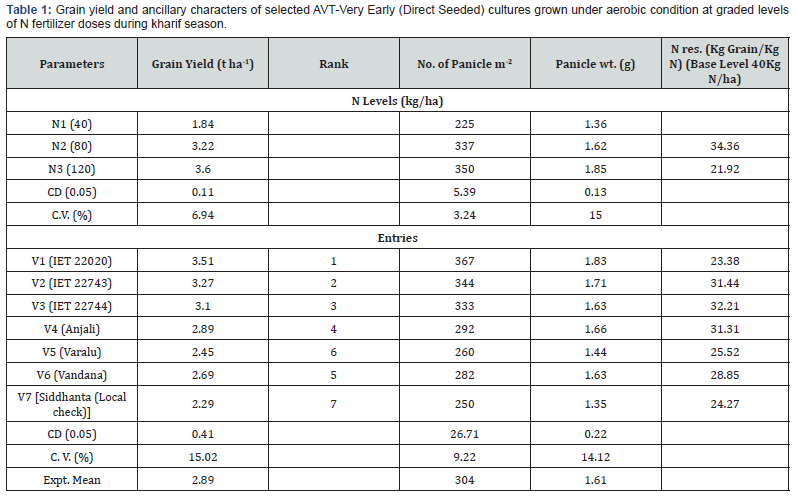
The effects of various levels of nitrogen (N) and very early rice
genotypes/varieties on various parameters have been presented
in Tables 1 and 2.
Nitrogen levels
The yield attributes of potential very early rice genotypes/
varieties were found to be differed due to applied nitrogen levels.
Each increase in the N-level increased number of panicles m-2
and matured panicle weight resulting higher yield attributes and grain yield (Table 1). Thus, at 150% recommended nitrogen (RN)
i.e 120kg N ha-1, the yield attributes recorded maximum number
of panicles m-2 (350), panicle weight (1.85g) and finally recorded
highest grain yield (3.60t ha-1) than lower fertilities. It was significantly
higher than other levels (rate) of nitrogen. While, at 100%
recommended nitrogen (RN) i.e 80kg N ha-1 the yield attributes
recorded second highest number of panicles m-2 (337), panicle
weight (1.62g) and finally recorded second highest grain yield
(3.22t ha-1) during investigation. While, at 50% recommended nitrogen
(RN) i.e 40kg N ha-1 the yield attributes recorded lowest
number of panicles m-2 (225), panicle weight (1.36g) and finally
recorded lowest grain yield (1.84t ha-1) during investigation. It
was significantly lower than other levels (rate) of nitrogen in this
experiment. The experimental results revealed that among the nitrogen
levels, the highest grain yield (3.6 t ha-1) was recorded with
150% recommended nitrogen (RN) i.e 120kg N ha-1 and it was
statistically significant higher than 100% recommended nitrogen
(RN) i.e 80kg N ha-1 (3.22t ha-1) and 50% recommended nitrogen
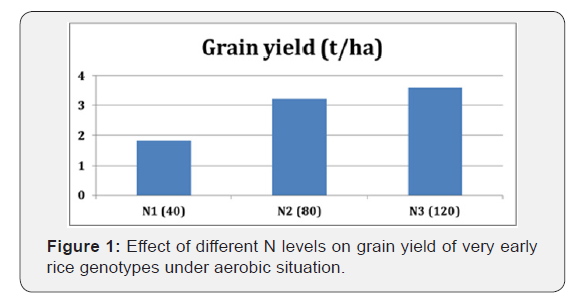
(RN) i.e 40kg N ha-1 (1.84t ha-1), respectively. There was a significant
increase in grain yield with the increase in N level from 40
to 120kg ha-1 and further increase in N level upto 120kg ha-1 could
increase the grain yield significantly (Figure 1).
The improvement in yield attributing traits may be ascribed to
the improved vegetative growth due to nitrogen fertilization, facilitating
photosynthesis, thereby increasing translocation of organic
food materials towards the reproductive organs; which enhanced
the formation of panicles with fertile grains. The improvement in
yield components due to increased nitrogen levels also have been
reported by many workers Shukla et al. [12], Pandey et al. [13]
and Singh et al. [14]. The productivity i.e. grain yield of aerobic
direct seeded rice was found to be differed with different level of
nitrogen during investigation. This might be due to better growth
and appreciable improvement in yield attributing characters. This
could be attributed to the fact that higher dose of nitrogen being
constituent of enzymes and protein enhanced cell expansion and
various metabolic processes. Grain yield production increased significantly
with incremental levels of N up to 120kg ha-1. This could
be attributed to the higher nitrogen application which might have
increased the chlorophyll formation and improved photosynthesis
and thereby increased the plant growth, number of panicles
per unit area and panicle weight leading to the production of high
grain yield. Similar results have also evinced by Liukhan et al. [15]
and Sabir et al. [16].
Varieties

There were significant differences among the potential very
early rice genotypes/varieties in plant growth, yield attributes
and grain yield. All yield attributing characters (number of panicle/
m2 and panicle weight) were remained differed with different
varieties. Among the seven genotypes/varieties, IET 22020 (very
early rice genotype) recorded maximum number of panicles m-2
(367), panicle weight (1.83g) and finally recorded highest grain
yield (3.51t ha-1). It was statistically at par with IET 22743 and IET
22744 (very early rice genotypes) with respect to grain yield (3.27
and 3.10t ha-1, respectively). IET 22743 recorded 344 numbers of
panicles m-2 and panicle weight was 1.71g. IET 22744 recorded
333 numbers of panicles m-2 and panicle weight was 1.63g. While,
IET 22020 was remained closed to IET 22743 and IET 22744 with
respect in grain yield under aerobic direct seeded situation during
investigation. Experimental results revealed that among the potential
very early rice genotypes/varieties, IET 22020 recorded
the highest grain yield (3.51t ha-1), which was significantly higher
to that of Anjali (2.89t ha-1), Varalu (2.45t ha-1), Vandana (2.69t ha-
1) and Siddhanta (2.29t ha-1) (local check) (Table 1). However, IET
22743 exerted second promising yield attributing characters and
grain yield during investigation (Figure 2).
The climatic condition and genetic makeup of variety had
better interaction under which could be enhanced growth and development
of panicles. The photoperiodic responses and genetic
potentiality on variation of yield attributes of improved varieties
have also been reported by Lar et al. [17]. Productivity of crop is
collectively determined by vegetative growth coupled with higher
yield attributes resulting in higher grain yield. Increased in grain
yield through greater partitioning of assimilates from shoot to
grain. The increased in grain yield by the varieties due to overall
respective performance in growth and appreciable improvement
in the yield attributing characters. Significant variations in grain
yield of rice varieties have also been reported by many workers
[17-19].
The experimental results revealed that grain yield differences
among the cultivars were significant. IET cultures recorded significantly
higher grain yields over standard and local check (Siddhanta).
IET 22020 recorded highest grain yield of 3.51t ha-1. Incremental
doses of nitrogen influenced the grain yield significantly.
Application of 150% of RDN recorded significantly higher grain
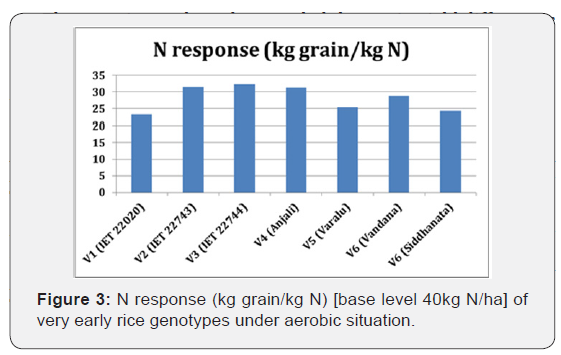
yield of 3.6t ha-1. The N response was higher (34.36) at 100% RDN
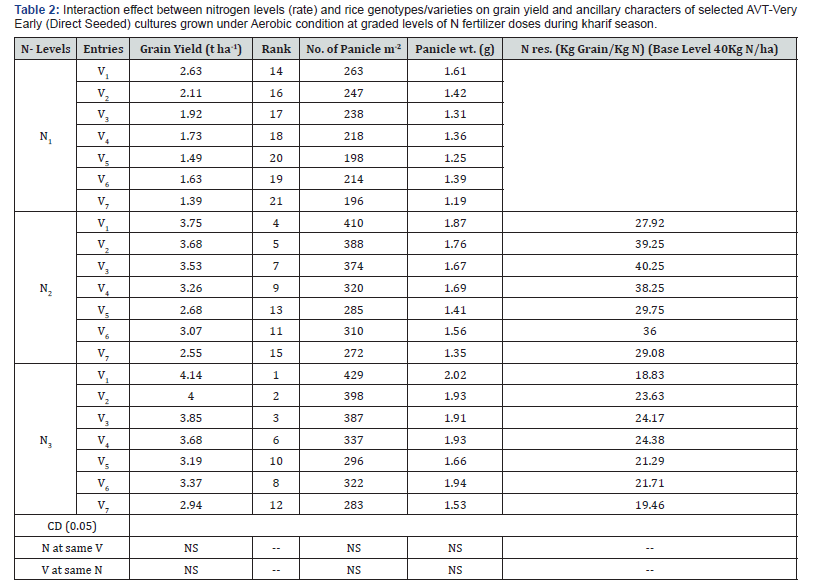
as compared to 150% RDN. Regarding interaction effect, combination
of N3 X V1 i.e 150% recommended nitrogen (RN) i.e 120kg N
ha-1 and IET 22020 (very early rice culture) recorded highest grain
yield of 4.14t ha-1 [20] (Table 2) (Figure 3).
Conclusion
From the present study, it may be concluded that among the
potential very early rice genotypes/varieties IET 22020 proved
most impressive by recording the highest grain yield and IET 22743
exerted second promising very early rice genotype under aerobic
direct seeded situation of red and laterite zone of West Bengal. IET
22020 has the potential to be an alternative/replacement as very
early rice genotype for Siddhanta in upland areas under aerobic
direct seeded condition with 150% recommended nitrogen (RN)
i.e 120kg N ha-1.
To know more about Journal of Agriculture Research- https://juniperpublishers.com/artoaj/index.php
To know more about open access journal publishers click on Juniper publishers


Comments
Post a Comment