Impact of Technology Adoption on Agricultural Productivity and Income: A case study of Improved Teff Variety Adoption in North Eastern Ethiopia-Juniper Publishers
Journal of Agriculture Research- Juniper Publishers

The study investigates the potential impact of
agricultural technology adoption, exemplified here by adoption of
improved Teff (Boset variety) on rural household agricultural
productivity and income. The research is motivated by two research
questions:
a. Why and how adoption of improved Teff variety affect the income of adopter farmers in the study area?
b. What are the costs and benefits associated with the adoption of improved Teff variety?
To answer these questions, the channels of impact are
identified based on an extensive literature review and modeled using a
household production function. This approach recognizes the
interrelation of households’ producer, consumer and labor supply
decisions and takes into account potential impact on income from
non-farm activities.
The study uses a cross-sectional data collected from a
randomly selected 163 sample households from North Eastern Ethiopia.
The analysis was conducted using a multivariate regression model, which
was developed based on the household production function. The estimated
result of a linear regression confirmed that adopter farmers have
generated, 24% higher farm income from the resulted increase of
agricultural output due to adoption. In addition, farm income of
households in the survey responds differently to other production
factors. The resulted change in farm income due to a unit change in
land, capital and other seeds was significant and positive. However, the
change in farm income, due to the change in other production factors
labour, irrigation water uses, and fertilizers application was negative
and insignificant. This could be due to existence of labour surplus,
inappropriate application of fertilizer and inefficient utilization of
irrigation water.
The study also identifies farmers, who adopt improved
seeds faced higher input cost (fertilizer and seed) and confirms that
adoption had increased the production costs of farmers. Finally, the net
impact of adoption calculated by combining the effect of adoption on
the farming household’s farm income and its effect on cost of inputs
confirms that the total benefit of adoption is far higher than the
associated increase in costs.
Keywords: Impact assessment; Technology adoption; Teff; Boset; Agricultural productivity; Income
Abbreviations:
ATA: Agricultural Transformation Agency; EIAR: Ethiopian Institute of
Agricultural Research; MoA: Ministry of Agriculture; UN-OCHA: United
Nations Office for the Coordination of Humanitarian Affairs; DA:
Development Agent
Introduction
During the last decades, due to the expansion of
agricultural farmland, there has been a rapid growth of agricultural
production in Ethiopia. However, the use and contribution of modern
agricultural inputs to overall agricultural growth is relatively low
[1]. Given the scarcity of suitable arable land it becomes largely
difficult to meet the increasing needs of the rapidly growing population
through expansion of the area under cultivation [2]. It is, therefore,
evident that, comprehensive efforts are required to increase
agricultural production through different intensification and
productivity enhancement mechanisms.
The adoption of modern agricultural technologies is
believed to improve the income of the smallholder farmers through
enhancing agricultural productivity. And improving the agricultural
productivity of farmers requires developing and disseminating
cost-effective agricultural technologies. Accordingly, increasing
agricultural production, reducing poverty and meeting the demands for
food without irreversible degradation of the natural resource base are
possible [3]. The theoretical case is in favor of agricultural
technology adoption as a panacea for improving the income of smallholder
farmers through closing agricultural productivity gaps. Therefore, it
is important to study the impact of adoption on the farm households’
agricultural productivity and
income empirically.
As compared to the availability of literature on the factors
influence adoption of improved agricultural technologies, studies
assessing the impact of technology adoption are very scarce
in Ethiopia. And the existing literature and studies are conducted
either at the regional or national level. Furthermore, most of
these impact studies are concentrated on Wheat, Cotton, Maize,
and Rice varieties. On the other hand, as [4] Teff is relatively unknown
somewhere else, [5] research with particular reference
to the impact of improved Teff adoption is very rare. According
to Agricultural Transformation Agency (ATA), Ministry of Agriculture
(MoA) and Ethiopian Institute of Agricultural Research
(EIAR), the focus of Teff research has been on breeding yet limited
attention given to applied research, such as adoption and impact
for many areas. In addition, the report calls for further research
on several dimensions, including “Socioeconomics: adoption, impact,
and a cost-value ratio of various inputs”. Based on these facts,
this study attempts to assess the impact of adopting technology
on farm households, agricultural productivity, and income, taking
improved Teff (Boset Variety) adoption in Kobo woreda as a case
study. Boset is a recently developed and released genetically modified
high yielding Teff variety.
In Kobo woreda, the north-eastern part of Ethiopia, Teff has
extensive coverage of the area planted. But Teff productivity in
Kobo is among the lowest in the region. For instance, the average
yield of Teff is estimated 1.3 tons per hectare, which falls below the
national average (1.47 tons per hectare) and is far from the potential
yield of it (3.91 tons per hectare) [6]. And Kobo is also listed as
high priority food insecure woreda for the United Nations Office
for the Coordination of Humanitarian Affairs (UN-OCHA) [7]. Improved
Teff varieties and different agronomic practices have been
introduced to resolve the problem of low agricultural productivity,
low income, and food insecurity in the area. This makes the woreda
interesting to study.
All the above reasons make worth to undertake this study.
Therefore, it can contribute to the existing limited literature by
bridges the gap of information with regard to the impact of improved
Teff (Boset variety) on agricultural productivity and income
of rural households. Thus, the study can serve as a reference
material for policy makers, academicians and researchers. Moreover,
this study can give a better insight into the role of modern
agricultural technology in the productivity of the agriculture sector,
hence, the income of rural households and poverty reduction.
Theoretical and Conceptual Framework
The link between improved teff adoption, productivity and income
Based on the review of the existing literature in the previous
chapter the following transmission mechanisms through which
improved Teff adoption will affect the agricultural productivity
and household income are identified:
a. Adoption of the technology (i.e. Boset Teff variety) is expected
to have a positive influence on the agricultural production
as it (Boset) takes less time to mature than local varieties. In addition,
water-logging resistant and weed tolerant nature of the technology
(Boset Teff variety), helps to increase yield by protecting
the yield that would otherwise be lost due to logging and weeds.
Therefore, adoption will lead to increased yields or intensive production
practice and diversification of produced crops that may
be used for own consumption and/or for being sold at the local
markets. Hence, it will lead to an increase in farm income.
b. Adoption of improved seeds is labor intensive. Consequently,
it will affect the households’ labour time allocation. The
increased yield resulted from technology adoption (Boset Teff variety)
require the farmers to spend more labour time on their field
to collect the harvest. While it is expected to increase the farm income,
it will reduce the time allocated for other productive (non/
off-farm) activities there by income from these sources.
c. In addition, the technology adoption (i.e., Boset Teff variety)
increase expenditures for a group of farm households that formerly
relied on local seed varieties. Further, adoption also changes
the use of other inputs like fertilizer, pesticides, herbicides etc.
Accordingly, the cost of production, including the transaction and
transportation costs, will likely to increase.
In order to assess the impact of improved Teff adoption on
the income of farm households’, this study examines the economic
costs and benefits of adoption. It is assumed that improved Teff
variety adoption has an impact on agricultural production, reallocation
of labour time and household expenditures. Being able
to infer a causal connection between a project and an impact indicator
depends both on the data that are used for the analysis
as well as the empirical methods that are employed. In analysing
agricultural production, the relationship between inputs and
outputs or profitability is often examined through production or
profit functions [8]. The model to estimate empirically all quantitative
impact of changes in agricultural practice (i.e, improved
Teff adoption) on production and income is modeled on/adopted
from the productivity method /income function framework/ by
Löwenstein et al. [9].
Productivity method
Productivity method is a revealed preference method which
measures the change in productivity and income of the affected
people by the given intervention [10]. The farm households in the
area earn total cash income (Y) from different sources including
farm income (Yfa), labour income from other productive (non/offfarm)
activities (Yop), and also income from transfers (remittances
and governmental subsidies) (Ytr). The farm household’s total income
(Yttl) can therefore be expressed as follows:

Transfer income will not be affected by adoption of
improved
Teff. Income from other productive activities of the farm house holds in
the area is also not affected by the adoption of improved
seed (Boset Variety) due to agrarian nature of the area (where
farming is seen as the main activity) and limited (none) existence
of other productive activities in the area. Moreover, there is
a strong cultural bias against non/off-farm activities in the area
where farmers prefer to spend their time for leisure or other social
activities than participating in other productive activities. Therefore,
there is no need for further analysis for these income categories.
On the other hand, farm income may be affected through
the above described changes in intensive use of production factors
and through the increased in productivity of farmland.
In simple agriculture production function, the farm output
(Xfa) will be produced by combining labor (L), land (Land), and
physical capital (K). In the area, farming follows traditional patterns
so that farming technology (A) can be assumed to be the
same for all households. Farming is not mechanized, characterized
by the use of the ard, a primitive ox-drawn plow, and it is more traditional
and involves extensive manual work. Farmers in the area
have access to irrigation and they use different local seed varieties
and chemical fertilizers. Land preparation is done by using animal
power. In addition, the use of simple agricultural tools such as
picks and hoes is common. All these form the capital stock (K) of
the household. More or less the capital stock of the households in
the area is assumed to be similar and traditional.
There is one part of the capital stock which is improved Teff
(Boset Variety) that makes a difference in capital between farm
households in the area. This element does vary between households
that are adopted improved Teff and those who are using
local varieties. Most producers in the area are smallholders, occupying
on average less than a hectare of land per household. Having
large family size with small plot size, we assume either a declining
(zero) or positive marginal productivity of labour.
Thus, the households farming production function contains
the following explanatory variables.

Farmers generate gross income (PX) by selling their output to
the nearest market for constant [11] market price (P). The farm income
can be calculated by subtracting the individual household’s
total production cost (Ci
fa), which is a combination of fixed (Ci
f) and
variable costs (Ci
v) from gross income. Thus, the households’ profits
from farming activities can be expressed as follows:

Equation (3) reveals that the adoption of improved Teff varieties
affects farm income of the households’ in two channels.
One, it is expected that the adoption of improved seeds will have
a positive influence on the agricultural production. Hence, the rise
in farm yield resulted from the increased in capital stock (i.e. improved
Teff varieties) will lead to an increase in the income of the
farm household that is generated from the sale of the harvested
output. The other channel is the expenditure channel. Farm income
falls from increasing the costs of farming as those farmers
who adopt improved seeds have to pay for the seeds and cover
expenses for related complementary inputs such as fertilizer and
also have to bear transportation cost of inputs.
Boset Teff has a tall and tender stem which is susceptible to
damage by wind and rain. Moreover, the grain holding per straw
of Boset Teff is higher than the local varieties, which puts more
pressure on the straw. The higher amount of seeds per Boset Teff
straw makes it easier to fall to the ground, which causes considerable
losses on both the quality and quantity of the harvest. Hence,
adopter farmers are expected to apply more fertilizer to strengthen
of the straw and control displacement of the steam from its
upright position. Consequently, the woreda agriculture office in
collaboration with the improved seed distributors of the area insists
the farmers to buy the recommended fertilizer quantity while
purchasing the seed [12].
Inserting equations (3) into equation (1) and considering the
assumptions, constant market price for outputs, the total differential
of the modified equation (1) can be expressed as follows:

By using equation (4), it is possible to quantify the extent to
which changes in agricultural technology (A), the production factors
capital (K), labour (L), and land (Land) and the interaction
with other income sources (other productive activities and transfer)
are systematically affecting the households’ total income.
Application of the theory and conceptual framework to the research agenda
In assessing the economic impact of improved seed adoption
on agricultural productivity and income of the rural households,
the study uses the above theoretical and conceptual framework. In
this study improved Teff variety used as a factor of production (i.e.,
Capital) that affect the production and productivity of the farmer.
Productivity method that presented in 3.2 is used to estimate
the magnitude of the impact (productivity and income) associated
with the adoption of improved Teff. As described on Bockstael &
McConnell [10], productivity method is used to analyses the economic
impact of an input which increases revenue or reduces variable
cost.
This study focuses on the ex-post economic impact analysis
of improved seeds adoption from the perspectives of smallholder
farm households that have adopted improved Teff variety.
It estimates the economic benefit and costs generated from the
adoption of improved Teff varieties in monetary terms. The actual
impact accrued by the smallholder farm households is attributed
to improved seed adoption. In the analysis of economic costs and
benefits, the viewpoint is very important [13]. Hence, this study
evaluates the impacts of improved Teff adoption from the perspective
of the smallholder farmers that uses it in their production. It
compares the magnitude of economic benefit and cost of farm households between the two worlds, with improved Teff and without
improved Teff. The differences between the real-world situation,
i.e., the world with improved Teff varieties, and the counterfactual,
i.e., the world without improved Teff with local varieties,
is quantified and fed into equation (4) in section 3.2 to calculate
the overall welfare impact of improved Teff adoption on the farm
households in the area.
Working hypothesis
Based on the vast literature on the subject and theoretical
and conceptual framework outlined in this chapter the following
working hypotheses were tested:
a. The adoption of improved Teff (Boset) variety increases
the output of farm households which results in higher farm income.
Hence, there is a strong case that farmers generate more
farm income due to adoption of improved seeds.
b. Technology adoption (i.e., Boset Teff variety) increase
the expenditure of a group of farm households that formerly relied
on local seed varieties. Therefore, their cost of production is likely
to increase due to adoption.
c. The total benefit generated in improved Teff adoption is
greater than the total cost of adoption for the farmers in the study
area. (the net welfare impact of improved Teff adoption is positive)
Methodology
Description of the area
The study is conducted in Kobo woreda which is located in
the North Wollo zone of the Amhara region. It is located at 570km
from the capital Addis Abeba and 49km from Woldia which is the
zone capital. Agriculture is the main economic activity in the woreda
in which about 86% of the population is engaged. The farming
system can generally be characterized as mixed and includes the
production of arable crops and the raising of livestock. Most of
the farmers are engaged in subsistence agriculture with relatively
small land holdings; which range from 0.25 to 2.5 hectares, and
insufficient application of basic agricultural inputs such as fertilizers
and pest control techniques. The main crops grown in the
area are Teff, Sorghum, Maize, and other cereals from July through
November. Due to the low rainfall amount and high rate of evaporation
and transpiration during the Belg rain, there was no crop
grown during this period i.e. farmers were producing once a year.
But now, with the use of ground water since 2005, farmers are
producing twice a year. In addition to the above cereals, cultivation
of the most commercial crops in the country such as tomato, onion
and pepper is possible during the dry season i.e. from March/April
to June/July [14].
Research design
For the purpose of assessing the impact of improved Teff adoption
on agricultural productivity and income in Kobo woreda, a
cross-sectional research design was adopted to collect data related
to the use of improved Teff varieties, production factors, output,
total income and income composition from different sources and
different socioeconomic and demographic characteristics of farm
households in the woreda for the production year 2014/15. According
to Bryman & Bell [15] “A cross-sectional design entails the
collection of data on more than one case and at a single point in
time in order to collect a body of quantifiable or quantitative data
in connection with two or more variables, which are then examined
to detect patterns of association [15].”
The main challenge in assessing the impact of improved Teff
adoption is to determine what would have happened to the farmers
in the absence of improved Teff adoption. That is, determining
the counterfactual will be necessary. For this specific study the
“with and without world” scenario is adopted. The counterfactual
is a world without the improved Teff, i.e. a world in which the
adopter households grow local varieties, and where they use seeds
from their last harvest or buy it in lower price. Then the study will
use the comparison of the two worlds approach.
Data source and method of data collection
Analysis of this study is principally based on primary data.
Primary cross-sectional data is collected for 2014/2015 cropping
season using structured household survey questionnaire and to
support this information focused group discussion with selected
farmers has also been conducted.
The data is collected from a group of farming households
(having both adopters and non-adopter farmers) using the structured
questionnaire prepared to gather information that helps to
address the research question and finally to attain the research
objectives. The questionnaire elicited information about household
demography, household income, expenditure on inputs, crop
production and resource endowment, etc. The data is collected
from July, 2015 to August, 2015 with the help of 3 Development
Agents (DA). The DAs were selected based on their experience and
extended knowledge of the existing social settings of study area.
One day training was given to the DAs. Before starting the actual
data collection, the questionnaire was pre tested on 10 households
who were randomly selected from the study area population
enabling the modification of some of the questions. Close supervision
and follow up was taken place by the researcher to avoid
fault and mistakes and to do timely correction as much as possible.
Furthermore, the study also used secondary data. Secondary data
was collected form, Central Statistics Agency, Zonal and Woreda
offices of agriculture, which is used to back up the findings from
primary sources.
Sample size and sampling technique
In order to make valid inferences and increase the
degree of accuracy
of the results, a well-designed sampling frame is a pre-requisite.
For this study, initially secondary data from the woreda agriculture
office is collected and used to identify the population of
the study area that can be possibly categorized as the sampling
frame. In this study a two stages sampling technique was adopted
for the selection of sample respondents (a group having both improved
Teff variety adopters and non-adopters). In the first stage,
from the total of 40 kebeles in the woreda, one kebele (kebele 08)
is selected purposively based on the distance from woreda capital,
relatively rural kebele which has better Teff production potential
and high improved Teff (Boset) variety adoption rate (80%).
The total farming household-head population size of the selected
kebele (kebele 08) is 1,430 (i.e, total poplution for the study) of
which 157 are women headed and the rest are male headed.
At the second stage, based on the data (registration list of kebele
08 farmers) from the woreda agriculture office, and Ambasel
Farmers’ Cooperative Union (distributor of improved seeds in
the woreda) the actual improved Teff variety users in 2014/2015
cropping season were identified. Using the same data, a list (with
both adopters and non-adopters) was prepared and households
were assigned a random number, then a representative sample
of 163 farming households (11.4% of the total population) were
selected from the list using simple random sampling technique.
From the selected 163 households 123 (75.5%) were adopter and
40 (24.5%) were non-adopter households.
Method of data analysis
Descriptive and inferential statistics were used to estimate
the impact of improved Teff adoption on the sample households.
Descriptive statistics such as tabulation, percentages, and frequencies
were used to describe demographics, income and factor
endowment of the sample population. In addition, chi-square test
and t-test were used to assess if there are possible differences in
our sample by differentiating adopter and non-adopter households.
Multivariate regression models, based on the theoretical
framework elaborated in section 3.2, is also used to analyse the
output and income impacts of improved Teff adoption in the study
area. STATA version 12 software package is used to analyse and
estimate statistical and regression models.
Econometric method: To analyses the impact of improved
Teff adoption a linear multiple regressions analysis was used.
As described in the theoretical framework of the paper the farm
households in the area earn total cash income (Y_total) from different
sources including farm income (Y_Farm), labour income
from other productive (non/off-farm) activities (Y_Non_farm),
and also income from transfers (remittances and governmental
subsidies)(Y_Transfer). The theoretical framework also describes
farm income as the total output produced by households multiplied
by price minus farming cost (refer equation (3) of chapter
three). Based on the assumption of constant price and fixed farming
cost the total differential of equation [4] from chapter three
gives a working model:

i = 1…n farming households
Definition of variables
a. ‘Y_total’ is the total annual income of households. This is cash
income of households from different sources of income. It is
the sum of income from farm activities, income from other
productive activities and income from different transfers in
one year.
b. ‘BOSET_SEED’ is the amount of money spent on improved
Teff seed for each household per cropping season. It is measured
in Ethiopian birr. The improved Teff variety in this
study stands for using Boset variety. This variable is used to
estimate the impact of Boset variety on the selected outcome
variables.
c. Adoption of technology is a mental process of applying a given
innovation. There is no universal agreed length of time to
say households as adopters or non-adopters. In this study
adopters are farmers who use improved Teff (Boset variety)
in 2014/2015 cropping season while non adopters are farmers
who are experienced in growing of local Teff varieties. As
many studies verify that adoption influence household wellbeing
positively and significantly [16,17] and similar to these
findings in this study it is hypothesized that adoption of improved
Teff variety is expected to have a positive and significant
impacts on productivity and household income.
d. ‘LABOUR’ is the total labour days (either family labour or
hired labour) spent on planting, weeding and harvesting. It is
measured in terms of man days for 2014/15 cropping season.
e. ‘LAND’ is the total area cultivated by the farm household for
the 2014/2015 cropping season. It is measured in terms of
hectares.
f. ‘CAPITAL’ is the value of all physical capital (hoes and ploughs
used for cultivation) for each household per cropping season.
It is measured in Ethiopian birr.
g. ‘FERTILIZERS’ is the amount of money spent on chemical fertilizers
for a 2014/2015 cropping season. It is measured in
Ethiopian birr.
h. ‘SEEDS’ is the amount of money spent on other seeds (without
Boset) for each household per cropping season. It is measured
in Ethiopian birr.
i. ‘IRRIGATION’ is the amount of money paid for irrigation
water used by the farm households for the production year
2014/15. It is measured in Ethiopian birr.
j. ‘Y_Non_farm’ is annual income of households generated
through participation in other productive activities. Other
productive activities in the survey refers both to self-employment
in non-farm sectors such as petty trade, craft work/
carpentry, etc. or off-farm employment such as; daily labour,
guard, etc.
k. ‘Y_Transfer’ is annual income of households from remittances
and government subsidies. This is mainly remittances received
form family member abroad and, in the city, and subsidies
form government.
l. ‘AGE’ is a continuous variable referring to the age of the
household head measured in years.
m. ‘SEX’ is a nominal variable used as dummy where it equals to
1 if the household head is male and 0 otherwise.
n. ‘DEP_ratio’ is household members below the age of 15 and
above 65 divided by the total household between the ages of
15 to 65. It shows the burden on the productive part of the
population.
A counterfactual world is generated by assuming a world without
the adoption of improved seed (Boset variety). In this simulated
world, the beneficiary households do not adopt improved Teff
(Boset variety) and are heavily dependent on local Teff varieties.
The differences between real world, i.e. the with-boset world, and
the counterfactual, i.e. the without boset world, were analysed using
equation [1].
Results and Discussion
Socio-economic and demographic characteristics of sampled households
In general, the descriptive analysis of shows that there is no
statistically significant difference in age, gender, education status,
household size and dependency ratio between adopter and
non-adopter groups of our sample. The descriptive statistics regarding
the input and institutional services utilization by households
gives an insight as to whether there is available difference
in our sample households with respect to asset endowment, utilization
of agricultural inputs and institutional services by comparing
the two subgroups of our sample. Based on the analysis, there
is no statistically significant difference in the asset ownership,
landholding, labour days spent on farming activities, utilization
of capital goods, use of irrigation water and fertilizers between
the adopter and non-adopter households of our sample. However,
even though it is not statistically significant, adopter households
had invested higher amount of money on fertilizers than those
who relied on local Teff varieties. Moreover, households with improved
Teff (Boset) variety were reported to have invest higher
amount of money on seeds (Boset and all other seeds) which is
statistically significant at 99% confidence interval. Considering
the utilization institutional services there is no statistically significant
difference in access to credit and agricultural extension
services between those two subgroups of our sample.
Hypothesis testing
To estimate the impact of improved Teff (Boset) variety adoption
on the income of sampled households, linear multiple regression
analysis based on the model presented in section 3.5 is
conducted. In the first approach, the influence of the independent
variables from equation (4) are used to estimate farm households’
total income (Y_total). The regression uses the stepwise approach
starting with a model which contains the full set of independent
variables that are then reduced to find the model with the best
statistical parameters. In addition to theoretically discussed independent
variables different control variables were added to
the regression. These are age of the household heads, sex of the
household heads and dependency ratio of the households. Table
1 summarizes the results of the regressions based on the working
model presented in section 3.5.
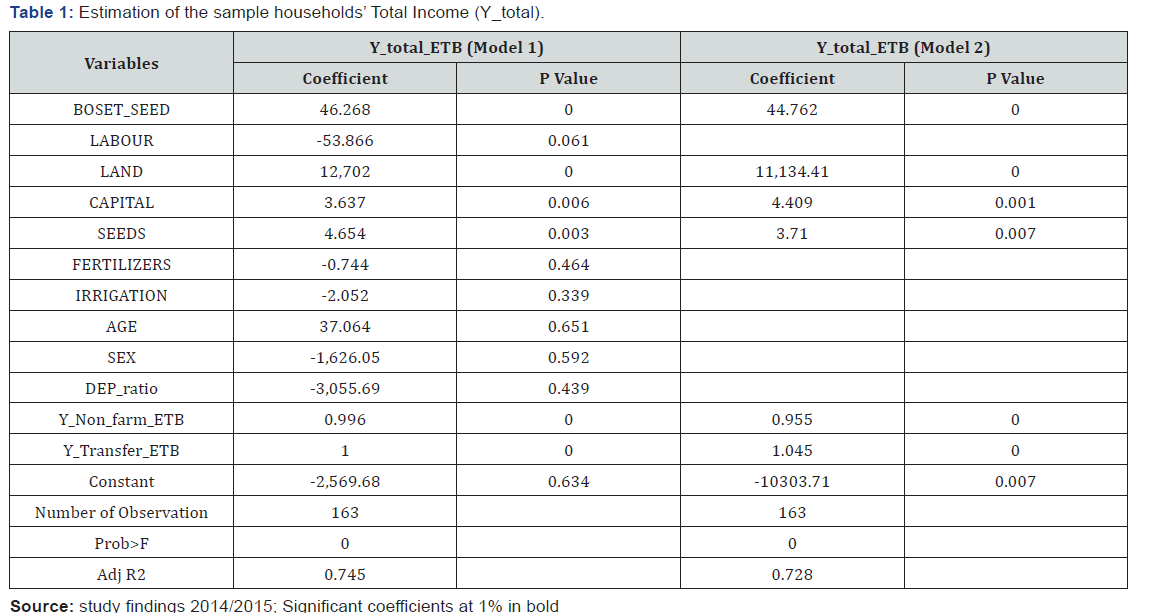
The regression results in the above (Table 1) shows
the contribution
of each factor of production, non-farm income, transfers income
and demographic variables towards change in total income
of the household. Both models showed variation in total income
due to change in different theoretical and controlled variables.
The P value of the F statistics shows the overall model is statisti
cally significant and the model fits the data very well. The adjusted
R-squared value of Model 1 and Model 2 is 0.745 and 0.728 respectively.
This means that Model 1 and 2 have relatively the same
explanatory power to explain the changes in total income due to
the change in independent variables.
All significant variables in Table 1 shows the expected signs. In
Model 1, household’s factors of production LAND, CAPITAL, SEEDS
and the use of improved Teff (BOSET_SEED) plus its income from
other productive activities (Y_Non_farm) and transfer income
(Y_Transfer) are significantly different from zero and influence the
household’s total income. On average, each additional Ethiopian
birr investment on improved Teff (BOSET_SEED) and other seeds
(SEEDS) increases the total income of the household by 46.268
and 4.654 Ethiopian birr respectively. Moreover, each additional
hectare of land cultivated brings 12,702 Ethiopian birr additional
income for the household. However, household’s application of
chemical fertilizer (FERTILIZRS), its use of irrigation water (IRRIGATION)
and the number of days that farmers spent on their farms
(LABOUR) are found to be insignificant to change the total income.
This means there is no change in total income due to the change in
each respective input. Likewise, the control variables dependency
ratio, age and sex of the households are statistically insignificant.
Result is also similar in Model 2, where only explanatory variables
that has systematic and significant influence on household’s total
income are considered.
So far, the study has examined the possible influence and signs
of coefficients of the independent variables included in the above
regression analysis. Afterwards the researcher analysed the potential
transmission channels between improved Teff (Boset) variety
and households’ welfare in a more detail and systematic manner
to test the proposed hypotheses in section 2.4 of the paper.
The analysis and estimation of the effect of improved seed (Boset)
adoption on farm households’ welfare through different possible
channels (i.e. Output and Expenditure), is done by applying a simulation
approach. The simulation approach uses a counterfactual
by assuming a world without the adoption of “Boset” variety. In
this simulated world, the adopter households do not have access
for “Boset” variety and are heavily dependent on the existing local
Teff varieties. The differences between real world, i.e. the with-
Boset world and the counterfactual, i.e. the without-Boset world
will be simulated and compared.
The output channel: more farm income due to increase in agricultural production
Hypothesis I: The adoption of improved Teff (Boset) variety
increases the output of farm households which results in higher
farm income. Hence, there is a strong case that farmers generate
more income due to adoption of improved seeds.
In order to test the above specified hypothesis and examine
the impact of different production factors including Boset variety
(BOSET_SEED) on households’ farm income the researcher estimates
the farm income (Y_Farm) of the farm households’ based on
the theoretical framework presented in section 2.2 of equation (3)
and (4). The result of Stata output is summarized in the following
table.
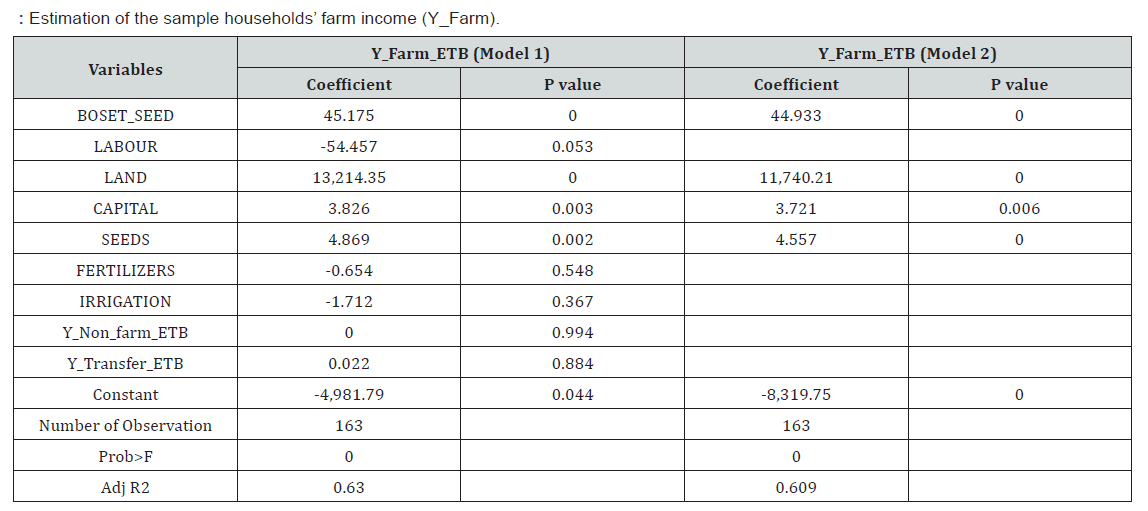
The regression results in the above (Table 2) shows the effect
of a change in each production factor on the farm income of the
households. The P value of the F statistics shows the overall model
is statistically significant and fits the data very well. The adjusted
R-squared value of the first model is 0.63 and the second model
is 0.609. This means that, almost both models have the same explanatory
power to explain the changes in farm income resulted
from changes of one or more independent variables. The models
were diagnosed for possible existence of multi-collinearity using
VIF. The STATA output for VIF show that there is no significant collinearity
between variables in both models. All the variables have
VIF of less than 3 or TOL of greater than 0.1 with mean VIF of 1.42
in Model 1 and mean VIF of 1.39 in Model 2.
The coefficients in the model shows the change in the outcome
variable (Y_Farm) for a one unit increase in the predictor variable,
keeping the remaining predictors constant. The estimated coefficient
of the conventional agricultural input variable labour (LABOUR)
shows a negative sign, and quite interestingly, chemical
fertilizers (FERTILIZERS) and household’s use of irrigation water
(IRRIGATION) also show a negative sign. This means that, a unit
change in labour days on the field, amount of chemical fertilizers
applied and amount the of water use affect the household farm
income in the opposite direction with the extent of the respective
coefficients. However, all these three inputs are statistically
insignificant to affect the farm income of the households. The insignificance
of labour is in line with the initially assumed and now
confirmed hypothesis that the traditional agriculture practiced in
the area might be characterized by labour surplus (cf. section 2.2).
Fertilizers are insignificant may be due the currently existing
blanket fertilizer amount (100kg per hectare) recommendation in
the national and regional level which does not consider location
and crop specific aspects. And “Such blanket fertilizer recommendations
have negatively influenced chemical fertilizer efficiency
and profitability since…fertilizer requirement is affected by soil
moisture, soil fertility status, cropping history and cropping systems
[18].” The insignificance of irrigation water uses to affect
the farm income of households is may be due to ineffective and
inefficient utilization of the water from the pressurized irrigation
system.
The other explanatory variables show the expected sign of directions.
Hence, the most important determinant of farm income
is area of land cultivated. On average, each additional hectare of
land cultivated increases the farm income of the sample households
by 13,214.35 Ethiopian birr keeping other variables constant.
The use of improved Teff ( BOSET_SEED) variety also has
higher impact on farm income. On average, 1 Ethiopian birr spent
on ‘Boset’ seed brings about 45.18 Ethiopian birr change in farm
income ceteris paribus. Looking in to the p value in the first model,
the use of improved Teff (Boset), land physical capital and other
seeds are statistically significant at 1% level of significance. However,
labour fertilizers and irrigation are statistically insignificant
in determining the value of farm income. Likewise, both income
from other productive activities and transfer income are statistically
insignificant to explain the change in farm income. This confirms
our assumption in section 2.2 that there is no link adoption
will affect the households’ labour time allocation in the area. As for
the transfer income, it may be due to the small representation of
households with transfer income in our sample households.
The second regression model is also statistically fit except,
for a small change in the coefficients of the previously statistically
significant variables that are included in the second model.
On average each additional Ethiopian birr investment of farmers
on ‘Boset’ seed increases their farm income by 44.93 Ethiopian
birr. In similar direction, increase in 1 hectare of land cultivated
increases farm income by 11,740.21 Ethiopian birr. Furthermore,
a one unit increase in capital stock increases farm income by 3.72
Ethiopian birr and each additional money spent on other seeds increases
farm income by 4.55 Ethiopian birr. All production factors
are statistically significant at 1% level of significance.
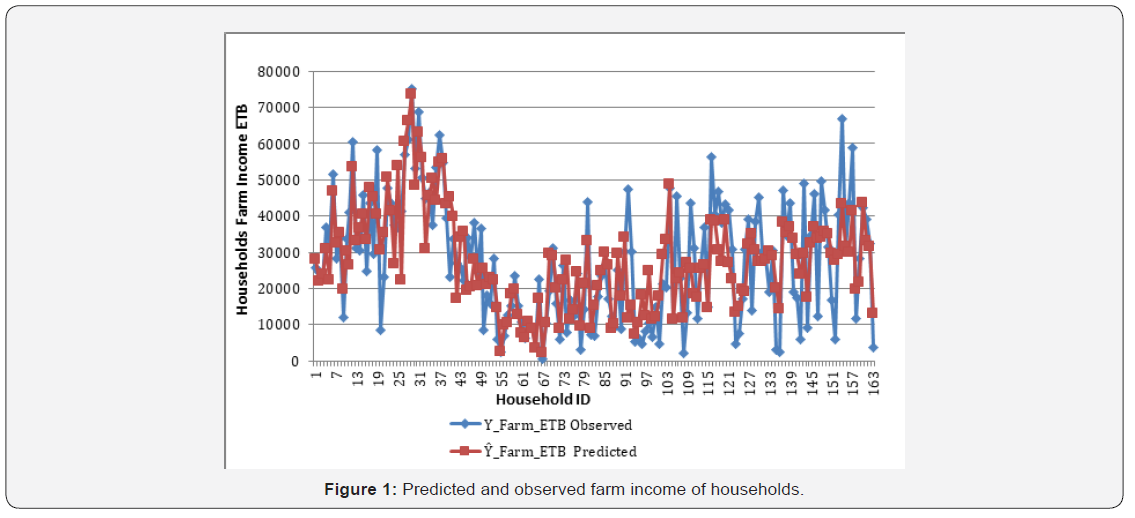
After predicting the farm income of sample households’ using
their real-world data and the coefficients from the above regression
models, the result of comparison between the observed and
predicted farm income is depicted in Figure 1 below.
According to the regression results presented in
Table 2, a
unit change in the amount of money paid for ‘Boset’ Teff variety
contributes 45.17 Ethiopian birr under Model 1 and 44.93 Ethiopian
birr under Model 2 to the households’ average yearly farm
income. However, in the counterfactual world, i.e. a world without
improved Teff, households do not have access to ‘Boset’ seed and
they are entirely dependent on the available local Teff varieties. As
local Teff varieties are susceptible to weeds and they take longer time
to mature than ‘Boset,’ the sampled households’ would have
produced less agricultural outputs in the counterfactual situation
which in turn reduced their income generated from farm.
In order to estimate the farm income of sample households,
without improved seed (Boset), the study used the unstandardized
coefficients from the regression estimation in the above models.
As the result from the estimation shows, on average households’
farm income would fall from 27,561.31 Ethiopian birr per
annum (empirically observed) by 6,590.30 [19] Ethiopian birr
based on Model 1 and 6,555.29 [20] Ethiopian birr based on
Model 2. This means on average farm income of the households
increase by 23.7% - 23.9% from the counterfactual income due to
adoption of improved Teff (Boset) variety. Therefore, the finding
of study supports the hypothesis that the adoption of “Boset” variety
contributed to the households farming income and households
earned more income due to increase in agricultural production.
The next step is predicting our population income. Since our
samples are taken randomly from the total population of 1,430
farming households and it was known that adoption rate of ‘Boset’
seed in the sample kebele is 80% (cf. section 3.4) then we can
easily calculate the impact of adoption on the total population.
Thus, 80% of the total 1,430 households, i.e, 1,144 households
are adopters. Extrapolating the above empirical results from the
sample to those 1,144 adopter households, the total income effect
of improved seed (Boset) adoption via the output channel is
estimated to be from 7,499,251.76 to 7,539,303.20 Ethiopian birr
per year.
The expenditure channel: less income due to additional input costs
Hypothesis II: Technology adoption (i.e., Boset Teff variety)
increase the expenditure of a group of farm households that formerly
relied on local seed varieties. Therefore, their cost of production
is likely to increase due to adoption.
To this point the study discussed the gross benefits generated
due to adoption of improved Teff (Boset) by farm households. In
this section the study identifies and calculates the costs farming
households’ incurred due to adoption of improved Teff (Boset) variety.
The data on additional costs of adoption were collected from
the sample respondents. They were asked if their production cost
has changed in relation with the adoption of “Boset” variety and
if yes to specify the type and amount of extra payment they made
due to adoption. This helps to calculate the additional economic
costs individual households incurred, if they are willing to adopt
‘Boset’ variety.
Accordingly, on average all the sampled adopter households
in the survey spent extra 83.29 Ethiopian birr on seeds. This may
be due to the fact that the selling price of improved seed (Boset)
is higher than the available local varieties in the area. Similarly,
adopter households had paid 299.67 Ethiopian birr extra cost of
fertilizer [21] than if they would have been used available local
Teff varieties. The reason of this extra cost of fertilizer is due to
the obligatory purchase of additional chemical fertilizers with improved
seeds (Boset) from Ambasel Farmers’ Cooperative Union.
Furthermore, sampled household farmers reported that there is
no any other additional cost than the above stated costs due to
adoption. Thus, the sum of the extra payment for seed and fertilizers
which is 382.96 Ethiopian birr give us the average annual expenditure
of our sample households due to adoption of improved
Teff variety. Therefore, this finding is in line with our assumption
of the expenditure channel and confirms our hypothesis that
adoption of improved Teff (Boset) variety increases the expenditure
of a group of farm households that formerly relied on local
seed varieties.
The next step is extrapolating the above empirical figure from
the sample to those 1,144 adopter households, the total effect of
improved seed (Boset) adoption on income via the expenditure
channel is expected to amount 438,106.24 Ethiopian birr per annum.
Net welfare effect of improved Teff (Boset) adoption
Hypothesis III: The total benefit generated in improved Teff
adoption is greater than the total cost of adoption for the farmers
in the study area. (The net welfare impact of improved Teff adoption
is positive).

So far, the study estimated the possible benefits and costs
of improved seed adoption through the output and expenditure
channels. The next step it to calculate the overall effect of adoption
on household’s welfare. This is done by subtracting all the
total expenses from the total benefits of adoption. As the overall
result from Table 3 shows the gross annual benefit of all the 1,144
adopter households in the area for production season 2014/15 is
between 7,499,251.76 and 7,539,303.20 Ethiopian birr. On average,
adopter households incurred additional cost of 382.96 Ethiopian
birr on seeds and fertilizers. Hence, by multiplying the number
adopter households (1,144) by the average additional cost of
adoption (382.96), the total annual cost of adopting ‘Boset’ Teff
is 438,106.24 Ethiopian birr. Therefore, the net annual benefit of
improved Teff (Boset) adoption for production year 2014/15 is
estimated from 7,061,145.52 to 7,101,196.96 Ethiopian birr. This
supports the hypothesis that the total benefit generated in improved
Teff adoption is greater than the total cost of adoption for
the farmers in the study area (the net welfare impact of adoption
is positive). The resulted changed in the average annual household
farm income can be attributed to the adoption of improved Teff (Boset) variety adoption. Converting the this net increase in
households income to the PCI level shows that, the adoption of
‘Boset’ variety increases the PCI of adopter household members
by 1,425.34 [22] -1,433.43 Ethiopian birr (USD 67.34-USD 68.12)
from the counterfactual situation.
Summary, Conclusion and Policy Implications
Summary and Conclusion
Agriculture is the main sources of Ethiopia economy and the
people at large. Even if it is very important to the people at large
and it contributes more to the GDP of the country, the sector has
been still dominated by the smallholder and the level of production
is very low due to less use of the modern technology and limited
use of best agronomic practices. Especially the productivity of
Teff crop is very low as compared to other cereal crops whereas
the land allocation is the highest one as compared to other crops.
To reverse this situation, a continuous emphasis is being placed by
the Government on its policies on the viability of intensification of
improved agricultural technologies and extension practices as a
vital measure for increasing crop production. In order to reflect
the impacts of such policy directions, evaluation studies are important.
This study applied a theory-based impact assessment approach
(i.e., productivity method) to evaluate the impact of technology
adoption, exemplified here by adoption of an improved Teff
variety, on agricultural productivity and income of farmers.
The study used a simulation approach to calculate the impact
of improved Teff (Boset) adoption on income of farm households.
In this method a counterfactual world, i.e. a world without
‘Boset’ seed, is simulated using real world data. This helps to build
a “credible counterfactual” in which the impacts of the adoption
can be compared. It also helps to identify different channels that
adoption affects the welfare of the adopter households. This approach
is different from control/treatment group comparison and
allows real world changes. Hence, it shows not only the changes
that occur but also why the changes occur. As such this study is
different from previous studies which only use treatment/control
group comparisons and adds to the existing literature. The study
uses a cross-sectional data collected from a randomly selected 163
sample households from keble 08 of kobo woreda. Using quantitative
approach, the paper tested three hypotheses in line with the
different research questions [23-26].
The estimated result of a linear regression confirmed that
adoption of improved Teff (Boset) variety has a significant impact
on the farm income of adopter households. Adopter farmers have
gnereated higher farm income from the resulted increase of agricultural
output due to adoption. A simulation result shows that
household’s farm income increases on average by 23.7-23.9 percent
due to the use of ‘Boset’ variety compared to the counterfactual
world where farmers do not have access to ‘Boset’ seed. In
addition to ‘Boset’ seed, farm income of households in the survey
also responds differently to other production factors. The resulted
change in farm income due to a unit change in land, capital and
other seeds was significant and positive. However, the change in
farm income, due to the change in other production factors labour,
irrigation water uses and fertilizers application was negative and
insignificant. This could be due to existence of labour surplus, inappropriate
application of fertilizer and inefficient utilization of
irrigation water.
The study also identifies additional costs associated with improved
Teff (Boset) variety adoption and confirms that adoption
had increased the production costs of farmers who grow ‘Boset’
variety. Adopter farmers spent more money on purchase of seeds
and fertilizers than if they would have been used the availablel local
Teff varieties. This extra paymet on seeds and fertilizers is due
to the relatively higher price of improved seeds than the local varieties
and the additional obligatory fertilizer purchase with those
seeds from the local seed distributor.
In testing the hypothesis that the total benefit generated in
improved Teff adoption is greater than the total cost of adoption
for the farmers in the study area (the net welfare impact of improved
Teff adoption is positive) the researcher calculates the
net impact of adoption by combining the effect of adoption on
the farming households farm income and its effect on cost of inputs
(i.e., additional costs of seed and fertilizers). Accordingly, the
study confirms that the total benefit of adoption is far higher than
the associated increase in costs. Using the sample result, the extrapolated
annual net welfare effect of adoption on the study area
was estimated between ETB 7,061,145.52 and ETB 7,101,196.96
which is equivalent to ETB 1,425.34 – ETB 1,433.43 increase over
per-capita counterfactual income.
Moreover, the empirical findings also show that all the sampled
households covered in this study are mainly dependent on
agriculture for their livelihood and have lower PCI than the national
average. Thus, this increase in annual PCI stemmed from the
increase in farm income of adopter households has a significant
impact on their lives. In addition to the above findings, the study
also tried to investigate whether there are systematic difference
and similarities in characteristics of sampled households across
adoption status using descriptive and inferential statistics.
Policy implications
The result of this study suggested that improved Teff adoption
has provide tangible benefits to the technology adopters in terms
of agricultural productivity and net farm income. As a country that
has over 6 million farmers growing Teff, the scaling up of this practice
to other areas will have a huge impact on the livelihoods of
the majority of the poor. So, based on the findings of the study, the
following recommendation are forwarded.
During the field survey the researcher had learned
that, there
is late delivery and shortage of improved Teff seed in the area.
This is due to the local distributor has lack of capacity in finance,
human capital, sufficient and clean warehouse and efficient logistics
system. Hence, the government and stakeholders should give
technical and financial support for local distributors of improved
seed varieties to make the agriculture extension effort more successful
in the study area and at large in the region and the country
level. Additionally, it is better to create an opportunity that
multiplication
and distribution of improved seed, to be done through
the channels of out growers (farmers) and additional cooperative
unions in the area.
Due to the aggressive efforts of the government to intensify
the use of agricultural technologies, the existing compulsory package
of fertilizer with improved seeds is discouraging farmers from
adopting improved Teff. Based on the analysis, the application of
fertilizer was found not significant to affect the farm income of
farm households in the study area. However, farmers are obliged
to buy additional fertilizers with improved seeds which costs
them additional payment and that reduce the benefit of adoption.
It shows the current blanket recommendation of fertilizers is not
profitable and the respective regional and woreda agricultural
offices should give value for local knowledge and traditional soil
fertility preservation mechanisms. And policies related to fertilizer
application recommendation should take in to consideration
the area and crop specific aspects. The recommended type and
amount of fertilizer should be based on soil calibration results of
each specific area.
It is also important to note that the utilization of the pressurized
irrigation scheme in the area needs further attention. The
result of our farm income regression analysis shows the use of
irrigation water was insignificant to explain the farm income of
households. This shows there is inefficient utilization (overuse)
of the water. Hence, there should be a mechanism that the woreda
agriculture office and the area farmers’ cooperative union to work
in cooperation to manage and control the efficient and effective
use of irrigation water.
To know more about Journal of Agriculture Research- https://juniperpublishers.com/artoaj/index.php
To know more about open access journal publishers click on Juniper publishers


Comments
Post a Comment