Influence of Different Levels Phosphorous and Zinc on Yield and Yield Attributes of Mung Bean [Vigna radiata L.]-Juniper Publishers
Journal of Agriculture Research- Juniper Publishers

To study the influence of different levels of
phosphorous and zinc on yield and yield attributes of mung bean (BARI
Mug 6) an experiment was conducted at Agronomy Research Farm, Peshawar,
during kharif season of 2017. Four phosphorus (P) levels (0, 15, 20 and
25kg P ha-1) and three zinc (Zn) levels (0, 1.5 and 4kg Zn ha-1) were
used in the study. The results of the study shown that stover and seed
yield of mung bean improved with increasing phosphorus and zinc levels
up to positive level. For instance of Phosphorous the significant
maximum stover yield (2.59t ha-1) and seed yield (1.53t ha-1) were
obtained with the treatment P3 (25kg P ha-1) and the significant minimum
stover yield (2.08t ha-1) and minimum seed yield (1.43t ha-1) were
obtained with the treatment P0 (0kg P ha-1). In case of Zn the
significant maximum stover yield (2.77t ha-1) and maximum seed yield
(1.77t ha-1) were obtained with the treatment Zn2 (4kg Zn ha-1) and the
significant minimum stover yield (2.19t ha-1) and minimum seed yield
(1.38t ha-1) were achieved with the treatment Zn0 (0kg Zn ha-1). The
significant maximum number of branch plant-1 (3.32), taller plant
(53.45cm), seed yield (1.94t ha-1), yield supporting factors as number
of pods plant-1 (20.89), 1000 seeds weight (45.66g) and number of seeds
pod-1 (12.98) were achieved with the treatment combination P2Zn2 (20kg P
ha-1 + 4kg Zn ha-1).
Keywords: Phosphorous; Zinc; Mung bean; Micro-symbionts; Rhizobium; Seed germination
Introduction
Mung bean (Vigna radiata L.) is an excellent source
of easily digestible protein and is one of the chief pulse crop [1]. It
belongs to the family Leguminosae. BARI mug 6 is a yield potential,
innovated by Bangladesh Agricultural Research Institute (BARI) and
contribute well in crop rotation between two different cereal crops [2].
In Bangladesh, daily consumption of pulses is only 14.30g capita-l
day-1, while 45g capita-l day-1 for a balanced diet suggested by World
Health Organization (WHO). Mung bean is rich source of vegetable protein
[3]. It is considered as poor man’s meat containing almost triple
amount of protein as compared to rice. It contains 50.4% carbohydrates,
3.5-4.5% fibers, 1-3% fat and 4.5-5.5% ash, while phosphorus and calcium
are 367 and 132mg per 100 grams of seed, respectively [4]. Hence, on
the nutritional point of view, mung bean is perhaps the best of all
other pulses [5]. Due to short duration of mung bean it can fit as a
cash crop between major cropping seasons. Mung bean cultivation can
advance the physical, biological and chemical properties of soil as well
as enhance fertility of soil through nitrogen fixation by symbiotic
process with the help of micro-symbionts (Rhizobium) Phosphorus is a key
constituent of ATP and it plays a significant role in the energy
transformation in plants [6] and also essential
for energy storage and release in living cells. The Zn essentially
is being employed in functional and structural component of several
enzymes, such as carbonic anhydrase, alcohol dehydrase, alkaline
phosphatase, phospholipase, carboxypeptidase and RNA polymerase [7].
Further, plants emerging from seeds with lower Zn could be highly
sensitive to biotic and abiotic stresses [8]. Zn enriched seeds performs
better with respect to seed germination, seedling growth and yield of
crops [9]. The farmers of Bangladesh generally grow mung bean with
almost no fertilizers. Considering the above facts, the present study is
aimed at following objectives to determine the effects of phosphorus
and Zinc on the growth and yield of mung bean and to study the combine
effect of phosphorus and zinc on growth and yield of mung bean [10].
Materials and Methods
The experiment was carried out in the Agronomy
Research Farm, University of Agriculture Peshawar, Pakistan, during the
passé from April to July, 2017. BARI mug 6, a great yielding variety of
mung bean was taken by National Agricultural Research Institute (NARC).
It is photo unaffected, semi synchronous maturity, short lifecycle (60
to 65 days) and bold seeded crop. Its yield potentiality is about 2t
ha-1. BARI mug 6 variety is much resistant to various viruses’ diseases
like yellow mosaic virus diseases, insects and pest attack. The plot
taken for the experiment was driven
by rotavator on the 6th April 2017, after the practice of rotavator
the land was ploughed and cross-ploughed numerous times. The
experiment comprised of two factors: Factor A: Phosphorus (P),
P0= No P ha-1, P1=15kg P ha-1, P2= 20kg P ha-1 and P3= 30kg P
ha-1; Factor B: Zinc (Zn), Zn0= No Zn ha-1, Zn1=1.5kg Zn ha-1 and
Zn2=4kg Zn ha-1 [11] treatment combinations were arrange from
these levels. The experiment was placed in a Randomized Complete
Block Design (RCBD) with four replications. The total number
of plots was 48, each sub plot was 2.5m x 2m. Blanket recommended
doses of K, N and Sulphur (30kg K from MoP, 20kg N from
urea and 15kg S ha-1 from Gypsum, respectively) were applied.
The basal dose of whole amounts of MoP, Gypsum and half of total
Urea fertilizer were applied during land preparation. The rest
of the fertilizer urea was given after 28 days of seed sowing. The
required amounts of P (from TSP) and Zn (from Zinc oxide) were
applied at a time as per treatment combination after field layout
of the experiment and were mixed properly through hand spading.
Mung bean seeds were sown on 18th April 2014 in rows following
the recommended row to row distance of 30cm and plant to
plant distance of 10cm. Various intercultural operations such as
thinning of plants, weeding and spraying of insecticides were
accomplished
whenever required to keep the plants healthy and the
field weed free. The crop was harvested at maturity on 29th June
2014. The harvested crop of each plot was bundled separately.
Ten (10) plants from each plot were selected as random and were
tagged for the data collection. Data were collected at harvesting
stage. The collected data were analyzed with the help of MSTAT-C
program and mean values of all the parameters were adjusted by
Least Significant Difference (LSD) at 5% level of probability [12].
Results and Discussions
Influence of phosphorus on growth and yield of Mung bean
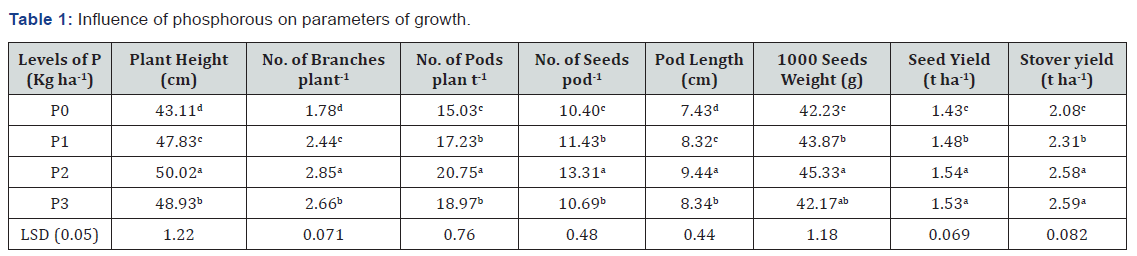
Mung bean plants revealed significant variation in respect of
plant height, number of branches plant-1, number of pods plant-1,
number of seeds pod-1, Pod length, 1000 seeds weight, seed yield
(t ha-1) and stover yield (t ha-1) when phosphorus application
in different dosages were applied (Table 1). Plant height, number
of branches plant-1, number of pods plant-1, number of seeds
pod-1: Plant height, number of branches plant-1, number of pods
plant-1, number of seeds pod-1, Pod length and thousand seeds
weight were increased with P levels from 0-20kg ha-1. The taller
plant (50.02cm), number of branches plant-1 (2.85), number
of pods plant-1 (20.75) and number of seeds pod-1 (13.31) were
achieved with the application of 20kg P ha-1. On the other hand,
the shorter plant (43.11cm), number of branches plant-1 (1.78),
number of pods plant-1 (15.03) and number of seeds pod-1 (10.40)
were observed where no application of phosphorous. The result
is approved with the findings of Kumar et al. [13]. Pod length and
weight of 1000-seeds as affected by different doses of phosphorus
showed significant variation statistically. Among the different doses
of Phosphorous the highest pod length (9.44cm) and thousand
seeds weight (45.33g) was observed in P2 (20kg P ha-1). The lowest
pod length (7.43cm) and thousand seeds weight (42.23g) were
observed where no phosphorous fertilizers were applied i.e. P0.
The result is similar with the outcomes of Kumar et al. [13] who
detected significant increase in pod length, number of grains pod-
1, 1000 seeds weight, seed yield, and stover yield of mung bean
due to the application of increasing level of Phosphorous fertilizer.
Seed yield and stover yield was also found significant by different
doses of Phosphorous been applied (Table 1). The highest seed
yield (1.54t ha-1) was recorded in P2 (20kg P ha-1) but the highest
stover yield (2.59t ha-1) was recorded in P3 (30kg P ha-1) treatment.
The lowest seed yield (1.43t ha-1) and stover yield (2.08t ha-
1) of mung bean was recorded where no phosphorous application
was applied i.e. P0. There was no significant difference between
P2 and P3 treatments. The result is fixed with the findings of Oad
et al. [14] who recorded significant increase in grain yield, and
straw yield of mung bean by the application of 100kg P fertilizer.
Effect of zinc on growth and yield of mung bean
Mung bean crop revealed significant variation for plant height,
number of branches plant-1, number of pods plant-1, number of
seeds pod-1, pod length, 1000 seeds weight, seed yield and stover
yield different dosages of zinc were applied. Plant height, number
of branches plant-1, number of pods plant-1 and number of seeds
pod-1. Among zinc fertilizer dosages, Zn2 (4kg Zn ht-1) showed the
taller plant (50.55cm), number of branches plant-1 (2.54), number
of pods plant-1 (19.11) and number of seeds pod-1 (11.70). On
the divergent, the shorter plant (46.80cm), number of branches
plant-1 (2.01), number of pods plant-1 (15.34) and number of seeds
pod-1 (10.14) was noted in the treatment where no application of
zinc was practiced. Islam et al. [15] noticed significant increase in
plant height, number of branches plant-1, number of pods plant-1
and number of seeds pod-1 of mung bean due to the application of
0.3% - 0.6% ZnO solution. Among the different Zn doses, Zn2 (4kgZn ha-1) showed the highest pod length (9.43cm) and 1000 seeds
weight (42.86g). On contrary, the lowest pod length (8.04cm) and
1000 seeds weight (38.22g) was noted where no application of
zinc practiced i.e. Zn0. Islam et al. [15] recorded significant increase
in length of pod of mung bean due to the application of
0.3% - 0.6% ZnO solution. Among the zinc fertilizer dosages, Zn2
(4kg Zn ha-1) gave the highest seed yield (1.77t ha-1) and stover
yield (2.77t ha-1) of mung bean. On the other hand, the lowest seed
yield (l.38t ha-1) and stover yield (2.19t ha-1) of mung bean were
found in Zn0 where no Zn fertilizer was applied. Zn 1 and Zn 2
were statistically similar in case of stover yield (Table 2).

Interactive effect of phosphorous and zinc on yield and yield attributes of mung bean
Mutual application of dosages of phosphorus and zinc revealed
significant effect on the plant height, number of branches
plant-1, number of pods plant-1, number of seeds pod-1, pod length,
thousand seeds weight, seed yield and stover yield of mung bean.
The shorter plant (41.55cm), number of branches plant-1 (1.58),
number of pods plant-1 (14.06) and number of seeds pod-1 (8.74)
were observed where no phosphorous and zinc application applied
i.e. P0Zn0. On the contrary the taller plant (53.45cm), number
of branches plant-1 (3.32), number of pods plant-1 (20.89) and
number of seeds pod-1 (12.98) were noted in P2Zn2 (20kg P ha-1
+ 4kg Zn ha-1) treatment combination. Ahmed et al. [16] recorded
significant increase in plant height, number of branches plant-1,
number of pods plant-1 and number of seeds pod-1 of mung bean
due to the increasing application level of P and Zn. The highest pod
length (10.57cm) and thousand seeds weight (45.66g) were noticed
in P2Zn2 (20kg P ha-1+ 4kg Zn ha-1) treatment combination.
On the divergent, the lowest pod length (6.43cm) and 1000 seeds
weight (38.98g) were noted in P0Zn0. Singh et al. [17] recorded
significant increase in pod length and thousand seeds weight of
mung bean due to the increasing application levels of P fertilizer.
The highest seed yield (1.94t ha-1) and stover yield (2.69t ha-
1) of mung bean were verified with the treatment combination of
P2Zn2 (20kg P ha-1 + 4kg Zn ha-1). On the other hand the lowest
seed yield (1.09t ha-1) and stover yield (2.06t ha-1) of mung bean
were recorded in P0Zn0 and P0Zn1 (No P and 1.5kg Zn) treatment
combinations, respectively. Singh and Bajpai 18 found that P and
Zn enhance significantly the grain as well as stover yields of chickpea
[18] (Table 3).

Conclusion
On the Basis of the results of the present findings, the following
recommendation may be considered - Application of Phosphorus
and Zinc fertilizers @ 20kg P ha-1 and 4kg Zn ha-1 may be the finest
combination for higher yield of mung bean and also to conserve
soil fertility and productivity than their individual application.
To know more about Journal of Agriculture Research- https://juniperpublishers.com/artoaj/index.php
To know more about open access journal publishers click on Juniper publishers


Comments
Post a Comment