Performance Evaluation of Improved Vetch Varieties/Accessions at the Highland of Guji Zone, Bore, Ethiopia-Juniper Publishers
Journal of Agriculture Research- Juniper Publishers

This study was conducted with an objective of
introducing, adapting, see the yield, quality and recommends improved
vetch accessions/varieties to the area in a randomized complete block
design (RCBD) with three blocks. Accessions/varieties were (Vicia
Villosa IRLI, Vicia Atropurporeum, Vicia Villosa Holota, Vicia Sativa
ICARD 61509, Vicia Sativa ICARD 61744, Vicia Dyscarpa Lana, Vicia
Dyscarpa Namoi, Vicia Narbonesis, Lelisa, Abdeta and Gebisa). The
analysis of yield and yield components and quality of the tested vetch
shows that Vicia Sativa ICARD 61744 was significant in seed yield which
is not statistically different from Vicia Sativa ICARD 61509 and less in
Acid Detergent Fiber (ADF) content than the rest accessions. Vicia
Sativa ICARD 61509 was significant in Dry Matter Yield (DMy) and it is
similar with other accessions except Vicia Dyscarpa Namoi. Vicia Vilossa
Holeta was significant in green forage yield and highest in Organic
matter (OM), Crude Protein (CP) and In vitro Organic matter
digestibility (DOMD) and. Abdeta was significant in seed per pod, seed
yield and Harvesting Index (HI) and highest in OM. Lelisa is significant
in green forage yield and late in date of maturity than the rest
varieties at (P<0.05).Therefore, based on the performance of most
parameters, Vetch accessions/varieties, Vicia atropurputeum, Vicia
villosa Holota, Vicia sativa ICARD61509 and Vicia sativa ICARD61744, in
2010 and Gebisa and Lelisa, in 2011 were selected and recommended to
highland of the Guji zone. Therefore, those accessions have to be
evaluated under farmers’ conditions so as to prove their best performing
ability. .
Keywords: Improved; Quality; Vetch; Yield
Abbreviations:
ADF: Acid Detergent Fiber; OM: Organic Matter; CP: Crude Protein; DOMD:
In vitro Organic Matter Digestibility; HI: Harvesting Index; OARI:
Oromia Agricultural Research Institute; NDF: Neutral Detergent Fiber;
ADL: Acid Detergent Lignin; GLM: General Linear Model
Introduction
Among a number of annual legumes introduced so far
vetches are one the leguminous forages adapted to the highland of
Ethiopian [1]. Vetches are being used for disease break, crops in the
rotation, grain crops, for stock feed, hay production and green and dry
grazing. As fodder crops, vetches mixed mainly with oats or other minor
cereals such as barley and can be fed to animals while green or as hay
or silage. Their matting types of growth not only protect the soil
erosion but also can improve the physical and fertility states of the
soil [1]. Vetches apart from being able to stay green in to the dry
season are high in protein content and have a considerable potential for
increasing forage quality. Information on feed quality is one of the
decision support tools required to provide rational basis to optimize
utilization of feed resources, to improve animal production and
productivity and ultimately to increase financial return to the
producer. The feasibility of
livestock enterprise is largely a function of the type, quality of feed
and the strategy of feeding.
Removing or reducing nutritional constraints leads to
dramatic improvement in livestock production and productivity. Dynamic
changes have been made in the areas of feed evaluation, nutrient
requirement and feeding systems [2]. Several environmental, genetic and
genotype by environment interaction aspects are expected to influence
chemical composition and nutritive value. Compositional data information
on digestibility and estimated metabolizable energy offers opportunity
to formulation of least cost ration. Vetches apart from being able to
stay green in to the dry season are high in protein content and have a
considerable potential for increasing forage quality [1]. There is no
any animal feed technology which is tested in the study area (Guji zone)
and no information on forage nutritional quality due to the remote ness
of the area and Bore Agricultural Research was established
recently. This experiment was initiated to introduce, evaluate
vetch genotypes for yield and yield attributes, see the adaptability
to that specific agro-ecology and see the nutritional quality of
adapted vetches. Therefore, this experiment was conducted with
the objectives of introducing, adapting, see the yield, quality and
recommend improved Vetch accessions/varieties to the area so as
to address farmers in quality and large quantity of forages.
Materials and Methods
Description of the study area
The experiment was carried out at Bore Agricultural Research
Center, which is one of the recently established Research Centers
of the Oromia Agricultural Research Institute (OARI) in Bore district,
Guji Zone of Oromia. Bore district is located at 385km to the
south from Addis Ababa and 220km from the Guji Zone capital
city (Negele) with geographical location of 557’23” to 626’52” N
latitudes and 3825’51” to 3856’21” E longitudes, South-eastern
Oromia. It has moist humid and sub humid moisture condition,
with relatively longer growing season. The annual rain fall is
about 1400-1800mm and the annual temperatures of the district
ranged from 10.1 to 20 ˚C. The major soil types are Nitosols (red
basaltic soils) and Orthic Aerosols [3]. Bore Agricultural Research
station is located at 7km from Bore district which is geographically
located at 624’37” N latitude and 3834’76” E longitudes. The
research site represents highlands of Guji Zone with an altitude of
2736m.a.s.l. receiving high rainfall characterized by bimodal distribution.
The first rainy season extends from April to October and
the second season starts late November and ends at the beginning
of March. The soil type of the site is mostly black soil.
Experimental procedures
The trial was arranged in randomized complete block
design
(RCBD). There were three blocks each containing 7 plots of vetch
accessions (Vicia Villosa IRLI, Vicia Atropurporeum, Vicia Villosa
Holota, Vicia Sativa ICARD 61509, Vicia Sativa ICARD 61744, Vicia
Dyscarpa Lana and Vicia Dyscarpa Namoi) resulting to twenty-
one plots in total in 2010 summer season and 4 plots of Vetch
varieties/accessions (Vicia Narbonesis, Lelisa, Abdeta and Gebisa)
resulting to twelve plots in total in 2011 summer season with each
plot measuring 3m x 4m. Distance between plots and replication
were 1m and 1.5m respectively. Plots in each block were randomly
assigned to the seven treatments. Broad casting methods and no
fertilizer were applied at the planting time for treatments of Vetch
accessions in 2010. Row method and 35cm spacing between rows
were applied for Vetch Varieties/accessions in 2011.
The nutrient analysis was conducted at Adami Tulu Agricultural
Research Center and Holeta Agricultural Research Center Laboratory.
Composite samples of Vetch accessions/varieties were collected
at 50% flowering stage at each consecutive year. Samples
were dried at 65 ˚C in a forced draft oven for 72hrs. All samples
were ground using a willy mill and allowed to pass through 1mm
screen, run in duplicates and Dry matter (DM), Ash, Crude protein
(CP), Neutral Detergent Fiber (NDF), Acid Detergent Fiber (ADF),
Acid Detergent Lignin (ADL) and In vitro dry matter Digestibility
(DOMD) were determined by Near Infra-Red Reflectance) NIRRS
methods and Hemicellulose was calculated by subtracting the ADF
from the NDF content while cellulose was determined by subtracting
the ADL from the ADF content and results were carefully collected.
The weighed fresh subsample (FWss) was oven dried at 60
˚C for 72 hours and reweighed (DWss) to give an estimate of dry
matter production. The dry matter production (tone/ha) was calculated
as (10 × TotFW × (DWss / HA× FWss)) [4].
Where;
TotFW = total fresh weight from plot in kg; DWss = dry weight
of the sample in grams; FWss = fresh weight of the sample in
grams; HA = Harvest area meter square and 10 = is a constant for
conversion of yields in kgm2 to tone/ha. Harvest index (HI) was
calculated on a plot basis, as the ratio of dried grain weight adjusted
to 12.5% moisture content to the dried total above ground
biomass weight.

Data collected
Date of emergency, date of 50% flowering, green forage yield,
dry matter yield (DMy), plant cover, disease score, pest, pod per
plant, seed per pod, date of maturity, seed yield, harvesting index
(HI) and chemical composition data were carefully collected for all
accessions/varieties at consecutive years.
Statistical analysis
Data on agronomic parameters, yield and chemical analysis
was analyzed by using SAS computer software (SAS, 2002 version
9.1) and General Linear Model (GLM) was used at 5% significance
level.
Results
Yield and yield components
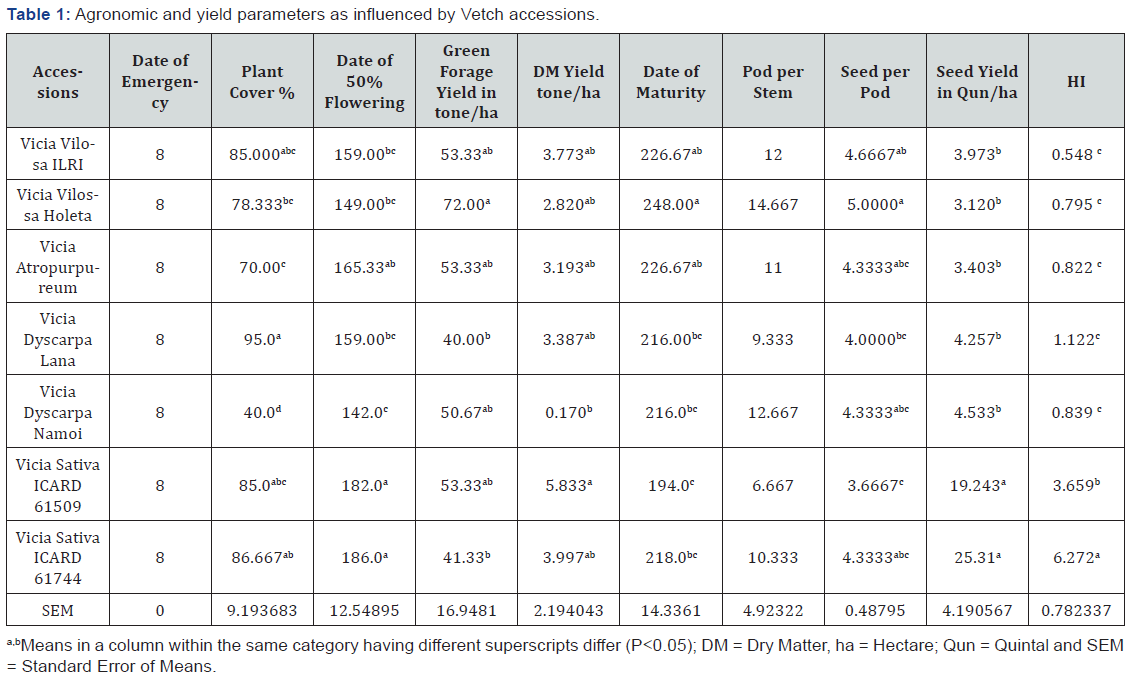
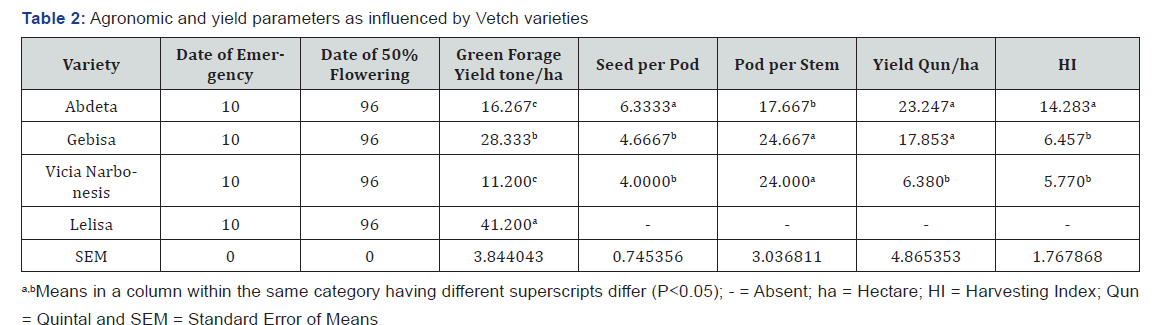
The analysis of variance shows that there was a significant difference
between accessions/varieties of vetch in date of flowering,
green forage yield, dry matter yield, date of maturity, seed per pod,
pod per stem, seed yield and plant vigor (Table 1 & 2).
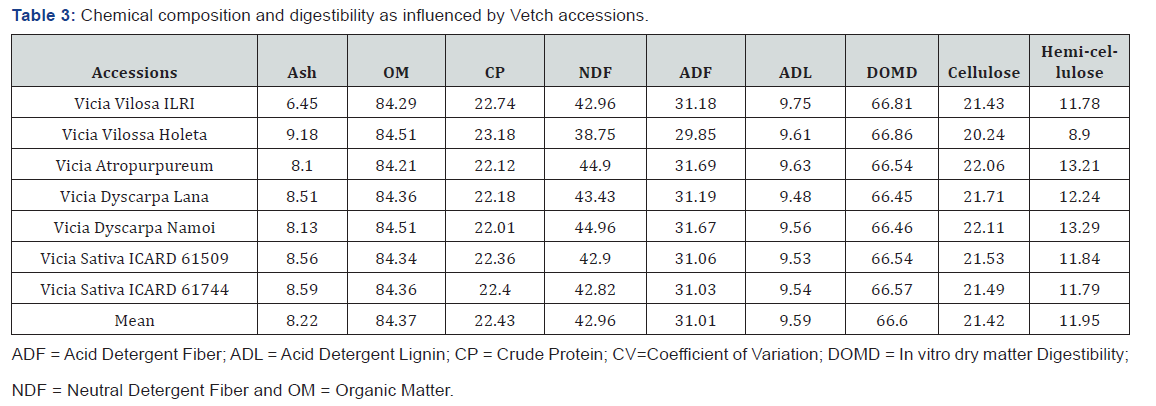
Chemical composition (Table 3)
Discussion
Yield and yield components
From accessions tested in 2010 summer season, Vicia
Sativa
ICARD 61744 was significant in date of 50% flowering and seed
yield which is not statistically different from Vicia Sativa ICARD
61509 in both parameters and Vicia Atropurpureum in 50% date
flowering. Whereas it is significant than the rest accessions at
(P<0.05). Regarding maturity, Vicia Vilossa Holeta was late matured
accession as that of Vicia Vilosa ILRI and Vicia Atropurpureum
than the other accessions. Vicia Sativa ICARD 61509 was
significant in DMy and it is similar with other accessions except
Vicia Dyscarpa Namoi which is less significantly. Vicia Sativa
ICARD 61509 was less significant in seed per pod than the rest
accessions,
Vicia Vilossa Holeta was significant in green forage yield
and Vicia Dyscarpa Lana was significant in plant cover than other
accessions at (P<0.05).
From vetch varieties/accessions tested in 2011 summer season,
Abdeta was significant in seed per pod, seed yield and HI and
less significant in green forage yield than the rest varieties/accessions,
Gebisa was significant in pod per stem and seed yield and
less significant in HI, Vicia narbonesis was significant in date of
maturity and pod per stem and less in green forage yield per hectare
and HI and Lelisa is significant in green forage yield and late in
date of maturity than the rest varieties at (P<0.05) and that is why
it is unable to produce seed at that specific area due to long rainy
season which causes it to become green throughout.
Chemical composition
From vetch accessions tested in 2011 summer season (Table
3), Vicia villosa Holeta was highest in Ash, OM, CP and DOMD and
less in NDF content, Vicia Dyscarpa Namoi was highest in OM, NDF
and less in CP content, Vicia Vilosa ILRI was significant in ADL and
less in Ash content, Vicia Atropurpureum was significant in ADF
and less in OM content, Vicia Dyscarpa Lana was less in DOMD
and Vicia Sativa ICARD 61744 was less in ADF content than the
rest accessions at (P<0.05). From tested varieties/accessions in
2011(Table 4), Vicia narbonesis was highest in Ash, CP, ADL and
DOMD and less in NDF and ADF content, Gebisa was highest in
NDF and ADF and less in Ash, CP, ADL and DOMD content, Abdeta
was highest in OM and less in CP and is less in OM and ADL content
at (P<0.05). The CP content of all accessions were above the
average CP content of a feed which is 10.6, but less than the CP
content of protein supplement feed which is 32.6. The result is in
line with the suggestion of Van Soest (5], which noted the CP content
of young herbage to be as high as 14 to 16%. This level of CP is
above the recommended minimum level of CP in the diet of ruminants
for optimum rumen function [6]. Decrease in NDF content
has been associated with increasing digestibility and hence feed
intake [5,7]. The NDF content of all accessions were less than the
average NDF content of feed which is 56.2. Roughage diets with
NDF content of 45-65 and below 45% were generally considered
as medium and high-quality feeds, respectively [8]. The NDF percentage
of Vetch recorded in this experiment ranged below the
45% value which can be categorized as high-quality feed category.
The ADF content of Vetch accessions are in the medium range of
quality [9] except Vicia villosa Holeta (29.85%) which is in a high
range since legumes with less than 31% ADF value are rated as
having superior quality whereas those with values greater than
55% are considered as inferior quality. All Vetch accessions consisted
ADL (limits DM intake) value was below 10% which is in
a good range [10]. The Cellulose and hemicelluloses contents of
all the tested vetch accessions/varieties were below those of most
tropical grasses, 31.9% and 35.4% respectively as noted by Moore
and Hatfield [11] which categorized the feed under good quality.
The DOMD content of all accessions were above the average DOMD
content of a feed and protein supplement feeds which is 50.3 and
65.3 respectively. The increase in the DOMD of Vetch accessions is
due to an increase in crude protein and decrease in ADF and ADL.
The increase in digestibility also will lead to increased feed intake
as digestibility and feed intake are positively correlated [5,12].

Conclusion
Access to new and improved agricultural technologies especially
that of forage is highly limited in Guji zone of Oromia, most
probably due to the remoteness from the center and in accessibility
of the area. That is why Bore Agricultural Research Center
paved the way to adapt and recommend new accessions/varieties
of forages to the area. Based on the results obtained from
the adaptation and nutritional quality analysis improved Vetch
accessions/varieties, Vicia atropurputeum, Vicia villosa Holota,
Vicia sativa ICARD61509 and Vicia sativa ICARD61744, in 2010
and Gebisa and Lelisa, in 2011 were selected and recommended
to highland of the Guji zone. Therefore, those accessions have to
be evaluated under farmers’ conditions so as to prove their best
performing ability.
To know more about Journal of Agriculture Research- https://juniperpublishers.com/artoaj/index.php
To know more about open access journal publishers click on Juniper publishers


Comments
Post a Comment