Response of Maize Crop to Deficit Irrigation and Planting Methods-Juniper Publishers
Journal of Agriculture Research- Juniper Publishers

Irrigation and planting methods are considered some
of the important factors affecting yield of maize. To evaluate the
effect of different Irrigation levels and planting methods on the
performance of maize, an experiment was conducted at Agronomy research
farms of The University of Agriculture Peshawar during summer 2017. The
experiment was laid out in Randomized complete Block design with split
plot arrangement having four replications. Deficit irrigations (Full,
one missing at six leaves stage, one missing at twelve leaves stage, one
missing at flowering stage, one missing at grains fillings stage) were
allotted to main plots and planting methods (Ridge, flat, broadcast)
were assigned to sub plots. Deficit irrigation had significant effect on
plant stem thickness, Ear weight, ear length, plant height, cob height
above the soil and biological yield. Highest plant stem thickness
(1.98cm), Ear weight (106.42g), ear length (16.45cm), plant height
(199cm), cob height above the soil (87cm) and biological yield
(13433.25kg ha-1) were attained from Full irrigation. Planting method
had significant effect on plant stem thickness, No of leaves plant-1, No
of Nodes plant-1, ear weight, ear length, plant height, cob height
above the soil, biological yield. Highest plant stem thickness (1.82),
No of leaves plant-1 (15), No of Nodes plant-1 (7), ear weight (102.15),
ear length (15.50), plant height (196.10), cob height above the soil
(86.10), biological yield (11899.90) were attained from ridge planting
method. It is concluded that Ridge planting method give a positive
response in majority of the parameters and improve maize yield. Among
deficit irrigations, deficit irrigation at tasseling and grain filling
stage significantly reduce yield of maize.
Keywords: Deficit irrigation; Planting method and Maize; Biological yield
Introduction
Maize (Zea mays L.) is a monoecious plant of poacea
family and is extensively grown in temperate, subtropical and tropical
regions of the world. Its range of adaptation stretches from 50o N to
40o S latitude and can be grown at an altitude from sea level to 3300
meters above sea level [1]. In Pakistan, during 2014, it was cultivated
on 1168.5 thousand hectares with total production of 4944.5 thousand
tones and productivity of 4317kg ha-1 [2]. Maize is the second most
important crop after wheat in Khyber Pakhtunkhwa (KPK) of Pakistan. It
is used as a fodder in a majority of the farming systems and staple food
in the rural areas of the province, especially at high altitudes. It is
also used in industries for making starch, oil, polishes, etc. [3].
During 2014, maize was grown on 470.9 thousand hectares in KPK with
total production of 914.8 thousand tones and productivity of 1943kg ha-1
[2]. The reasons for low production include poor soil preparation, weed
infestation, inefficient irrigation system and water scarcity.
In recent years water resources and planners and
researchers have diverted their attention towards deficit irrigation
which has been widely recognized as a valuable strategy for dry regions
[4].
Deficit irrigation maximizes water productivity, which is the main
limiting factor. In other words, the aim of deficit irrigations to
stabilize yield and to get high field water application efficiency [5].
Pereira et al. [5] while working in cornell, USA reported that up to 60%
deficit irrigation application resulted in only 13% wheat grain yield
reduction.
Deficit irrigation progressively affected the
productivity of water, generally with adequate harvest quality, allows
efficient economic planting and consistent income due to stabilization
of the harvest in comparison with rain fed cultivation. It also
decreases the risk of certain diseases like in high humidity (e.g.
fungi) in contrast with full irrigation. To make water resource-saving
techniques workable for farmers in Pakistan and getting higher water
productivity, crop should be cultivated under a certain level of deficit
irrigation because every crop has a critical limit up to which it can
tolerate water deficit, but after the limit it starts losses in growth
and yield. Similarly, [6] reported that mild stress had less effect on
photosynthesis but moderate and sever water stress significantly
decreases photosynthesis. The loss in grain yield by deficit irrigation
can be covered by using better sowing methods
and soil moisture conservation practices in combination with deficit
irrigation.
Materials and Methods
The experiment was conducted at the research farms of The
University of Agriculture Peshawar during summer 2017. The experiment
was laid out in RCBD with split plot arrangement having
four replications. The experiment comprised of two factors: Factor
A. Deficit Irrigation in which irrigations I1= Full irrigation, I2=
one missing at six leaves stage, I3= one missing at twelve leaves
stage I4= one missing at flowering stage I5= one missing at grains
fillings stage at were allotted to main plots, while planting methods
PM1= Ridge, PM2= flat, PM3= broadcast) was allotted to sub
plots. The size of sub plot was 14m2 (4m × 3.5m). Each subplot
consists of 5 rows having 70cm row-to-row and 20cm plant-toplant
distance. The recommended rate of NPK (120-60-0Kg ha-1)
were applied uniformly to all plots. Full P and half N was at the
time of sowing and half N was applied before flowering. Different
cultural operations were performed such as thinning, weeding
and pesticide application when needed in order to keep the plants
healthy and active during the whole life cycle of the crop. The crop
was sown (Azam Variety) on 26th of June 2017 and was harvested
during the month of September 2017.
Statistical Analysis
For statistical analysis of the recorded data, analysis of variance
procedure was followed according to RCBD split plot. Means
was compared using least significant differences (LSD) test at P≤
0.05 upon significant F-test [7].
Results
Plant stem thickness

Irrigation 1 = Full irrigation (10 irrigations).
Irrigation 2 = Deficit irrigation (one irrigation missing at six leaves stages).
Irrigation 3 = Deficit irrigation (one irrigation missing at twelve leaves
stage).
Irrigation 4 = Deficit irrigation (one irrigation missing at flowering stage).
Irrigation 5 = Deficit irrigation (one irrigation missing at grain filling
stage).
LSD value for irrigation at ≤ 0.05=0.034.
LSD value for planting methods at ≤ 0.05=0.024.
Data regarding plant stem thickness as affected by planting
methods and deficit irrigation are presented in Table 1. Analysis
of the data showed that irrigation and planting methods has significantly
affected stem thickness. The interaction was non-significant.
Mean values of irrigation showed that maximum stem thickness
(1.98cm) was recorded from full irrigation (10 irrigations)
and minimum plant stem thickness (1.23cm) was observed from
deficit irrigation (one irrigation missing at twelve leaves stage).
Mean values of planting methods showed that maximum stem
thickness (1.82cm) was recorded in ridge planting and minimum
plant stem thickness (1.32cm) was noted from broadcast planting
method.
Ear weight (g)
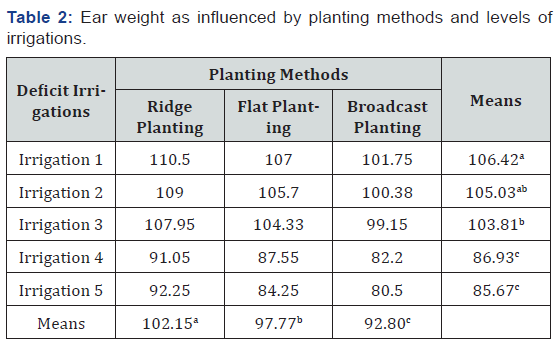
Irrigation 1 = Full irrigation (10 irrigations).
Irrigation 2 = Deficit irrigation (one irrigation missing at six leaves stages).
Irrigation 3 = Deficit irrigation (one irrigation missing at twelve leaves
stage).
Irrigation 4 = Deficit irrigation (one irrigation missing at flowering stage).
Irrigation 5 = Deficit irrigation (one irrigation missing at grain filling
stage).
LSD value for irrigation at ≤ 0.05 =0.499.
LSD value for planting methods at ≤ 0.05 =0.234.
Data regarding Ear weight (g) as affected by planting methods
and deficit irrigation are presented in Table 2. Analysis of the
data showed that irrigation and planting methods has significantly
affected ear weight (g). The interaction was found non-significant.
Mean values of irrigation showed that maximum ear weight
(106.42g) was recorded from full irrigation (10 irrigations) and
minimum ear weight (85.67g) was observed from deficit irrigation
(one irrigation missing at grain filling stage). Mean values of planting
methods showed that maximum ear weight (102.15g) was recorded
from ridge planting and minimum ear weight (92.80g) was
noted from broadcast planting method.
Ear length (cm)
Ear length (cm) of maize as affected by planting methods and
levels of irrigation are presented in Table 3. Analysis of the data
showed that irrigation and planting methods has significantly affected
ear length (cm). The interaction was non-significant. Mean
values of irrigation showed that maximum ear length (16.45cm) was recorded from Full irrigation (10 irrigations) and minimum
ear length (12.78cm) was observed from Deficit irrigation (one
irrigation missing at grain filling stage). Mean values of planting
methods showed that maximum ear length (15.50cm) was recorded
from ridge planting and minimum ear length (14.08cm) was
noted from Broadcast planting method.
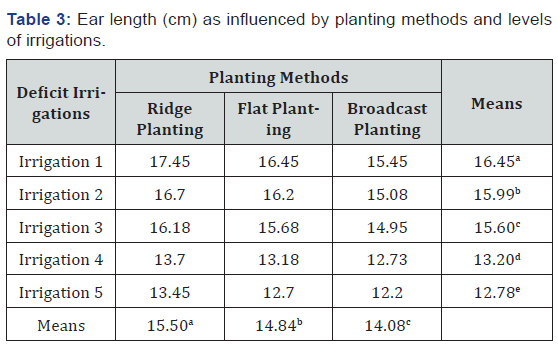
Irrigation 1 = Full irrigation (10 irrigations).
Irrigation 2 = Deficit irrigation (one irrigation missing at six leaves
stages).
Irrigation 3 = Deficit irrigation (one irrigation missing at twelve leaves
stage).
Irrigation 4 = Deficit irrigation (one irrigation missing at flowering stage).
Irrigation 5 = Deficit irrigation (one irrigation missing at grain filling
stage).
LSD value for irrigation at ≤ 0.05 =0.112.
LSD value for planting methods at ≤ 0.05 =0.109.
Plant height (cm)
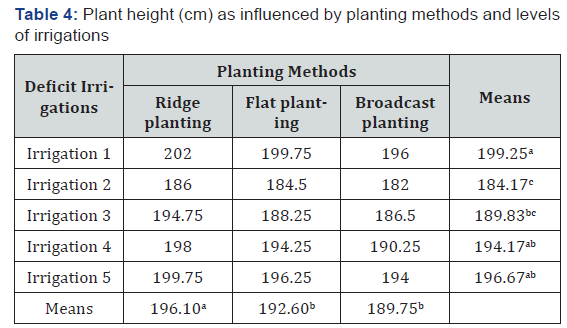
Irrigation 1 = Full irrigation (10 irrigations).
Irrigation 2 = Deficit irrigation (one irrigation missing at six leaves stages).
Irrigation 3 = Deficit irrigation (one irrigation missing at twelve leaves
stage).
Irrigation 4 = Deficit irrigation (one irrigation missing at flowering stage).
Irrigation 5 = Deficit irrigation (one irrigation missing at grain filling
stage).
LSD value for irrigation at ≤ 0.05=2.186.
LSD value for planting methods at ≤ 0.05=0.720
Plant height (cm) of maize as affected by levels of irrigations
and planting methods are presented in Table 4. Analysis of the
data showed that irrigation and planting methods has significantly
affected Plant height (cm). The interaction was non-significant.
Mean values of irrigation showed maximum Plant height
(199.25cm) from treatment of Full irrigation (10 irrigations) and
minimum Plant height (184.17cm) was observed from Deficit irrigation
(one irrigation missing at six leaves stage). Mean values
of planting methods showed that highest plant height (196.10cm)
was recorded in ridge planting and lowest plant height (189.75)
was noted from Broadcast planting method.
Cob height above the soil (cm)

Irrigation 1 = Full irrigation (10 irrigations).
Irrigation 2 = Deficit irrigation (one irrigation missing at six leaves stages).
Irrigation 3 = Deficit irrigation (one irrigation missing at twelve leaves
stage).
Irrigation 4 = Deficit irrigation (one irrigation missing at flowering stage).
Irrigation 5 = Deficit irrigation (one irrigation missing at grain filling
stage).
LSD value for irrigation at ≤ 0.05=1.676.
LSD value for planting methods at ≤ 0.05=0.707
Cob height above the soil (cm) of maize as affected by levels of
irrigations and planting methods are presented in Table 5. Analysis
of the data showed that irrigation and planting methods has
significantly affected cob height above the soil (cm). The interaction
was non-significant. Mean values of irrigation showed that
maximum cob height above the soil (87.92cm) was recorded from
Full irrigation (10 irrigations) and minimum cob height above the
soil (72.67cm) was observed from Deficit irrigation (one irrigation
missing at six leaves stage). Mean values of planting methods
showed that maximum cob height above the soil (86.10cm) was
recorded in ridge planting and minimum cob height above the soil
(75.70cm) was noted from Broadcast planting method.
Biological yield (kg ha-1)
Biological Yield (kg ha-1) of maize as affected by levels of irrigations
and planting methods are presented in Table 6. Analysis
of the data showed that irrigation and planting methods has significantly
affected biological Yield (kg ha-1). The interaction was
non-significant. Mean values of irrigation showed that maximum
biological Yield (13433.25kg ha-1) was recorded from Full irrigation
(10 irrigations) and minimum biological Yield (9119.50kg ha-
1) was observed from Deficit irrigation (one irrigation missing at
six leaves stage). Mean values of planting methods showed that maximum biological yield (11899.90kg ha-1) was recorded from
ridge planting and minimum biological yield (10819.60kg ha-1)
was noted from Broadcast planting method.
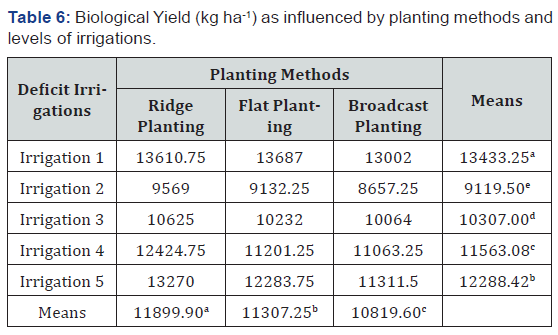
Irrigation 1 = Full irrigation (10 irrigations).
Irrigation 2 = Deficit irrigation (one irrigation missing at six leaves
stages).
Irrigation 3 = Deficit irrigation (one irrigation missing at twelve leaves
stage).
Irrigation 4 = Deficit irrigation (one irrigation missing at flowering stage).
Irrigation 5 = Deficit irrigation (one irrigation missing at grain filling
stage).
LSD value for irrigation at ≤ 0.05 =118.933.
LSD value for planting methods at ≤ 0.05 =95.687.
Discussion
The data collected in accordance with the procedure outlined
in materials and methods, which are further described in experimental
results in previous chapter, are discussed in the light of
literature collected for the purpose of clarification and comparison.
Data regarding plant stem thickness as affected by planting
methods and levels of irrigation presented in the previous chapter
showed that deficit irrigation and planting methods had significantly
affected plant stem thickness. Plots applied with full irrigation
results in maximum plant stem thickness compared with
plot having one irrigation missing at twelve leaves stage. These
results are in agreement with those of [8] who reported maximum
plant stem thickness with levels of irrigations. Plant stem thickness
increased with ridge planting method compared with broad
cast method. Same finding was reported by [9]. They reported that
maximum plant stem thickness from ridge planting method.
Data regarding ear weight presented in previous chapter
showed that irrigation and planting methods had significantly
affected ear weight. In case of irrigation, maximum ear weight
was recorded in plots applied with Full irrigation while minimum
ear weight was observed in plots with one irrigation missing at
grain filling stage. These results are in agreement with those of [4]
who reported highest ear weight from full irrigation. Ear weight
increased with ridge planting compared with Broadcast method.
Same finding was reported by [10] they reported that ear weight
was increased with planting maize crop on ridges.
Analysis of data revealed that ear length was remarkably affected
by irrigation and planting methods. Plots with full irrigation
results in maximum ear length compared with plot having one irrigation
missing at grain filling stage. These results are in agreement
with those of [11] and [12] who reported increase in ear
length with full irrigation. Highest ear length was observed with
ridge planting method compared with broad cast method. Similar
results were obtained by [11] they reported that ear length was
increased with planting maize crop on ridges.
Data regarding plant height presented in previous chapter
showed that irrigation and planting methods had significantly affected
plant height. In case of irrigation, the maximum plant height
recorded from plots applied with Full irrigation while minimum
plant height was observed in plots with one irrigation missing at
six leaves stage. Same finding was obtained by [13]. Plant height
was increased with ridge planting compared with Broadcast
method. Huang et al. [9] Recorded the same result regarding increase
in plant height with ridge planting.
Cob height above soil was significantly affected by irrigations
and planting methods. Highest cob height above soil was recorded
in plots applied with Full irrigation while minimum cob height
above soil was observed in plots having one irrigation missing at
six leaves stage. These results are in agreement with those of [8].
They reported maximum cob height above soil by providing full
irrigation. Cob height above soil was increased with ridge planting
compared with Broadcast method. Kilic [14] Reported the same
result regarding increase in cob height above soil with ridge planting.
Data regarding Biological yield as affected by planting methods
and deficit irrigation presented in previous chapter showed
that irrigation and planting methods had significantly affected
biological yield. In case of irrigation, the highest biological yield
recorded from plots applied with full irrigation while lowest biological
yield was observed in plots with one irrigation missing
at six leaves stage. Same finding was obtained by [13]. Biological
yield was increased with ridge planting compared with broadcast
method. Bakht et al. [15] Concluded that ridge sown maize produced
maximum biological yield.
Conclusion
On the basis of findings obtained in this research study. It is
concluded that:
a. Ridge planting method give a positive response in majority of
the parameters and improve maize yield.
b. Among deficit irrigations, deficit irrigation at tasseling and
grain filling stage significantly reduce yield of maize.
Deficit irrigation at 6 leaves stage were resulted in reduction
of vegetative growth.
To know more about Journal of Agriculture Research- https://juniperpublishers.com/artoaj/index.php
To know more about open access journal publishers click on Juniper publishers


Comments
Post a Comment