Effect of Foliar Application of Zinc and Boron on Growth and Yield Components of Wheat-Juniper Publishers
Journal of Agriculture Research- Juniper Publishers

A field experiment entitled “Effect of foliar
application of Zinc and Boron on growth and yield components of wheat”
was conducted at Bacha Khan Agricultural Research Farm (BARF), Bacha
Khan University, Charsadda during the winter season 2015-16. The aim of
the experiment was to investigate the effect of foliar application of
Zinc and Boron on growth and yield components of wheat. Treatments
included zinc (as zinc sulfate 25g/L-1), boron (as boric acid 20g/L-1)
and zinc plots boron (as zinc sulfate and boric acid 25 g/L-1 and
20g/L-1, respectively). Water spray and no spray were used as control.
The experiment was planned according to randomized complete block design
(RCBD) consisting of three replications. Seed was applied at the rate
of 100kg ha-1. The recommended dose of NPK was applied at the rate of
60, 75 and 0kg ha-1 respectively. It was revealed from that the results
of the experiments that foliar application of zinc + boron in wheat
showed significant variation for all of the parameters recorded during
the course of study except days to emergence. In case of interaction,
maximum plant height (103cm), grains spike-1 (45), 1000 grains weight
(37g), grain yield (5966.67kg ha-1), biological yield (19059kg ha-1) and
harvest index (31.30%) were recorded with foliar application of zinc +
boron. Maximum plant height (102cm), grains spiek-1 (44.6), 1000 grains
weight (36g), grain yield (5743kg ha-1), biological yield (14707.7kg
ha-1) and harvest index (39.06 %) were recorded with foliar application
of zinc.
Keywords: Wheat; Zinc; Boron; Foliar
Introduction
Wheat (Triticum aestivum L.) is a member of family
gramineae. In Pakistan, wheat is used as a staple food. Wheat plays a
major role in the world food trade. Wheat provides around 20% of protein
and calories consumed around the world. In Khyber Pakhtunkhwa it was
grown on about 0.746 million hectares with annual production of 1.76
million tones. The average yield was 2359 kg ha-1 [1]. Wheat is the
major source of plant-based human nutrition and a part of daily dietary
need in one form or the other. A conservative estimate illustrates two
and half times low yield in Pakistan than other wheat producing
countries of the world including China, India, USA, Russia and France
[2].
Micronutrients play a vital role in plant nutrition
and plant production. Agricultural soils generally show deficiency in
micronutrients such as zinc, boron, iron and copper. The deficiency may
occur due to the low contents of micronutrients [3]. Wheat is known to
respond to the application of several macro and micronutrients during
its growing stages and results in enhanced output in terms of yield.
Although micronutrients comprising zinc, copper, iron, manganese, boron,
molybdenum and chlorine are required by plants in much smaller amounts,
they are as essential as the major nutrients such as nitrogen,
phosphorus, potassium
etc. Arif [4] found that foliar application of micronutrients at
tillering, jointing and booting stages help in improving yield of wheat.
Foliar application is credited with the advantage of quick and
efficient utilization of nutrients, eliminating losses through leaching,
and fixation and helps in regulating the uptake of nutrients by plants
[5]. The benefit of nutrients application on leaves is that it gets very
quickly and directly to the leaf cells where they are utilized [6].
Boron is one of the seven essential micronutrients
required for the normal growth of most of the cereal, fruit and
vegetable crops. It also influences cell development and elongation [7].
Boron affects carbohydrates metabolism and plays a role in amino acid
formation and synthesis of proteins [8]. Deficiency of boron can also
cause reduction in crop yield and inferior crop quality. Boron is an
essential plant food element, having a specific role in growth and
development of plants.
Abbas [9] found that different Zn levels
significantly affected spike length, number of spikelet spike-1,
1000-grains weight and straw yield. Habib [10] reported that Zn spray
increased grain yield of wheat and its relevant traits. El-Ghamry [11]
stated that foliar micronutrients (Boron and Zinc) gave the maximum
mean values of all investigated yield parameters. Ali [12] stated
that significant increase was recorded in number of spikes m-2
grains spike-1, 1000-grain weight, biological yield and grain
yield for foliar application of Zinc and Boron as compared to
both the control treatments. Zinc concentration of plants is also
affected by organic matter, water situation, and texture of the
soils [13]. The primary tasks of foliage are photosynthesis and the
regulation of transpiration. Because of their structure, leaves can
uptake nutrients under certain conditions and to a certain extent
only [14]. The role of essential microelements Zinc was proved
in forming of more than 200 enzymes [6]. Keeping in view the
increasing demand of wheat worldwide, the present study was
therefore carried out to investigate the effects of different foliar
applications of Zn and B on growth and yield components of the
wheat variety Pirsabak-2013.
Materials and Methods
A field experiment entitled “Effect of foliar application of
Zinc and Boron on growth and yield components of wheat” was
conducted at Bacha Khan Agricultural Research Farm (BARF),
Bacha Khan University, Charsadda during the winter season 2015-
16. The aim of the experiment was to investigate the effect of foliar
application of Zinc and Boron on growth and yield components
of wheat. The experiment was planned according to randomized
complete block design (RCBD) consisting of three replications,
each replication having 5 plots. The variety Pirsabak-2013 was
used as test variety. The net plot size was 5x1.8m2 with 5 rows.
Plot to plot distance was 0.5m while replication to replication
distance was kept 1m. Row to row distance was 30cm. Seed was
applied at the rate of 100kg ha-1. The recommended dose of NPK
was applied at the rate of 60, 75 and 0kg ha-1 respectively. Urea and
DAP were used as sources of N and P respectively. Full dose of DAP
was applied at the time of sowing. Half of Urea was applied at the
time of sowing and the remaining half was applied after the first
irrigation. Foliar spray of Zn, B and Zn + B was applied on February
18, 2016 i.e. at booting stage. All other agronomic practices were
kept uniform for all the plots of the experiment.
Results and Discussion
Days to physiological maturity
Table 1 shows data for days to physiological maturity of wheat
as affected by foliar application of Zinc and Boron. By analyzing
the data statistically, it was revealed that days to maturity of
wheat were significantly affected by foliar application of Zinc
and Boron. Control plots took maximum days to maturity (165).
Foliar application of zinc, boron and their combination resulted
in minimum number of days. To maturity i.e. 159, 161 and 159
respectively. It is revealed that both zinc and boron application
have maturity of the wheat crop. These results are in line with
Khalili et al. [16].
Plant height (cm)
Data for effect of foliar application of Zinc and Boron on wheat
is shown in Table 1
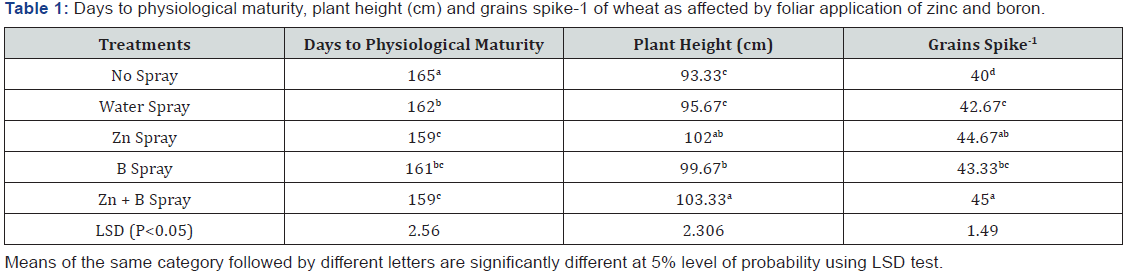
After statistical analysis of the data, it was revealed that plant
height of wheat was significantly affected by foliar application of
Zinc and Boron. Combined application of Zinc and Boron produced
maximum plant height (103.33cm) while the control plots
produced minimum plant height. Increase in plant height might
be the involvement of micronutrients in different physiological
processes like enzyme activation, electron transport, chlorophyll
formation and stomatal regulation etc. which ultimately resulted
in greater dry matter [16,17].
Grains spike-1
Grains spike-1 of wheat as affected by foliar application of zinc
and boron is presented in Table 1. Analysis of the data showed
that treatments significantly affected Grains spike-1 of the crop.
Maximum grains spike-1 (45) were recorded in plots sprayed with
combination of zinc and boron, while minimum Grains spike-1
(42.6) were recorded in plots without any spray. Increase in
number of grains spike-1 might be due to foliar application due
the involvement of B in pollen tube formation resulting in more
seed settlement. Deficiency of B at reproductive stage may result
in male sterility of wheat [18] leading to shorter anthers and nonfertility
of many florets and ultimately poor grain set per ear [19-
21].
1000-grains weight (g)
Statistical analysis of the data showed significant effect of
foliar application of Zn and B on 1000-grains weight of wheat
(Table 2). Maximum 1000-grains weight (37g) was noted in plots
which received foliar application of Zn + B while minimum 1000
grains weight (32g) was recorded in control plots. Increase in this
attribute by foliar spray might be due to the involvement of the
sprayed zinc and boron in enzyme activation, membrane integrity,chlorophyll formation, stomatal balance and starch utilization
at early stages which enhanced accumulation of assimilate in
the grains resulting in heavier grains of wheat at later stages. In
conformity, Soylu et al. [22], Guenis et al. [20] and Hussian et al.
[17] reported significant increase in 1000-grains weight of wheat
with foliar application of micronutrients.
Grain yield (kg ha-1)
Table 2 shows data for grain yield of wheat as affected by foliar
application of Zn and B. Statistical analysis of the data revealed
that the combine application of Zn and B produced maximum grain
yield (5966.67kg ha-1) while minimum grain yield (4921.3kg ha-1)
was recorded when no spray was used. Zinc and boron play a vital
role in increasing grain yield of wheat because zinc and boron take
place in many physiological process of plant such as chlorophyll
formation, stomatal regulation, starch utilization which enhance
grain yield of wheat [17]. Zinc also converts ammonia to nitrate in
crops which contribute to yield [23].
Biological yield (kg ha-1)
Data regarding biological yield are presented in Table 2.
The table shows that foliar application of Zn and B significantly
affected biological yield. Maximum biological yield (19059.7kg
ha-1) was obtained when Zn and B foliar application was used
while minimum biological yield (12929.3kg ha-1) was recorded
in plots with no spray. Application of micronutrients enhances
physiological processes in plant, resulting in enhanced Growth
and dry matter production [16,17]. As earlier reported in Table
2, application of zinc and boron resulted in higher plant heights
which resulted in higher biological yield of the crop.
Harvest index (%)
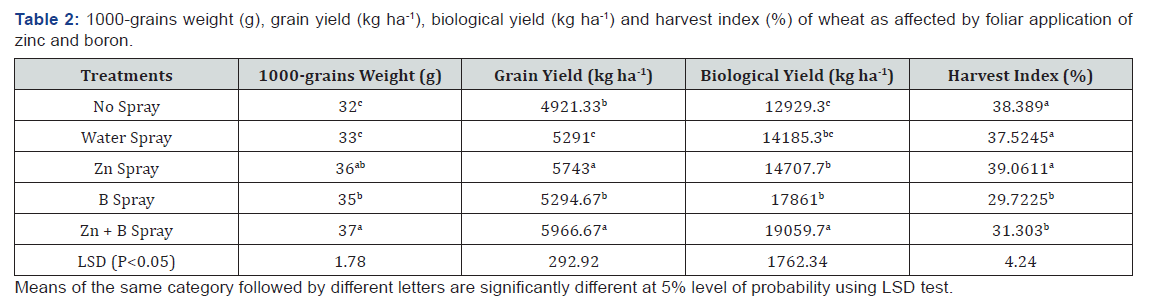
Harvest index of wheat as affected by foliar application of zinc
and boron is presented in Table 2. Analysis of data revealed that
significant differences occurred on the harvest index (HI) due
to difference treatments. Maximum harvest index was recorded
in plots sprayed with zinc. However, this was not significantly
difference from harvest index (29.72) was observed in plots with
boron. This too was similar to harvest index (31.30) from plots
sprayed with combination of zinc and boron. Foliar application
of zinc and boron significantly affected harvest index of wheat.
Maximum harvest index was recorded with zinc spray while
minimum harvest index was observed with boron application.
This might be due to better starch utilization resulting in more
seed set and developing grains which increases the grain size. The
result is in line with Gouis [24].
Conclusion
a. It was concluded from the results of the experiment
that maximum grains spike-1 and 1000-grains weight were
recorded for foliar application of Zn + B.
b. Similarly, biological yield and grain yield were also
maximum with the application of Zn + B spray.
To know more about Journal of Agriculture Research- https://juniperpublishers.com/artoaj/index.php
To know more about open access journal publishers click on Juniper publishers


Comments
Post a Comment