Effect of N Fertilizer Level and Plant Density on Grain Yield of Newly Released Maize Variety-Juniper Publishers
Journal of Agriculture Research- Juniper Publishers

Number of plants per unit area and the nitrogen
nutrient in the soil are the most leading factors for Maize production
as it lacks tillering capacity to adjust available spaces and its highly
responsiveness to available nitrogen. Thus, improving of these factors
to optimum level significantly increases the grain yield of the crop.
Particularly, BH-546 is recently released maize hybrid which has narrow
leaf area and erected leaf architecture that needs modification of plant
population with optimum nitrogen level to fully exploit its yield
potential. Based on this perspective, a field experiment was conducted
at three locations for three consecutive years (2016-2018) to determine
the optimum plant density and nitrogen level for high yield. The
experiment was laid out in a Randomized Complete Block Design in
factorial arrangement with three replications. Three plant density viz.,
44444, 53333, 62500 and 66666 with five nitrogen levels viz. 69, 92,
115, 138 and 161kg ha-1 were combined by factorial combinations and
tested in the experimental plots to select the optimum level for high
yield. Based on the results, the maximum grain yield (7713.3kilo gram
per hectare) was obtained when the hybrid was sown at the highest plant
density (66666 plants per hectare) with application of 115 kilo gram
nitrogen per hectare. This result showed 20.2% and 20.7% yield
advantages compared to the standard check and satellite check
respectively. Similarly, application of 115kg N ha-1 under 66666 plant
density was the most profitable compared to other combinations. Thus,
the highest plant population (66666 plants per hectare) with application
of 115kg N ha-1 is suitable for the higher yield of hybrid maize BH546
during main seasons for all locations.
Keywords: BH546; Nitrogen level; Plant density; Grain yield
Introduction
Maize (Zea mays L.) is one of the most widely
distributed cereal crops in the world. It is successfully grown in
diverse ecologies for various benefits of human beings. In Ethiopia,
maize is one of the top priority food crops selected to achieve food
security, particularly in the major maize producing regions, western,
north western and southern parts of the country. Currently, maize covers
large cultivated area (2,128,448.91 hectares), next to teff, and coming
first of all cereals in production and productivity in this country
[1]. Maize is one of an important source of food and income generation
on which 10573934 people depend on it for their livelihood [1]. It is
used for household diet in different forms. Bread, muffin, boiled grain,
enjera, local beer (tela), green cob and porridge are the most common
prepared forms for direct use [2].
The importance of maize particularly in the food
security attracted the attention of government to select it as one of
the national commodity crops to satisfy the food self-sufficiency
program of the country [3]. This situation leading various researchers
to emphasized on improvement of maize production through continual
practical research work. Due to these continue
efforts various hybrids with high yield potential and different
morphological characters were released through breeding. However, these
hybrids cannot exploit their yield potential fully under limited
nitrogen fertilizer as well as under scattered or too dense population.
Besides this the dynamic nature of soil (continuous degradation of soil
fertility through erosion, leaching and uptake) the recommended amount
of fertilizer in the past several years ago cannot be sufficient for the
current production. Similarly, the previously recommended plant
population cannot be appropriate for newly released maize hybrids of
modified architecture to exploit their yield potential. Thus, to achieve
maximum economic yield of maize hybrid BH546 determination of plant
population per hectare with appropriate N-fertilizer rate was needed.
Keeping this in view the study was conducted with objective: To evaluate
the effect of plant population and N fertilizer level on yield
potential of maize under various locations.
Materials and Methods
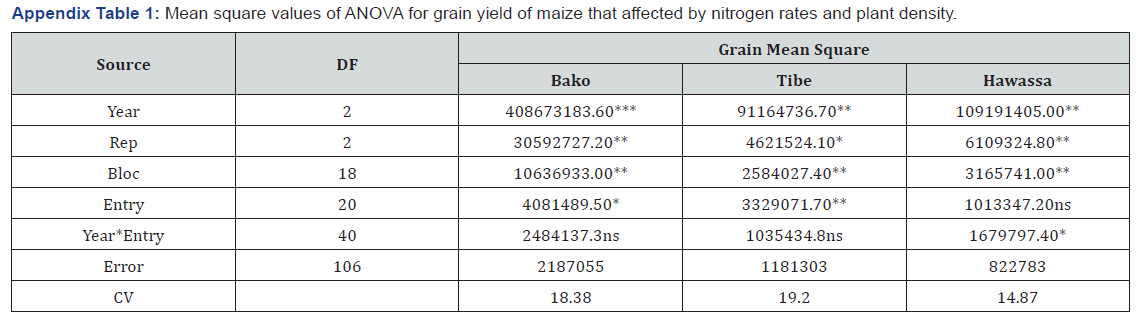
The experiment was conducted at three locations for three consecutive seasons, 2016-2018, (Table 1).
Experimental materials
Maize variety: Hybrid maize variety BH-546 was used for
the study. BH-546 is intermediate maturing variety released in
2013, performing well in agro-ecological range of 900-1800 meter
above sea level with rainfall range of 900-1200mm. It can give
8500-9500 and 5500-7000 kg ha-1 grain yield on-station and onfarm
experiments, respectively. It matures at about 145 days with
plant height of 250-260cm.
Fertilizer: Nitrogen fertilizer in the form of urea (46% N)
and NPS fertilizer in the form of (19% N, 38% P2O5, and 7% S)
were used as a source of nitrogen and Phosphorus respectively.
Nitrogen fertilizer was used for the experiment. It was applied at
different rates to each treatment

Treatment setup: The hybrids BH546 was treated under five
rates of Nitrogen (69Nkg/ha, 92N/ha, 115N kg/ha, 138N kg/ha
and 161N kg/ha) and four plant population densities as indicated
in Table 2. The treatment set up that contains 44444 plants ha-1
with application of 92kg N ha-1 was used as a standard check. One
satellite check plot having plant density (62, 500) with 150kg
NPSBZn blended fertilizer application was added as a second
check.
Experimental design
The experiment was laid out as a randomized complete block
design (RCBD) in factorial arrangement with three replications.
The gross plot size was 4.8m × 6m (28.8m2) with row length of
4.8m, but the net plot size 4.8m × 4.5m (21.6m2) was used for
harvesting to minimize the border effects on the grain yields.
The treatments were randomly assigned to the experimental unit
within a block. The blocks were separated by 2m wide space.
Experimental procedures
Land preparation was done three times from March to May
in each location by using tractor plough at Bako and Assosa;
and by using oxen plough at Tibe. Planting time was varied from
location to location and from year to year, but all planting times
were done in between May 17 to June 20. Planting was done with
one additional seed per hole, 1seed + required seed number for
each hole. Two weeks after planting, seedlings were thinned to
required plant per plot by keeping a good stand seedling for each
treatment.
Full dose of phosphate fertilizer in the form of NPS at the
national recommended rate of 69kg P2O5 ha-1 was applied
uniformly to all plots at the time of sowing. Half dose of nitrogen
fertilizer as per the treatments was applied at sowing time and
half dose of nitrogen fertilizer was applied four weeks after sowing
and immediately covered with soil. Any weeds were removed just
before the second split urea fertilizer application. The other crop
management practices were applied as per the recommendation
for maize. Finally, maize plants in the central net plot area were
harvested at harvesting maturity stage for the next work and
analysis.
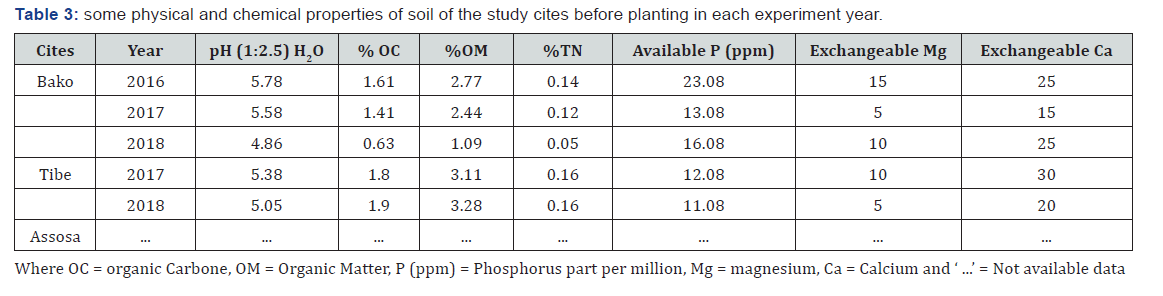
A representative Soil samples were taken 0 to 30cm depth
using an auger in a diagonal pattern among each 5m interval
before planting from each cite in each experimental year. Then
the soil samples were analyzed at soil laboratory for physical
and chemical properties (texture, soil pH, organic carbon, total N,
available phosphorus and cation exchange capacity (CEC) using
standard laboratory procedures (Table 3).
Crop data collection and measurement
Grain Yield was the targeted data and in all cites and in each
year grain yield data was taken
Statistical analysis
Analyses of variances for the data recorded were conducted
using the SAS version 9.3. Least significant difference (LSD) test
at 5% probability was used for mean separation if the analysis
of variance indicated the presence of significant treatment
differences.
Economic analysis
Economic analysis was performed to investigate the economic
feasibility of the treatments. The price of maize that farmers
received from sale was calculated based on current market price
of maize. The total variable costs including the cost of fertilizers,
improved seed and labors were also calculated based on the
current price. The net return was calculated by subtracting total
variable cost from the gross benefit. The Gross benefit was
calculated with that grain yield (kg ha-1) and stalk yield multiplied
by field price that is money gained from sale of the grain and stalk.
Finally, to assess the cost and benefit associated with different
treatments, the partial budget analysis technique of CIMMYT [4]
was applied.
Results
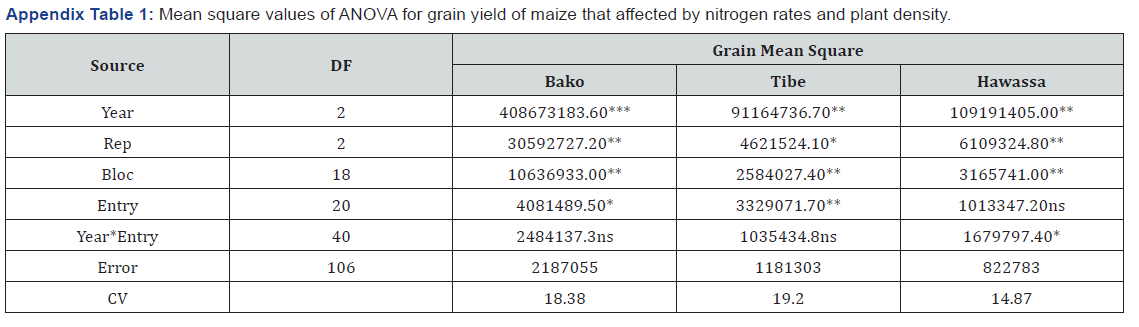
There was a significant difference among treatments at Bako
and highly significantly difference at Tibe. In all location the year
had highly significant effect on grain yield. But the interaction
between treatment and year at Bako and Tibe and; among
treatments at Hawasa had not shown any significant difference
(Appendix Table1)
The combined results of analysis showed that highly significant
(P<0.01) effect of year, location, block, entry and interaction
among year location and entry on the grain yield. However, the
interaction effects of year and location; and the year and entry
were not significant on grain yield of maize (Appendix Table 2).
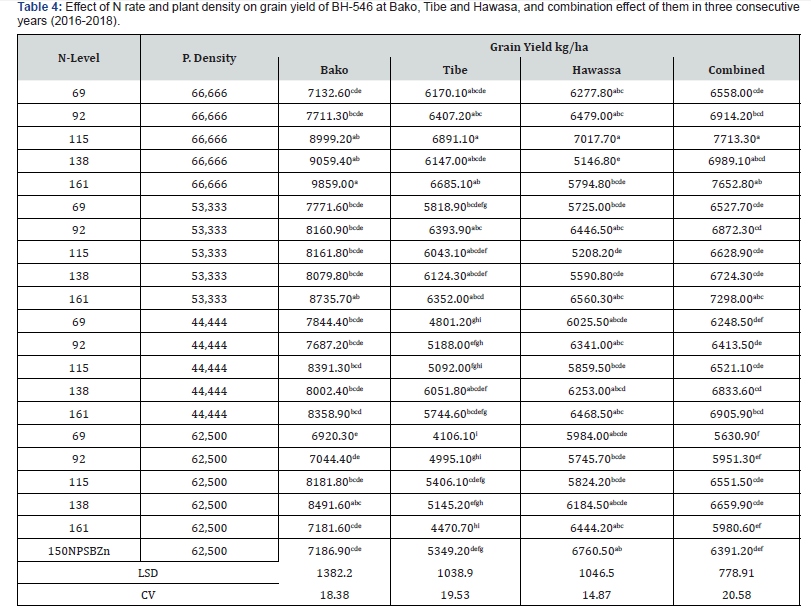
Maximum grain Yield 9859 kg ha-1 was recorded at higher
plant density (66666 plants ha-1) with application of 161kg N ha-1
at Bako. But statistically similar grain yield was recorded under
application of 115 and 138kg N ha-1 in the same plant density and
161kg N ha-1 under 53333 plants ha-1. In case of Tibe Maximum
grain Yield 6891.1kg ha-1 was recorded at higher plant density
(66666 plant ha-1) with application of 115kg N ha-1. But statistically
similar grain yield was recorded under 66666 and 53333 plants
ha-1 with application of either of N rate except 69kg application
on 53333 plants per hectare. But at Hawassa Grain yield had not
shown any significant differences among treatments.

In combined analysis, maximum grain yield (7713.3kg/ha)
was obtained under 66666 plant ha-1 with application of 115kg
N ha-1. However, statistically similar grain yield was also obtained
with increasing N rate at the same plant density and with highest
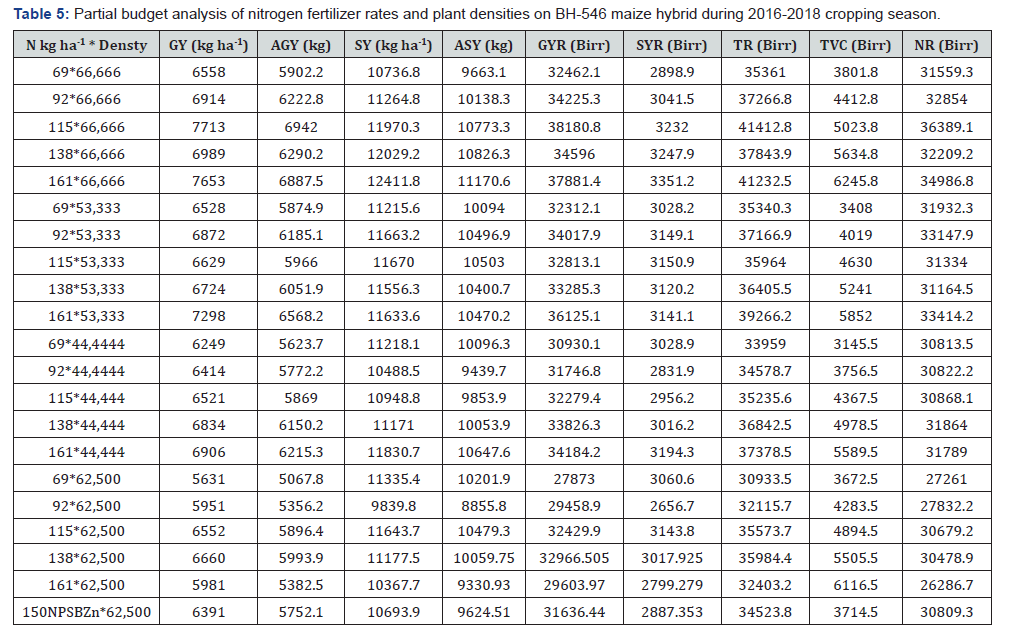
N rate under 53333 plants ha-1 (Table 4). But the maximum
economic return was achieved under treatment of 66666 plants
ha-1 with application 115kg N ha-1 compare to other treatments
(Table 5).
Discussion
The grain yield of maize increased with increasing plant
density. Maximum grain yield was obtained under highest plant
density (66666 plants per hectare) at all locations. Similarly,
Grain yield was also increased with increasing nitrogen rate up
to optimum. The combined analysis showed that maximum Grain
yield (7713.3kg ha-1) under 66666 plant density with application
of 115kg N ha-1.
Compared to the standard control of 44444 plant ha-1 with
the application of 92kg N ha-1, the mean grain yield was increased
by 1299.8kg ha-1 or 20.2% when the maize hybrid sown at 66666
plants ha-1 with application 115kg N ha-1. Similarly, the results
surpassed the satellite check plot by 20.7% (Table 4).
In general, the grain yield ha-1 was increased with the increase
plant density and N rate, although, economically faceable grain
yield was achieved at 115kg N ha-1. The positive relationship
between grain yield and plant density was due to the high number
of plants per unit area. The increased in maize grain yield under
high plant density might be due to efficient utilization of available
resources like nutrient, water, air and solar radiation. Maize
hybrids can be grown up to 76500 plant ha-1 with no adverse effect
on yield or grain quality [5]. Leaf area index and light interception
increased with increasing in planting density [6]. Farnia et al. [7]
reported that plant shortage per unit area prevents maximum
usage of production parameters while over density can increase
the competition and decrease the yield. Higher grains yield at
higher nitrogen levels might be due to the lower competition
for nutrient and positive effect of N on plant growth, leaf area
expansion and thus increase solar radiation use efficiency which
indirectly increases dry matter production for grain filling that
ultimately increases in grain yield [2]. These results are in line
with many workers [8,9].
Summary and Conclusion
The grain yield of BH 546 maize hybrid tends to increase
with increasing plant population and N fertilizer level. Maximum
grain yield ha-1 (7713.3kg) was obtained under plant density of
66,666 plant ha-1 with the application of 115kg N ha-1. This grain
yield result exceeds by 20.2% and 20.7% compared to the grain
yield of standard check and satellite check respectively. Similarly,
application of 115kg N ha-1 under 66666 plant density was the
most profitable compared to other combinations. Thus, this hybrid
should be sown with 66,666 plants ha-1 (75cm x 20cm spacing)
with application of 115kg N to ascend its production by 20% from
current production status.
To know more about Journal of Agriculture Research- https://juniperpublishers.com/artoaj/index.php
To know more about open access journal publishers click on Juniper publishers


Comments
Post a Comment