Ethno-Pharmacognosy and Diversity Encourage Conservation of Wild Ziziphus species Collected from KP, Pakistan-Juniper Publishers
Journal of Agriculture Research- Juniper Publishers

The genus Ziziphus consists of almost 100 species
been used in folk and alternative systems of treatment in order to
combat different diseases such as; fever, diabetes, skin infections,
antipyretic, antinociceptive, antioxidant, antilisterial and larvicidal
[1-4]. Due to peculiar geographical region, Pakistan exhibits a great
diversity of flora as represented by 7 genera along with 13 species for
Ziziphus [5].
Ziziphus oxyphylla Edgew (synonym; Ziziphus acuminata
Royle) also written as “Zizyphus oxyphylla Edgew” belongs to the genus
Ziziphus and family Rhamnaceae (known as buckthorn family). The plant Z.
oxyphylla, popular with common names i.e. Mamyanu, Elanai, Tukbari,
Phitni, Amlai and Sezen is a small glabrous tree with short, recurved
and unequal spine along with edible fruit (oval in shape), belongs to
the genus Ziziphus. Based on folklore use, the plant is in-use for
traditional treatment of diseases i.e. jaundices, diabetes, hypertension
as well as in gas trou
bles [6-9], since long, Z. oxyphylla distributed in different areas of
Pakistan, but mostly in warm temperate and subtropical regions
throughout the world, especially in Pakistan and India. In Pakistan it
may be found in different regions, particularly the rainy and mountain
areas as well as the Himalayan series of mountains. The plants is
distributed as; Swat Valley, Northern Pakistan, Chagharzai valley,
District Buner, KP, Pakistan [9], Buner, Hazara, Swat, Garhi Habibullah,
Dir Kohistan valleys, Pakistan [6,10], Kot Malakand agency, Islamabad ,
subtrop-ical hills of Darazinda, Takht-e-Suleman range Dera Ismail
Khan, Pakistan, Palas Valley, Pakistan, Kotli, Azad Jammu Kashmir,
Pakistan [11-13].
Ziziphus mauritina Lamk, is most important an
well-known species of Ziziphus belonged to buckthorn family Rahmnaceaes.
Z. mauritiana genotypes are very important medicine, ethno medicine and
traditionally for the control of different diseases cough, sore throat,
anti-oxidant, high fevers, jaundice, diabetes and hypertension etc,
[14-16s]. well distributed in different region of tropical and
sub-tropical areas of the world and mostly found in
all continent of the world and native of Afghanistan, Australia,
North Africa, North India, Malaysia, and southern China and Pakistan
Z. mauritiana is a dominates species/variety of wild vegetation
in different arid and as well as desert while in great examples
of drought and hard species of Ziziphus [17,18]. In Pakistan,
it is widely distributed in three provinces i.e. KPK, (Banuu, Karak
and Kohat) while district swat, Buner and Dir is found in only wild
from, Punjab (Attock, Chakwal and Mianwali districts) and Sindh
province (Karachi, Hyderabad and Nawabshah districts). In Pakistan,
jujube is cultivated on an area about 5.425ha with an annual
production of 28.000 tones [19].
There is lack of information regarding jujube cultivars in Pakistan.
Indigenous cultivars are missing and there is little research
work available on their botanical classification [18]. Fluctuation in
yield and quality of jujube fruit is greatly affected by the soil properties,
climatic factors and cultivar selection [20]. Fruit quality attributes
largely depend upon cultivar to be selected. Previously,
variations in fruit weight, juice content [21] and seed weight has
been recorded in jujube cultivars [22].
Morpho-biochemical methods are used to screened best genotypes
in large collected germplasm of different crop species [23-
30]. Among these methods the SDS-PAGE method is effectively
used to determinate the taxonomic and evolutionary difficulties
of certain plant species [28]. The seed storage protein studies help
in documentation and description of variability in crop varieties,
cultivars and their wild species but also rich genetic variability
and phylogeny association of the accessions. It is considered that
variability in protein bands intricate the association among the
assortment from various geographical regions [31]. SDS PAGE as a
powerful tool that has been used in the solution of problems in the
field of taxonomy and explains the origin and evolution of cultivated
plants, including the fenugreek [32].
It provides maximum variability among different crop species
and the level of polymorphism depends upon the plant species
[33]. Haliem and Huqail [34] found 168 different polypeptides
bands among diverse Fenugreek genotypes of Saudi Arab and Yemen
through SDS-PAGE method. They recorded 26 different polymorphic
bands characterized Brassica rapa sub-species brown
sarson through this method and recorded 83.33% polymorphic
protein bands. They also noted four different cluster groups for
the twenty studied genotypes. Jan et al. [28], evaluated three different
ecotypes of B. rapa through SDS-PAGE method and high
level of variability were noted in protein bands size. Protein electrophoresis
is considered a reliable, practical and reproducible
method because seed storage proteins are the third hand copy of
genomic DNA and largely independent of environmental fluctuations
[34,35].
The main objectives of the current research studies on Ziziphus
species (1) ethno medicinal uses of Ziziphus species in local peoples
(2) to explore different aspects the genetic relationship of
wild Ziziphus species (Z. oxyphylla and Z. mauritiana) genotypes
based on different morphometric collected from different regions
of district Swat KP, Pakistan (2) to study genetic diversity based
on store seed protein (SDS-PAGE) of wild Ziziphus species of their
genotypes (3) by the using of multivariate analysis, phylogenetic,
PCA, for the checking of their relationship of wild Ziziphus species
collected from different regions of distract Swat KP, Pakistan.
Materials and Methods
Samples collection and Ethno-pharmacognosy
Exploratory trips were arranged to different areas of KP, Pakistan
years, 2017-2018 and total two Ziziphus species (50 genotypes)
were identified and investigated for morphological characterization
and SDS PAGE protein profiling. The plants (Ziziphus
species) Z. oxyphyla and Z. mauritina specimen were store in the
herbarium Department of Botany, Hazara University, Mansehra,
KP, Pakistan; the specimens were recognized referring different
Floras, viz., Hooker (1872-1897). Ethno medicinal data has been
collected through Participatory Rural Appraisal (PRA), which is
based on communication with indigenous people and direct communication
in the field Martin [36]. The data have been noted
through semi-structured interviews with people involved in the
plants, organization [37]. A total of 130 residents have been interviewed
during the field survey, information on uses of plants
to cure various diseases of human being, parts used, of medicine
have been collected. Based on the information obtained from the
informants in the study area, all the reported diseases have been
classified into 12 groups.
The different level of the similarity among information delivered
by various informants was calculated by the Informants’
Consensus Factor, ICF Trotter and Logan [38] by applying the following
formula:
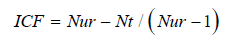
Where, Nur = number of use reports from informants for a
specific plant-use category; Nt = number of taxa or species that
are used for that plant use category for all informants.
ICF Values range between 0 and 1, where ‘1’ indicates the
highest level of informant agreement. The fidelity level (FL), the
percentage of informants claiming the use of a certain plant species
for the same major purpose, was calculated for the most frequently
reported diseases or ailments as:

Where, Np = number of informants that claim a use of a plant
species to treat a particular disease; N = number of informants
that use the plants as a medicine to treat any given disease [37].
Morphological analysis
In the current work qualitative and quantitative
characterizations
were carried out of the collected samples, Qualitative
traits were recorded on the general visualization (phenotypic
observations). Ten qualitative traits i.e. Tree vigor, Leaf type, Leaf
shape, Leaf colure, Tomentose, stem color, Spines, fruit color, leaf
margin, fruit shape and quantitative characters which were measured
with the help of vernier caliper for the measurement of
plant height(feet), Branching, Leaf length(mm), Leaf width(mm),
Leaf thickness(mm), Petiole length(mm), Inter node length(cm),
Stem diameter(inches), fruit weight, fruit diameter (mm) and fruit
length (mm).
Protein extraction and their preparation
Total seed protein (SDS-PAGE), a single mature and uncontaminated
seed of Z. oxyphylla and Z. muritiana was selected for the
analyses of total protein form each genotype collected from different
regions of Swat KP, Pakistan. The seed was ground through the
pestle and mortar and for the extraction of total protein and were
add 400μl protein extraction buffer composition as (0.5M Tris-
HCL pH 8.0, 0.2% SDS, 5M Urea, 1% B-mercaptoethanol) to 0.1g of
seed powder into 1.5mL eppendr of tube and then vertex for three
(3), mints thoroughly to homogenize the powder and solution.
Bromo-Phenol Blue (BPB) solution was added to the protein
extraction buffer as tracking dye to monitor the movement of
protein in the gel, then samples were centrifuge for 40 mints at
14,000rpm at 10 0C and follow the standard electrophoretic method
[4,39]. After centrifugation samples the curd protein were recovered
as a clear supernatant on the top of the tube. Then were
transferred into a new tube and were store at 120 0C until electrophoresis.
After that for the checking of make 12% polyacrylamide
gel the separation gel were making form the mixing of (3.0M Tris-
HCl pH9.0, 0.4% SDS) and 4.5% stacking gel (0.4M Tris-HCl pH8.0,
0.4% SDS), Electrode buffer (0.025 M Tris, 129 M Glycine, 0.125%
SDS) was add into the top of the gel plate and select total volume
as 8μl of the protein extraction mixture were loaded into each well
of the gel with the help of micropipette and add molecular markers
and finally run 100V until the blue color were passed through
the bottom of the gel plates, the gel were stained by the staining
solution containing 0.2% BPB dissolved in 10% glacial acetic acid,
40% methanol and water in the ratio of 10:40:50. Gels were destained
in a solution consisting 5% acetic acid and 20% methanol
for 15 minutes [40].
Data analysis The current data was recorded from the design gel (destined) on the basis of absences and presences of total seed protein gel bands, 1 is denoted for the presence and 0, for the absence of the loci were arranged in Microsoft excel 2010, and this 0, 1 data were analyzed for cluster analysis and PCA (Principles Component Analysis) was performed by PCord 5.0, SSPS and Statistics.
Results
Ethno-pharmacognosy
The current research work on two wild Ziziphus species Z.
oxyphylla and Z. mauritina collected from different regions of KP,
Pakistan, we have been in listed for control of diseases categories
as12 and for each Ziziphus species , scientific name, family , local
name, illnesses to be treated, and parts used for the different diseases
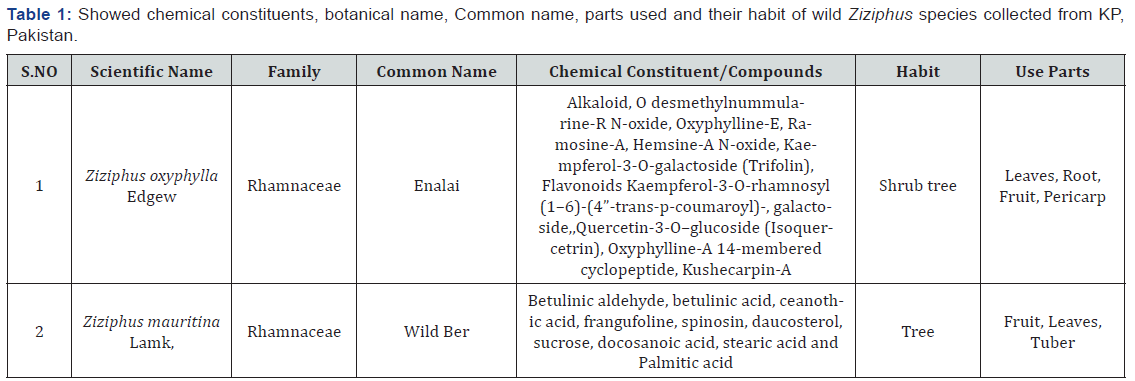
were noted in (Table 1). Consumption of plant parts as medicine
among the informants shows disparities. Fruits are mostly
used part for majority, followed by roots, leaves and bark, this was
the first time of the study area threat to the species is marginal as
seeds are the leading plant part used for medicinal purposes. It
was supposed that the collection of part of plant as medicinal part
from the wild were not manageable. According to residents, this
type of activity is done by the collectors related to illegal activity
of medicinal plants. Ziziphus species mostly Z. oxyphylla is vulnerable
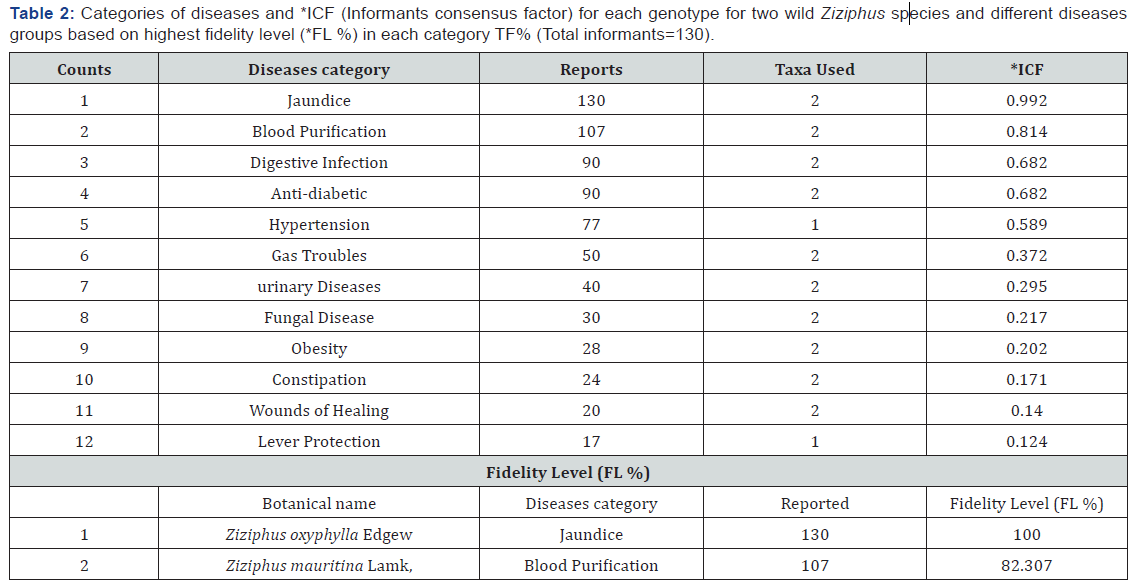
to this type of activity in the study region. ICF values were
established to know the settlement among the informants of Swat
valley for usage of plants to cure certain illness groups. The ICF
values ranges from 0.992 to 0.124 with an average value of 0.440.
Jaundice has the highest ICF value 0.992 with 130 use-reports for
2 plant species.
The specie liable for this high consensus was Z.
oxyphylla with
130 of the defined events, linked by Blood purification values for
ICF 0.8140, 107 use reports and 2 species respectively, for the use
of Digestive infection ICF values 0.682, 90 and for 2 species etc
(Table 2). Medicinal plants thought to be effective in treating specific
illness have high ICF values. The high ICF value for Urinary
infection possibly unveiled that this ailment is common in the
study area High ICF values also designate that the specie predictably
used to treat these illnesses are worth searching for bioactive
compounds. The least agreement (ICF=0.124) between the informers
was detected for plants used to cure Lever protection. The
low ICF value as noted in our study could be due to a lack of
communication among people in various areas. To discover conventionally
significant medicinal species in the society, Fidelity Level
(FL) of plants has been predicted based on use reports which have
been cited by 50 or more informants for being used against a given
disorder and the examination demonstrated that the highest FL
value found in Z. oxyphylla followed by Z. mauritina respectively.
The least FL value was found in the case of Z. oxyphylla. FIC and
FL studies presented that the most commonly used species in the
study area are Z. oxyphylla (ICF = 0.992) with 130 use-reports and
FL value (100%). When choosing the most ideal plant species for
each ailment category, we took the high-fidelity Level (%) in each
category of ailment due their high biological compounds which
were used for the control of various numbers of diseases (Table 2).
Morphological characterization
In the current work qualitative and quantitative characterizations
were carried out of the collected samples, Qualitative traits
were noted on the general visualization (phenotypic observations).
qualitative traits i.e. Leaf pubescent, Leaf shape, Leaf color,
fruit color, Seed shape and quantitative characters which were
measured with the help of vernier caliper for the measurement of
plant height (feet), Branching, Leaf length (mm), Leaf width (mm),
Leaf thickness (mm), Petiole length (mm), Inter node length (cm),
Stem diameter (inches), fruit weight, fruit diameter (mm) and
fruit length (mm).
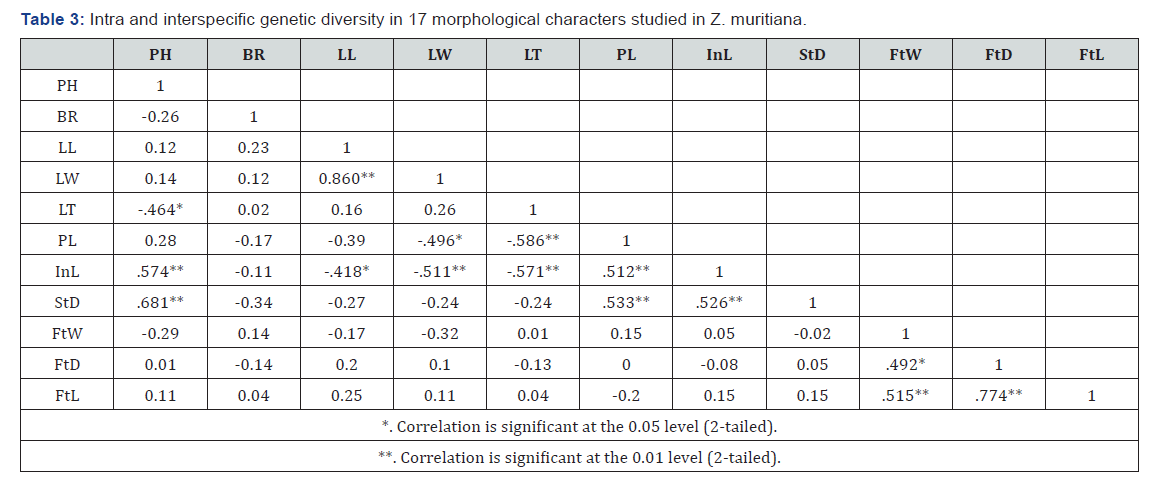
By using the Pearson correlation coefficient, the
result for the
association coefficient among the various traits for the two species
of Ziziphus (Z. oxyphylla and Z. muritiana) was performed (Table 3
and 4). In correlation study the petiole length in the Z. oxyphylla, is
negatively correlated with leaf length in the while positively
correlated
with leaf length in Z. muritiana. Leaf width is negatively
correlated with the leaf length in Z. oxyphylla while positively
correlated
in the Z. muritiana. The flower length in Z. muritiana and
Z. oxyphylla is negatively correlated with the leaf length and leaf
width and so on.

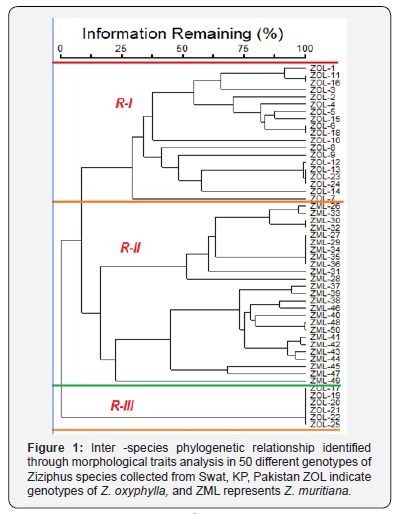
The double data matrix of 50 genotypes based on morphology
was analyzed for the construction of phylogenetic tree to represents
the similarity of various species or genera and the two
species of the Ziziphus were investigated for similarities and the
phylogenetic tree was constructed. The phylogenetic tree divided
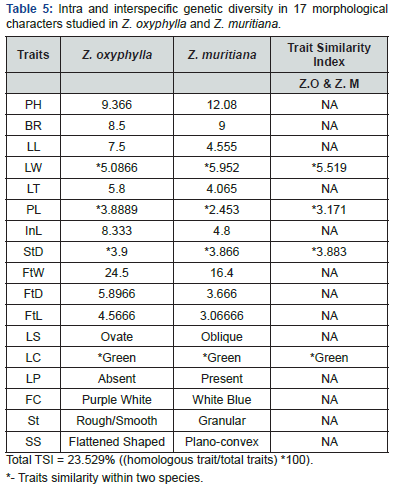
the two species in three groups R1. RII and RII (Figure 1). R1 and
RII consisted of total genotypes of Z. oxyphylla. While the RII was
into composed of all genotypes of Z. muritiana. The similarity indexes
were performed for all the genotype of 2 species that was
23.529% for Z. muritiana and Z. oxyphylla (Table 5).
SDS- PAGE analysis
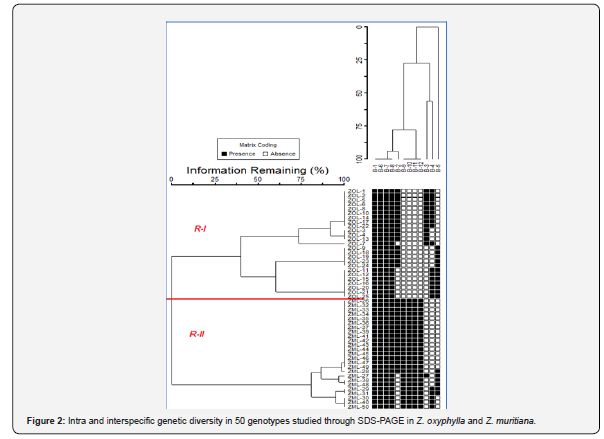
Total 12 bands were observed in the both of species, the phylogenetic
relationship among the 2 species through phylogenetic
tree has been shown in the (Figure 2). The phylogenetic tree was divided into two regions. R-I comprised of only genotype of
Z. oxyphylla collected from (KP, Pakistan), while Regon II consists
of genotypes of Z. muritiana collected from (KP, Pakistan) respectively.
Locus variation
Table 6 show interspecific variation among 50 genotypes of
the Ziziphus (Z. oxyphylla and Z. muritiana) species. Among all the
genotypes, 12 loci (L1-L12) were noted out of these L1, 6, 7 and 8
was monomorphic and were marked as generic specific which is
used to discriminate the Ziziphus species. Moreover, the loci L-2,
L-4, L-5, L-9, L-10, L-11 and L-12 marked as polymorphic with 34,
70, 68, 70, 50, 50, 50 and 50 percent genetic diversity, respectively.
The inter species comparative locus contribution toward genetic
disagreement (CLCTGD) was 66.66% in the two species of 50
Ziziphus genotypes (Table 6 and Figure 2). Intraspecific locus variation
among 25 genotypes of Z. oxyphylla is represented in Table
7, Notably, L-9, 10, 11, 12 were absent in Z. oxyphylla. L-1, L-6, L-8
was monomorphic in Z. oxyphylla. While L-2, 3, 4 and L-5 was polymorphic
and the locus contribution toward genetic disagreement
(LCTGD) of Z. oxyphylla was 41.66% (Table 7).
The Table 7 represents the intraspecific variation among the
25 genotypes of Z. muritiana, exhibited high intra-specific locus
variation. Among 12 loci, out of which L-1, 7, 8, 9, 10, 11 and 12
was monomorphic, while L-2, L-4, L-5and L-6 were polymorphic.
The locus contribution toward genetic disagreement (LCTGD) of Z.
muritaiana was 25% (Table 7).
Discussion
Many of the local communities in the regions depends on
the consumption of medicinal plants to use for the control/use
against different number of diseases, However, the vanishing of
these plant species is steadily reported chiefly due to fluctuations
in the environment, land degradation and unsustainable use of
these plants; moreover, the expansion of invasive species has donated
a lot to their disappearance [41]. Conservation of medicinal
plant genetic diversity has freshly created a lot of attention in
the tropics as a result of many years of misconduct, adverse environment
as well as socio-economic changes. Population genetic
theory expects that the reduction in the genetic diversity limits a
species ability to keep pace with the changing selection pressure
[42]. Plant species mainly the medicinal plants rely on the existing
genetic diversity for constancy and survival under the ever-fluctuating
environments [43]. Understanding medicinal plants species
population genetic structure is vital for their conservation, planning
and justifiable organization [44].
Therefore, a common goal line of conservation is to preserve
genetic diversity in “red listed” species, which is crucial for longterm
survival and evolutionary response to the altering environment
[45]. One main implication of this method, from the viewpoint
of conservation genetics, is that it could help us set sampling
intervals of areas within populations to optimize the genetic diversity
in collections from local populations of rare, endangered,
or endemic plant species [46]. For the purpose of conservation of
plant species, most of the investigations deal only with determination
of genetic diversity in individual populations [40].
The purpose of this study was to recognize the phylogenetic
relationship, genetic diversity, genetic structure, and a core collection
of Ziziphus species. Now, we explain our consequences with
respect to genetic diversity and the causes of the genetic idleness.
The current position of genetic structure is briefly debated. Moreover,
we further clarify the competence of the plan used to build
the core collection. Genetic redundancy is a significant issue in
plant genetic resource management. The identification of duplicates
is important in germplasm repositories, particularly when
considering the construction of core collections [40].
Various apparatuses are now presented for documentation of
required differences in the genotypes, including morphological
/ phenotypic, biochemical and molecular markers [40]. Though
morphological description is the principal step in the description
and alliance of crops genotypes, but these are highly subjective
by the environment [40]. The double data matrix of 50 genotypes
based on morphology was analyzed for the construction of phylogenetic
tree to represents the similarity of various species or
genera and the two species of the Ziziphus were investigated for
similarities and the phylogenetic tree was constructed (Figure 1).
The phylogenetic tree divided the two species in three groups R1,
RII and RII (Figure 2). R1 and RII consisted of total genotypes of Z.
oxyphylla. While the RII was into composed of all genotypes of Z.
muritiana. The similarity indexes for all the genotype of 2 species
was 23.529% for Z. muritiana and Z. oxyphylla [47].
The two plant species under the genus Ziziphus study exposed
that no two plants have similar protein banding patterns which
demonstrates the presence of genetic diversity between these
species. The presence of common bands/locus (L-1, 6, 7, 8) among
these two Ziziphus species suggests their close genetic similarity
and common ancestry [40]. Also, [40] accredited the appearance
of a common locus/band in all individual in a population to the
fact that the gene coding for the enzyme or protein does not differ.
Due to High inter-species locus contribution toward genetic disagreement
SDS-PAGE could be a reliable technique for identification
of these two species, while intra-specie locus contribution toward
genetic diversity was high in genotypes of Ziziphus oxyphylla
(41.66%) as compare to Z. muritiana (25%).
Conclusion
Best of our current study was first time to investigated that
the seed protein and ethno medicinal uses of wild Ziziphus species
collected from different regions of KP, Pakistan, the genetic pool of
dissimilarity within genotypes and Z. oxyphylla and Z. mauritiana
as well, is due to selection as well as for the crops/plants species
improvement and their conservation for the better studies of
genetic diversity and its distribution in the wild Ziziphus species
of the studies needed duet to their conservation and will be help
greatly to labeling what to conserve as well as where to conserve
and will be and will enhance our information and understanding
of the taxonomy, origin and evolution of wild Ziziphus species (Z.
oxyphylla and Z. mauritiana) respectively.


Comments
Post a Comment