Factors Influencing Zai Pit Technology Adaptation: The Case of Smallholder Farmers in the Upper East Region of Ghana-Juniper Publishers
Journal of Agriculture Research- Juniper Publishers

Low agricultural productivity resulting from low
erratic rainfall, high evaporation, and deteriorating soil fertility
among farmers in the upper East region has led to a mission for
sustainable production practices with greater resource use efficiency.
To lessen water stress and reduce runoff rains, water harvesting
technologies like the zai pit technology is an alternative option whose
influence on agricultural productivity cannot be under estimated. This
study therefore seeks to assess the influential factors of zai pit
technology adaptation among 296 smallholder farmers in the Upper East
region of Ghana. Out of the 296 sampled population 155 respondents were
adopters of the technology already while 141 were not. The study used
binary logistic regression to analyses the factors influencing the
adoption of zai pit adoption among farmer. The results from the studies
shows that socio-demographic characteristics of farmers such as,
farmer‘s age, years of experience, number of non-formal trainings
attended, beneficiaries of NGOs, and membership of associations, were
significant and plays an important role in farmers adaptation of zai
pits technology. On the contrary variables like, land size, sloppiness
of land, household size, holding of formal title to land and used of
improved planting materials were not significant variable to farmer’s
adaptation of the zai pit technology in the study area. Based on the
results it was recommendations that farmers should be encouraged to join
farmer groups or association and also attend non- formal training on
agricultural practices to improve adoption and utilization of zai pits.
Keywords: Binary logit; Smallholder farmers; Upper east; Zia pit technology
Abbreviations:
EPA: Environmental Protection Agency; GDP: Gross Domestic Products;
SPSS: Statistical Packages for Social Sciences; ICARDA: International
Center for Agricultural Research on Dry Areas; NARS: National
Agricultural Research System; SWC: Soil Water Conservation; TAM:
Technology Acceptance Model; PU: Perceived Usefulness; PEOU: Perceived
Ease-of-Use
Introduction
Low soil fertility is a major limitation to rain fed
agriculture among smallholder farming in Africa [1]. Nutrient depletion
and inadequate water in the soil of most African countries for some time
now has transformed originally fertile lands that could yielded between
2t ha-1 and 4t ha-1 of cereal grain, into infertile lands where cereal
crops yields less than 1t ha-1 [2]. Insufficient water couple with soil
infertility is a major drawback to rain fed agriculture among
smallholder farming in Africa [1]. To be able to restore soil to
sufficient level of fertility, water harvesting techniques and improved
soil fertility management technologies should be promoted among the
smallholder framers. The soil fertility interventions include use of
mineral fertilizer and organics such as animal manure and green manure
among others [3]. The use of these technologies enable farmers to deepen
their production and thereby increase economic benefits due to
increased yields.
Water as identified to be one of the important
factors that facilitates plant growth needs to be sustained in the soil
to improve plant growth. Soil moisture method farmers can adopt
includes, macro and micro catchment technologies and rooftop harvesting
technologies. Micro-catchment is a method of collecting runoff rains
near the growing plant and replenish the soil moisture which are
generally used to grow plants like maize, sorghum, groundnuts and
millet. The micro-catchment methods includes zai pit, also known in
Niger as Tassa and in Mali as Towalen, which has been identified as one
of the successful interventions that improve rainfall capturing and
lessen runoff and evaporation, and in a long run improves agricultural
productivity [4].
Zai is a term that refer to small planting pits that
typically measure 20-30cm in width, are 10-20cm deep and spaced 60-80cm
apart. Zai is an ancestral practice to regenerate degraded and crusted
soils by breaking up the surface crust to improve water infiltration. It
is a traditional land rehabilitation technology to
rehabilitate degraded drylands and to restore soil fertility to the
benefit of farmers living in drylands. The technique was adopted
to reclaim severely degraded farmland that water could not penetrate.
This technology is mainly applied in semi-arid areas on sandy/
loamy plains, often covered with hard pans, and with slopes
below 5% [5].
The application of the zai technique can increase production
by about 500 % if well executed [6]. Sawadogo [7], explained that
pits have been used to diversify plants biomass in Burkina Faso
and the practice has help improve soil fertility and crop yield in
the area. The zai pit is most suitable for cultivated lands characterized
by crusted soils, hardpan formation, compaction, inadequate
ventilation, reduced penetrability and limited plant root development
[8]. With these characteristics pit digging enables more
water penetration and runoff water is trapped due to the earthen
bund formed downslope of the pits [9]. Zai pits are especially relevant
to areas receiving 300-800mm annual rainfall [10]. Higher
rainfall amounts could cause water-logging of the pits. Zai allows
collecting 25% of a run-off coming from 5 times its area [11].
One of the major constraints to agriculture development in
the Upper East Region of Ghana is land degradation due to desertification.
Mr. Asher Nkegbe, the Regional Director of the Environmental
Protection Agency (EPA) due to this problem introduced
the zai pit technology as a new sustainable water harvesting technique
intervention in the region. This provides a window of opportunity
for farmers to improve crop performance in this harsh
and changing climate. The future seems brighter for the farmers
and their families, says Mr. Nkegbe.
Materials and Methods
Study area
This study was conducted in the upper east region of Ghana,
the studies was narrowed to two districts where the zai pit technology
was introduced first in the region. The two districts were
the Kassena-Nankana West district and the Talensi district. Kassena-
Nankana West District is one of the thirteen districts in the
Upper East Region of Ghana. It is located approximately between
latitude 10.97° North and longitude 01.10° West. It has a total land
area of approximately 1,004sq. km. The District falls within the
interior continental climatic zone of the country characterized by
dry and wet seasons. The Talensi district was part of the Talensi-
Nabdam district in the Upper East region. The separate Talensi
district was created in 2012 with Tongo as the capital. The district
lies between latitude 10o 15’ and 10o 60’ North of the equator and
longitude 0o 31’ and 1o 05’ West of the Greenwich meridian. It has
a land area of 838.4km2.
In the rural localities of these two districts, nine (9) out of ten
(10) households (93.4%) are agricultural households while in the
urban localities, 75.4 percent of households are into agriculture.
Most households in the district (98.2%) are involved in crop farming.
Crop farming, animal rearing and hunting are the main economic
activities in the two districts. Agriculture is mainly rain fed
with little irrigation and serves as the main source of employment
and account for 90.0 percent of local Gross Domestic Products
(GDP). The main agricultural produce are groundnuts, sorghum,
millet, rice and maize.
Sampling strategy
This study used primary data collected through questionnaire
from smallholder farmers in the Upper East region of Ghana.
The purposive stratified sampling was adopted in household interviews
to ensure representative adopters and non-adopters of
the technology were sampled within the area of study. The study
makes use of the [12] sample size determination formula to determine
the sample size. That is
Where, n = sample size
t = value of selected alpha level of 0.025 in each tail = 1.96 for
95% (that is the alpha level of 0.05 which indicates the level of
risk the researcher is willing to take, the true margin of error may
exceed the accepted margin of error).
Z = proportion of population of farmer engaged I the zai technology.
h = proportion of population of farmer who are not engaged in
the zai technology.
d = accepted margin of error for proportion begin estimated=
0.05 (error researcher is willing to accept).
The first stage of data handling involved data cleaning. The
data was first of all cleaned by examining the questionnaire to
ensure they were complete and had been consistently filled. The
household survey data was analyzed by the use of Statistical Packages
for Social Sciences (SPSS) software. The study employed
analytical techniques like descriptive statistics and binary logistic
regression. Descriptive statistics such as frequency tables,
percentages mean and standard deviations were used to analyze
farmers’ socio-economic characteristics. Chi - square analysis was
employed to test the relationship between farmers ‘socioeconomic
characteristic and adoption of zai pits technology. To ascertain
the differences of means between adopters and non-adopters, the
statistically significant paired t- tests was used. Binary logistic regression
was used in zai pit adoption model to determine factors
influencing adoption of zai pits. That is
Where;
K= is the probability of adopting zai pits
(1-K) = is the probability that a farmer does not adopt zai pit
α = y intercept
β = regression coefficients
e = error term
1 10 x − x = independent variables
The independent variables were the socio – economic characteristics
as shown below;
X1 = Household size
X2 = Non – Formal Training
X3 = Member of association.
X4 = Total Farm Size
X5 = Sloppy Land
X6 = Formal Title
X7 = Used Improved Planting Material
X8 = Farmers experience
X9 = Beneficiary of NGO.
X10 = Age of farmer
Review of related literature
Water scarcity impact on agricultural productivity: One of
the major impediments to rain fed agricultural in arid and semi-arid
areas is scarcity of water. Low productivity in arid and semi-arid
areas are credited to marginal and unpredictable rainfall, worsened
by high runoff and evaporation loose among other factors
[13]. Unpredictable rainfall and droughts are included in the influential
factors of agricultural production among smallholder
farmers mostly in rural areas [14]. The mainstream of agricultural
lands in Africa are arid and semi-arid lands as a result effort to
increase productivity of rain-fed system in these areas is a step
in the right direction. Several water harvesting techniques alongside
irrigation systems should be adopted by farmers to improve
water moisture deficit in arid and semi-arid areas, since there is
a promising increase in productivity if the soil moisture is maintained.
The best way to deal with water scarcity challenge which
is a major threat to food security, is to embrace water harvesting
techniques to manage water for rain-fed agricultural [15].
A number of case studies by the International Center for Agricultural
Research on Dry Areas (ICARDA) affirmed that productivity
gaps can be reduced by engaging in improved soil and water
management practices by farmers [16]. Improved water management
in the long run serves as a catalyst for economic growth
among farmers in arid and semi-arid areas since the productivity
of farmer will increase. Numerous researchers has come out with
ways to address the challenge of water scarcity to enhance productivity,
among their suggested water harvesting techniques are
the zai pits, negarims, semi-circular bunds and half-moons [17].
This study focuses on the zai pit technique technology as a water
harvesting technique in the most sim-arid area in Ghana.
Definition of zai pit technology
The zai pit technology originated from Burkina Faso, although
some scholars trace it origin to Dogon in Mali [18]. “Zai” in Burkina
Faso, refers to small planting pits typically measuring 20-30cm
in width, 10-20cm deep and spaced 60-80cm apart. There are
different names ranging from counties to countries, for instance
it is known as “tassa”, “towalen” in Niger and Mali respectively.
However, the English term used for this pit includes “planting
basins”, “micro pit” and “small water harvesting pits”. Zai pits are
most relevant in areas that receives 300-800mm rainfall annually
[10]. Zai pits technology has caught the attention of many NGOs
and for that matter intensive campaign is embarked on it adoption
in Zimbabwe and other parts of Africa [19]. Zai pit technology is
practiced in Niger [20], South Africa [21], Zambia [22,23], Ethiopia
[24] and recently in Ghana. [25] recognized how the central
plateau of Burkina Faso experienced major improvement in millet
and sorghum productivity from around 400kg ha-1 in 1988 to
650kg ha-1 in 1996-2000. The rise was mainly due to improved
soil and water preservation as well as addition aspects of ISFM. In
Ghana, the zai pit technology is currently practiced in the upper
east region of the country, which was introduce by the Director of
the Environmental Protection Agency (EPA). During the inception
of this technology, about 100 farmers from selected communities
like Kazugu, Kayilo, and Kulia Yiduriand Wuug embraced the technology
and participated in it. Report from some participant like
Thomas Aluah, Apiato Masumdok and Pastor Michael Tamponab
just to mention but few testified to it that the technology has help
them increase their productivity and were welling to continue it
practice.
Factors that influence the farmers adaption of zai pits
technology: Adaptation and utilization of water harvesting techniques
is one of the important conditions, for agricultural development
especially in the arid and semi-arid areas. Despite the
technologies developed and tested on farms by the National Agricultural
Research System (NARS) to reduce the effects of water
scarcity in semiarid areas, farmer’s adaptation remains low rendering
continuous low productivity [17]. Factors inducing zai pits
adaptation vary from place to place and from household to household
due to differences in socio-cultural, economic and biophysical
conditions [26]. Slingerland & Stork [27], examined determinants
of practice of zai and mulching in north Burkina Faso and
they found that farmers applying zai pits had larger households,
more means of transport and more livestock, which is consistent
with their need for manpower and manure.
Wildemeersch et al. [28] identified that, lack of
enough knowledge
on erosion and other key resources such as manure, agricultural
equipment and transport facilities limit the application of zai
pit technology in Tillaberi Niger. In northern Burkina Faso, [29]
found that, variables like education and perceptions of soil degradation
were bases for the adoption of zai technique. Ndah et al.
[30] also found out that, the great potential adoption of zai pits
displayed by farmers from Malawi and Zambia case relates to positive
institutional factors such as well-structured extension system
and integration of the lead farmer approach [31]. The above studies
emphasis on farmers ‘characteristics and resource availability
to describe adoption problems in different regions. However, in
Ghana research on factors influencing farmers ‘adoption of zai pits
is scanty, therefore it will not be prudent to infer the results of
the above studies in Ghana. Furthermore, zai pits have their own
unique characteristics and requirements different from other rain
water harvesting technologies hence it is important to establish
factors that influence its adoption.
Socio-economic factors and adoption of zai pit technology
to enhance food security: The studies of [32], revealed that
low uptake of improved technologies and incorrect soil fertility
management practices compromise sustainability and food security
among smallholder farmers. The driven force of agricultural
growth of any nation is high outputs to farmers’ production. To
increase the productivity of farmer, a larger number of farmers
are expected to adopt improved agricultural technologies that
increase productivity and also be more efficient in the use of resources
like land and water in an environmental sustainable manner
(World Bank Group, FAO and IFAD, 2015).
Adekambi, Diagne, Simtowe, & Biaou [33] is also of the view
that different variables such as age and education affect adaptation
of agricultural technologies either positively or negatively. He
found out in his studies that, higher education influence adoption
decision positively since it is associated with ability to synthesis
more information on technologies that are on offer and this leads
to improvement of the general management of the farm. On the
other hand, more education can also lead to individuals having
more available occupation option thereby spend less time to attend
to this farm activities affecting adoption of agricultural related
technologies negatively.
The number of hours involve in digging a zai hole has also
been another influential factor to its adaptation. Barro & Lee [34]
noted that it takes about 300hour/ha to dig the zai pit, whiles [9]
assert that 450hours/ha is involved in digging the zai pit plus another
250hour/ha to apply fertilizer in the holes, hence the zai pit
is more suitable when practiced by a group of farmer together instead
of individual farmers. This means wealth farmer are more
likely to benefit from this technology since they can employ more
laborers to work for them.
Murgor, Saina, Cheserek, Owino, & Sciences [35] found that,
financial issues like cost of hired labour, transportation cost, construction
cost etc. are limitations for farmers to adopt improved
agricultural technologies. It is difficult to increase agricultural
productivity without credit facilities, with the fact that most farmers
are poor in resource. Another expects, higher investment and
management in livestock leads to increased readiness of dung.
Better-quality livestock keeping brings revival of indigenous foliage
and greater accessibility of fodder [36]. Research findings indicates
that rainwater in Africa is at 127mm yr-1 contrary to North
America’s 258mm yr-1, South America’s 648mm yr-1 and global
mean of 249mm yr-1 [37].
Impact of zai pits technology on output of farmers: Research
has revealed that, zai technology escalates crop yields and
straw (residue) production on highly degraded soils and helps
to lessen the opposing effects of dry spells, which are frequent
during the cropping period in the dry land areas [9,38]. A study by
[9] revealed that, zai pit technology increased sorghum yields by
310kg ha-1 as compared to the non-zai pit situation in the village of
Donsin. Zai pits technology (also known as Tumbukiza) produced
significantly higher dry matter yields than conventional method in
Western Kenya [39]. In semi-arid areas, a drought can lead to total
crop failure but experience from Zambia [22] shows that, planting
basins can improve the possibility of maintaining some production
with very low rainfall. During an impact assessment of Soil
Water Conservation (SWC), agroforestry and agricultural intensification
in 5 villages on the northern part of the Central Plateau of
Zambia, farmers agreed unanimously that soil water conservation
(SWC) and in particular zai had a positive impact on household
food security [36]. In West Africa, [40] found that, the use of zai
alone would not improve much the productivity (only 200kg ha-1
of sorghum grain) but when the zai is associated with manure and
fertilizer large crop yield increases can be obtained (1700kg ha-1
of sorghum grain). Again, in Niger manure application with zai
showed a 2-69 times better grain yields than zai pit with no nutrient
amendment [38].
Theoretical framework
Technology acceptance model (TAM): This is the commonest
and most used model of acceptance and use of technology [41].
It was developed by Fred Davis and Richard Bagozzi with its main
assumption as, when a person intends to act, they will be free to
act unhindered [42]. However, in reality and practical acceptance
and adoption is constrained by limited ability (such as cognitive,
psychomotor or materials), time environmental or even unconscious
habits that hamper the autonomy to act. The model assert
that when users are faced with a novel technology, the choice
about how and when to apply that technology is influenced to a
large extent, the perceived usefulness (PU) which was described
by [42] as “the degree to which a person believes that using a particular
system would enhance his or her job performance”, and the
perceived ease-of-use (PEOU) also been described as “ the degree
to which a person believes that using a particular system would be
free from effort” [42].
According to [43], both PEOU and PU are subject to
external
variables mainly social factors, cultural factors and political factors.
The social factors are language skills and enabling conditions,
whiles political factors are the effects of the technology use
on politics and political crisis. Attitude is about the user of the
technology evaluation of the attractiveness to employ a certain
technology. Behavioral intention is the measure of the probability
of an individual to apply the technology. Technology Acceptance
Model (TAM) enables understanding of the role of perception on
usefulness and ease of use in determining the desire to apply the
technology and the level to which the technology will be adopted.
Additional, external variable affects the behavioral intention to use
and the actual usage of the technology given their indirect
effect on PEOU and PU.
To make use of the two models, this study proposes that
technology adoption is a multifaceted, inherently social, developmental
process, individuals create distinct yet flexible views of
the technology that affect their adoption choices. The adoption is
influenced by the perception of the inherent features of the technology,
social-economic factors like educational level, involvement
of males in the process of adoption and post-implementation extension
services offered to the farmers to determine the extent of
consequent spread.

Roger’s innovation diffusion theory: Rogers’s doctoral dissertation
in 1957 which study’s rural and agricultural sociology,
focusing on the trends of use of new weed spray by Iowan farmers.
Rogers made an appraisal on related findings on the way people
embraced a new technology or idea; studies in varied disciplines
such as medicine, agricultural and marketing, at the end he realized
so many similarities and he used it to formulate an all-embracing,
theoretical framework.
According to Rogers innovation can be define as a new object,
idea, technology, or practice. Innovation can either be tangible,
physical objects like new device or machine or intangible objects
like a new design method or educational method. Also, the concept
of innovation originality could relate to both place and population.
This model is general in nature giving it extensive application.
Diffusion can also be defined as the spatial and temporal
movement of the new technology to different economic units. Kaminski
[44] put a difference between adoption and diffusion by
defining diffusion (aggregate adoption) as the process in which
a technology is transferred through various channels over time
amongst the members of a community. He identify four elements,
firstly, the technology that is the new idea, practice or object being
spread, secondly, communication channel which represent how
information on the new technology move from change agent (extension,
technology suppliers) to the final consumers or adopters
example farmers, thirdly, the time period over which a technology
is adopted in a social system and lastly, the social system.
On the other hand, Rogers emphasize that adoption is where
someone (farmer) is motivated to either using or not to use a novel
technology at certain period of time. Feder et al. [45] also differentiated
between individual (farm level) and aggregate adoption.
They are of the view that, individual adoption is the degree of use
of a new technology (innovation) in the long-run where the individual has adequate information on the new technology and it’s
potential whereas aggregate adoption is measured by the aggregate
level of use of a given technology within a given geographical
area. Ruttan [46], also described aggregate adoption as the spread
of a new technique within a population. The difference between
adoption and diffusion is essential for theoretical and empirical
evaluation of the levels of the two economic phenomena. Kaminski
[44] and Mahajan & Peterson [47], brought reasons for the
process of attaining information and the time intervals created in
respects to the rate of adoption by people (farmers) in the society
(Figure 1).
Based on the theoretical framework, the study was guided
by the above conceptual framework. Erratic rainfall experienced,
high temperature which causes evaporation and bad farming
practices has rendered almost all the land in the study area infertile
with little water sustain in them. These problems leads, to
low productivity since the nutrient and water in the soil are not
enough to support plant growth. This situation calls for an intervention
to eradicate the problem hence the adaption of the Zai pit
technology, which helps to sustain water in the soil for a long time
and also increases soil fertility when combined with organic or inorganic
substances. Zai pit technology is the dependent variable.
Adoption of the Zai pit technology is influence by independent
factors like the socio-economic factors, perceptions farmers have
about the technology and external factors like government policies
on water harvesting techniques which the farmer has no or
little control over it.
Results and Discussion
Factors influencing zai pit technology adaptation
Out of the 296 farmers interviewed for the studies, 72.6%
representing 215 farmers were males and the remaining 27.4%
representing 81 farmers were females. The number of farmers
who were adopters were slightly higher than the number of farmers
who were non-adopters of the technology with percentages
of 52.4% and 47.6% (155 and 141) respectively. About 103 farmers
representing 66.5% out of the adopter were males with only
52 farmers representing 33.5% were females. In the case of the
non-adopter the number of females was 29 respondents representing
20.6% and 112 respondents representing 79.4% were
males. Buyu [48], is of the view that gender difference is one of the
determinants of choice of soil conservation and water harvesting
technique. Gender difference is known to determine the choice
of soil conservation and water harvesting technique [48]. Women
base their choices in terms of the opportunity cost of realizing
better yields while men consider cost related matters such as labor
and time requirements [48]. This is probably because female
famers are equally committed as male farmers to find mitigation
measures to food insecurity and overall improvement of their families
‘wellbeing (Table 1).
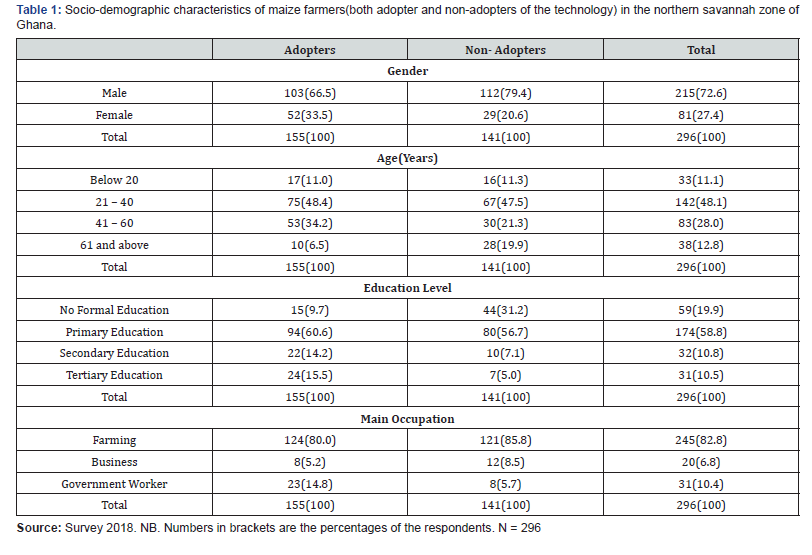
Majority of the farmers (174 farmers) with a percentage of
about 58.8% had attain primary education out of which 94 respondentss
were adopters and 80 respondents were non-adopters.
Respondents with tertiary education recorded the least the
number with 31 respondents standing for 10.5% of which out of
this number, 24 respondents representing were adopters and 7
respondents were non-adopters. Respondents with no formal education
recorded 19.9% which represent 59 respondents out of
this 15 were adopters whiles 44 were non-adopter. Those with
secondary education recorded 10.8% standing for 32 respondents
out of these 22 respondents were adopters whiles 10 respondents
were non-adopters. These studies are consistent with the work of
[49], who found out in his studies that, higher education influence
adoption of decision positively since it is associated with ability
to synthesis. Education levels of the farmers may influence chances
of implementing and/or adopting the water harvesting techniques.
Low education levels of the interviewed respondents may
have significantly contributed to the low or non-adoption of water
harvesting techniques. This is because, education increases one
access to information and therefore creates awareness and contributes
to adoption of water harvesting systems. Chianu & Tsujii
[50], reported that farmers ‘educational achievement can increase
the probability of water harvesting technology adoption.
The results revealed that, a higher percentage of young aged
farmers (21-40 years) 48.4% respondents had adopted zai pits
as compared to older farmers (61 and above years) 6.5%- and
middle-aged farmers (21-40 years) 34.2%. In general, the results
showed that farmers in their middle ages recorded higher percentages
82.6% (21 – 40 years and 41 -60 years) as compared to
very young and older farmers who together also recorded 17.4%
(below 20 years and 61 and above years). These results could be
associated to the fact that, zai pit technique is labor intensive. According
to a study by [51] the age of the farmer is a significant
variable that can impact use of soil conservation technologies.
Generally, older farmers may be more conservative, less flexible
and more uncertain about the benefits of zai pits.
It was shown from the results that, majority of the farmers
(82.8%) depends on farming activities for survival and generation
of income with very few depending on business and government
work for income with percentages of 6.8% and 10.4% respectively.
The gap between the farmers who had adopted the technology
and the non-adopters was very small. According to [52], agricultural
activity is one of the many possible sources of employment
and income for farm households across the world. This perhaps
may be one of the reasons why adoption of the water harvesting
technologies is low (Table 2).
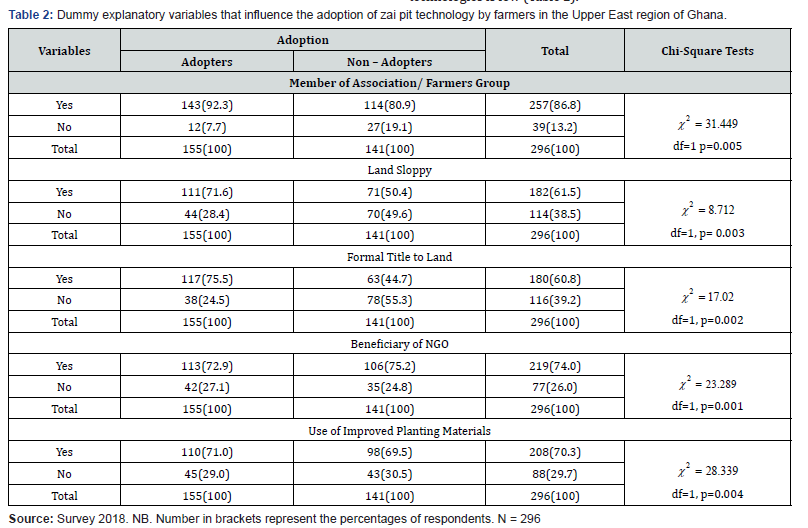
The studies revealed a great number of adopted
farmers of
zai pit technology joining farmers association with a percentage
of 92.3% as again 7.7% who are not part of farmers associations.
The number of non-adopter who are part of farmers associations
is also greater than those who are not members of associations
with percentages of 80.9% and 19.1 respectively. In a nutshell the
numbers of farmer both adopters and non-adopter who are members
of farmers association is greater than their counterparts who
are not members with percentages of 86.85 against 13.2%. The
results revealed a positive significant relationship between membership
of farmers association adoption ( χ 2 = 31.449 , p=0.005). This
could be the reason why a large number of farmers were recorded
to be adopters since the information about the technology may be
spread to them in the groups.
Considering the gap between farmers who have sloppy land
and those who do not have is relatively wide, with majority of
farmers who have adopter the technology has sloppy land (71.6%).
Adopted farmers without sloppy land recorded the least percentage
(28.4%) followed by non-adopter with sloppy land. In general,
most farmers in the study area have sloppy land (61.5) as compared
to farmers who don’t have sloppy land (38.5%). A positive
significant relationship was recorded between landscape (sloppy
land) and adoption of zai pit technology ( 2 χ = 8.712 , p=0.003). The
majority of adopters of the technology having sloppy land can be
attributed to the fact that zai pit technology is a measure of collection
of runoff rain [17].
Based on the results, both adopter and non-adopters of the
technology who have benefited from NGOs are greater than their
counterparts who have not benefited from any NGOs with percentages
of 74.0% as against 26.0%. Adopters recorder the highest
number of people who have benefited from NGOs (113) followed
by non-adopters (106). The external support provided by
NGOs to farmers had a significant and positive relationship with
zai pit technology adoption ( 2 χ = 23.289 , p=0.001). This suggests
that promotion by external organizations plays a significant role
in adoption of soil water management technologies as revealed by
[31] in his studies. This result is also in agreement with the work
of [53] who established a positive and significant relationship of
external service and adoption of rain water harvesting technology.
The results suggest majority of the adopters have formal title
to their lands (75.5%) with relatively fewer adopters not having
formal titles to their lands (24.5%). On the other hand, there was a
great number of non-adopter not having formal title to their lands
as compared to those having title to their lands with percentages
of 55.3% and 24.5% respectively. The result revealed a significant
relationship between farmers holding formal titles to their lands
and zai pit adoption ( 2 χ = 17.02 , p= 0.002).
Majority of the adopters were identified to be using improved
planting materials with very few of the adopters not using improved
planting materials with percentages of 71.0% as against
29.0%. In the case of the non-adopters too majority of the farmers
were using improved planting materials as compared to their
counterparts who were not using improving planting materials
having percentages of 69.5% and 30.5% respectively. In general,
it was revealed that majority of the farmers were using improved
planting materials as compared to those who were to using improved
planting materials (Table 3).
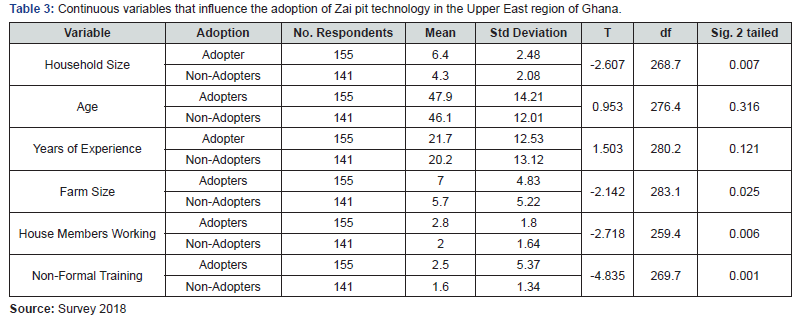
From the table above, the t-test result revealed a significant
difference between household adopters (6.4) and non-adopter
(4.3). Also, there was a significant difference (p= 0.006) that exist
between household members who work in the farm among the
adopters and the non-adopters. The average household for adopters
and non-adopter were 6.4 and 4.3 respectively. The results
showed that adopters had more labour sources compared to the
non- adopters with confirms the assertion [54] that large household
suggests more provision of labour particularly in the preparation
and maintenance of water harvesting technologies.
Moreover, the average age of the adopters was 47.9 years
whiles that of the non-adopter was 46.1 which suggest the farmers
in the study areas are in their youthful ages. Though the difference
in farmer’s age was not statistically significant, studies by
[55,56] revealed that older farmers are used to short term planning
thus are more reluctant to invest in soil conservation technologies
which take long before realizing the benefits. Contrary, [57]
in his studies reported that older farmers could be more aware
of soil infertility in their farms henceforth are more willing to try
new technologies that curtail the negative effects.
The total average farm size of adopter was highly than their
counterpart non-adopters with mean of 7.0 and 5.7 respectively.
There exists a significant difference at less than 5% probability
level. This result is in agreement with the studies [58] who find
out that farmers who had bigger farm size were likely to adopt
rain water harvesting techniques. Averagely, farmers who has adopted
the technology has received more non-formal training than
the non-adopters (2.5 and 1.6) respectively. This result shows that
non formal training plays a crucial role in the adoption of zai pit
technology. The result agrees with a similar-studies by [59] which
revealed significant and positive association between training and
adoption of water harvesting technologies (Table 4).
Table 4: A Logistic Regression for the Predictors of Zai Pit Technology Adoption in the Upper East Region of Ghana.
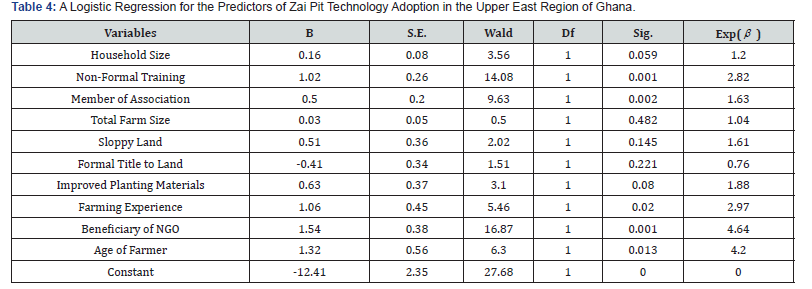
The logistic regression table revealed that, non-formal training
attended by farmers had a significant and positive influence
on adaptation of zai pit technology with exp ( β ) value of 2.820.
Farmer belonging to farmers groups and associations also had a
positive impact on adaptation of zai pit technology with exp ( β
) value of 1.63. The value of the exp ( β ) signifies that, for 1 unit
increase in the farmers joining or belonging to an association, the
probability of farmers adoption would increase by a factor of 1.63.
The result also shows that, there was a statistical significant relationship
between farmers farming experience and adaptation
of zai pit technology with exp ( β ) value of 2.97. Age of farmers
also had a positive impact on the adoption the zai pit technology
with exp ( β ) value of 4.20 which signifies a unit increase in age of
farmers, the probability of adaptation will increase by 4.420. The
results shows that beneficiary of NGOs was significant and had a
positive relationship with adoption of zai technology with exp ( β
) value of 4.46 which means a unit increase in the beneficiaries of
NGOs would render an increase in the probability of adaptation
by 4.46.
On the other hand, the logistic model results revealed that,
farm size, sloppy land, household size, used of improved planting
materials and formal title to farm lands were not significant
variables in the adaptation of the zai pit technology. Holding of
formal title to farming land had an insignificant negative effect on
adoption of the technology, however it was anticipated that farmers
who have title deeds are more likely to adopt the technology
as compared to those who don’t have the title deeds. Many smallholder
farmers who apply these technologies on leased land lose
the benefit of their investments because the owners withdraw the
land for their own use soon. Tenure insecurity explains farmers
‘unwillingness to invest effort in measures to improve soil conservation
and enhance fertility [60,61].
The results obtain from land size, family size sloppy land and
use of improved planting material (insignificant) is in contrast to
the studies of [62], who find out that the size of the farm was a
major a predictor in the adoption of soil water conservation measures
in Chile. The result was also in contrast with the studies finding
of [61,63] who also identified significant positive relationship
between land size and farmers decision to adopt soil conservation
and water harvesting techniques.
Conclusion and Recommendation
Out of the 296 farmers interviewed for the studies, 72.6%
representing 215 farmers were males and the remaining 27.4%
representing 81 farmers were females. The number of farmers
who were adopters were slightly higher than the number of
farmers who were non-adopters of the technology with percentages
of 52.4% and 47.6% (155 and 141) respectively. Majority
of the farmers (174 farmers) with a percentage of about 58.8%
had attain primary education out of which 94 respondents were
adopters and 80 respondents were non-adopters. Respondents
with tertiary education recorded the least number with 31 respondents
standing for 10.5% of which out of this number, 24 respondents
representing were adopters and 7 respondents were
non-adopters. In general, the results showed that farmers in their
middle ages recorded higher percentages 82.6% (21 – 40 years
and 41 -60 years) as compared to very young and older farmers
who together also recorded 17.4% (below 20 years and 61 and
above years). It was shown from the results that, majority of the
farmers (82.8%) depends on farming activities for survival and
generation of income with very few depending on business and
government work for income with percentages of 6.8% and 10.4%
respectively.
The results from the studies shows that
socio-demographic
characteristics of farmers such as, farmer‘s age, years of experience,
number of non-formal trainings, beneficiaries of NGOs, and
membership of associations, agents play an important role in
farmers adaptation of zai pits. On contrary variables like variables
like land size, sloppy land, household size, formal title to land and
used of improved planting materials were not significant variable
to farmer’s adaptation in the study area. The most common source
of information in the adoption of zai pits was non-government extension
agents. Majority of the farmers who had adopted zai pits
used animal manure as a soil fertility amendment.
Considering the verdicts from this study, the researcher, recommendations
that farmers should be encouraged to join farmer
groups or association and also attend non- formal training on agricultural
practices to improve adoption and utilization of zai pits.
Also, it is recommended that zai pit technology should be promoted
by the government and NGOs as a water harvesting technique
in the study area.
To know more about Journal of Agriculture Research- https://juniperpublishers.com/artoaj/index.php
To know more about open access journal publishers click on Juniper publishers


Comments
Post a Comment