Nozzles Clogging as Limiting Factor in Pressurize Irrigation Systems-Juniper Publishers
Journal of Agriculture Research- Juniper Publishers

Modern irrigation systems have gained globally
popularity, used widely in agriculture and landscape throughout the
world, since it has more advantages in terms of the water use
efficiency. However, these irrigation systems affect by water quality
which leads to very serious problems of nozzle’s clogging’s. The nozzles
are the main component of pressurized irrigation systems, however,
these parts always subject to the clogging by undissolved chemical
granular fertilizers and sediments, such as suspended clay particulates.
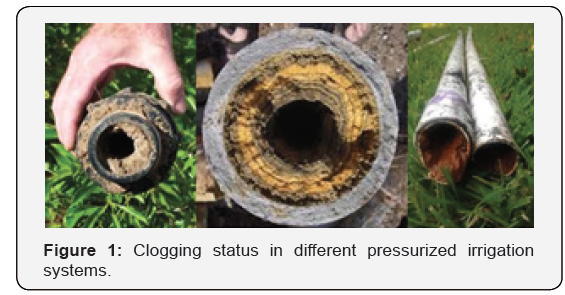
As a result, biofilms develop inside the drip lines due to accumulation
of suspended matters which leads to orifices clogging (Figure 1).
Clogging has been a serious problem for inline drippers since these
types of emitter are build-in the drip line, therefore, it is difficult
to replace or cleanup. Nevertheless, the low water quality irrigation
water contributes for far extent in emitters clogging. Nakayama et al.
[1] reported that the clogging in pressurized irrigation systems is
associated with concentrations of physical (inorganic particles
suspended), chemical (dissolved solids) and organic (organic matter)
contaminants.
The clogging’s whether partially or fully occurs due
to precipitation or accumulation of salts around the nozzles or
emitters. Consequently, these results in low distribution of water and
farther more affect the productivity of the plants. There’re, a lot of
studies have been carried out to mitigate the problem of clogging’s
[2,3]. These trials have taken different ways, such as, rational
filtration equipment, periodic treatment through
acidification and chlorination, and optimization of emitters design.
These method of fixing clogging emitters are time consumer and costly.
Most of these investigations were focused on physical and chemicals
means such as filtering and flushing the irrigation water before
converting to the main irrigation lines or adding chemicals in water
supply to avoids accumulation of solid particles. Therefore, there is
urgent needs for efficient approach that environmentally friendly,
quick, and sustainable. Kotan and Şahin [4] reported that, some of the
microorganisms have been shown positive effects on controlling of
pathogenic microorganisms in crop production. Thus, they might be
beneficial for development of an alternative method of controlling
biological clogging pressurized irrigation systems. Hence, this
viewpoint highlights the significance of utilizing this friendly
environmental method in addressing the nozzles clogging problems.
The effective micro-organism (EM) is a mixed culture
of beneficial micro-organisms (primarily photothenthic eclectic acid
bacteria yeasts, actenomycides fermenting fungi), main species involved
in EM include: Lactic acid bacteria - Lactobacillus plantarum, L. casei,
Streptococcus lactic; Photosynthetic bacteria - Rhodopseudo
monaspalustrus, Rhodobacter spaeroides; Yeasts- Saccharomyces
cerevisiae, Candida utilize; Actinomycetes- Streptomyces albus, S.
griseus; Fermenting fungi – Aspergillus oryzae, Mucorhiemalis. The EM of
selected concentrations should be injected at points located after the
connection of the laterals to the sub main lines. EM concentration
should be taken into consideration to avoid the viscosity and to ensure
the flow rate through the pipes. The EM are expected to have high
potential ability in reducing clogging in nozzles, due to its content of
photothenthic eclectic acid. The effective micro-organism can cause to
reduced emitters clogging percentage by 80% and the reduction percentage
increases with increasing of eclectic acid concentration level.
Moreover, EM could serve as fertilizer due to its ability to increase
the soils microbial community this leads to improve the both soil and
crop quality.
This view attempt to present a solution through the impact
of EM on mitigating clogging problems normally associated with
modern irrigation systems. The using of EM is expected to achieve
great reduction in emitters clogging and prevention nozzles. Also,
EM will have positive fertility effect for plant growth. Therefore,
we suggested that, EM has potential capability to diminishing
emitter clogging or event alleviate it. Hence, it can be key solution
that should be considered when dealing with modern pressurized
irrigation systems.
To know more about Journal of Agriculture Research- https://juniperpublishers.com/artoaj/index.php
To know more about open access journal publishers click on Juniper publishers


Comments
Post a Comment