Organic Matter and the Absorption of Cadmium in Organic Cacao Almonds (Theobroma cacao L.), Leoncio Prado-Huánuco-Juniper Publishers
Journal of Agriculture Research- Juniper Publishers

Soil quality has an important influence on the dynamics of cadmium by the cacao plant (Theobroma cacao
L.), in particular the organic matter (MO) present in the soil.
Therefore, the objective was to measure the influence of soil MO on the
levels of cadmium absorption in cocoa almonds CCN-51 in Leoncio Prado -
Huánuco province. ADCA design was used, for which 20 agricultural plots
were selected from the members of Cooperative Cacao Alto Huallaga, who
complied with all organic production standards and techniques. 20
samples of soils and almonds were analyzed. The results show that the
average content of the MO was 2,3%, the cadmium available in the soil
was 0,32μg g-1 and the content of cadmium in the almonds yielded 0,98μg
g-1. The research concludes that the values of cadmium in almonds are
above the maximum level allowed by the European Union and a
non-significant negative correlation was found between soil MO and the
content of cadmium in soil and cocoa almonds, finding a non-significant
dependence of cadmium in almonds, with respect to soil MO.
Keywords: Cadmium in the soil; Cadmium in almonds; Cocoa CCN-51; Soil organic matter
Introduction
Cocoa (Theobroma cacao L.) is one of the crops
of great economic importance for Peru, Huánuco contributes with it 6%
of the national production, occupies the fifth place in the list (San
Martín with 43%, Junín with the 18%, Cusco with 9%, Ucayali with 8%). In
addition, the Ministry of Agriculture and Irrigation-MINAGRI [1],
reports the behavior of the national production of cocoa between 2009
and 2015, it shows an average annual increase of 15.5%, so that, of 36.8
thousand tons produced in in 2009, it rises to 87.3 thousand tons in
2015 (137.2% increase), reaching an area of 121.3 thousand hectares with
an average yield of 720kg/ha.
However, the European Union (EU) approved the new
regulation on maximum limits of cadmium in cocoa derivatives through
Regulation No. 488/2014 which comes into force as of January 1, 2019
throughout the EU, the norm considered as the maximum content of cadmium
in various cocoa products in a range of 0.10 to 0.80μg g-1 [2] and
exports of cocoa beans from Peru, highlights the EU which concentrates
76% of total exports [1]. Therefore, this becomes a national concern,
since it is our
main target market, making it necessary to investigate to generate
basic knowledge that allows generating technologies to reduce the levels
of Cd2+ in cocoa beans.
It is necessary to point out that in natural
conditions there is averages of <1μg g-1 of Cd2+ in the soil solution
and most researchers consider that their absorption in almonds is
influenced by some soil parameters [3]. The type of soil has an
important influence on the availability and absorption by the plant,
among the soil parameters that correlate with the concentration of heavy
metals, as the cadmium are pH, texture, OM and Zn and P levels [4,5].
Therefore, the objective of the work is to evaluate the influence of OM
on the levels of Cd2+ in the soil and on organic cocoa almonds CCN-51 (Theobroma cacao.), in the Leoncio Prado - Huánuco province.
Materials and Methods
Study area
The investigation was developed in the last quarter
of 2017, in the province of Leoncio Prado, located in the department of
Huánuco-Peru, The climatic conditions in which this project was
developed are: average annual precipitation of 3,428.8mm, average annual
temperature of 24.5 °C and an average relative
humidity of 77%, according to the weather station José Abelardo
Quiñones (Universidad Nacional Agraria de la Selva). It presents
bimodal season; the highest rainfall occurs between the months of
September to April and the dry season covers from the months May
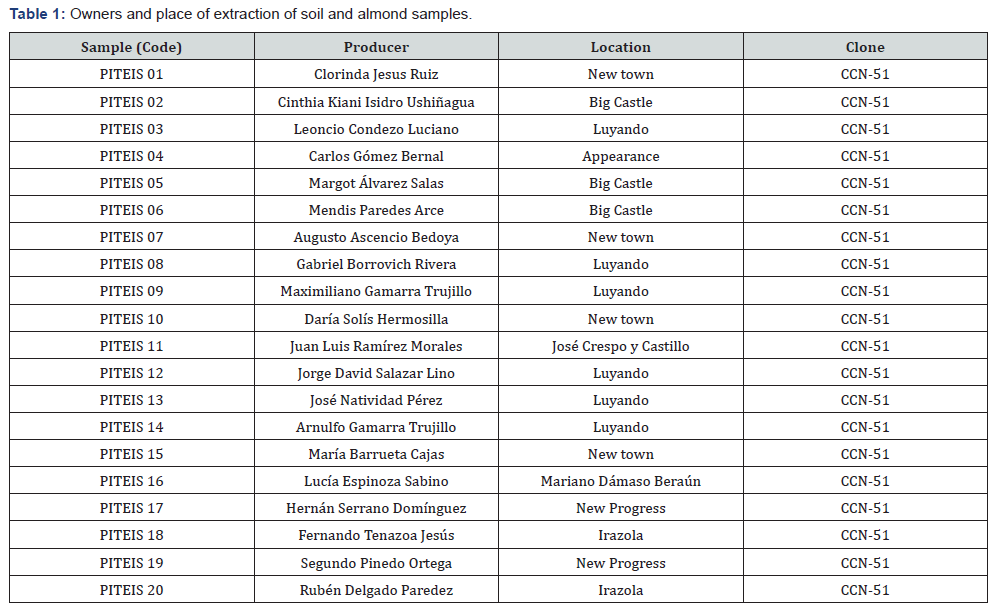
to August. The characteristics of the evaluated plots correspond
to cocoa plantations of Clone CCN-51 with an approximation of 7
years of production, with organic certification and with an average
production of 500kg/ha (Table 1).
Soil sampling
Soil sampling followed the criteria of the methodology
proposed by the USDA, extracting a composite sample (from 20
subsamples) per hectare, to a depth of 0-20cm and be submitted
to the analysis of characterization in the analysis laboratory of
Soils of the National Agrarian University of the Selva (UNAS).
The chemical analysis of cadmium requires milling the sample
in porcelain mortar and passing through a 150μm sieve, then
applying the ISO 11466-Soil quality methodology, which consists
of:
a. Weigh approximately 3g of the soil sub-sample with an
accuracy of 0.001g in the 250ml reaction balloon.
b. Moisten the soil with 0.5-1ml of distilled or deionized
water and add stirring, 21ml of hydrochloric acid followed
by 7ml of nitric acid, dropwise if necessary, to avoid foam
production.
c. Add 15ml of nitric acid to the reaction balloon and let
stand for 16h. and cover with a clock moon.
Slowly increase the temperature of the reaction mixture
to reflux conditions and keep it for 2h.
e. After 2 hours have elapsed, let the sample cool down.
f. Then decant the supernatant extract on whatman 40
filter paper, collect the filtrate in a 100ml graduated flask. Pass
all the extract through the filter paper and wash the insoluble
residue with the minimum volume of nitric acid.
g. The extract prepared in this way is suitable for
the determination of metals by Atomic Absorption
Spectrophotometry.
For soil pH analysis the potentiometer method was applied
with a soil/water ratio of 1: 1. For the analysis of cadmium in
cocoa beans, the following protocol was applied:
a. Remove the mucilage from the samples of fresh cocoa,
and then dry in the oven at 75 ºC for 24 hours.
b. Descascarillar the almonds with the help of a razor of
suitable and sterile material that does not contaminate the
samples.
c. Crush the samples, from this crushed 0.5g will be taken.
d. Take 0.5g of the sample and undergo a perchloric nitric
acid solution, in an extract ratio of 1: 4, 4 (according to Carillo, 2003, cited by MITE, 2010). The ground vegetable tissues
should be mixed with HNO3 (8ml) and HClO4 (2mm) for one
hour and heated at 180 °C for 90 minutes until complete
digestion.
e. Then filter this extract in 50ml balloon and bring to
volume with deionized water.
f. The extract obtained can be read in the spectrometry
equipment [6].
Statistical analysis
The design used is completely randomized DCA where the
treatment is constituted by CCN-51 cocoa plots, with sample size
n = 20 (soil and almond samples). The data of OM levels and the
Cd2+ contents of the soil and plant were subjected to Pearson
correlation analysis (p <0.05).
Results and Discussion
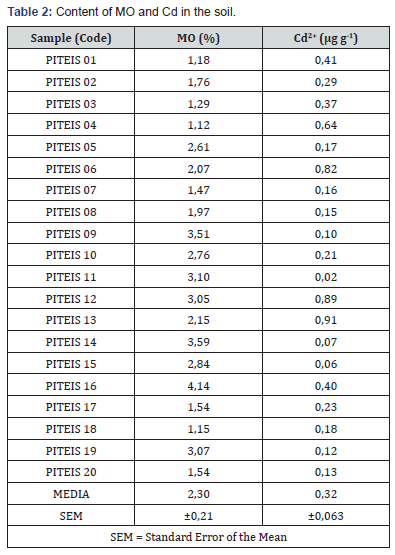
The average value of the OM is 2.3% (Table 2), which
corresponds to a medium level [7], which are typical values of
the tropical part and in particular in soils where cocoa is grown.
This content contrasts with Arévalo et al. [5] in a study of the
main cocoa producing areas of Peru, reported similar values,
contents that vary from 2-4% were found in Tumbes (Tumbes),
Piura, Cajamarca (Jaén), Amazonas and San Martín (Bellavista,
El Dorado, Huallaga and Mariscal Cáceres), Huánuco and Junín.
However, they also found high concentrations >4% in the Cuzco
region; while low contents were located in Tumbes (Zarumilla)
and San Martín (Tocache).
Within the scope of our research there are some reports that
warn a similar content of MOS in soils with cocoa production.
Huamani et al. [4], in a research located between Huánuco and
Ucayali, reports an average MOS content of 2.58% and consider
this value as an adequate condition for the development of the
cocoa crop. Also, the results of Tantalean and Huauya [8], in
Jacintillo and Ramal de Aspuzana, found higher values for residual
and alluvial soils with variations of 3 to 4%, however, these values
are considered as average contents [7]. Therefore, the average
value found represents adequate and typical values of the areas
destined for the production of cocoa in the province of Leoncio
Prado.
The values of Cd2+ found in this investigation, presents an
average of 0.32μg g-1 (Table 2), categorized as low level of Cd2+ by
the most important standards such as the Environmental Agency
of the United States of North America (USEPA) established a
critical level of 0.43μg g-1 of total cadmium in agricultural soils
[9]. Also, the EU European Union, through the Kelley directive,
indicates that typical values in uncontaminated cadmium soils are
between 0 and 1μg g-1 [10] and our regulation establishes 1, 4μg
g-1 for agricultural land [11].
However, when compared with other local investigations, it is
lower than that reported in this same area by Huamaní et al. [4],
average cadmium values of 0.53μg g-1 and considers its results as
a low content. However, Tantalean and Huauya [8] found values
of 0.90 for residual soils and 3.68μg g-1 for an alluvial soil, the
latter are high values and is considered as a soil contaminated
by Cd2+, according to our regulations and the aforementioned
international standards. In addition, there are references at the
national level such as Crozier et al. [12], who found higher values
of Cd2+ in the North Zone (0.79μg g-1) and lower in the Central
Zone (0.68μg g-1) and South (0.46μg g-1) of Peru. On the contrary,
the results of Arévalo et al. [5], reports that cadmium has been
the least common metal in the sampled soils. Null values of 0.00μg
g-1 found in Cajamarca (San Ignacio), San Martin (El Dorado and
Tocache), Huánuco and Cuzco.
The correlation analysis (Figure 1) between MO and Cd2+ in
the evaluated soils shows statistically a nonsignificant negative
correlation, with a coefficient of determination of R2 = 0.026;
According to the curve of the mathematical function, a slight
decreasing tendency of cadmium in the soil can be observed, as
MO increases. This behavior is corroborated by Tantalean and
Huauya [8], they found a negative tendency between the presence
of cadmium with the increase of OM. However, it is contrary to that
reported by Arévalo et al. [5], since in their results they observed
statistically significant differences (p <0.05) and a significant
positive correlation for MOS, with R2 = 0.33.
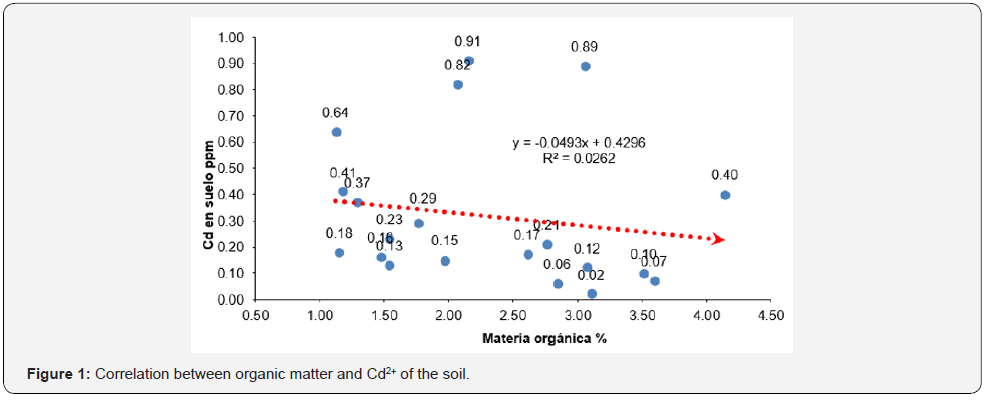
According to the correlation analysis (Figure 1), we observed
that the MO does not correlate significantly with the Cd2+, it can be
explained taking into account that the availability of Cd2+ in the soil
can be influenced by other parameters, within the main attributes
that are Related to the mobility and availability of heavy metals
in the soil are pH, Fe, Mn and Zn oxides and clay content [4,5,13].
The organic matter of general form influences in the properties
of the floor that contribute to the quality of the soils like the
apparent densidad, structure, acidity, availability of nutrients and
decrease of the availability of heavy metals [14,15]. This behavior
is also pointed out by Sauve et al. [16], specifies that heavy metals
are a function of pH, clay content, organic matter, cation exchange
capacity and other soil attributes.
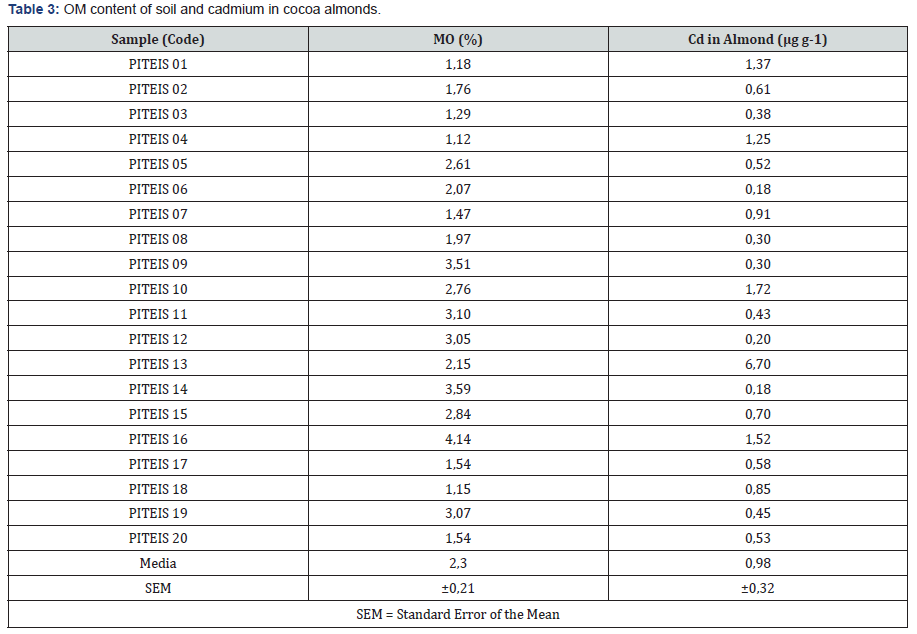
In Table 3, the cadmium content of cocoa almond samples is
shown; whose average content is 0.98μg g-1; this level exceeds the
maximum permissible limit of the EU (Regulation No. 488/2014)
which establishes the maximum content for cocoa derivatives in
a range of 0.10 to 0.80μg g-1 [2]. These high cadmium contents
in almonds, for this investigation is not related to MO, because
the correlations found are not statistically significant. Therefore,
we attribute this high level of Cd2+ fundamentally to other soil
characteristics; as a level of pH, CIC, oxides and the amount of clay
present [4,5,15].
In addition, Tantalean and Huauya [8], explain that the high
concentrations of total cadmium in almonds, may be due to
the high concentrations of cadmium available in the soil, total
cadmium in root, stems, leaves, and their mobility in the crop.
Finally, Isaura [17], says that organic matter acts actively in the
adsorption of cadmium, and this activity is defined not only by the
amount in which it is found in the soil environment, but also, and
decisively, by its composition. Even that, for our case, this attribute
shows a non-significant action.
There are local investigations that agree with our results, such
as Tantalean and Huauya [8], which report cadmium content in
almonds from plots located in residual soil of 0.84μg g-1, and in
the alluvial soil of 1.08μg g-1, even higher values, reports Lanza et
al. [18], Cd2+ concentrations located in a range between 0.95 and
2.09μg g-1. However, these results are high compared to what was
reported by Zambrano [19], in the city of light of America-Ecuador,
their results showed maximum levels of 0.41μg g-1 and minimum
levels of 0.31μg g-1 in CCN-51 with different drying method.
Likewise, Sofia and Pablo [20], in Esmeraldas-Ecuador, found an
average of cadmium in cocoa almonds of 0.35μg g-1, a value lower
than our results.
In the regression equation between soil organic matter and
cadmium in almonds (Figure 2), the trend line that best fits
the evaluated values is linear (y = -0.1106x + 1.2378) with a
coefficient of determination of R2 = 0.0052; According to the curve
of the mathematical function, a slight decreasing tendency of the
cadmium in the almonds can be observed, as the organic matter in
the soil increases.
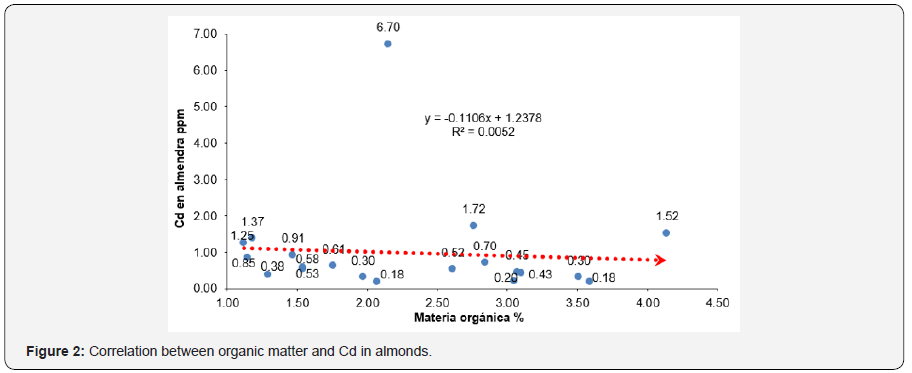
Finally, our results show a low content of Cd2+ in the soils and
high in almonds and the correlation analysis shows no significance
between the MO and the Cd2+, that is, the OM does not explain
or significantly influence the high levels found in the almonds.
Therefore, recent studies of Cd2+ in soils and almonds, which
warn of high levels of heavy metals [4,5,8,12] and that would
affect consumption and exports as of January 2019, have not been
resolved clearly. Therefore, it is necessary to continue research
to generate basic knowledge that allows finding technologies to
reduce the levels of Cd2+ in cocoa beans.
Conclusion
The average content of soil organic matter was 2.3%, which
represents an average level in the cocoa plots [7] and the average
level of cadmium available in the soil was 0.32μg g-1, considered
low for USEPA [9], the Kelley directive of the European Union and
the ECA of Peru. The average content of cadmium in cocoa beans
in the samples analyzed was 0.98μg g-1, higher than the maximum
level allowed by the European Union (Regulation No. 488/2014).
Finally, a non-significant negative correlation was found between
the MO and Cd2+ in the soils evaluated with R2 = 0.0026 and a
nonsignificant negative correlation between the soil MO and the
cadmium content in the cocoa almonds, with R2 = 0.052 that is to
say, as the OM of the soil increases, the cadmium tends to decrease
in the soil and cocoa almonds.


Comments
Post a Comment