Physicochemical Properties of North African Donkey Milk-Juniper Publishers
Journal of Agriculture Research- Juniper Publishers

The present work was undertaken to study the
physicochemical characteristics of North African donkey milk. Chemical
composition of donkey milk was carried out for dry matter, fat, crude
protein, pH, lactose and ash using an automated milk analyzer. The
results showed that the North African donkey milk composition was: dry
matter 9.42%, ash 0.35%, fat 1.09%, lactose 7.02% and protein 1.44%.
Further research on milk production, milk functionality, and
valorization, market development, and genetic selection will help to
better preserve and use of donkeys.
Keywords: Donkey milk; North african; Physicochemical; Production
Abbreviations: TN: Total Nitrogen; NPN: Non-Protein Nitrogen; NCN: Non-Casein Nitrogen
Introduction
The donkey is an animal that first started to
localize in northeastern Africa. It was tamed in Egypt around 4000-5000
BC and in the Middle East around 100 BC [1,2]. The donkey’s milk was
utilized as a breast milk substitute because for its comparative dietary
synthesis unusually low casein content [3], and high substance of
lysozyme 1mg/l [4]. It is increasingly more used to sustain unfavorably
susceptible children to dairy animals milk [5,6]. Lately, a few analysts
demonstrated the impacts of donkey’s milk on atherosclerosis aversion
[7], they additionally shown that it has an antibacterial, antiviral and
antitumor effect [3,8-11]. In the end, Donkey’s milk is exceptionally
utilized for corrective reasons.
In Tunisia, the donkey was utilized in homesteads for
horticultural work. Donkey’s milk wasn’t valorized yet. National
insights demonstrate a headcount of 123000 [12] unequally appropriated
in a Tunisian area; actually, rugged, fringes and focus districts hold
most of a donkey.
Barely any examinations concerning this topic were
completed, for example, which is keen on the phenotypic portrayal of
donkey breeds in Tunisia, [13] has considered the microbiological nature
of Arabian donkey milk. Along these lines, it appears to be imperative
to concentrate on this species that is by all accounts
a commercial potential for Tunisian ranchers later on. For these
reasons, this examination is keen on donkey milk piece of Tunisian
donkey breed.
Materials and Methods
Donkey milk sample
The study was conducted among North African donkeys
reared in the traditional breeding system in El Kef (Northwest of
Tunisia) and Zaghouan (Northeast). This breed is considered very useful
in a mountainous area for agricultural work. A total of 80 records were
used to analyze the milk yield. Milk samples were immediately cooled and
transported to the laboratory under refrigerated conditions (4 °C).
Chemical composition of donkey milk
Milk samples were analyzed for dry matter, fat,
protein, ash, and lactose contents using an automated milk analyzer
“Lactoscan MCC” calibrated for donkey milk. Nitrogen fractions of milk
(total nitrogen (TN), non-protein nitrogen (NPN) and non-casein nitrogen
(NCN)) were determined using Kjeldahl method according to the ISO
8968-1 (2014) in order to calculate casein concentrations TC = (TN–NCN)*
6.38 and whey proteins WP = ((NCN- NPN)* 6.38).
Results and Discussion
Average daily milk yield and physicochemical composition
of donkey milk have been presented in Table 1. The average milk
production of North African doneky’s breed is 0.723 ± 0.12kg. It is
higher than that of the littoral-Dinaric donkey (0.172kg) [14] and
the Ragusana asses (0.55kg) [15]. The distinction in milk creation
is influenced by the genetic potential, milking number, both breed
and the reproducing season [16].
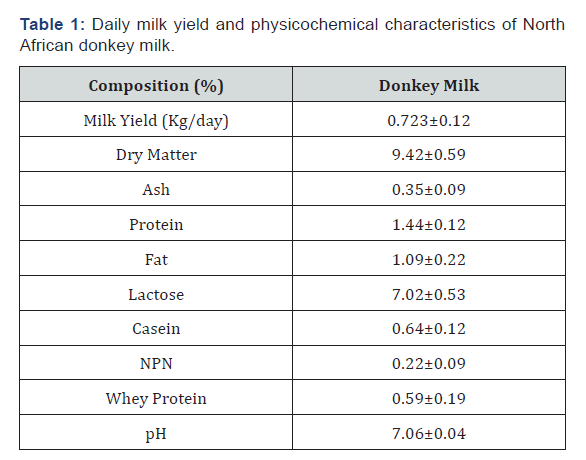
The dry matter (9.42%) is higher than the results revealed by
[13] for the Arabian donkey (8.62 %). The total unrefined protein
content (1.44%) is as per the outcomes acquired by [17,18]. It
is composed of 0.64% of casein, 0.59% whey protein and 0.22%
of NPN. Donkey’s milk three noteworthy whey protein are
β-lactoglobulin (β-Lg), α-lactalbumin (α-La) and lysozyme which
is a special additive, giving an extensive period of usability to crude
donkey’s milk [19]. Besides, it contains immunoglobulin (Igs),
lactoferrin which has a critical antimicrobial bacterial activity
by hydrolyzing of glycosidic obligations of mucopolysaccharides
in bacterial cell walls [20] and lactoperoxidase which add to
improving the regular additive activity of donkey milk.
The whey protein content is a crucial part in jenny milk for its
properties in the skin maturing rebuilding process [21], in quieting
bothering [22] and lessening the frequency of gastrointestinal
diseases in new born children [23]. The observed standard milk
fat substance is like the data detailed by [24] 1.15% for Italian
jackass and higher than element specified for by [14]. The solid
substance is helpful for the treatment of some atopic dermatitis
[25].
The regular lactose content (7.02%) is as per their established
by [13,17]. The high lactose content adds to the sweet taste of
jenny milk, advances the intestinal retention of calcium and
phosphorus and impacts the mineral collection in bone structure
[26]. Donkey milk has a neutral pH (7.06), it is in accordance with
their founded by [13,17,18].
Conclusion
For its different healthful and functional characteristics,
donkey’s milk has been considered an exciting substitute for breast
milk; it can be the best “pharma food” for people experiencing
distinctive nourishment hypersensitivities, skin and bone issues.
These days, for its multidisciplinary, utilize, for example, beauty
care products, therapeutic and medical problems donkey milk
turn out to be increasingly more looked for which makes the
exploration of their creation likely outcomes sensible. Further, it is
required to improve rearing practices to upgrade milk generation
and potential impacts on milk quality.


Comments
Post a Comment