Pine Forest on Tree-Line Ecotone in the Mountain Kazbegi in the Georgia (South Caucasus)-Juniper Publishers
Journal of Agriculture Research- Juniper Publishers

A widely distributed species of the pine in Georgia
is - Pinus kochiana in the Caucasus Mountains. Central Great Caucasus
higher is 5047m of Mt. Kazbegi and many summits are higher than 4000m.
Caucasian pine from 300 to 2600m above of alpine tree line ecotone.
Caucasian Pinus kochiana is on slopes from 784-2417m. Forest degradation
will be activated to climate change in alpine zone and forest
restoration is for protection of the environment. Other, planted pine
species are migrated from Russia in Georgia in 1970s and this is mainly
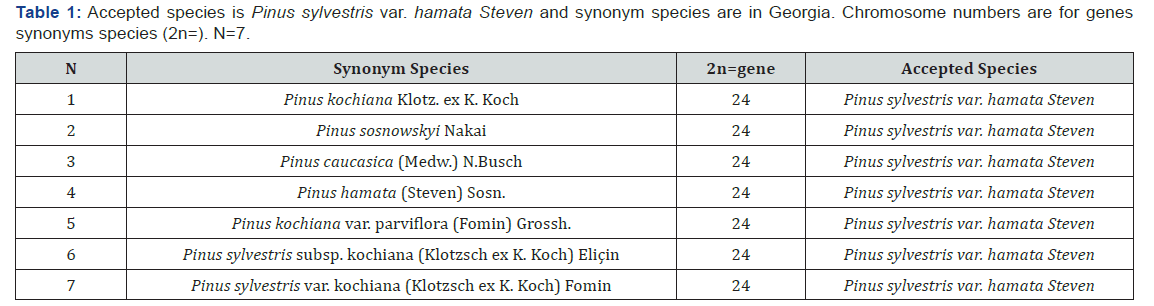
Pinus sylvestris. Pinus kochiana is synonym and accepted name is Pinus
sylvestris var. hamata Steven. Other synonym names of this species are
Pinus sosnowskyi, Pinus caucasica, Pinus hamata, Pinus kochiana var.
parviflora, Pinus sylvestris subsp. kochiana, Pinus sylvestris var.
kochiana. Forests occupy 32-35% of the territory of Georgia. The
riparian and marsh forests occur in all regions of Georgia. The number
of chromosomes in Pinus kochiana was precisely reported as 2n=24 and no
mutation has been found. Forests were destroyed and burned by Kazbegi
district during the wars in old centuries. Scots pine (Pinus sylvestris
L.) is planted in degraded areas. Flowering period of this species is
April-May and seeds are matured in September-October. Caucasian pine
rock scree forest is distributed on the slopes of rocky southern
exposition dry ecotone or limestone layers.
Keywords: Pinus; Subalpine; Forests; Synonym; Accepted
Introduction
Georgia covers an area of 69 494 km2. Forests cover
are mountain forests spread from the lower mountain belt up to the tree
line ecotone the highest summits of the Caucasus. Elevation range of the
Caucasus Greater Mountains varies from sea level to 5633m of Mt.
Elbrus. Western Great Caucasus in Georgia has a highest peak 5068m of
Mt. Shkhara and Central Great Caucasus higher is 5047m of Mt. Kazbegi
and many summits are higher than 4000m [1,2]. Thus, the alpine and
subalpine belts are here much wider, and the possibilities for high
mountain forest growth and diversity are greater. In addition to their
ancient isolation, the differences within their high mountain forest
have also been influenced by the following factors. Forest degradation
will be activated to climate change in alpine zone and forest
restoration is for protection of the environment. It presents a great
variety of widely contrasting landscapes due to geological,
geomorphological, hydrological, climate and soil conditions and
frequently alternating and ranging from subtropical forests to Desert
Steppes from Black Sea to the east. The western region Kolkhis has a
subtropical climate, with a warm winter. In sharp contrast to this
region is eastern and southern Georgia with a nearly continental
climate. The vegetation in Kolkhis is represented by wetlands, forests
and even dense subtropical forests, in high mountains (western and
eastern Georgia) tree line ecotone and alpine meadows followed by the
nival ecotone are representative; southern Georgia is covered by
secondary
mountain steppes occupied area of primary forests growing in this area
in the past; arid and semi-arid vegetation is widely spread in the
eastern Georgia. Most typical of these include semi-deserts (with desert
spots), steppes, vegetation of dry canyons, hemixerophilic shrub lands,
foothill deserts, and dry open woodlands [3,4].
A widely distributed species of the pine in Georgia
is - Pinus kochiana Klotz. ex K. Koch. (synonyms Pinus hamata, Pinus
sosnowskyi). Accepted species is Pinus sylvestris var. hamata Steven.
Caucasian pine (Pinus kochiana) composed in the mountains from 300 to
2600m above of alpine tree line ecotone. Forests were destroyed and
burned by Kazbegi district during the wars in old centuries. Scots pine
(Pinus sylvestris L.) is planted in degraded areas. Caucasian pine is
distributed on the slopes of rocky southern exposition. Scots pine grows
in different slopes. These two pine species have the same 6
ectomycorrhizal fungal species and can growing in similar soils. In west
Georgia it is mixed with coniferous forests, the pure stand is only in
rocky locations. Vertical borders on the distribution of the pine forest
are from 700 to 2400 meters a.s.l.. Optimum conditions for the
distribution are at the altitude of 1000-2200 meters. In certain places
pine is found at the altitude of 2500-2600 meters. The pine grows both
on limestone and volcanic layers. The pine rocky forest is especially
distinguished in terms of the great variety of species [5].
The pine forest of limestone on Tetrobi-Chobareti range
(1800-2000 meters) is characterized by a slightly different composition.
Earlier the pine distribution here was considered as
endemic Pinus kochiana, whereas a more widely distributed was
called “Sosnowski pine” (Pinus sosnowskyi). At the moment they
are considered as one species. However, the Tetrobi pine forest according
to the composition is considered as a peculiar refugium
where pine is mixed with mountain steppes. In this community
overall 48 species of vascular plants are represented. The following
species of herbaceous plants are associated with Pinus kochiana:
Steven arenaria - Arenaria steveniana, Sosnowski chickweed
- Cerastium sosnowskyi, Voronov minuartsia - Minuartia woronowii,
caryophylaceae campion - Silene dianthoides, Sosnowski houseleek
- Sempervivum sosnowskyi, astragalus - Astragalus arguricus, A.
campylosema, Javakheti lucerne - Medicago dzhawakhetica, sun
rose - Helianthemum nummularium, H. orientale, Transcaucasian
Daphne - Daphne transcaucasica, prickly thrift - Acantholimon
glumaceum, hogweed - Heracleum antasiaticum, bedstraw - Galium
grusinum, cornflower - Centaurea bella, hawksbread - Crepis
pinnatifida, grapevine hyacinth - Muscari sosnowskyi, etc. This
phytosenosis is quite rich with endemic species that are mainly
common on the limestones of the tetrobi plateau. Diphelypaea coccinea
(the blooming parasite) and asphodelo - Asphodeline taurica
need to be mentioned especially [6,7].
These range from the obvious timber to mushrooms, berries
and edible plants that have become more important for rural
populations during economic hardship. From soil and watershed
protection to recreation, tourism, and the existence value associated
with the conservation of biological and landscape diversity
of forests. Pine forests yield excellent construction and carpentry
timber, fuel, tar, resin, pitch, black or marine tar, carbon black, turpentine,
essential turpentine oil, and colophony.
Materials and Methods
Caucasian pine trees growing in slopes with all exposition and
are oriented as well on high inclination till 900. Natural habitat of
this species is oriented on rocks and as well on other slopes with
different geological rocks. The elevation is from 0 to 2100m a.s.l.
Caucasian pine tree up to 35m tall and only to 15-20m high in Kazbegi
high mountain areas. Snow cover is <0.3m. Sunny edge is low
on North Slope; dappled shade is more not only on North Slope:
North Wall, East Wall, and West Wall. Suitable for: light (sandy)
and medium (loamy) soils, prefers well-drained soil and can grow
in nutritionally poor soil. Suitable pH: acid, neutral and basic (alkaline)
soils and can grow in very acid and very alkaline soils. It
can grow in semi-shade (light woodland) or no shade. It prefers
dry moist or wet soil and can tolerate drought. The plant can tolerate
maritime exposure. It can tolerate atmospheric pollution.
Plant material
Forests occupy 32-35% of the territory of Georgia. The riparian
and marsh forests occur in all regions of Georgia. Mountain forests
are represented by lower, middle and upper belts. Oak, beech
(Fagus orientalis) and beech to chestnut forests grow in the lower
and middle belts changing higher in the mountains into the Caucasian
fir (Abies nordmanniana) and Oriental spruce (Picea orientalis)
forests. Pinus kochiana, Acer trautvetteri or Quercus macranthera
grow at tree line ecotone in different regions. There are also
well-developed crooked stem birch forests (Betula litwinowii) in
the tree line, usually occupying the steepest northern slopes. Dry
open woodlands relict forests are to be found in semi-arid regions
of the eastern Georgia and are composed by Pistacia mutica, Juniperus
spp., Pyrus spp., etc.
Methodology
Forested land in Georgia occupies 2.773.400ha. About 2.2
million ha are classified as state forest under the responsibility of
the Department of Forest Management (DFM) and the remaining
consists of former “Kolkhoz lands” part of which are now in the
process of being transferred to the DFM [8]. About 98% of forest
is located on the mountain slope. There are about 400 species in
forests, among them are: trees 153, high shrubs 202, low shrubs
29, and lianas 11. Conifers are 11 species belonging to three families
Pinaceae (4), Taxaceae (1) and Cupressaceae (6). 81% of total
forest area is occupied by broad-leaved forests of Beech, Georgian
and high mountain oak, hornbeam, chestnut, ash, maple etc. 19%
is coniferous forest composed by Caucasian fir (8.5%), Oriental
spruce (5.8%), Caucasian and Bichvinta pines (4.7%), yew and
juniper species.
Approximately 208.000ha of forest areas were included in the
Protected Areas, which amounts to 7.5% of the total forest area
of Georgia. According to the “Forest Code of Georgia” a number
of forest categories are subjected to some restrictions, which allow
us to consider them as Protected Areas. The calculated area
of “protected forest categories” (resort, green zone, steep slope,
tree line and riparian forests belong to the corresponding IUCN
categories; V, V-VI, IV-V, IV-V, IV-V) amounts to 1.113.130ha, which
is almost 15.9% of Georgia’s territory.
Statistical analyses
The analysis was performed using the software packages SPSS
v.16.0 for Windows and Statistical 6.0. We used ANOVA (p<0.05)
post hoc range test to investigate whether the average soil T °C,
minimum soil T °C, June minimum T °C and GDD changed in the
1m x 1m quadrates from 2012 to 2018. We used Canonical Component
Analysis (CCA) of the species cover in 1m x 1m permanent
plots and Dominance Curves test of PCORD. 5 statistic program
in order to test the species composition and determine dominant
species on each summit. The species are ranked by cover and
abundance.
Results and Discussion
Georgian pine species
Pinus kochiana Klotzsch ex K. Koch is a species of
the Caucasus
Mountains and this is synonym from other same (Table 1) and
it is related to the Scots pine group with accepted name as Pinus
sylvestris var. hamata Steven. Other synonym names of this species
are Pinus sosnowskyi, Pinus caucasica, Pinus hamata, Pinus kochi ana
var. parviflora, Pinus sylvestris subsp. kochiana, Pinus sylvestris
var. kochiana. Coniferous forest has 19% territories and composed
by 8.5% of Caucasian fir (Abies nordmanniana), 5.8% of Oriental
spruce (Picea orientalis), and 4.7% of and Bichvinta (Pinus pityusa)
pines. Coniferous forests mainly composed in the Western
Georgia of fir, spruce and The Central and Eastern Great Caucasus
contains only Caucasian pine and some species of Cupressaceae.
The number of chromosomes was precisely reported as 2n=24
and no mutation has been found. It is the species related to the
European pine (Pinus sylvestris L.). P. sylvestris is located in north
areas of the Europe and Asia and it has many subspecies and varieties.
However, P. sylverstris has different number of chromosomes
– 2n=18; 24; 25; 36; 48. It is used as planted tree and it is used
for multiplication in nursery which might be used by chromosome
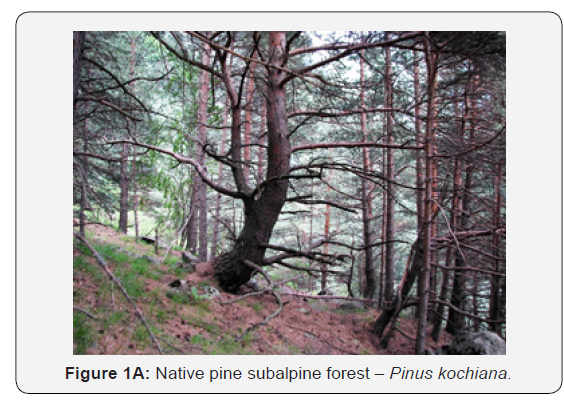
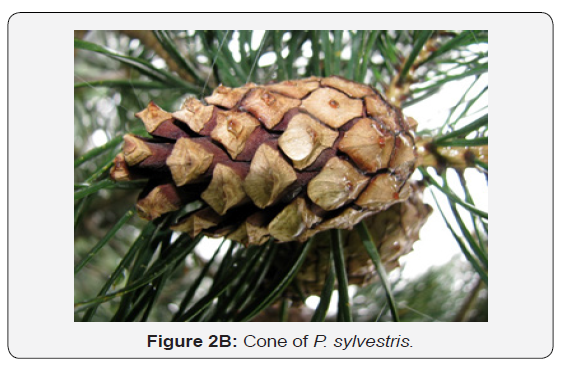
number change. Morphologically P. kochiana has different structure
of cones (Figure 1A & 1B) to P. sylvestris (Figure 2A & 2B).
Therefore, it might be remained as other species. Caucasian pine
tree grows till 35 m in the subalpine zone and leaves stiff, straight
or slightly curved, mucronate, glaucescent, 3-7cm long and 1-2mm
broad; male cones dense, ovoid-conical, the scales slightly denticulate
on the margin; ovulate cones solitary or in 2’s-4’s, at first
green, turning reddish-brown, at length brownish-gray, ovaloid/
spherical, recurved, lustrous, 1.5-5.5cm long and 2-4cm broad at
base; epiphysis subrhombic, rugose, flat or pyramidal, the umbo of
scales on the illuminated side of the cone produced into a hooked
spine; seeds 4-5mm long, the wing 13-15mm long and 4-5mm
broad.


Coniferous forest areas
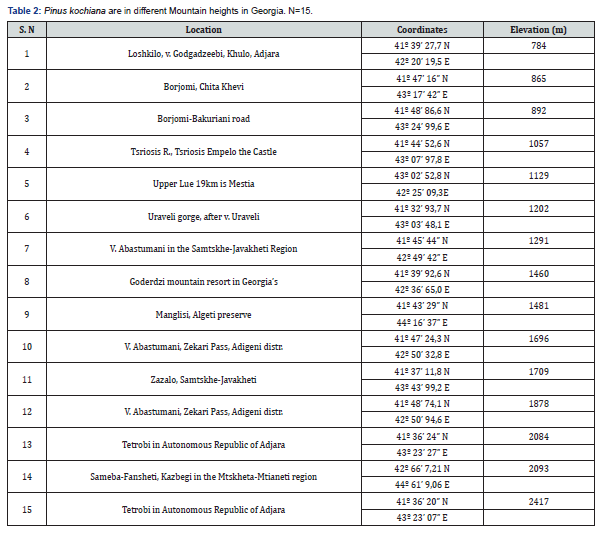
Caucasian pine from 300 to 2600m above of alpine tree line
ecotone. Caucasian Pinus kochiana is on slopes from 784-2417m
(Table 2). The area of its common distribution is Caucasus, Crimea
and western part of small Asia, Ponto mountains. In Georgia pine
forests are mainly common in the mountains. The pine grows in
Kazbegi District on rocks of volcanic layers. The pine rocky forest
is especially distinguished in terms of the great variety of species.
Caucasian pine rock scree forest is distributed on the slopes of
rocky southern exposition dry ecotone or limestone layers. Forested
land in Georgia occupies 2.837.900 ha which is a 43.18%
of Georgian territory (69494 km2). About 98% of forest is located
on the mountain slopes. 81% of total forest area is occupied by
broadleaved forests of beech (Fagus orientalis), Georgian and Caucasian
oak (Quercus iberica, Q. macranthera), hornbeam (Carpinus
caucasica), chestnut (Castanea sativa), ash (Fraxinus excelsior),
maples (Acer spp.), etc. North Ridge Mountains of the Central
Great Caucasus mainly created with crooked steam forests/elfin
woods of birch species (Betula litwinowii, B. raddeana, etc.) Caucasian
oak and pine are on south and eastern slopes as subalpine
forest till alpine tree line.
Native subalpine pine forest
The pine forests are widely distributed in the
Caucasus Mountains.
The forests of Kazbegi National Park are located on steep
slopes (4790ha). Birch forest is covered in 2595ha and native
subalpine pine forest (369ha) is located in protected area of north
ridge of Central Great Caucasus. 105 species of wood plants can be
found in these forests. Dominant species of the subalpine pine forest
is Caucasian pine (Pinus kochiana) distributed in many areas
of Georgia. Other trees are Quercus macranthera, Fagus orientalis,
Juniperus spp. etc. Mountain pine forests of relatively dry ecotones
can be found almost everywhere within the distribution area of P.
kochiana. It is best to sow the seed in individual pots in a cold
frame as soon as it is ripe if this is possible otherwise in late
winter.
A short stratification of 6 weeks at 4 °C can improve the germination
of stored seed. Plant seedlings out into their permanent positions
as soon as possible and protect them for their first winter or
two. Plants have a very sparse root system and the sooner they are
planted into their permanent positions the better they will grow.
Trees should be planted into their permanent positions when they
are quite small, between 30 and 90cm. We actually plant them
out when they are about-10cm tall. So long as they are given very
good weed excluding much, they establish very well larger trees
will check badly and hardly put on any growth for several years.
This also badly affects root development and wind resistance. Cuttings.
This method only works when taken from very young trees
less than 10 years old. Use single leaf fascicles with the base of the
short shoot. Disbudding the shoots some weeks before taking the
cuttings can help. Cuttings are normally slow to grow away.
Reproduction and growth characteristics
Caucasian pine tree with whorled branches and two types
of shoots: Long shoots appearing in spring and becoming woody,
and dwarf shoots growing from the axils of scale-like leaves and
also bearing scale-like and true acicular leaves, in clusters of two,
three, or five. Caucasian pine has crown wide, twigs spreading and
directed upright. Bark dark greyish dark browns or dark browns.
Needles greyish-green, margins fringed, 3.5-5 or 5-8cm long, to
two, rarely to three of tree. Leaves in clusters of two or three;
Male cone is round or oblong-cylindrical, clustered into globose
or broadly ovoid racemes. Male strobilus develops at the base of
young long shots in the axils of scale leaves. Female cones woody,
maturing in two to three years, bract scales coriaceous, shorter
than the broad ovuliferous scales; seeds winged, less often nutlike,
wingless. Female cones opening at seed maturity; mature female
cones 3-7cm long, dull, light brown or gray 6 seeds winged 4.
Seed cones ovate, solitary, pink brown or yellowish when mature,
glossy, directed horizontally or upright. Seed scales with pyramidal
and hooked apophysis. Seed obovate, acute, 4.5mm long, wing
with brown stripes. Needles persisting for four to eight years, yellowing
in winter, 3-3.5 cm long; cones 3-3.5cm long. Flowering
period of this species is April-May and seeds are matured in September-
October. It forms woods forests or grows as single trees on
rocks, reaches tree line.
Forest degradation and restoration
The degradation of qualitative consistence and productivity of
the forest lead to the reduction and sometimes even caused loss
in the functionality of forests. Forest area was diminished in the
Kazbegi district due to anthropogenic factors such as fires, cutting
of trees, and uncontrolled grazing. Forests were destroyed and
burned by Kazbegi district during the wars in old centuries. As a
result, avalanches and landslides are happening quite often in the
mountainous regions. They are mainly located on steep slopes of
Great and Minor Caucasus where the access is restricted. The loss
of diversity and changes in species composition in forests is mainly
a result of anthropogenic influence. Therefore, the degraded
forest should be restored, and climate change will be ended. Other,
planted pine species are migrated from Russia in Georgia in 1970s
and this is mainly Pinus sylvestris L. and some other individuals’
P. nigra subsp. pallasiana (D. Don) Holmboe. These planted species
are in all regions, from the subarctic to the forest steppe zone,
it forms pure pine forests in the mountains, on sandy soils of the
plains and mixed forests on loamy soils and podzols
Conclusion
Caucasian pine forms forests or grows as single trees on rocks.
They occur on skeletal and poorly developed soils of prominent
southward slopes. These pine forests are characterized by rich
and diverse ground vegetation. The pine rocky forest is especially
distinguished in terms of the great variety of species. Caucasian
pine rock scree forest is distributed on the slopes of rocky southern
exposition dry ecotone or limestone layers. These range from
the obvious timber to mushrooms, berries and edible plants that
have become more important for rural populations during economic
hardship. From soil and watershed protection to recreation,
tourism, and the existence value associated with the conservation
of biological and landscape diversity of forests. P. kochiana pine
forests yield excellent construction and carpentry timber, fuel, tar,
resin, pitch, black or marine tar, carbon black, turpentine, essential
turpentine oil, and colophony. The foliage yields 170 so-called
pine- wool and bedding litter; young shoots have medicinal use.
The pollen is used in pharmacies as a substitute for lycopodium.
To know more about Journal of Agriculture Research- https://juniperpublishers.com/artoaj/index.php
To know more about open access journal publishers click on Juniper publishers


Comments
Post a Comment