Carbon Stock of Luvisols as Influenced by Cropping System of Abela Lida, Southern Ethiopia-Juniper Publishers
Journal of Agriculture Research- Juniper Publishers

Assessing and quantifying carbon stock by taking into
consideration the type of land use and soil type would have great
contribution for an appropriate land use decision and sustainable carbon
soil stock management. The purpose of this study was to examine the
influence of cropping systems on carbon stock of Luvisols of Abela Lida,
Southern Ethiopia. Three representative adjacent cropping systems
(enset, coffee and maize-haricot bean intercropping) were considered for
the study. The mean values of soil organic carbon (SOC) ranged from
1.72 to 2.75%, medium to high status, respectively. The highest mean
value of SOC (2.75%) was recorded in soils under coffee. In the other
hand, the lowest mean value (1.72%) of SOC was recorded under the soils
of maize-haricot bean intercropping. The results of the study showed
significant difference (P≤ 0.05) in soil organic carbon stock under the
different cropping systems. Soil under coffee cropping systems had
significantly higher values of SOCst (51.01.9Mg ha-1) than enset and
maize-haricot bean intercropping (46.61 and 34.58Mg ha-1, respectively).
It could be concluded that cropping systems have significant influence
on soil organic carbon status and carbon stocks of the soils of an area.
Therefore, it is important and advisable to consider cropping systems
of a given area for soil management to optimize organic carbon status
and carbon stock in a sustainable manner
Keywords: Land use; Organic carbon; Soil management
Introduction
Carbon exists as inseparable components of biomass
and soil organic matter. Its storage in soil organic matter is important
in mitigating global climate change and improves the livelihood of
resource- poor farmers [1]. Soil organic carbon represents a key
indicator for soil quality [2], both for agricultural functions
(production and economy), especially for resilience and sustainability
of agriculture and for environmental functions (carbon sequestration and
air quality)[3]. Due to these facts, carbon stocks have received
considerable attention in the recent past [4].
Soil organic carbon (SOC) plays an important role in
the global carbon (C) cycle. Soils have the potential to sequester
carbon from the atmosphere with proper management [5]. It is generally
assumed that soils are the largest C sinks in terrestrial ecosystems [6]
with C stock of (~1500Pg), which approximately twice the amount held in
the atmosphere and three times the amount contained in terrestrial
vegetation [7]. In the other hand, the global emission of soil carbon
dioxide is well recognized as one of the largest contributors to
worldwide carbon fluxes [8]. Therefore, increasing attention has been
paid to soil carbon sequestration over recent decades [9].
Carbon stock of an area could be influenced by land
use, soil type and soil management practices. The amount of carbon in
any soil is a function of the soil forming factors including climate,
relief, organisms, parent material, and time. Over the centuries,
humans, usually included as part of the “organisms” factor, have
profoundly influenced the dynamics and sequestration of carbon in soils
by their land use and management practices [10,11]. Generally, the type
of land use system is an important factor that controls SOC levels
[12,13]. Therefore, assessing and quantifying carbon stock by taking
into consideration the type of land use and soil type would have great
contribution for an appropriate land use decision and sustainable carbon
soil stock management for the study area, where there is little
information in this regard. It has also been suggested that monitoring
the effect of land use on soil quality attributes within an ecosystem
can provide a useful way to control land degradation and achievement of
sustainable management [11]. Moreover, in order to estimate the change
in the C stocks of soils, it is first necessary to establish baseline
data [14].
Materials and Methods
Description of the study area
The study was conducted at Abela Lida, mid altitude
parts of Shebedino district of Sidama zone in southern region of
Ethiopia. It has an altitude of 1877masl with a bimodal rainfall pattern
where the short rain falls from mid-February to April and the long
rain fall during the period of June to September. The mean annual
precipitation ranges between 1200-2500 mm and mean annual
temperature ranges 12-20°C [15].
The soil type of the study area is Chromic Luvisols [16] and it is
locally characterized as Shakado, Kakacha and Dora. The base for
their classification is the fertility status of the soils. Shakado soils
are found near the farmers’ house, which developed through the
continuous application of organic manure and house refuses, and
have deep top soils of very dark brown color. The soil is friable and
very easy to manipulate. This type of soil is mainly planted enset
and coffee along with high value fruits and vegetables. Kakacha
soils are less fertile than Shakado. They are found at some distance
from the homestead and seldom received manure and used mainly
to maize-haricot bean cropping. Dora soils, on the other hand are
characterized as the least fertile soils of the area and very small
area support coffee plantation, although the trees give production
once in two years.
Major crops grown in the study area are enset, coffee, maize
and haricot bean. The enset and coffee are traditional component
of the farming system of the area. From fruits and vegetable,
avocado, banana, orange, papaya and sugar cane are common in
the area.
Soil sampling and analysis
Three representative adjacent cropping systems (enset, coffee
and maiz-haricot bean intercropping) were considered for the
study. In each cropping system, four composite soil samples were
taken by thoroughly mixing forty subsamples that had been taken
randomly in three replications within 0 to 20cm depth. Twelve
undisturbed samples were also collected with core sampler for
determination of bulk density. The samples were air-dried, ground
with mortar and pestle to pass through 2mm sieve.
Bulk densities were determined by core sampling [17]. Particle
size distribution was determined by Bouyoucos hydrometer
method [18]. Soil pH was measured using a 1:2.5 soil to water
ratio [19], whereas OC was determined by wet digestion method
[20].
The soil organic carbon stock of the different cropping systems
was estimated with the following equation [21]: 
Where: SOCst is soil organic carbon stock (Mg C ha-1); SOC
the soil organic carbon concentration (%); BD is the bulk density
(gcm-3); D is the depth (cm); multiplied by 100 to convert from g
C cm-2 to Mg C ha-1.
Statistical analysis
The analysis of variance (ANOVA) was performed using
General Linear Model (GLM) procedure [22] version 9.2. Mean
separation was carried out using LSD at P < 0.05.
Results and Discussion
Selected soil physical and chemical properties of the study area
The selected soil physical and chemical properties of the
study area are presented in Table 1. The textural class of the study
area was loam, irrespective of the cropping systems. Texture as
an inherent characteristic of the soils does not easily influence
by cropping system and soil fertility management. The highest
(29.08%) mean value of clay was obtained from maize-haricot
bean cropping system, whereas relatively the lowest (24.07%)
mean value of clay was recorded under enset cropping system.
In previous study, it was stated that highest clay content of soils
was recorded under maize and the suggested reason was due to
accelerated weathering as the result of disturbance caused by
continuous cultivation as compared to enset and coffee cropping
systems that have minimum disturbance [23]. The highest
(40.65%) mean value of silt was recorded under enset, while
the lowest (36.64%) was obtained under maize-haricot bean
intercropping. With respect to sand, the highest (39.01%) mean
value was recorded under coffee cropping system.

The mean values for bulk density of surface soils
(0-20cm)
of the considered cropping systems ranged from 0.93 1.02gm/
cm3 (Table 1). The result of the study agrees with Brady and Weil
[24], who indicated that the range of bulk density between 0.8
and 1.2g/cm3 is a typical characteristic of loamy A horizon. The
bulk density values of the soils under enset and coffee cropping
systems are relatively lower as compared to that of maizeharicot
bean intercropping. The reasons for relatively lower bulk
density in the case of enset and coffee cropping systems might
be intensive manure application, decomposition of fallen leaves,
left over of harvesting and processing. [24,25] stated that dung
decomposition plays a role in reducing surface compaction by
increasing the volume of soils macro-pores. On the other hand,
relatively the highest bulk density value was under maize-haricot
bean intercropping, which might be due to the low levels of
organic matter and compaction effect as a result of continuous tillage
activities. These soils did not receive application of manure
and there has been complete removal of crop residues from the
fields for different purposes
The mean soil pH values of the considered cropping systems
ranged from 6.31 to 7.59. The highest mean soil pH value (7.59)
recorded in soils under enset, which might be due to the relatively
high amount of manure application. Previous study confirmed that
the application of farmyard manure led to higher soil pH [26,27].
Moreover, decomposition of the large enset leaves biomass, left
over of harvesting and processing enrich exchangeable bases
that are responsible for high soil pH values. The mean pH value
(6.52) under coffee was relatively low, basic cations removal due
to harvesting might be the reason. Heavy cropping coffee over a
period of years would reduce level of potassium and the pH would
fall [28]. Relatively the lowest mean value of pH was recorded
under maize-haricot bean. The reason might be due to long-term
cultivation and fertilization. The pH of the surface few centimeters
of soil usually decreased rapidly when high rates of nitrogen
fertilizers is used [29].
The effluence of cropping system on carbon stock of Luvisols
The mean values of soil organic carbon (SOC) ranged from
1.72 to 2.75% (Table 2), medium to high status respectively [30].
The highest mean value of SOC (2.75%) was recorded in soils
under coffee, which might be due to the decomposition of fallen
leaves of shade trees and grasses. Generally, the mean values
of SOC were high in coffee and enset cropping systems. The
application of manure and decomposition of fallen leaves might
be the reason. The no tillage practices of the farmers in these
cropping systems may also contribute these values. Long term no
tillage systems protect SOC through formation of stable sand and
silt sized particles [31]. It was reported that SOC was significantly
higher in the upper 0 to 5 cm depth under no tillage farm [32].
The lowest mean value (1.72%) SOC was recorded under the
soils of maize-haricot bean intercropping. The reason could be
continuous oxidation of organic matter due to intensive cultivation
and complete crop residue removal for different purposes. Tillage
practices can alter the distribution of SOC. Several studies under
varies soils and climate conditions have shown the impact of
tillage on SOC [33].
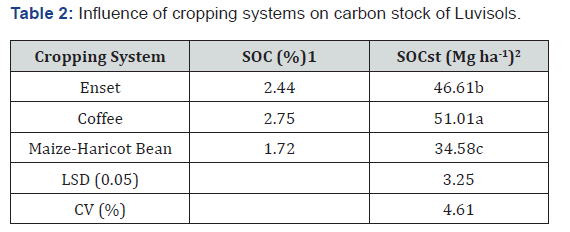
The mean values of soil organic carbon stock (SOCts) of the
copping systems ranged between 34.58 to 51.01 Mg ha-1 within 0
to 20cm soil depth. There were significant differences (p<0.05) in
mean values of SOCst among the cropping systems (Table 2). The
highest mean value of SOCst (51.01Mg ha-1) was obtained in coffee
cropping system. In this cropping system, there was high status of
organic matter due to the decomposition of fallen leaves of shed
trees and continuous application of manure. In the other hand,
the lowest mean value (34.38 Mg ha-1) was obtained in maizeharicot
bean intercropping. Comparable result was obtained from
cultivated land of Kersa sub watershed, eastern Ethiopia [34]. In
this cropping system, the organic matter was depleted duet to
continuous cultivation and complete removal of crop residues.
Conclusion
The findings of this study clearly showed that cropping
systems significantly influenced the soil organic carbon contents
and carbon stock. The organic content and carbon stock of coffee
and enset cropping systems were greater than the maize-haricot
bean intercropping. It is therefore important and advisable to
consider cropping systems of a given area to optimize organic
carbon status and carbon stock of the soils in sustainable manner.


Comments
Post a Comment