Nutritional Compositions and Sensitivity Analysis of Poultry Feed Mills in Bangladesh through Experimental Economics Approach-Juniper Publishers
Journal of Agriculture Research- Juniper Publishers

This research aimed at analyzing of nutritional
compositions and resource use efficiency of poultry feeds covering
Dhaka, Gazipur, Narsingdi, Kishoreganj and Mymensingh districts in
Bangladesh. A total of 30 feed mills which categorized as high, medium
and low quality on the basis of feed conversion ratio were selected
purposively. The feed sample were collected during March 2013 to March
2014 and analysis by using AOAC, 2000 methods and KII. It is evident
that a compound broiler feed of different feed manufacturers has
differed between analytical value (AV) means laboratory test result and
MV of various nutritional composition of ME value (energy). There is
much difference in CP content which was lower than requirements and ME
content was higher than requirements. The analytical value of EE (ether
extract) was higher than manufacturer value which influence on human
health. The results of sensitivity analyses clearly indicate that
poultry feed mills were price sensitive.
Keywords: Broiler production; Poultry feeds; Nutritional compositions; Financial profitability; Sensitivity analysis
Abbreviations:
AV; Analytical Value; EE: Ether Extract; FCR: Feed Conversion Ratio;
BCR: Benefit-Cost Ratio; NPV: Net Present Value; IRR: Internal Rate of
Return
Introduction
Livestock is playing an important role in the
national economy by contributing significantly to agriculture and to the
gross national product of Bangladesh [1-5]. Furthermore, it plays a
pivotal role in the rural socioeconomic system as maximum households are
directly involved in livestock sub-sector. Poultry industry is one of
the major among livestock sub-sectors that committed to supply cheap
sources of good quality nutritious animal protein to the nation in terms
of meat and eggs [1]. Total investment in poultry industry was Tk. 150
billion with an annual turnover of Tk. 200 to 250 billion [3]. Poultry
meat production was 30.21 lac tons and egg production 67542.80 lac in
2013/14 [6]. Poultry plays a pivotal role in bridging the protein gap of
animal origin in Bangladesh [7]. The poultry industry in Bangladesh
plays a crucial
role in economic growth and simultaneously creates numerous employment
opportunities for more than 6 million people [3]. Among animal number in
Bangladesh, poultry population was the highest in 2011-2012, it was
reaches 2329.9 lac in 2005-06 to 2932.4 lac in 2012-13 [8]. Chowdhury
[3] pointed out that the per capita consumption of all meat is 14.67kg
and egg is 31 numbers as against the requirements of 56kg meat and 365
eggs, respectively. The per capita poultry meat availability is
approximately one-fifth of the consumed meat (3kg) which needs to be
increased more than double to satisfy the current demand of 7.67kg while
that of egg more than three times to meet the per capita minimum
requirement of 102 eggs [2,4,9]. The trends of milk, meat and eggs
productions were increasing significantly from 2005-06 to 2012-13 [6].
Poultry feed mill industry as an agribusiness enterprise is
comparatively new in Bangladesh [9-12]. Total feed business,
especially, the business of concentrates was controlled by some
feed traders. Bangladesh is a feed deficit country [13]. At present
there are about 250 registered feed mills in Bangladesh. These
feed mills are not produced sufficient amounts of feed [4]. There
is a general agreement that low poultry production in Bangladesh
is mainly due to lack of nutritious feed and high price of poultry
staffs. The major feed additives are: toxin binder, mold inhibitor,
enzymes, synthetic amino acids and vitamins, feed premixes,
vitamin-mineral premixes, trace minerals, organic acids,
probiotics, salmonella killer, antibiotic for therapeutic use through
feeds (antibiotic as growth promoter is strictly prohibited to use
in the feed according to Feed Act 2010). Most of the feed additives
have been imported by the health companies and feed millers. The
major feed ingredients have been imported by the commercial
feed millers. The major feed ingredients are: meat and bone meal,
fish meal, protein concentrates, fish meal, soybean meal where
around 50% is locally produced [4].
Though, due to the government’s initiatives, supply situation
of feed has improved slightly, but still supply is very much
inadequate in relation to high increasing demand. The expansion
of commercial feed industry in Bangladesh can possible to
fulfill more than 80% of the total compound feed requirements.
Considering the existing growth rate of poultry, cattle and
aquaculture, the estimated annual compound feed requirement
would be 10.60 million MT in 2020-21 [4]. Therefore, according to
the estimation of their existing production capacity, it is revealed
that compound feed production will meet only 26.11% of the total
requirement in 2020-21 [13]. Hence, it indicates the potential of
compound feed production in the country in future.
Moreover, the poultry farmers are suffering severely from
the lack of security of their farms and investment of Bangladesh
[14]. Every year, thousands of farms are collapsing due to bird
flu outbreak and many for their incapability to buy high priced
poultry ingredients and absorb losses from market price fall [14].
In addition, feed intake accounts for approximately 65-70 percent
of the total cost of a farm. The poultry feed consumption was
around 18.36 lac MT in 2015 [5]. The most significant constraint
in the development of livestock sub-sector is the acute shortage
of balanced feed, which has been discussed earlier. In recent past,
many small-scale dairy and poultry farms were established in the
country, but 20 to 25 percent of dairy farms and 25 to 30 per of
poultry farms dropped out in their infant stage. Thus, by ensuring
the supply of quality feed for livestock sub-sector, the feed mill
industry is enhancing the whole economy significantly through its
forward linkage effect.
As the quality of feed is one of the determinant factors in
successful poultry farming, the present research was taken to
evaluate the quality of compound broiler feeds manufactured by
different feed manufacturers. This quality assessment of feeds had
been focused on several tests from initial observation on receipt,
quantitative analysis. This study is a modest effort undertaken
to examine the cost-effective supply chain of raw materials
and supply of poultry feed. The overall goal of this research is
to analysis the nutritional compositions of poultry feeds and
return over investment considering sensitivity analysis of broiler
production in Bangladesh and policy implications for the future
research. The specific objectives are as follows:
a. The nutritional composition determined by using the
method of AOAC [15].
b. The nutritional value obtained from AOAC was compared
with written in company supplying over the bags.
c. The objective function = Nutrient requirement was
maximized, and cost of the raw ingredient was minimized.
Materials and Methods

Sixty compound feed samples (30 broiler starter feeds and
30 broiler finisher feeds) of 30 different feed manufacturers
were collected proportionately from different locations of Dhaka,
Gazipur, Narsingdi, Mymensingh and Kishoreganj districts. The
field work conducted with feed miller, dealer, different sizes of
poultry farm owners and farmers. Table 1 showed that a multistage
stratified sampling was applied in this study. The feed mills
categorized on the basis of feed conversion ratio (FCR) that is high
quality feed mills (FCR; below 1.5 to below 1.6), medium quality
feed mills (FCR: 1.6 up to below 1.7) and low-quality feed mills
(FCR: 1.7 up). The selected commercial farms were categorized
by flock size small scale: < 1000 birds, medium scale: 1001-2000
birds and large scale: above 2000 birds. In conformity with the
objectives of the study, a structured questionnaire developed for
collecting relevant primary data from the poultry feed miller,
dealer and sub-dealer and farmers. The present study covered approximately from March 2013 to December 2014. It has been
found that CP (crude protein) and energy level written over the
bag but some time industries people are exploiting to farmers by
using unknown growth stimulating substances to increase for FCR
value:
a. The nutritional composition determined by using the
method of AOAC [15].
b. The nutritional value obtained from AOAC was compared
with written in company supplying over the bags.
c. The objective function = Nutrient requirement was
maximized, and cost of the raw ingredient was minimized.
The quality of compound feeds depends on the storage time
also. The broiler feed samples were collected within 10-15 days
after manufacturing of feeds at feed mills from broiler farmers.
After collection, feed samples were stored in refrigerator during
chemical analysis at animal nutrition laboratory. During the
collection of samples, feed bags and nutrient specification, expired
date on bags of different feed sample were carefully observed and
recorded.
Chemical analysis (proximate analysis)
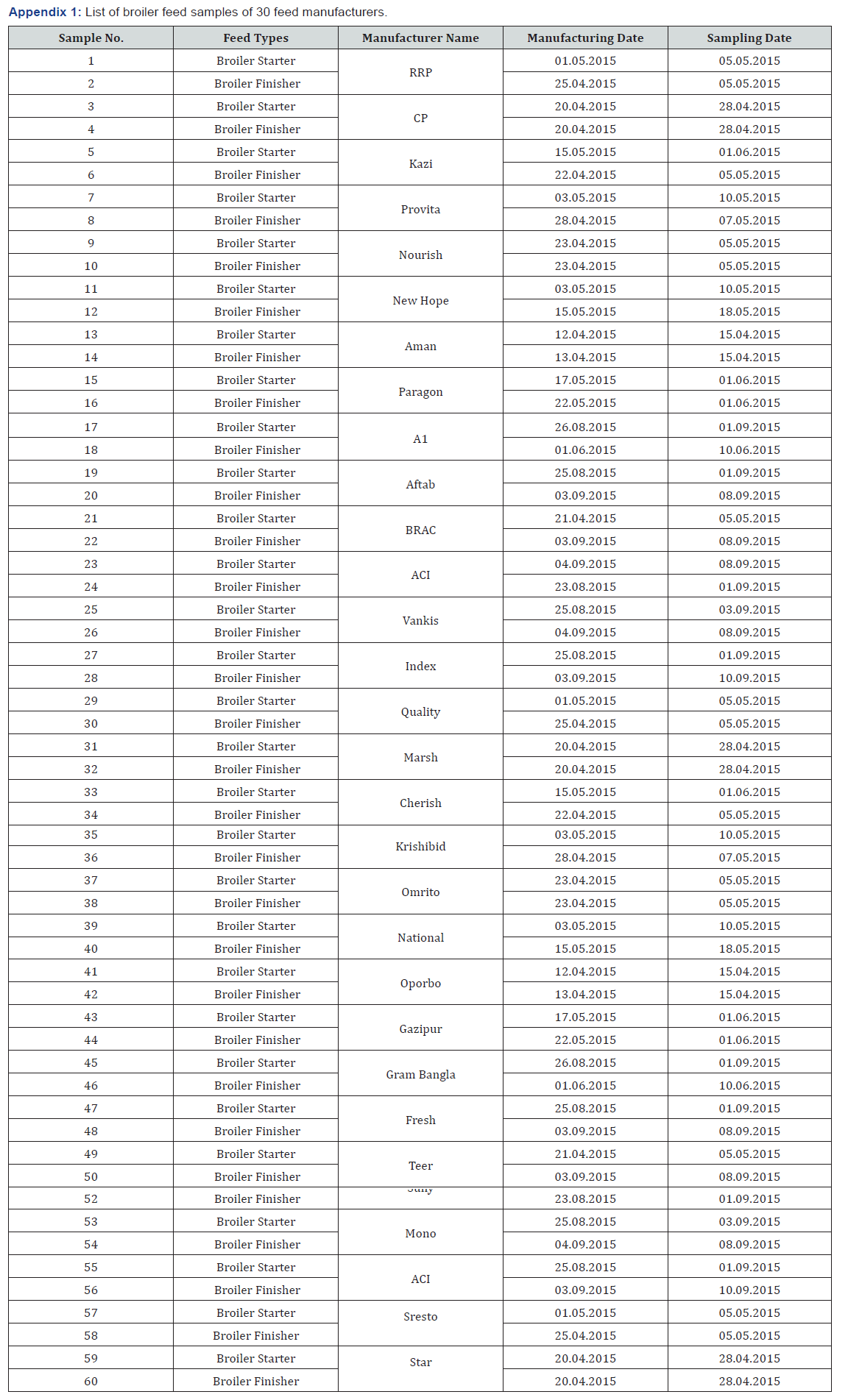
The proximate components and energy content of the
collected feed samples were tested at Animal Nutrition Laboratory,
Bangladesh Agricultural University, Mymensingh (Appendix 1).
The chemical composition (dry matter, crude protein, crude fibre,
ether extract and ash) was determined by the procedure of AOAC
[15]. The ME content of the feed samples was determined by
using the values of crude fiber (CF), ether extract (EE), and ash
according to the method of Wiseman [16].
The formula is ME (Kcal / kg ) = 3951 + 54.4EE − 88.7CF − 40.8Ash
Where, CP is the crude protein (in percentage), EE is the ether
extract (in percentage) and Ash is the Ash (in percentage).
Return over investment analysis
To estimate the profitability of the feed mills and poultry
farms, project appraisal techniques such as BCR, NPV and IRR were
used. The financial analysis in this study was conducted from the
view point of owner of feed mill. Discounted measures of project
were used for financial analysis since undiscounted measures of
project worth is quite unable to take into consideration the timing
of benefits and costs through the project life. The discounted
measures are commonly used in agricultural project analysis.
These are:
a. Benefit-Cost Ratio (BCR).
b. Net Present Value (NPV).
c. Internal Rate of Return (IRR)
The BCR is a relative measure which is used to compare
benefits per unit of cost. The NPV, on the other hand, is an
absolute measure which estimates the projects net present worth.
The IRR is also a relative measure which may be defined as the
average earning power of the money invested in a project over the
project life [17,18]. The formal mathematical statements of the
discounted measures of project worth suggested by Gittinger [19]
are as follows:
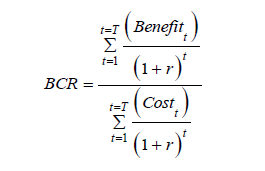
Benefit cost ratio (BCR): The benefit cost ratio (BCR) is a
relative measure which was used to compare benefit per unit of
cost. BCR estimated as a ratio gross returns and gross costs. The
formula of calculating BCR (undiscounted) is shown as below.
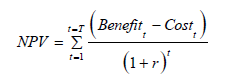
Net present value (NPV): NPV is the current value of all net
benefits associated with a project. NPV calculated by the following
equation:
Internal rate of return (IRRI): IRR is the maximum interest
rate that could be paid for the project resources that would leave
enough money to cover investment costs and still allow society to
break even. IRR will be calculated by the following equation.
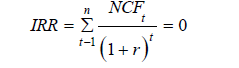
Where, B is the benefit in each year; Ct is the cost in each year;
NCFt is the net cash flow in each year f = 1,2…..n; n is the number of
years; i is the interest (discount) rate; and t for time.
For calculating the IRR, interpolation method is usually used.
The rule for interpolating the value of the internal rate of return
lying between discount rates at too high on the one side and at too
low on the other side. Thus,

Sensitivity analysis of poultry feeds production
Output and prices vary over time and subject to feed millers
and farmers’ risk. In the production cycle, certain prices, quantities
and costs may be highly variable resulting in a large effect on net
returns. At the same time, good output prices make poultry feed
millers and farmer’s profitable and less prices make looser. In case
of poultry feed raw materials price, output price is more sensitive.
So, sensitivity analyses have been done by assuming some
scenarios with varying input and output prices. By doing this, it
is possible to study the impact of changing feed raw materials
and feed price. Effects of sensitivity analysis of different quality
poultry feed mills considering followings situation.
a. Considering 5 percent decrease of feed price in market.
b. Considering 10 percent decrease of feed price in market.
c. Considering 5 percent increase of raw materials price in
market.
d. Considering 10 percent increase of raw materials price
in market.
Results and Discussion
Analytical and manufacturer value of broiler starter and finisher feed
The results of analytical value (laboratory test result) and the
manufacturer value (different company supply feed bags labeling
there gives statement of the percentage of different components)
differed. The nutritional components of analytical value and
manufacturer value (the statement of feed company supplying
bag) of broiler starter feed samples differed except the moisture,
CF, and Ash content of feeds. The analytical value of broiler starter
feed of F1 manufacturer of moisture, CP, CF, Ash and EE were
11.32%, 20.08%, 3.30% 7.07% and 6.73% whereas manufacturer
values were 12%, 22.50%, 4.00%, 3.00% and 5.00%, respectively.
But ME value of this manufacturer MV and AV were 3200.00
and 3768.76 kcal per kg which indicates that analytical value
more than manufacturer values (Table 2). The analytical value of
broiler starter feed of F2 manufacturer of moisture, CP, CF, Ash
and EE were 12.08%, 18.94%, 3.84% 6.30% and 5.77% whereas
manufacturer values were 12%, 22.00%, 5.50%, 3.00% and 6.00%,
respectively. But ME value of this manufacturer MV and AV were
3200.00 and 3718.20 kcal per kg which indicates that analytical
value more than manufacturer values. The moisture content of F2
manufacturer is the height of these manufacturers. The analytical
value of broiler starter feed of F3 manufacturer of moisture, CP,
CF, Ash and EE were 8.32%, 18.69%, 3.37% 6.30% and 6.25%
whereas manufacturer values were 12%, 22.50%, 4.00%, 3.00%
and 5.00%, respectively. But ME value of this manufacturer MV
and AV were 3100.00 and 3739.44 kcal per kg which indicates
that analytical value more than manufacturer values. The similar
results also found for broiler starter feed of F5, F7, F21, F23 and
F27 manufacturer (Table 2).
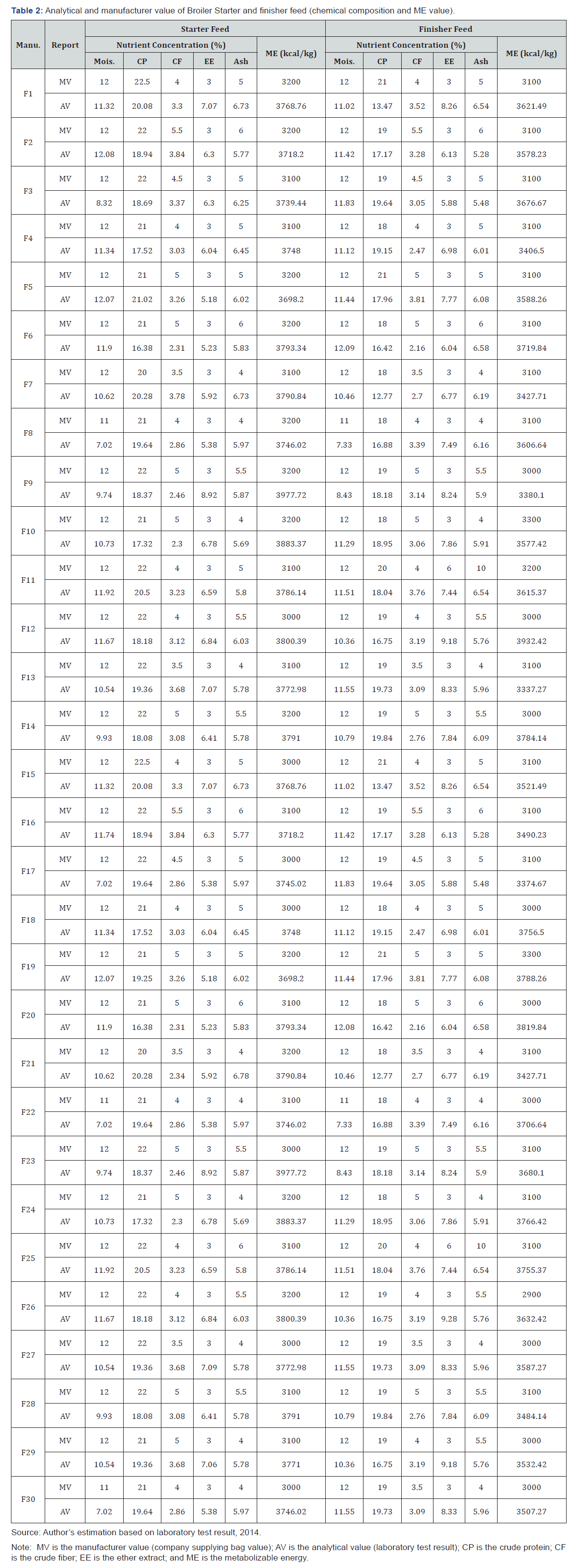
In case of broiler finisher feed of F1 manufacturer
of moisture,
CP, CF, Ash and EE were 11.02%, 13.47%, 3.52% 8.26% and 6.54%
whereas manufacture values were 12.00%, 21.00%, 4.00%, 3.00%
and 5.00%, respectively. But ME value of this manufacturer MV
and AV were 3100.00 and 3621.49 kcal per kg which indicates that
analytical value more than manufacturer values. The analytical
value of broiler finisher feed of F6 manufacturer of moisture were
12.09% whereas manufacture values were 12.00% which is the
height value of these manufacturers. The analytical value of broiler
finisher feed of F14 manufacturer of crude protein was 19.84%
whereas manufacture values was 19.00% which is the height value
of these manufacturers. The analytical value of broiler finisher
feed of F26 manufacturer of ether extract was 9.28% whereas
manufacture values was 9.00% which is the height value of these
manufacturers. The analytical value of broiler finisher feed of F20
manufacturer of ME was 3819.84% whereas manufacture values
was 3000.00% which is the height value of these manufacturers
(Table 2).
Some research findings showed that there are several factors
can contribute to the variation in nutrient content including
genetic background of the plant, agricultural conditions where
the plant is grown (e.g. fertilization rates), stressors (e.g. drought,
extreme heat early frosts and diseases) and processing conditions
(e.g. mechanical extraction or chemical extraction). Other factors
like sampling and laboratory analysis could add up to the nutrient
variability [20,21].
Average chemical composition (analytical value and manufacturer value)
Average chemical composition of nutritional components
and ME value of the broiler feed samples of 30 different feed
manufacturers which were collected from feed company bags
and analyzed in the laboratory (Table 3). Table 3 shows that the
average analytical value of broiler starter feed of high-quality
manufacturer of moisture, CP, CF, Ash and EE were 11.32%,
19.47%, 3.52%, 6.26% and 6.54% whereas manufacturer values
were 12%, 22 %, 5.00%, 3.00% and 6.00%, respectively. But high
quality of manufacturer’s average ME value of MV and AV was
3200.00 and 3793.34 kcal per kg which indicates that analytical
value of ME is more than manufacturer values. The medium quality
manufacturer of their nutrient concentration of average analytical
values were 11.42%, 18.17%, 3.28%, 6.13% and 5.28% whereas
manufacturer values were 12%, 21 %, 4.00%, 3.00% and 5.00%,
respectively. But medium quality of manufacturer’s average ME
value of MV and AV was 3100.00 and 3777.72 kcal per kg which
indicates that analytical value of ME is more than manufacturer
values (Table 3). The low-quality manufacturer of their nutrient
concentration of average analytical values were 11.00%, 17.64%,
3.05%, 5.88% and 5.48% whereas manufacturer values were
11.00%, 20.00%, 3.00%, 3.00% and 5.00%, respectively. The low
quality of manufacturer’s average ME value of MV and AV were
3000.00 and 3709.44kcal per kg which indicates that analytical
value of ME value is more than manufacturer values.
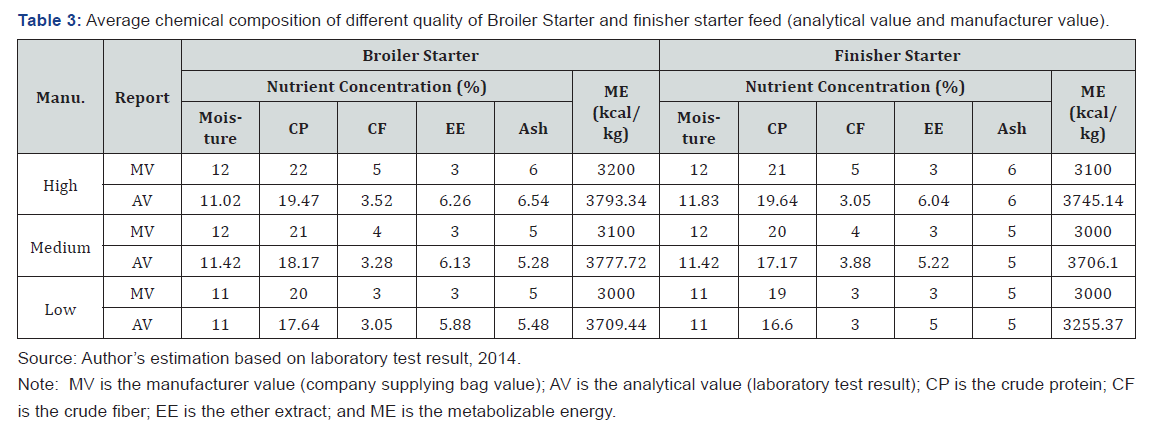
In case of finisher feed the average analytical value of highquality
manufacturer of moisture, CP, CF, Ash and EE were 11.83%,
19.64%, 3.05%, 6.04% and 6.00% whereas manufacturer values
were 12.00%, 21.00 %, 5.00%, 3.00% and 6.00%, respectively.
But high quality of manufacturers’ average ME value of MV and
AV were 3100.00 and 3745.14kcal per kg which indicates that
analytical value of ME is more than manufacturer values. The
medium quality manufacturer of their nutrient concentration
of average analytical values were 11.42%, 17.17%, 3.08%,
5.22% and 5.00% whereas manufacturer values were 12.00%,
21.00%, 4.00%, 3.00% and 5.00%, respectively. But medium
quality of manufacturer’s average ME value of MV and AV were
3000.00 and 3706.10kcal per kg which indicates that analytical
value of ME is more than manufacturer values. The low-quality
manufacturer of their nutrient concentration of average analytical
values were 11.00%, 16.60%, 3.00%, 5.00% and 5.00% whereas
manufacturer values were 11.00%, 19.00%, 3.00%, 3.00% and
5.00%, respectively. The low quality of manufacturers’ average
ME value of MV and AV were 3000.00 and 3255.37kcal per kg
which indicates that analytical value of ME value is more than
manufacturer values (Table 3).
Profitability analysis of broiler production
After estimation all cost and returns it was easy to find out
financial returns of poultry feed mill. The result of benefit-cost
analysis is highly sensitive to the discount rate; the choice of
an appropriate discount rate, therefore, plays a vital role in the
appraisal of projects. The difficulties in estimating the opportunity
cost of capital are reflected by the study. The case becomes more
difficult in developing countries, because of various kinds of
imperfection and high distortion in the capital market. However,
the available literature suggests that in most developing countries,
the opportunity cost of capital varies between 8 to 15 percent.
According to the manager of the Sonali Bank of Mymensingh
branch, the lending rate of agriculture (production) loan is 14
percent. Thus, a 14 percent discount rate has been chosen for the
appraisal poultry feed mill.
Before proceeding to the final results, it is worthwhile to
recapitulate some salient features of the selected discounting
measures i.e., Benefit Cost Ratio (BCR), Net Present Value (NPV)
and Internal Rate of Return (IRR). The BCR is a relative measure
which is used to compare benefits per unit of cost. The NPV
criterion, on the other hand, is an absolute, not a relative measure
may have a smaller NPV than a large marginally acceptable project.
As long as both have a positive NPV, this is not really a problem
for the selection of a project. The IRR is not affected by the rate
of discount, while the NPV may change as a result of using a
different discount rate [22,23]. It is argued [24] that the ranking of
projects under the IRR criterion may also differ in the case where
net benefits vary overtime, even though all projects may have the
same life time. Nonetheless, all projects having IRR above the
opportunity cost of capital can be accepted. The summary results
of financial analysis of thirty poultry feed mill are presented in
Table 4 shows that BCR was 2.94, 2.16 and 1.9, respectively a high,
medium and low-quality feed mill which indicates the benefit
cost ratio of high-quality feed was better than medium and lowquality
feed. Considering 20 years’ time period and 14 percent
discount rate, the NPVs from poultry feed mill were also positive.
The average NPV of high, medium and low-quality feed mill was
also positive. The NPV of high, medium and low-quality feed mill
were Tk. 12374.39 lack, Tk. 4628.46 lack and Tk. 517.18 lack,
respectively which indicates the net present values of high-quality
feed mill was more than medium and low-quality feed (Table 4).

The positive NPVs indicate that poultry feed mill are
considered to be financially sound and the project said financially
viable because average IRR of high quality feed mill and low quality
feed mill. And IRR of high, medium and low-quality feed mills were
64.97%, 50.21% and 31.39%, respectively which greater than the
normal bank rate also indicates the internal rate of return of highquality
feed mill was better than medium and low quality feed.
That means it support that investment on high quality poultry
feed mill is highly profitable and economically viable. In view of
these circumstances, the financial analyses showed that poultry
feed mills were highly profitable from the view point of individual
investments. This research is also supported by some research like
feed costs typically represent the highest cost item in smallholder
production systems, implying that both quantity and quality of
feed have a significant effect in determining profitability [25,26].
Sensitivity analysis of different quality poultry feed mills
Considering decrease in 5 and 10 percent poultry feed:
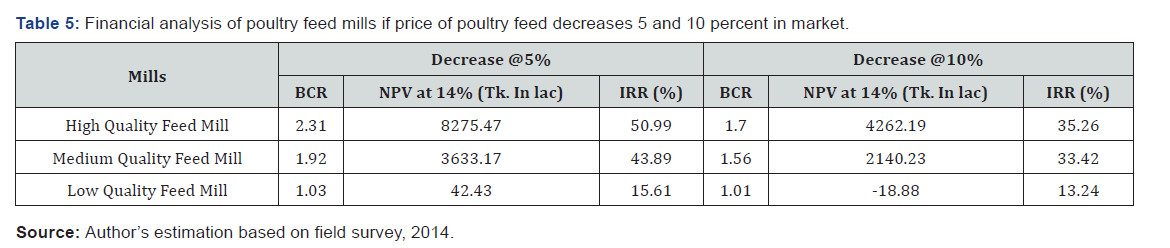
The evaluation of financial analysis as stated in Table 5 has been
done on the basis of certain assumptions as stated earlier. It
was assumed that the prices of all cost items as well as flow of
income would remain constant during the farm’s life. This short
of assumptions may turn out to be unrealistic in an uncertain
world. The result of sensitivity analysis shows how the investment
decision changes with the changes in the value of any variable in
the discounted cash flow analysis. The profitability of poultry feed
mill may be expected to be sensitive to price and yield uncertainty
which effects on gross benefits of the feed mill. Even the mills
themselves may not perform in the way expected. Many authors’
(e.g. [22,23]) also argue that the problem of uncertainty is another
knotty problem to which there is no tidy solution. A great deal
will inevitably depend upon the judgment of those making the
decision. Only one vital factor such as price of feed decrease to
the market is considered in this study for the sensitivity analysis.
The aim of this section is to analyze what happens to profitability
under the changed circumstances.
It is evident from financial analysis; the poultry
feed mills were
making high profits. Sensitivity analysis was conducted based on
the assumptions that all benefits and investment of capital costs
would happen in profitability of the feed mills; if price of poultry
feed decrease 5 percent or 10 percent, respectively and if price
of raw materials increase 5 percent or 10 percent, respectively
(Table 5). In case of 5 percent decrease of feed price in market
shows that BCR was 2.31, 1.92 and 1.03 respectively a high,
medium and low-quality feed mill which indicates the benefit cost
ratio of high-quality feed was better than medium and low-quality feed.
Considering 20 years’ time period and 14 percent discount
rate, the NPVs from poultry feed mill were also positive. The
average NPV of high, medium and low-quality feed mills was also
positive. The NPV of high, medium and low-quality feed mill were
Tk. 8275.47 lack, Tk. 3633.17 lack and Tk. 42.43 lack respectively
which indicates the net present values of high-quality feed mill
was more than medium and low-quality feed. The positive NPVs
indicate that poultry feed mills are considered to be financially
sound and the project are said financially viable because average
IRR of high, medium and low-quality feed mill. And IRR of high,
medium and low-quality feed mills were 50.99%, 43.89% and
15.61%, respectively that is higher than the normal bank rate
(Table 5). In view of these circumstances, the sensitivity analysis
showed that poultry feed mills were highly sensitive. This implies
that if the price of poultry feed price decrease at 5 percent in
market then poultry feed mill could run their business but some
mills were making loss and reluctant to operate feed mill.
Sensitivity analysis has been done taking into account 10
percent decrease of feed price in market. Summary results of
these analyses are presented in Table 5 shows that benefit cost
ratio (BCR) was 2.31, 1.92 and 1.03, respectively a high, medium
and low-quality feed mill which indicates the benefit cost ratio of
high-quality feed was better than medium and low quality feed.
The average NPV of high and medium quality feed mills was also
positive but low-quality feed mill was negative. The NPV of high,
medium and low-quality feed mills were Tk. 4262.19 lack, Tk.
2140.23 lack and Tk. -18.88 lack, respectively which indicates the
net present values of high-quality feed mill was more than medium
and low-quality feed. The positive NPVs indicate that poultry feed
mills are considered to be financially sound and the project are
said financially viable because average IRR of high and medium
quality feed mill but low-quality feed mills financially was not
viable. And IRR of high, medium and low-quality feed mills were
35.26%, 33.42% and 13.24%, respectively that is higher than the
normal bank rate. In view of these circumstances, the sensitivity
analyses showed that poultry feed mills were highly sensitive.
This implies that if the price of poultry feed price decrease
at 10 percent in market then poultry feed mill could run their
business but some mills were making loss and reluctant to
operate feed mill that means if price fall 10 percent then average
performance of poultry feed mill for both categorize would be in
loosing condition. Though some high-quality feed mills could able
to incur bank rate but they also not interested to continue their
business due to very low return from business. On the other hand
low quality feed mill stopped producing feed because average BCR
of poultry feed mill were less than unity, NPV was negative and
IRR was undetermined.
Considering decrease in 5 and 10 percent of raw materials:
Sensitivity analysis has been done taking into account 6 percent
increase of raw materials price in market. Summary results of
these analyses are presented in Table 6 shows that benefit cost
ratio (BCR) was 2.33, 1.94 and 1.12, respectively a high, medium
and low-quality feed mill which indicates the benefit cost ratio of
high quality feed was better than medium and low quality feed.
The average NPV of high, medium and low-quality feed mills was
positive. The NPV of high, medium and low-quality feed mill were
Tk. 8393.81 lack, Tk. 3695.32 lack and Tk. 294 lack, respectively
which indicates the net present values of high-quality feed mill
was more than medium and low quality feed.
The positive NPVs indicate that poultry feed mills are
considered to be financially sound and the project are said
financially viable because average IRR of high, medium and lowquality
feed mills financially was viable. And IRR of high, medium
and low-quality feed mills were 51.42%, 44.30% and 24.45%
respectively that is higher than the normal bank rate. In view of
these circumstances, the sensitivity analyses showed that poultry
feed mills were highly sensitive. This implies that if the price of
raw materials was increased at 5 percent in market then poultry
feed mill could run their business but some mills were making
less benefit and reluctant to operate feed mill that means if price
increased 5 percent then average performance of poultry feed mill
for both categorize would be in loosing condition. Though some
high-quality feed mills could able to incur bank rate but they also
not interested to continue their business due to very low return
from business.

Sensitivity analysis has been done taking into
account 5
percent increase of raw materials price in market. Summary
results of these analyses are presented in Table 6 shows that
benefit cost ratio (BCR) was 2.06, 1.72 and .99 respectively a high,
medium and low-quality feed mill which indicates the benefit
cost ratio of high-quality feed was better than medium and lowquality
feed. The average NPV of high, medium and low-quality
feed mills was positive. The NPV of high, medium and low-quality
feed mill were Tk. 6645.57 lack, Tk. 2786.62 lack and Tk. -81.99
lack respectively which indicates the net present values of highquality
feed mill was more than medium but low-quality feed was
negative (Table 6). The positive NPVs indicate that poultry feed mills
are considered to be financially sound and the project are
said financially viable because average IRR of high and medium
financially was viable and sound but low-quality feed mills was not
viable. And IRR of high, medium and low-quality feed mills were
44.90%, 38.13% and 12.70% respectively that is higher than the
normal bank rate. In view of these circumstances, the sensitivity
analyses showed that poultry feed mills were highly sensitive.
This implies that if the price of raw materials was increased at 10
percent in market then poultry feed mill could run their business
but some mills were making less benefit and reluctant to operate
feed mill that means if price increased 10 percent then average
performance of poultry feed mill for both categorize would be in
loosing condition. Though some high-quality feed mills could able
to incur bank rate but they also not interested to continue their
business due to very low return from business. On the other hand
low quality feed mill stopped producing feed because average BCR
of poultry feed mill were less than unity, NPV was negative and
IRR was undetermined.
Conclusion
It is clear that compound broiler feeds of different feed
manufacturers has differed between analytical value and
manufacturer value of various nutritional composition of
metabolizable energy value. There is much difference in crude
protein content and metabolizable energy content. The crude
protein was lower than requirements and metabolizable energy
was higher than requirements. The analytical value of EE was
higher than manufacturer value. Further research is needed to dig
down the limit of lowering the protein and increasing the ME value
of broiler feeds of manufacturers. Because, the analytical value
of EE was higher than manufacturer value which has influence
of health hazard. The findings of the study the benefit from high
quality feed are higher than medium and low-quality feed. It
is evident that the high-quality poultry feed mills were highly
profitable comparatively medium and low-quality feed mills
considering the real condition. The results of sensitivity analyses
clearly indicate that poultry feed mills were price sensitive. If price
fall in the market, then they can marginally sustain in the market
but if it is more than 5 percent then they will reluctant to operate
poultry feed mill. So, we can say, profitability of poultry feed mills
appears to be negatively correlated with decrease of poultry feed
price in market. If price of raw materials price were increased in
the market, then they can marginally sustain in the market but
if raw materials price were increased 10 percent then average
performance of poultry feed mill for both categorize would be in
loosing condition. Though some high-quality feed mills could able
to incur bank rate but they also not interested to continue their
business due to very low return from business. On the other hand,
low quality feed mill stopped producing feed because average BCR
of poultry feed mill was less than unity.


Comments
Post a Comment