Screening of Six Parents and 15 Cross Combinations against Bacterial Wilt (Ralstonia solanacearum)-Juniper Publishers
Journal of Agriculture Research- Juniper Publishers

The study on the screening for resistance to
bacterial wilt (Ralstonia solanacearum) of six parents and 15 cross
combinations/hybrids were evaluated under artificial epiphytotic
conditions at the Plant Pathology lab and glass house of Plant Pathology
Section of Horticulture Research Centre (HRC) of Bangladesh
Agricultural Research Institute (BAIR), Gazipur, Bangladesh during the
period from September 2016-17 to develop high yielding F1 eggplant varieties resistant to bacterial wilt. Amongst the six parents and 15 hybrids, six hybrids viz., F1 4x17, F1 4x5, F1 18x17, F1 3x17, F1 3x5, F1 17x5 showed resistant (R) reaction. The cross F1 3x17, F1 17x5 exhibited the lowest percent of wilt (10%) followed by F1 4x17 (16.67 %), F1
3x5 (13.33 %). In case of parents, three parents showed resistant (R)
reaction viz. BL083 (20.00% wilting), BL081 (16.67% wilting) and BLS2
(16.67% wilting). Incubation period ranges from 4 days to 12 days. The
lowest incubation period (4 days) was observed form the parent BL034
followed by Islampuri (5 days) and Uttara (6 days), hybrids F1 4x14 (6 days) and F1 18x14 (6 days).
Keywords: Ralstonia solanacearum; Hybrids; Epiphytotic; Plant Pathology; Horticulture
Abbreviations:
HRC: Horticulture Research Centre; BAIR: Bangladesh Agricultural
Research Institute; TZC: Triphenyl Tetrazolium Chloride; CRD: Completely
Randomized Design; HR: Highly Resistant; MR: Moderately Resistant; MS:
Moderately Susceptible; HS: Highly Susceptible
Introduction
Bacterial wilt caused by Ralstonia solanacearum [1], synonym Pseudomonas solanacearum
Smith (1914), is widespread in the tropical, subtropical and temperate
region, where it represents a major constraint to the production of
numerous crops [2,3]. Recent reviews showed the very extensive host
range of R. solanacearum which includes several hundred species
representing about 53 families of plants [4]. Host species include
ornamentals, weeds and important crops such as tomato (Lycopersicum esculentum L.) potato (Sonalum tuberosum L.) eggplant (Solanum melongena? L.), chilli pepper (Capsicum spp.), tobacco (Nicotiana tabacum L.), ginger (Zingiber officinale L.), peanut (Arachis hypogea L.) etc.
The incidence of soil borne diseases particularly bacterial wilt caused by Ralstonia solanacearum
E.F. Sm. is the most limiting factor to produce eggplant in Bangladesh.
Not only in Bangladesh, bacterial wilt is a disease of world wide
importance in eggplant production [5]. An early crop of eggplant is very
profitable for the farmers in Bangladesh, but the early crop is
particularly vulnerable
to this disease. Once the eggplants are affected by bacterial wilt, they
die within three to four days. The organism when injected in the
susceptible hosts through the root systems cause vascular wilt and
ultimate death of the plant [6]. The characteristics symptoms of
bacterial wilt in most hosts are wilting, stunting and yellowing of the
foliage. With susceptible infected eggplants, the most striking symptom
is the rapid and complete wilting of the plants following field
infection. Distinct epinasty of the petioles prior to wilting may be
apparent if disease development is slow. Internal symptoms include
discoloration of vascular tissue and decay of portions of the pith at
the advanced stages of infection. It is the most destructive bacterial
plant pathogen especially in the warm regions [6]. In recent years,
bacterial wilt has become a great problem for eggplant cultivation in
Bangladesh. The main effort to control this disease has been directed
towards the development of resistance cultivars. But available
information suggests that very few of the cultivars were reported as
resistant to this disease. Various attempts to control bacterial wilt of
different crops have been reported [7] but success was limited.
Breeding for resistance,
therefore, remains the best control strategy, even though varietal
resistance differs in different localities due to extreme variability
and adaptation of the pathogen [8].
The grafting of cultivated variety on wild brinjal root-stock can
successfully control the disease [9], but grafting technology is not
well adopted to the farmers due to some technological aspects and
it is some time troublesome. So, development of disease resistant
cultivar is the easiest way to solve the problem, but development of
disease resistant variety is not easy. Many workers are still working
in the world to develop disease resistant variety. The development
of resistant cultivars for the control of bacterial wilt has been
successful in the case of tobacco and peanut [3]. Many cultivars of
tomato are resistant for certain environments, but their resistance
was not stable under conditions of high temperature and humidity
in the lowland tropics. Similarly, some chilli accessions which
were found to be resistant in India were susceptible in Japan [10].
Thus, the development of resistant variety in specific locations
of the crops to certain pathogen remained a continuous process.
Available information suggests that no appreciable attempt has
yet been made to study the local as well as the available exotic
plant material against bacterial wilt resistance in Bangladesh.
Besides, no hybrid variety has been screened against bacterial wilt
disease. The present study has been undertaken to evaluate the
performance of the hybrid variety against bacterial wilt disease.
Materials and Methods
The present study was carried out to find out the resistance
against bacterial wilt of the 15 cross combinations/hybrids and six
parents and screened them to find out suitable cross combination
of inbred lines for developing hybrid variety with high yield and
wilting resistant. The materials required and methodology are
described below under the following sub-heading.
Experimental site
The present experiment was conducted at the Plant Pathology
lab and glass house of Plant Pathology Section of Horticulture
Research Centre (HRC) of Bangladesh Agricultural Research
Institute (BAIR), Gazipur, Bangladesh during the period from
September 2016-17.
Materials: Six parents and 15 cross combinations/hybrids
total 21 eggplant genotypes were used in this experiment. The
parents were selected not only based on high yield and other yield
contributing characters and quality but also on the basis bacterial
wilt resistant. Therefore, the selected parents exhibited some
degrees of resistant and the main objective of the experiment was
to find out how the intensity of resistance turns to the hybrids
form the parents.
Seeding production: Seeds of the parents and cross
combinations were sown in steel tray containing sterilized
soils mixture (soil: sand: compost) in the ratio of 3: 2: 1 on 1st
September 2016. Before sowing, the seeds were treated with GA3
solution (100ppm) for 24 hours at room temperature for quick
and uniform germination. Seedlings were germinated on trays
with sterilized soils mixture for a period of ten days. Ten days
after seed germination young seedlings were transferred to the
individual plastic pot (9cm diameter) containing sterilized soil
mixed with 50% organic matter (v/v).
Bacterial cultures, preparation of inoculum and stock
cultures: Pure culture of R. solanacearum strain used in this study
was isolated form wilted eggplant showing typical symptoms of
bacterial wilt form the research field of Plant Pathology Section,
HRC, BARI. The pathogen on isolation on triphenyl tetrazolium
chloride (TZC) agar medium [6] yielded grayish white, fluidal
colonies with light pink centers. After purification, the isolate was
characterized as race1 according to pathogenicity and host range
[2], and biochemical test [4]. The identification of the isolates was
also confirmed by Cock’s Postulate. All isolates were kept as stock
culture in lyophilized form and in 5ml sterilized tap water kept at
15 ˚C. Before preparation of inoculum, the bacteria was streaked
on TZC from the stock culture. The inoculum was prepared by
culturing the virulent and fluidal colony of R. solanacearum on
casamino acid-peptone-glucose (CPG) agar medium.
Experimental design
The plants of 15 cross combinations and six parents were
arranged in the glass house following Completely Randomized
Design (CRD) with three replications and ten plants were
inoculated in each replication. Line to line and plant to plant
distance were maintained 30cm and 25cm respectively. The plants
were inoculated when they were approximately 35 days old (15
days after transplanting in plastic pot).
Inoculation: Suspension of R. solanacearum was prepared
form the stock culture which was grown on CPG for 48 hours
at 300C. A sterile toothpick was used to inoculate the bacterial
suspension containing approximately 2.0 108cfu/ml (colony
forming unit per milliliter) was inserted at the axil of 3rd fully
expanded leaf of the plants. Plants were observed regularly for the
initiation of symptoms of wilt, incubation period, 25% and 50%
plant wilt (days after inoculation). After recording the 50% wilted
plant data regularly, data recorded at seven days interval and final
data recorded at 42 days after inoculation. The initiation of the
first wilt-symptoms after inoculation and the number of wilted
plants for each accession was recorded and graded on a 0-5 rating
scale of Winstead & Kelman [5] with some modifications. The
modified rating scale is;
0 = Plants did not show any symptoms of wilt; highly resistant
(HR)
1 = 1 - 20% plants wilted; resistant (R)
2 = 21 - 40% plants wilted; moderately resistant (MR)
3 = 41 - 60% plants wilted; moderately susceptible (MS)
4 = 61 - 80% plants wilted; susceptible (S)
5 = more than 80% plants wilted; highly susceptible (HS)
The reaction of the hybrids and parents were categorized
as highly resistant, resistant, moderately resistant, moderately
susceptible to highly susceptible, depending on the percentage
of wilt of the plants. The incubation period, time taken to
produce 25% and 50% wilt at days after inoculation (DAI) were
also recorded. Final data on wilting (recorded at 42 DAI) were
converted into percent wilt and the reaction of the genotypes was
graded on a 0-5 rating scale according to Winstead & Kelman [5].
Results and Discussion
The reaction of the eggplant parents and hybrids against
bacterial wilt shown in Table 1. It was revealed form the result
reaction against bacterial wilt exhibited different degrees of
variation. Among the 15 cross combinations, six hybrids showed
resistant (R), seven hybrids showed moderately resistant (MR)
and two hybrids showed moderately susceptible (MS) reaction
against wilting. But in case of the parents three showed resistant
(R) and three parents showed moderately susceptible (MS)
reaction against wilting.
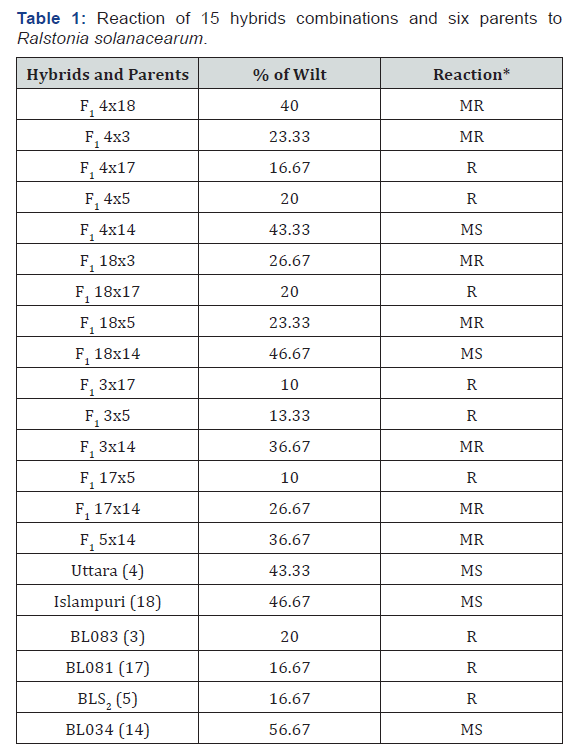
N.B. 4 = Uttara, 18 = Islampuri, 3 = BL083, 17 = BL081, 5 = BLS2, 14
= BL034
*0 = Plants did not show any symptoms of wilt, highly resistant (HR);
1 = 1 - 20% plants wilted, resistant (R); 2 = 21 - 40% plants wilted,
moderately resistant (MR); 3 = 41 - 60% plants wilted, moderately
susceptible (MS); 4 = 61 - 80% plants wilted, susceptible (S); 5 = more
than 80% plants wilted; highly susceptible (HS).
Among the 15 hybrids six hybrids viz., F1 4x17, F1 4x5, F1 18x17,
F1 3x17, F1 3x5, F1 17x5 showed resistant (R) reaction. The cross F1
3x17, F1 17x5 exhibited the lowest percent of wilt (10%) followed
by F1 4x17 (16.67 %), F1 3x5 (13.33 %). The 20.00% wilting was
observed form hybrids F1 4x5, F1 18x17. Seven hybrids showed
moderately resistant (MR) reaction against bacterial wilt disease
and the percent wilting plants ranged from 23.33 to 40.00%. The
hybrids exhibited 23.33% wilting were F1 4x3, F1 18x5; 26.67%
wilting observed form the hybrids F1 18x3, F1 17x14; 36.67% form
F1 3x14, F1 5x14 and 40.00% from F1 4x18. Moderately susceptible
(MS) reaction showed only by two hybrids they were F1 4x14
(43.33% wilting) and F1 18x14 (46.67% wilting).
In case of parents, three parents showed resistant (R)
reaction viz. BL083 (20.00% wilting), BL081 (16.67% wilting)
and BLS2 (16.67% wilting). Three parents exhibited moderately
susceptible (MS) reaction they were Uttara (43.33% wilting),
Islampuri (46.67% wilting) and BL034 (56.67% wilting). Rahman
[9] reported from an experiment against bacterial wilt (R.
solanacearum) that line BL081 showed resistant reaction while
the genotypes BL099 showed moderately resistant reaction.
Six genotype BL117, ISD011, ISD001, BLS18, BLS2 and Tarapuri
(hybrid variety) were found moderately susceptible to bacterial
wilt.
From the above discussion it was revealed that the hybrids
along with the parents BL083, BL081 and BLS2 showed resistant
to moderately resistant reaction against bacterial wilt and
increased the resistant reaction against the disease intensity.
All the hybrids performed better than the lower parent and mid
parent and sometime better parent also. When the parent crossed
with BL034 performance was not satisfactory. Among the 15 cross
combinations the hybrids F1 3x17, F1 17x5, F1 4x17, F1 3x5, F1 4x5, F1
18x17 performed better and showed resistant reaction (R; wilting
0-20% plant) than other hybrids against bacterial wilt disease.
Rashid et al. screened twenty-three local and exotic cultivars of
eggplant and three wild relatives of the crop against bacterial
wilt in the glass house. The wild relatives Sonalum mammosum
was found resistant while the cultivar Dingaras Multiple Purple
and Khakhatia long were found moderately resistant, the cultivars
Nayankazal, Kahkhatia round, Tiwan naga, Nagasaki naga and
Kurume naga were found moderately susceptible, while the rest of
the cultivars as highly susceptible to bacterial wilt.
Mochizuki & Yamakawa [11] studied the resistant of selected
eggplant cultivars and wild Solanum species to bacterial wilt. They
reported that among eggplant cultivars tested “Dingras Multiple
Purple” (from India) and “Aubergine” (form USA) showed higher
resistant to bacterial wilt “Taiwan naga” one of the most resistant
cultivars in Japan. Eggplant varieties No. 1 (from Malaysia) and
“Sinampiro”, “Makiling” and “Mayon” (form the Philippines)
showed resistance like that of “Tiwan naga”.
Incubation period ranges from 4 days to 12 days (Table 2). The
lowest incubation period (4 days) was observed form the parent
BL034 followed by Islampuri (5 days) and Uttara (6 days), hybrids F1 4x14 (6 days) and F1 18x14 (6 days). The highest days (12) for
incubation was recorded for hybrids F1 4x17 and F1 17x5 followed
by F1 3x17 (11 days), parent BL081 (11 days). Form the discussion
it was revealed that moderately susceptible genotypes required
fewer days (4 to 6 days) and moderately resistant to resistant
genotypes required more days (7 to 12 days) for incubation.

N.B. 4 = Uttara, 18 = Islampuri, 3 = BL083, 17 = BL081, 5 = BLS2, 14
= BL034
*DAI = Days after inoculation.
Only parent BL034 exhibited 56.67% wilting and days
after incubation was nine days. The rest of the other resistant,
moderately resistant and moderately susceptible genotypes did
not show 50% wilt even at 42 days after inoculation. Among the
15 cross combinations 13 hybrids did not show 25% wilting and
among the six parents three parent did not 25% wilting at final
data collection (42 DAI). Six hybrids exhibited 25% wilting within
8 to 12 days and three parents showed 25% wilting within 6 to
11 days.
Conclusion
Pure culture of R. solanacearum strain used in this study
was isolated form wilted eggplant showing typical symptoms of
bacterial wilt form the research field. Considering the reaction to
Ralstonia solanacearum the six parents and 15 hybrids, six hybrids
viz., F1 4x17, F1 4x5, F1 18x17, F1 3x17, F1 3x5, F1 17x5 showed
resistant (R) reaction. The cross F1 3x17, F1 17x5 exhibited the
lowest percent of wilt (10%) followed by F1 4x17 (16.67 %), F1
3x5 (13.33 %). In case of parents, three parents showed resistant
(R) reaction viz. BL083 (20.00% wilting), BL081 (16.67% wilting)
and BLS2 (16.67% wilting). Incubation period ranges from 4 days
to 12 days (Table 2). The lowest incubation period (4 days) was
observed form the parent BL034 followed by Islampuri (5 days)
and Uttara (6 days), hybrids F1 4x14 (6 days) and F1 18x14 (6
days).


Comments
Post a Comment