Soil Amendments with Sugarcane Bagasse and its Effect on Soil Humic Acid Contents and Chinese Cabbage Growth Components-Juniper publishers
Journal of Agriculture Research- Juniper Publishers

The population increase and industrial development
produce an enormous amount of organic residues creating great
environmental problems now a day. The appropriate agriculture use of
these residues can become advantageous for the mankind because it allows
nutrients recycling, improve crop production, less pollution problems
and as well the improvement of the physical, chemical and biotic
conditions of the soil [1]. Organic matter applied to the soil favors
the development and growth of plants because it prevents nutrients loss
by leaching [2-4]. The sugarcane is a grassy crop that produces, in a
short period, a high income of biomass, energy and fibres, being
considered one of the plants with larger photosynthetic efficiency [1].
Its plantation in a wide scale is traditional in several countries of
the tropical and subtropical regions to produce sugar, alcohol and other
bio-products. Several tons of sugarcane residues are produced and need
to be conditioned.
Experiments have been conducted to study the
viability of those residues on fish feeds, as nematicide on mandarin
culture as horticulture substrate mixes or wheat production [5-8].
Sugarcane bagasse is a source of vegetal fiber that has potential use on
the industry of polymeric composites [9]. Sugarcane bagasse (SCB)
produce humic acid (HA) after decomposition which have colloidal
character and huge active surface which provide fine adsorptive
properties [10]. Adsorptive features of HA allow to supply necessary
micro-and macronutrients to plants and eliminating from the ground ionic
and molecular impurities in the form of heavy metals [10,11]. All these
potential uses have the major goal of resolving the disposal problems
of sugarcane residues. The main objective of this study is to quantify
the amount of HA produced after amending the soil with SCB with respect
to the entire life span of growing plant Chinese cabbage (Brassica rapa,
subsp. pekinensis).
Materials and Methods
Mode of collection and preparation of soil and sugarcane bagasse samples
The composite sampling method was used for sampling,
where about 25 subsamples of each 2kgs collected from Ngongona
villege in Dodoma region and a composite sample of 50kgs used
in this study. Samples were collected with the help of an auger
from the 10cm depth and kept in plastic bags and packed in the
bucket [12]. Soil samples were air dried on dry wood which act
as drying surface. 20kgs of sugarcane bagasse was collected from
local sugarcane juice vendors (Ngongona sugarcane juice extracts)
manually by using hands processed before use. The sugarcane
sample was air dried for four days and then dried in an oven at
70°C for two consecutive days. Finally grounded by using blender
and sieved (2mm mesh) to make fine powder [13].
Extraction of humic acid
SCB amended (50:50) soil (10g) was mixed with 5mL of
distilled water allowed decomposing at 37 °C. Four samples
were prepared in the same manner and allowed to decompose
at different periods (0, 10, 20 and 30 days). Humic acids were
extracted using the classic alkali/acid fractionation method [14].
The SCB amended soil was digested in 0.1 N KOH (1:10 W/v) for
24 hours at room temperature (23 ± 2 °C). The undigested bulk
residue from SCB compost was then separated from the solute
fraction by centrifugation at 5000rpm for 30 minutes followed
by vacuum filtration through a glass filter paper. The filtered
supernatant was acidified to pH 2 with 6.0 N H2SO4 and kept in
a cold room in the dark for 24hrs in order to obtain flocculation
of humic acids. After acidification, the humic precipitate (humate)
was collected by centrifuging at 5000rpm for 30min, washed three
times with distilled water to remove residual H2SO4, freeze-dried
and brown powder was obtained for each treatment which was
used for FT-IR to characterize humic acid.
Experimental set up and treatments for growing Chinese cabbage
The experiment was carried out at College of Natural and
Mathematical Sciences, The University of Dododma, Dodoma,
Tanzania from Mid-May to July 2018. This experiment employed
quasi-experimental method using four treatments. Each
treatment has potted plants composed of three sample plants per
pot (3.5kg) in triplicate making a total of 12 pots. The collected
soil was mixed thoroughly to form homogeneous mixture in
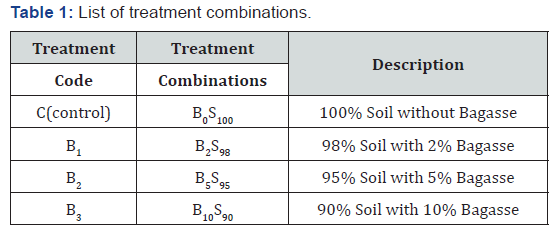
different concentrations (0, 2, 5 and 10%) of SCB (Table 1). For
proper decomposition, SCB was applied one month prior to seed
planting in the field since the rate of decomposition is affected by
temperature, moisture, population and diversity of soil microorganisms
[15].
Field management
Chinese cabbage seeds were germinated following the
recommended practice in the soil with different treatments (Table
1). One pot has three sample plants. Plants were watered with
100mL for the first 3 days to check the response of pot treatments.
Additional 50mL of water was administered, depending on the
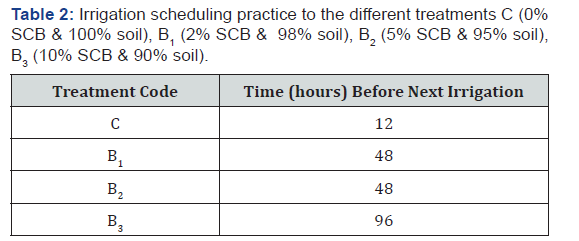
response of the plants to respective pot treatments (Table 2), but
equal amount of water (150mL) was administered for every plant,
using graduated cylinder. To control pests and diseases, the use
of contact insecticide (cypermethrin) available in the market was
done. It was sprayed following the prescribed dosage (2mL per a
liter of water) of the manufacturer.
Antifungal resistance
Agronomy and physiological data of Chinese cabbage growth
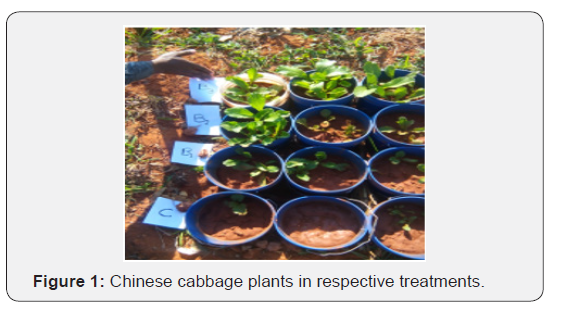
were collected as indicated below for different treatments (Figure
1) and analyzed by Microsoft excel.
Agronomic parameters
Days to emergence: This parameter of the Chinese cabbage
was determined by counting the number of days from sowing
to the time when 50% of the plants started to emerge the tip of
panicles through visual observation
Plant height and root length: Plant height was measured at
maturity from the ground level to the top of the Chinese cabbage
from each treatment and for selected three plants and the average
was taken as plant height (cm). Root length also studied to the
same plant for which plant height was determined
Number of leaves per plant: Number of leaves were counted
from three representative plants from each pot and averaged as
per plant.
Physiological parameters
Plant samples were collected at 5 weeks after sowing.
Chinese cabbage plants were separated into leaves and roots for
determining relative water content, plant dry mass, root to shoot
ratio.
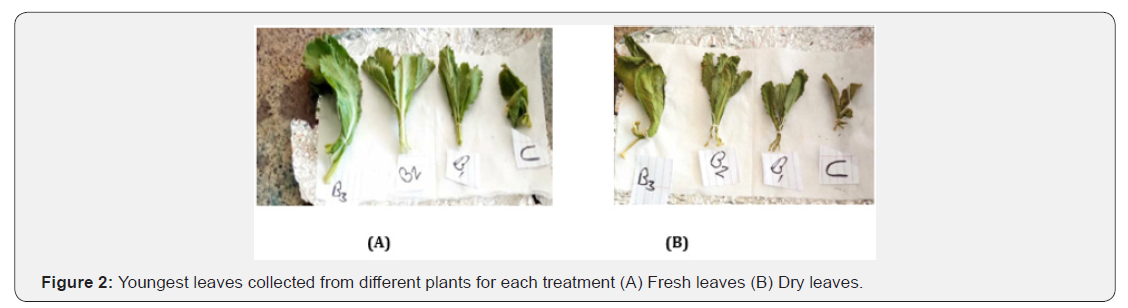
Relative water content (RWC): Fully expanded youngest
leaves were selected from different plants from each treatment
(Figure 2). Five leaves were sampled and weighed immediately
to determine the fresh weight (FW). Then immersed in distilled
water in Petri-dishes for 24h in darkness and then turgid weight
(TW) was determined. The leaves were dried in an oven at 70 °C
for 24h and the dry weights (DW) were obtained [16]. From the
obtained data, relative water content was calculated using the
following formula:

Plant dry mass: Three Chinese cabbage plants from each
treatment were separated into shoot and roots. Then washed in
tap water to remove the soil particles and blotted to dry on paper
towels. The shoots were weighed by using an electronic weighing
balance to determine the fresh weight (FW). Then shoots were
dried in an oven at 70 °C for 24 hours and the dry weight (DW) was
obtained. The plant dry mass was calculated by using following
formula.

Root to shoot ratio: The above ground part (shoot) and below
ground part (root) of Chinese cabbage from each treatment were
sampled from the plant which is grown very well. The roots were
washed in tap water to remove the soil particles and blotted to dry
on paper towels. The fresh weight was determined immediately
after harvesting using an electronic weighing balance. The
collected samples of shoots and roots were dried in an oven at 70
°C for 24 hours to obtain dry weight. Then root to shoot ratio was
calculated by using formula below [17].

Results and Discussion
The amounts of humic acid extracted from SCB after
decomposition at different periods were shown in Table 3. Higher
amount (0.2779g) of HA was extracted after 30 days, and small
amount (0.0053g) was extracted from 0 day of SCB decomposition.
The amount of HA extracted from soil with SCB is significant with
respect to the time taken for decomposition of SCB. The humic
acid content of soil with SCB is proportional to the degree of
decomposition of SCB [3].
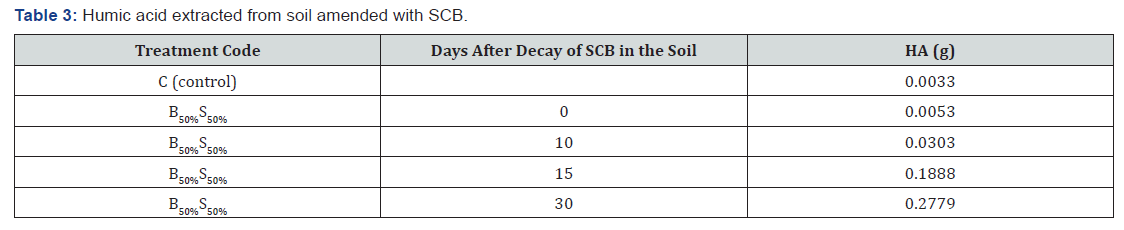
B50%S50% = 50% SCB mixed with 50% soil.
Characterization of humic acid using FTIR spectra
Figure 3 shows the FTIR spectra of the humic acid samples
collected at 0, 10, 15, 30 days. In general, all spectra are almost
similar in the position of the main bands, but some differences
can be observed in their relative intensity. All the spectra showed
bands that could be assigned to the main groups, as: 3371.74 –
3335.45cm-1 the intense and broad absorption band due to O-H
bond stretching which mainly belongs to the carboxylic acids
involved in hydrogen bonding. The week and narrow bands at
2930.99-2854.66cm-1 for HA extracted from zero and ten days after decomposition of SCB was due to symmetric stretching
bands of aliphatic C-H bonds of -CH3, -CH2- and tertiary C-H. The
obtained absorption band is very similar to that from soil HA
which is reported by Stevenson [3].

It is possible to differentiate the source and the humification
condition of the organic matter by using FT-IR spectrum. The HA
with relatively low degree of humification has a spectrum with
-CH3 and -CH2- and tertiary C-H absorption bands (generally
located around 2900-2850cm-1). It is clearly observed that these
bands are absent or overlapped with O-H band of COOH group
in the spectra of HA samples collected at 15 and 30 days of
decomposition of SCB. Moreover, the band intensity of carboxylic
O-H groups increased with the number of days of decomposition
of SCB. This implies as the decomposition period increases the
number of carboxylic acid groups increased. Hence it is proved
that more humic acid produced with more number of days of
decomposition of SCB. The sharp and medium intense bands
(1633.79, 1706.76, 1635.62 and 1636.23cm-1 for 0, 10, 15 and 30
days respectively) observed in the carbonyl region also indicates
the production of humic acid with the decomposition of SCB. A
pair of bands observed between 1598.11 - 1450cm-1 (for C=C)
indicate the presence of aromatic ring in humic acid. The results
were slightly similar with the results reported by Reddy and his
co-workers (2018) on FTIR spectrum of HA of paddy soils [18].
Effects of SCB on agronomic parameters of Chinese cabbage
Days to seed emergency: Days to emergence
generally took 3
to 5 days. The plants emerged fast from the soil mixed with 10% of
SCB (Treatment B3). Faster germination from B3 treated pot might
be due to SCB amendment germination. In order to emerge the
plants from 50% of seeds it took only three days in the case of
soil with 10% of SCB whereas it took five days in the case of soil
without any SCB (control). With the increase in the percentage
of SCB from 0 to 10% the plant emergence from 50% of seeds
took a smaller number of days (Table 4). The absorption of humic
substances produced by SCB into seeds has a positive influence
on seed germination and seedling development. Availability of
humic (HA) or fulvic acids (FA) to seeds will increase the seed
germination, resulting in higher seed germination rates [19].
Results of this study are similar with the findings of Eyheraguibel
[20]. According to their study the germination was started 3 days after
sowing and the first daily count of germinated seed showed
more radicle emergence from the soil with humic like substances.
Stehouwer and Macneal [21] recorded an increase of germination
and fescue seedling establishment after the first leaching event
as a response of the salt decrease following compost amendment
[21].

Plant height and root length: Plant height increased from
5.3 to 15.3cm with the increase in the percentage of SCB in the
soil from 0 to 10%. This indicates the increase in growth of the
plant in soil amended with SCB. This might be due to increase
in the amount of humic acid and organic carbon in the soil
after amendment with SCB. The tallest root length (6.2cm) was
observed in the soil amended with 10% of SCB (treatment B3)
and the shortest root length (2.2cm) was obtained from the
control (Table 4). For treatment B3 the amended organic matter
improves the physical properties of the soil and causes increase
of root development which helps the uptake of more water
and nutrients [22]. Both plant height and root length increased
significantly with the increase in the percentage of SCB in the
soil. The significant increase might be from soil properties that
support the root growth due to the enough oxygen diffusion to the
root tip and supply of enough water for root growth. The results
of this study are like that of reported by Robert & Ronny [22]
that after application of organic matter, soil sodium adsorption
ratio declines 56%, and root length of plant increases 140%.
Sodium induces soil structural deterioration (slaking, aggregate
destruction, and clay and organic colloid dispersion), leading to
subsequent water infiltration and percolation problems [22].
Number of leaves in plant: The average number of leaves per
plant was found highest (8.7) in the soil with 10% of SCB and lowest
(3.6) was in the control (Table 4). The average number of leaves
of Brassica rapa, subsp. Pekinensis growing in soil with different
concentration of SCB reveals an overall increasing pattern from
control to B3 (10% SCB). This might be due to improvement in the
soil properties to increase soil fertility, water holding capacity and
soil porosity etc. to support the plant growth. SCB when applied
to land increases soil fertility by providing macro nutrients such
as nitrogen and phosphorous and micronutrients such as Zn and
Cu [22].
Effect of SCB on physiological parameters of Chinese cabbage

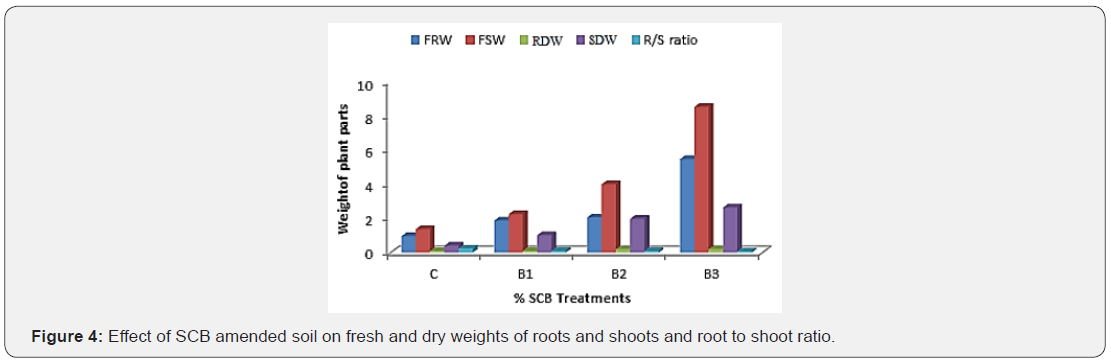
RWC = Relative Water Contents; PDM = Plant Dry Mass;
FRW = Fresh Root Weight; FSW = Fresh Shoot Mass; RDW = Root Dry Weight;
SDW
= Shoot Dry Weight.
Relative water content: Relative water content (RWC) is
the most appropriate measure of plant water status in terms of
the physiological consequence of cellular water deficit. Water
potential as an estimate of the energy status of plant water is useful
in dealing with water transport in the soil-plant-atmosphere
continuum. However, it does not account for osmotic adjustment.
For the same leaf water potential two different cultivars can have
different leaf RWC, indicating a corresponding difference in leaf
hydration, leaf water deficit and physiological water status. Hence
RWC is an appropriate estimate of plant water status in terms
of cellular hydration under the possible effect of both leaf water
potential and osmotic adjustment [23]. From the data in Table 5,
relative water content increased significantly from 57.29 to 73.21,
when SCB increased from 0 to 10% in the soil (treatments C (0%
SCB) to B3 (10%SCB)).
Plant dry mass and fresh weight: Results presented in Table
5 shows that the fresh weights of root and shoot (g per plant)
significantly increased with increase in the SCB content in the
soil from 0 to 10% (treatments from C, B1, B2 and B3 respectively).
Furthermore, dry shoot and root biomass of the plant were
significantly enhanced in the soil with SCB as compared to the soil
without SCB (control). The root/shoot ratio also enhanced due to
soil amendment with SCB comparing with the control (Figure 4).
The observed enhancement of plant growth by the application of
SCB to the soil is due to increase in uptake of the elements such
as N, P, K, Fe, Zn, and Mn nutrients [24]. Moreover, enhancement
of photosynthesis, plant root respiration has resulted in greater
plant growth with HA produced by SCB [25]. The performance of
the soil in the plant growth after the application of SCB was due
to enhancement in moisture retention and the improvement of
nutrients supply in the root zone [26].
Conclusion
Sugarcane bagasse is generally considered as an
agricultural
waste product; however, the present findings show it contains
enough amounts humic acid after decomposition. Application of
different levels of sugarcane bagasse positively influenced most
of the yield parameters of Chinese cabbage (Brassica rapa, subsp.
pekinensis). Crop improved in response to its favorable effects on
the soil characteristics. Utilization of sugarcane bagasse as organic
fertilizer can save chemical fertilizers along with minimizing
environmental pollution. By comparing the levels of sugarcane
bagasse application in this study, 10% was suggested to be the
standard dose due to best yield parameters such as the root and
shoot length of plant, root and shoot dry weight of plant, number
of leaves and relative water content of Chinese cabbage (Brassica
rapa pekinensis) crop in the soil amended with SCB


Comments
Post a Comment