Challenges Associated with a Successful Management of Regulated Deficit Irrigation in Commercial Fresh-Fruit Production- Juniper Publishers
Journal of Agriculture Research- Juniper Publishers

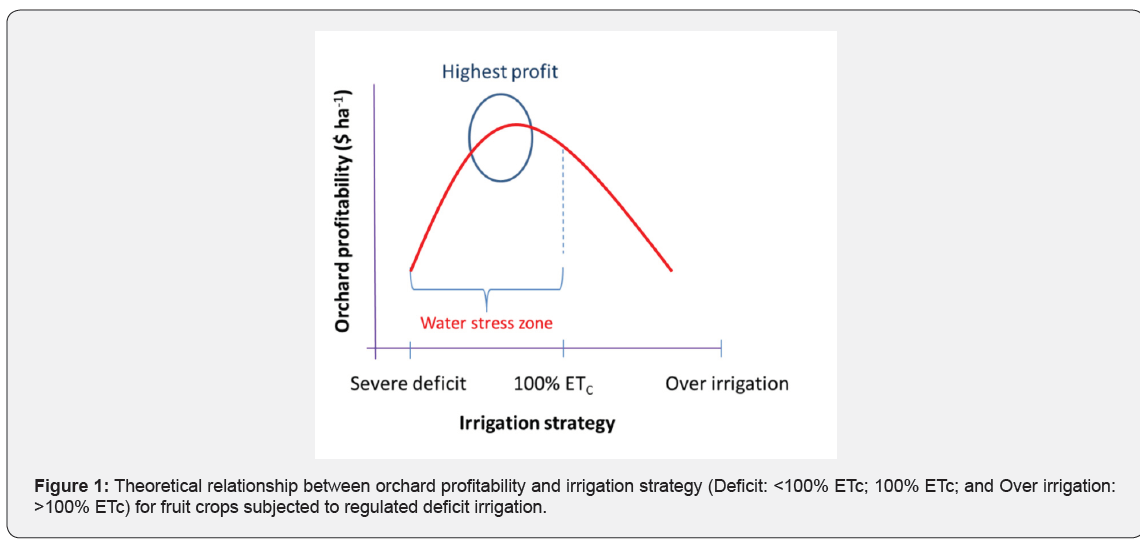
Regulated deficit irrigation (RDI) is a cultural practice by which the amount of water applied to the crop during specific periods of the growing season is below the maximum water demand. Depending on the crop species, the most recognized benefits of deficit-irrigating fruit orchards are: 1) important water savings [1], 2) increased water productivity and intrinsic water use efficiency [2], 3) improved fruit quality and uniformity of fruit maturity [3] and 4) reduced vegetative growth [4]. Therefore, maximum orchard profitability is reached when water application has induced some level of water stress (Figure 1). Of course, this premise breaks away from the traditional principle that both full irrigation and optimum plant water status are indispensable to maximize profitability. The correct use of RDI implies the use of water stress during periods of the growing season when the sensitivity of reproductive development to drought is moderate or low. It must be carefully handled, because, it is well known that severe water stress may reduce fruit size and compromise yield of the next season (as well as the current season if improperly applied) [5]. This is why RDI has been mostly employed in fruit crops whose economic value is not determined by fresh weight, such as wine grapes [3], almonds [5], and prunes [6], among others. Furthermore, the fact that fresh-fruit growers have been hesitant to use this irrigation technique [7] is a good example of how the adoption of water conservative irrigation strategies, is strongly hindered by farmer’s aversion to risk [8]
The implementation of successful RDI in fruit orchards must include several key points that are not always properly considered. Among these are: 1) a precise identification of water stress-sensitive phenological stages, 2) a deep understanding of physiological responses to water stress, and 3) a robust methodology to measure both orchard water requirements and plant water status during the season. The precise identification of critical periods to use RDI is not easy, as water stress-sensitive periods differ among fruit crops. For instance, late water deficits can generate considerable reductions in yield of stone fruit trees, as water stress may induce large reductions in elongation growth rates [5]. On the other hand, moderate levels of water stress applied during the last growth stage of table grape berries have shown no impact on berry size and yield per vine [3].
The application of RDI is based on the principle that water stress-induced stomatal closure generates a greater reduction in plant transpiration than in net photosynthesis [7]. However, the relationship between water stress and stomatal conductance is not straightforward, showing important variation among species and varieties. For example, leaves from severely water-stressed kiwifruit vines (Actinidia deliciosa A. Chev.) may exhibit very high stomatal conductance [8], which explains the high vulnerability of kiwifruit to cavitation. On the other hand, leaves from highbush blueberry plants (Vaccinium corymbosum L.) have been reported to show an exponential reduction in stomatal conductance as water stress severity increases [9]. Consequently, RDI application and management depend on the development of accurate and precise physiological thresholds to identify severity levels of water stress for each fruit crop.
Currently, there are many available methods and types of equipment for determining orchard water requirements and plant water status in the field, which include 1) bio-meteorological techniques, such as the Bowen ratio, eddy covariance, and surface renewal; 2) plant-based methods, such as leaf and stem water potential, dendrometry, sap-flow sensors, and stomatal conductance, and 3) remote and on-site sensing systems, among others [11]. Unfortunately, this large methodological diversity is one of the key challenges that fruit growers have to face to correctly manage an RDI program. Independent or government extension specialists can help farmers to adopt the most appropriate tool for their irrigation needs [and scale, and assist them through the process of adoption]. However, technology transference in many fruit-producing countries is led by private companies, which may compromise the objectivity of the extension process.
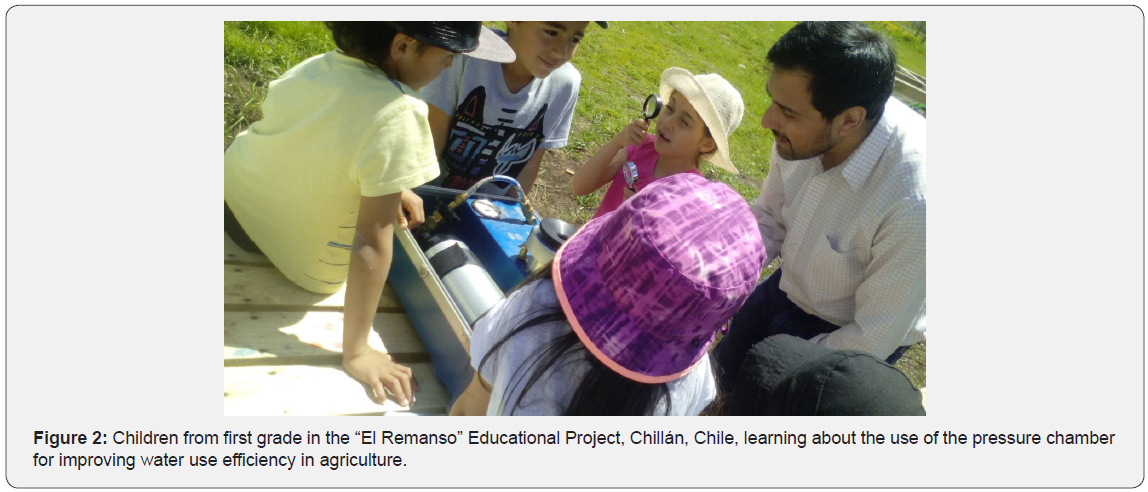
Since climate change models predict important rises in atmospheric water demand and progressive reductions in precipitation, an increasing number of fresh-fruit growers from Mediterranean-climate areas have become interested in deficit irrigation [7]. Indeed, the emerging question is whether deficit irrigation strategies should be optional or mandatory, in areas affected by low water availability. In the meantime, agricultural extension efforts must be directed towards training fruit growers in the correct implementation of RDI, which will increase its adoption rate in commercial fresh-fruit production. A starting point to move forward may be improving educational efforts related to the importance of reducing water use in agriculture in a climate change scenario (Figure 2).
Acknowledgement
I gratefully acknowledge the funding provided by the “Proyecto de Apoyo al Retorno de Científicos del Extranjero” (Proyecto 821320062), Programa de Atracción e Inserción de Capital Humano Avanzado (PAI), Conicyt, Chile. I am grateful to Dr. Michael Wolff from the California Department of Food and Agriculture, Office of Environmental Farming and Innovation for their technical support and assistance.
To know more about open access journal publishers click on Juniper publishers


Comments
Post a Comment