Response of Grafting Height on Growth Success of Acid Lime (Citrus aurantifolia Swingle) Saplings- Juniper publishers
Journal of Agriculture Research- Juniper Publishers

Citrus is the most important fruit crop of mid-hill region of Pakistan. APP [1] has envisaged citrus as the number one priority crop for mid-hill region. Citrus is commercially cultivated in 42 mid-hill districts [2]. Acid lime (Citrus aurantifolia Swingle) is the second important citrus crop of Pakistan after mandarin in terms of area coverage [3]. Unlike mandarin and sweet orange, acid lime can be cultivated successfully from Terai to mid-hill region of Nepal. There is enormous scope of acid lime production in Nepal. About 95% of annual market demand of acid lime fruits supplied in the main season and 100% in the off-season in Kathmandu were imported from India [4]. Dhakal et al. [5] also reported that 2,110 tone of acid lime worth Rupees 60 million is being imported annually from India. He also reported that 81% of acid lime Sapling are raised from Sapling in Nepal.
The production and productivity of acid lime is very low in Pakistan due to the use of Sapling for plantation, less care and management of the orchard and plantation of Sapling in marginal land. Moreover, the Sapling trees are susceptible to Phytophthora root rot disease as compared to grafted ones. Sapling prepared by grafting acid lime onto trifoliate orange [Poncirus trifoliata (L.) Raf.] are tolerant of Phytophthora gummosis, cachexia-xyloporosis and nematodes, especially the Tylenchulus semipenetrans. The rootstock is also resistant to the citrus tristeza virus [6]. The demand of grafted Sapling is growing day by day within the country. Trifoliate orange Sapling has poor growth in open field condition. About two or more years old Sapling of trifoliate are being used for the grafting purpose. Some Sapling are very dwarf to be grafted with the suitable scions. Grafting at too low height can create the problem of rot disease at the point of union of the Sapling after plantation. Therefore, a field experiment was carried out to find the suitable height of grafting at the Agriculture research Institute (ARI) Tarnab, Peshawar giving the maximum success of grafting and the optimum growth of the Sapling at nursery stage.
Materials and Method
The study was carried out at ARI Tarnab, Peshawar, during 1st January to 30th December 2017. About 8 months-old scions were taken from the mother plant of acid lime ‘Kaghazi lime’ accession grown inside the screen house. Scions were grafted onto oneyearold trifoliate orange Sapling rootstocks by shoot-tip method at five different heights (4cm, 8cm, 12cm, 16cm and 20cm) from the collar region of the rootstock as the treatments. The grafts were planted inside the closed tunnel made from bamboo splits, jute sheet cover from inside and plastic sheet cover from outside at 10×8cm spacing in experimental plots laid out in randomized complete block design (RCBD) with four replications. Each 64×100cm sized experimental plots were supplied with a total of 10kg vermi-compost (nitrogen 1.25-2.5%, phosphorus 0.75-1.6% and potash 0.5-1.1%) containing 80 grafts. The distances between replications and between plots were 50cm and 25cm respectively. Treatments were allotted on the experimental plots randomly. Ten plants were selected from each experimental plot for the study. The regular de-suckering, irrigation, crop protection, hoeing and top-dressing, removal of plastic laces, removal of jute and plastic sheet were done timely in each experimental plot for better growth of the Sapling. The recorded data were reduced, arranged in MS-Excel and analyzed by MSTAT-C package. The means were separated by Duncan’s Multiple Range Test (DMRT).
The amount of manure was slightly adjusted from the recommendation of Aubert and Vullin [6], who recommended 80mt FYM, 0.4mt TSP (Tripple Super Phosphate (45% P2O5) and 0.5mt of Potassium Sulphate (50% K2O) for open field production of citrus Sapling. Excluding the chemical fertilizers, the amount of vermin- compost was doubled in the experiment
Results and Discussion
Graft success
The sprouting of a graft is considered as the success of grafting in the final observation. At the initial observation, all the grafts were not sprouted, therefore success was not conformed. Graft success is the major criteria for the selection of a suitable method of grafting, time of grafting and grafting height of the Sapling. In the present study, the success of grafting was not found to be significantly affected by the height of grafting. However, at final observation of success at 180 days after grafting, the highest success (99.37%) was given by 16 cm grafting height followed by 20cm (99.06%) and the lowest (97.81%) by 8cm (Figure 1).
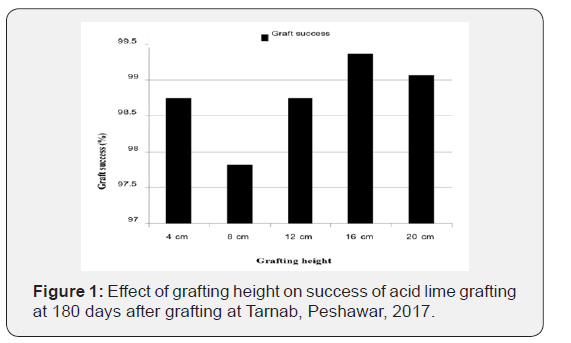
Present finding was also supported by Poon [7] who reported 88.73%, Gautam et al. [8] reported 87.5%, Chalise [9] reported 77.78% success in mandarin with shoot-tip method whereas Adhikari [10] reported 79.73% success in acid lime grafted onto trifoliate orange rootstock. The present result was higher than previous findings which may be due to more experienced grafters, more suitable temperature and humidity for callusing and more care of grafts after planting.
Growth of scion height
The growth of scion height was significantly affected by the grafting height at 180 and 300 days after grafting while nonsignificant at rest of the observations. At 180 days after grafting, the maximum growth of scion height (27.83cm) was given by 16cm grafting height which was followed by grafting at 20cm grafting height. Similarly, at 300 days after grafting, the highest growth of scion height (39.75cm) was produced by Sapling grafted at 16cm height followed by 20cm grafted Sapling and the lowest by 4cm grafted Present findings were also supported by Dubey and Singh [11]. They reported 29.53cm scion height at 11 months after grafting Sapling. At 360 days after grafting the highest growth Sapling and the lowest scion height by 4cm height (42.13cm) was again produced by 16cm height grafted Sapling (Table 1).
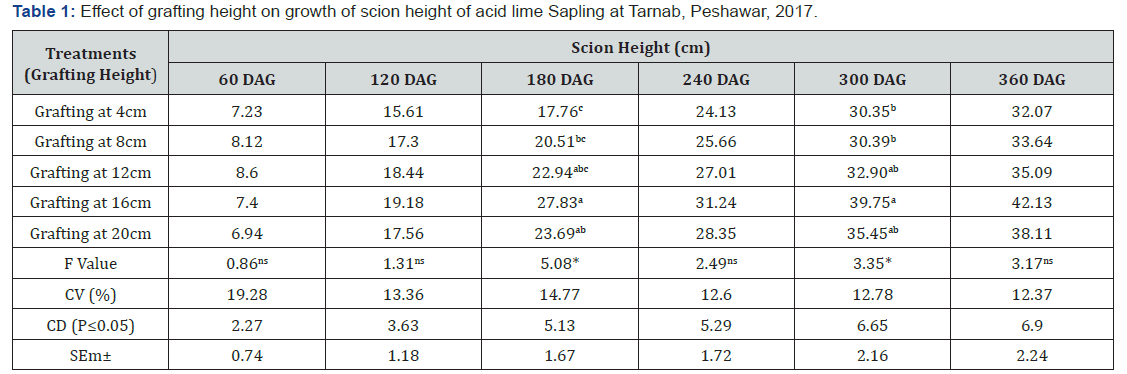
SEm±=Standard error of mean difference, CV=Coefficient of variation, CD=Critical difference at probability value 0.05; Treatment means followed by common letter(s) are not significantly different at 5% by DMRT; DAG=Days after grafting.
Darjeeling mandarin grafted onto rough lemon rootstock. Scion height of 21.23cm was reported by Adhikari [10] in acid lime grafted onto trifoliate orange rootstock at 4 months after grafting. Similarly, Chalise [9] reported 17.86cm height of mandarin at 6 months after grafting onto trifoliate orange rootstock. However, the present result was higher than past findings.
Number of leaves per sapling
The number of leaves per Sapling prepared by grafting at different height on the rootstock was found significant at 300 days after grafting while nonsignificant at the rest of the observations. At 300 days after grafting, the significantly higher number of leaves per Sapling (53.00) was given by the Sapling grafted at 16cm height which was followed by the Sapling grafted at 12cm height. Statistically, 12cm and 16cm grafting heights were at par. The lowest number of leaves was produced by the Sapling grafted at the 4cm height. At 360 days after grafting, all the grafting heights were not significantly different statistically, however, the maximum leaf number (47.50) was given by 16cm height grafting (Table 2). This may be due to fast healing of the wounds of the grafts at this height. Present findings were also supported by Dubey and Singh [11]. They observed 47 leaves per Sapling in Darjeeling mandarin grafted onto rough lemon at 330 days after grafting. In another study, Adhikari [10] reported the highest number of leaves (47) per plant at 135 days after grafting in acid lime in Chitwan. Similarly, Chalise [9] reported 48.47 leaves of mandarin Sapling at 180 days after grafting.
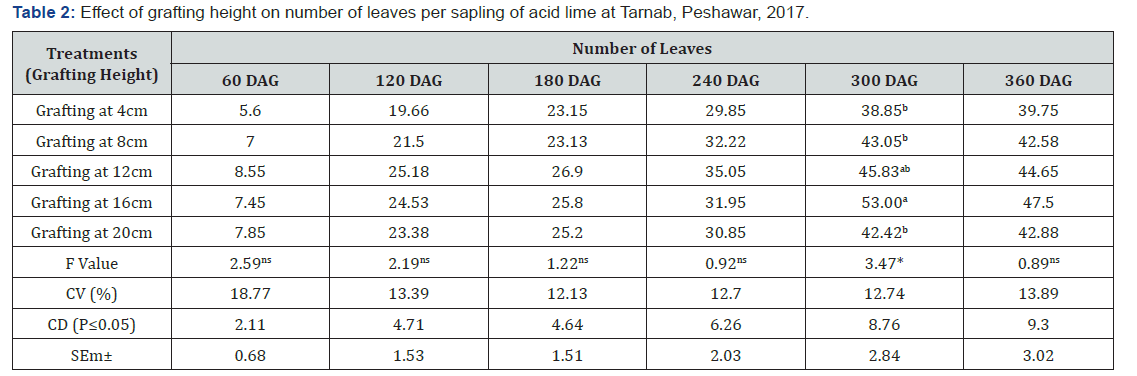
SEm±=Standard error of mean difference, CV=Coefficient of variation, CD=Critical difference at probability value 0.05; Treatment means followed by common letter(s) are not significantly different at 5% by DMRT; DAG=Days after grafting
Growth diameter
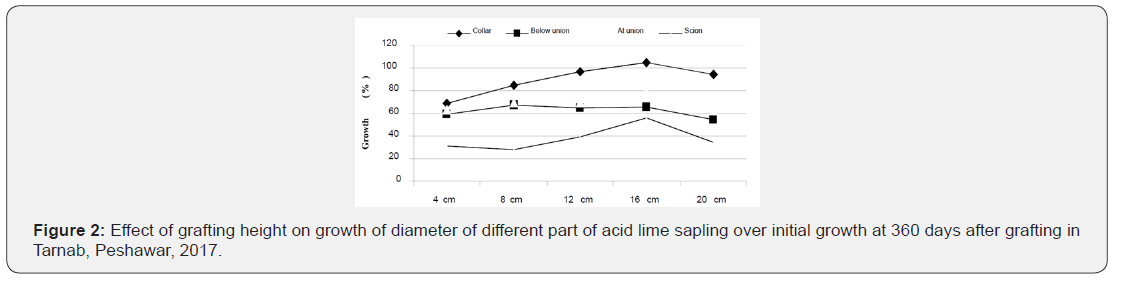
Union diameter were found statistically nonsignificant. However, the growth of scion diameter was found significant at 360 days after grafting. The highest growth (104%) of collar region was given by 16cm grafting height and the lowest (69.11%) by 4cm grafting height. Below the union diameter was maximum (67.46%) in 8 cm grafting height and the lowest (54.14%) in 20cm height grafting. Similarly, the highest growth of union diameter (79.24%) was given by 16cm grafting height and the lowest (62.34%) by 20cm grafting height. The scion diameter growth was recorded maximum (55.61%) in 16cm grafting height and the minimum (28.06%) in 8cm grafting height. Among the four different parts of sapling the collar diameter growth was found maximum followed by union diameter and below the union diameter and the least growth on scion diameter (Figure 2).
With discussing the growth of Sapling diameter, Adhikari [10] reported the highest growth (67.88%) of the scion diameter, while Chalise [9] recorded the highest growth (60.33%) of collar diameter over the initial growth among collar diameter, below the union diameter union diameter and scion diameter
Number of primary branches per sapling
The number of primary branches per sapling was found nonsignificant from 60 to 360 days after grafting in the present study. However, at 360 days after grafting the highest number of primary branches per sapling (2.425) was produced by the sapling grafted at 12cm height which was followed by 4cm grafting height and the lowest number of primary branches was recorded in sapling grafted at 16cm height (Table 3).
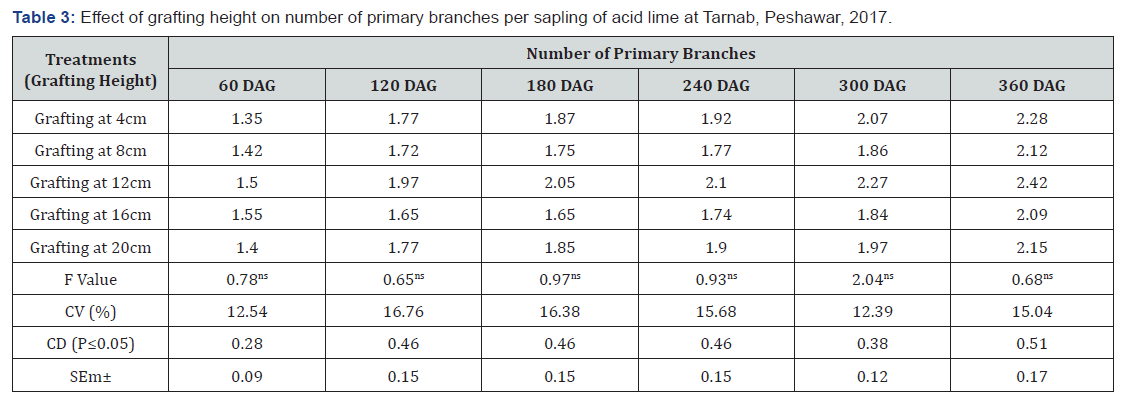
SEm±=Standard error of mean difference, CV=Coefficient of variation, CD=Critical difference at probability value 0.05; Treatment means followed by common letter(s) are not significantly different at 5% by DMRT; DAG=Days after grafting.
Length of primary branches
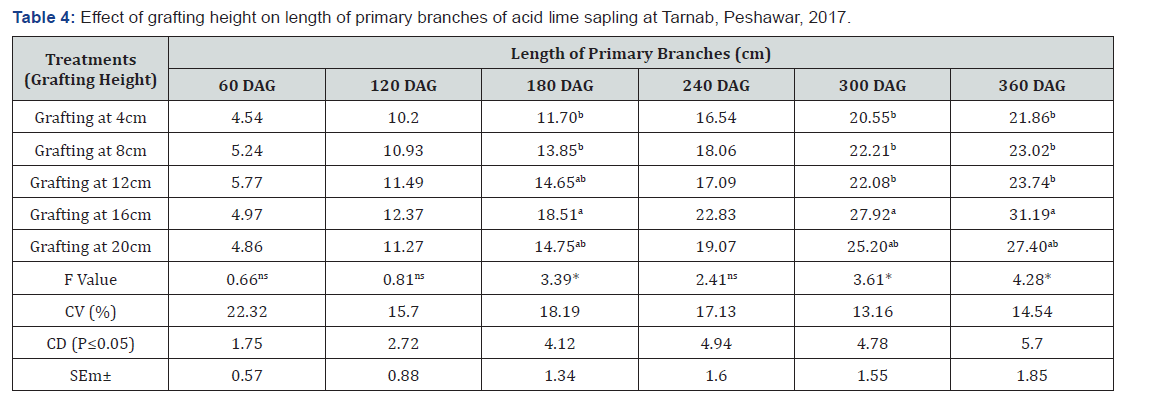
SEm±=Standard error of mean difference, CV=Coefficient of variation, CD=Critical difference at probability value 0.05; Treatment means followed by common letter(s) are not significantly different at 5% by DMRT; DAG=Days after grafting.
The length of primary branches was found significant at 180, 300 and 360 days after grafting while nonsignificant at the rest of the observations. At 180 days after grafting the highest length of primary branches (18.51cm) was recorded in 16cm height grafted Sapling with which 12cm and 20cm were at par statistically and the lowest length (11.70cm) was given 4cm grafting height. At 300 days after grafting, maximum height (27.92 cm) was again given by 16cm and the lowest (20.55cm) by 4cm height of grafting. At 360 days after grafting, the highest length (31.19cm) was recorded in 16 cm height of grafting and the lowest (21.86cm) in 4cm grafting height (Table 4).
Number of secondary branches per sapling
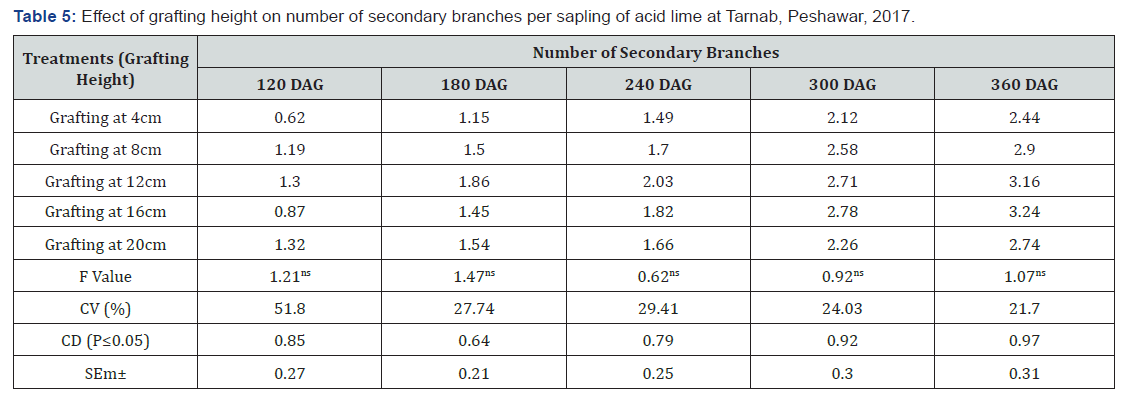
SEm±=Standard error of mean difference, CV=Coefficient of variation, CD=Critical difference at probability value 0.05; Treatment means followed by common letter(s) are not significantly different at 5% by DMRT; DAG=Days after grafting.
The secondary branches of sapling were recorded only after 4 months after grafting. The number of secondary branches were found nonsignificant at 120 days to 360 days after grafting. However, at 360 days after grafting, the highest number of secondary branches (3.24) was produced by the sapling prepared by the grafting at 16cm height which was followed by 12cm height grafted sapling (3.158) and the lowest number (2.438) was produced by sapling grafted at 4cm height (Table 5).
Length of secondary branches
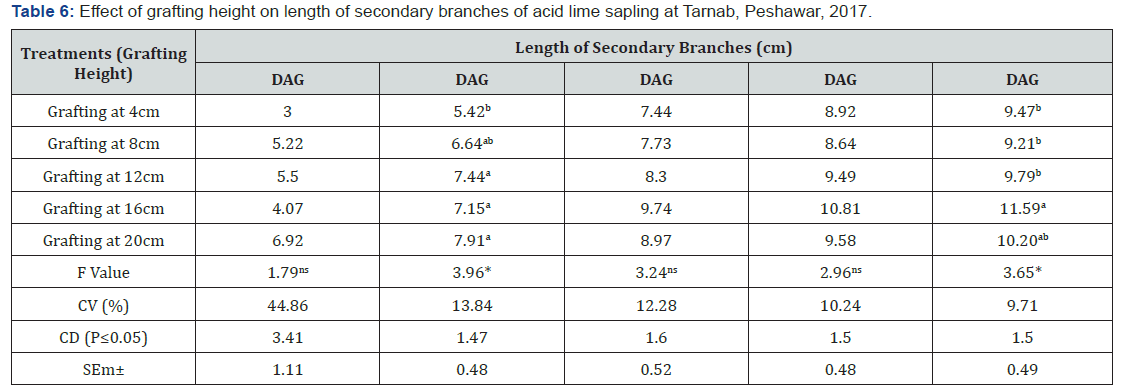
SEm±=Standard error of mean difference, CV=Coefficient of variation, CD=Critical difference at probability value 0.05; Treatment means followed by common letter(s) are not significantly different at 5% by DMRT; DAG=Days after grafting
The length of secondary branches was found significant at 180 and 360 days after grafting and nonsignificant at the rest of observations. At 180 days after grafting, the highest length (7.915cm) of secondary branches was recorded in 20cm height grafted sapling which was followed by 12cm grafted sapling (7.445cm) and the lowest length (5.425cm) by 4cm height grafted sapling. At 360 days after grafting, the highest length (11.59cm) of secondary branches was given by 16cm height grafted sapling followed by 20cm grafted sapling (10.20cm) and the lowest (9.215cm) by 8cm height grafted sapling (Table 6).
Graft spread
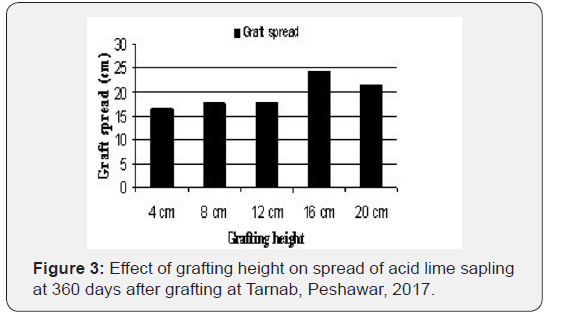
The average graft spread of sapling was found highly significant at 180, 300 and 360 days after grafting, significant at 240 days after grafting and nonsignificant at the rest of the observations. At 180 days after grafting, the maximum graft spread (12.43cm) was observed on 16cm height grafted sapling and the minimum (9.62cm) in 4cm grafted sapling. Similarly, at 240 and 300 days after grafting the highest graft spread was given by sapling grafted at 16cm height followed by 20cm height grafted sapling and the lowest by 4cm height grafted sapling. Again at 360 days after grafting, the extra graft spread (24.35cm) was recorded in 16cm height followed by 20cm and the lowest in 4cm height grafted sapling (Figure 3).
Canopy volume
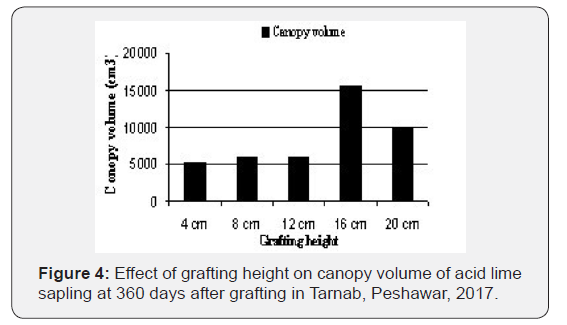
Canopy volume of sapling was calculated by the formula ð.D2.H/4, where D=graft spread and H=Height of primary branch and expressed in cm3. A slight change in the graft spread and height can make much difference. The canopy volume of sapling was found significantly affected by the grafting height at 180 and 240 days after grafting and highly significantly affected at 300 and 360 days after grafting. From 180 to 360 days after grafting, the highest volume of canopy was recorded in sapling grafted at 16cm height followed by 20cm grafted ones and the lowest in 4cm grafted sapling. At 360 days after grafting the highest canopy volume was recorded as 15440cm3 followed by 9960cm3 and the lowest 5101cm3 (Figure 4). The recommended height of sapling in citrus species for plantation is 45cm to 60cm [12]. To attain this height, the age of the sapling should be one to one and half year for open field condition. Most of the citrus saplings are produced by grafting the desirable species/varieties onto the trifoliate orange rootstock. About one and half year is taken by the trifoliate orange to attain the graft able size which compels the nursery owners grafting at much lower height even at 2.5cm or less above the collar region. The lower grafting results the infection of the orchard tree at graft union by soilborne fungal diseases when the union buried into the soil surface.
Recommendation
The recommendation of the study is that grafting can successfully be done at any height started from 4 cm to 20 cm for success point of view only, however, the subsequent growth of sapling was found to be affected by the height of grafting. At shorter height, the growth of sapling was found slower and at higher grafting height the growth was found higher up to 16 cm only. Beyond this height sapling growth was again found retarded in the field condition. Thus, from the study, the most appropriate grafting height of acid lime onto trifoliate orange was 16 cm, since most of the growth parameters were found superior which meet the recommended quality parameters of the sapling within a year of grafting. Higher grafting also minimizes the possible attack of diseases at union in main field condition.
To know more about open access journal publishers click on Juniper publishers


Comments
Post a Comment