Analysis of Agricultural Investment Efficiency Based on the Ultra-Efficient Dea Method- Juniper Publishers
Journal of Agriculture Research- Juniper Publishers

To cope with the impact of the financial crisis on China's economy, China has implemented a "four trillion" investment policy to enable China to smoothly weather the financial crisis. However, the growth of investment has led to a decline in investment efficiency. Based on the research sample of 23 provinces from 2008 to 2017, this paper studies the efficiency of Agricultural Investment in China and puts forward some suggestions.
Keywords: Ultra-efficient DEA; Agriculture; Investment Erficiency
Literature review
At present, multi-factor model is the mainstream method to analyze the comprehensive efficiency of investment efficiency. The earliest appearance of this method is traced back to Jefferson (1990) [1], who used the packet model (DEA) to analyze the technical efficiency of China's steel industry, the results show that China's steel industry technology efficiency is low, and some improvement methods are proposed. In the process of rapid development of this method, the whole factor productivity (TFP) method began to emerge, the specific research method is divided into two categories, one kind of scholars use Cobb-Douglas production function, CES production function, etc. to calculate the total factor productivity changes by using the potential output method, by estimating the forward production function, and then calculating the distance between the actual input-output combination and the cutting-edge function. Later, Malmquist S proposed the concept of Malmquist index, but the method was widely used after the DEA method became popular. When the research on investment efficiency of the overall economy matures gradually, many scholars in China have started to combine the current situation of our country and carry out the research on investment efficiency for different sub-industries [2], analyzed the investment efficiency of cultural industry in Hubei Province and concluded that the investment efficiency of cultural industry in this region is in a state of fluctuation and higher than the average of other provinces, but still not effective in DEA, studies the investment efficiency of cultural industry in Shandong Province and concludes by DEA method that the overall investment efficiency of cultural industry in Shandong Province is high, but there are fluctuations in scale efficiency in different years [2]. Puts the perspective on the investment efficiency of hydropower industry and thinks that the investment efficiency and electricity efficiency of hydropower industry in China are low, and the potential for improvement is huge.
Efficiency calculation of agricultural investment
Model selection
The DEA model: At present, the academic method of measuring efficiency is divided into the following two categories, one is the parameter method, mainly includes the amendment of the least square, the cutting-edge production function method and so on, the other is the non-argument method, and the packet analysis method (DEA) is the representative of it. Packet analysis (DEA) is a nonparametric method to measure the relative efficiency value of a decision unit (DMU) in the case of multiple inputs and multiple outputs. For other parameter methods, the DEA model has its unique advantages: 1, the method does not need to set a specific function form, which avoids the error caused by artificially setting the efficiency function equation; The deA model uses input and output data to build an efficiency frontier with all decision units (DMUs) by mathematical planning, and the closer the DMU is to this frontier, the more efficient the DMU efficiency value is 1. Assuming the existence of N decision units (DMU), I input indicators, and J output indicators, the specific form of the DEA model is shown in equations 1-1.
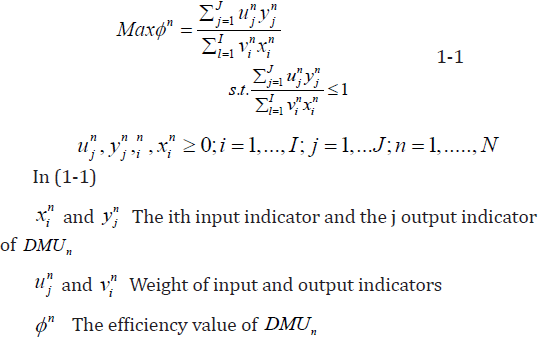
It can be found that the traditional DEA model may have multiple efficiency units equal to 1, at this time cannot distinguish between good and bad in all valid units, so this paper chooses the super-efficiency DEA model for efficiency analysis.
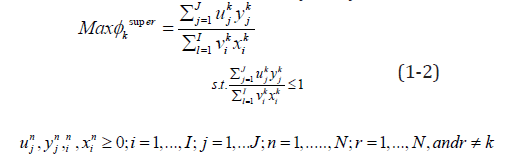
Ultra-efficient DEA model: In view of the disadvantages of the traditional DEA model, Banker e al (1988) puts forward the super-efficient DEA model, the principle is to exclude the DMU to be evaluated from the reference set, so that the effective decision-making unit reorders the advantages and disadvantages. The model is specific to see 1-2. In (1-2), The indicator means the same as the normal DEA model. At this point, the calculated efficiency value of the can be greater than 1, in this paper, the use of DEA solver Pro5.0 software for efficiency analysis.
The efficiency calculation of agricultural input and output
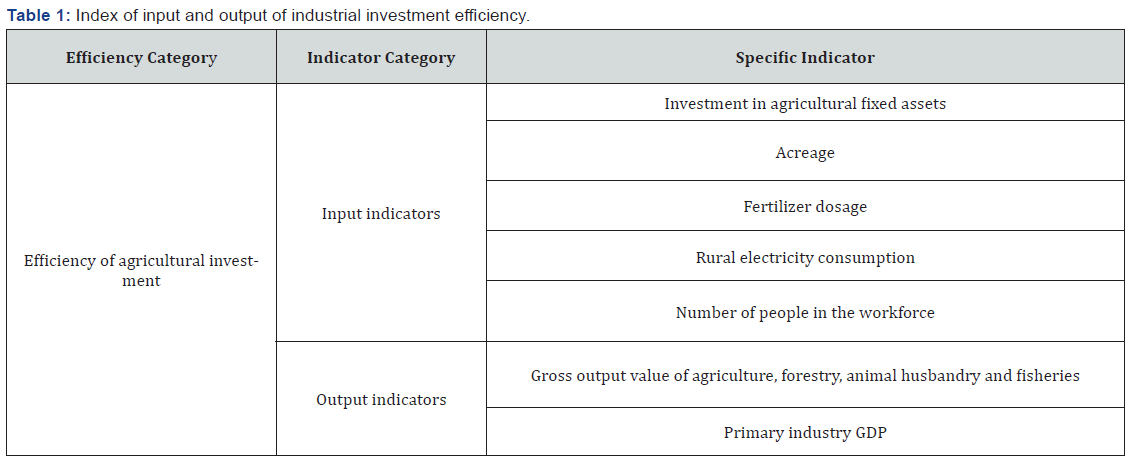
Input and output indicator selection: The data are from the China Statistical Yearbook, the China Financial Statistics Yearbook, the statistical yearbook of the provinces, as well as the wind database, CSMAR database. Agricultural investment efficiency reference [4] selected agricultural fixed asset investment, the end of the year commonly used arable land area, rural working population, rural electricity consumption as input indicators detailed indicator information see Table 1.
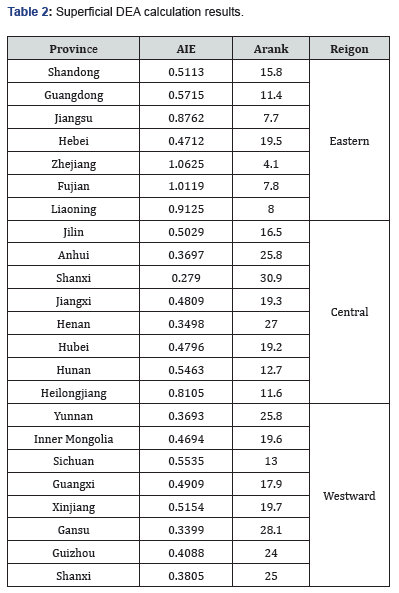
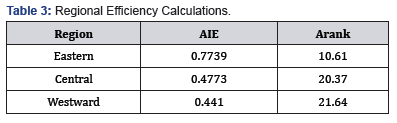
The results of the calculation: [4], the method of super-efficiency DEA model is not radially improved, so this paper contains the following assumptions: 1, scale compensation variable, because it is difficult to achieve efficiency under fixed-scale compensation due to legal system, market competition and other reasons; The results are shown in (Tables 2,3) (1) On the whole, the overall investment efficiency of China's agriculture is not high, even in the highest eastern region, the efficiency value is still less than 0.9. In terms of agricultural investment efficiency, the eastern region is much higher than the central region and the western region, and the investment efficiency of the central region and the western region industry is not very different. (2) In terms of comprehensive investment efficiency ranking, Zhejiang, Jiangsu and Fujian ranked first in the agricultural investment efficiency ranking, while Henan and Shandong, the traditional agricultural provinces, ranked lower, indicating that some areas of agriculture are larger, but the investment efficiency is not high the agricultural investment efficiency is high in inner Mongolia [5-7].
Conclusion
Based on the macro data of 23 provinces in China from 2008 to 2017, this paper calculates the efficiency of agricultural investment in China and finds that the overall investment efficiency of agriculture in China is not high, and there are obvious regional differences, and there is still a lot of room for improvement in the level of agricultural modernization and large-scale construction. As a basic industry, the state should give more policy support to improve china's agricultural modernization and large-scale construction level. Microcosmicly, to improve the efficiency of agricultural investment needs to give enterprises more freedom, improve the agricultural economic subject "small, scattered, chaotic" status quo, improve the construction of agricultural industry system, promote industrial integration and development, and thus improve the efficiency of agricultural investment.
To know more about open access journal publishers click on Juniper publishers


Comments
Post a Comment