Factors That Affect Yield in Wild Blueberry, Vaccinium Angustifolium Aiton- Juniper publishers
Journal of Agriculture Research- Juniper Publishers

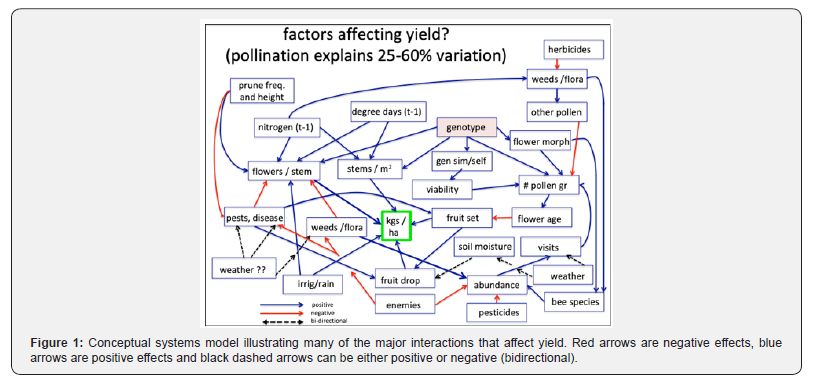
Wild blueberry (Vaccinium angustifolium Aiton), also known as lowbush blueberry is an ericaceous native North American plant that is managed for berry production in the eastern U.S., the Canadian Maritimes and Quebec. The crop is not planted, it is a natural component of the understory in mixed deciduous and coniferous forest and when trees are harvested, existing blueberry plants are managed to produce agricultural fields [1]. My research lab has been studying wild blueberry pollination and other factors that affect yield for over 30 years. Figure 1 is a synthesis of our knowledge of factors that affect yield of this native North American crop [2-14]. A summary of these factors follows. First of all, wild blueberry is a bee dependent crop for pollination. Bee species diversity is high (>120 spp.). Honeybees are a major bee pollinator, being rented by growers every year. Wild native bees are also important providing 10-50% of pollination. Pesticide exposure and natural enemies (parasites and pathogens) can reduce abundance. Bee abundance is related to both floral abundance and diversity within and adjacent to wild blueberry fields.
Many species of bees are floral constant t blueberry during bloom, but non-blueberry flowering plants during bloom can have negative effects on pollination by contamination of blueberry stigmas with non-blueberry pollen. Total bee abundance in a field is directly related to percent fruit set, but most native bee species are more efficient at depositing pollen on blueberry stigmas than honeybees. The higher the fruit set, the greater the number of fertilized ovules in a flower and the greater the number of seeds in a fruit. Fruits with more seeds are larger and have greater mass. Because wild blueberry is not planted, plant (genet) genetic diversity is high in fields. While most plants require outcrossing because they are self-incompatible in terms of their own pollen. Genetic compatibility is non-reciprocal, such that some pollen genotypes placed on stigma result in high levels of fruit set and others, even if a high abundance of pollen is deposited, result in a low level of fruit set. About 20% of all genotypes have high levels of self-compatibility. These self-compatible individuals are also universal mothers (meaning they can accept pollen from any sire and have high levels of fruit set) and because of this have high yield potential either through self or outcrossed pollination. Flower number per stem and stems density increase yield if bee abundance is adequate. Stem density and flowers per stem can be increased with fertilization and the height and timing of pruning (early in season). Pollination is a strong determinant of yield (in any given year explaining 25-60% of the variance in yield). Weeds, plant disease, and insect pests can indirectly and directly reduce yield by reducing flower bud development and number during the prune year (insect gall makers, insect defoliators, leaf-spot pathogens, and weeds shading blueberry plants), reducing flowers during bloom (insect defoliators and plant pathogens), and reducing fruit number (insect feeding on and insect parasitism of fruit, and plant pathogens of fruit). In addition, extreme heat and drought can result in reduction of fruit size. Fruit drop also occurs after pollination and fruit set. Fruit drop is a function of the density of flowers set on a stem, the number of fertilized ovules in a fruit, and available resources during fruit maturation, especially water which can be supplemented through irrigation. The effects of fruit drop have a compensatory effect on yield.
When fruits are reduced in number through reduction of flowers or when fruit are formed and then dropped, remaining fruit tend to compensate or become larger due to the higher amount of assimilates and water available for those fewer remaining fruits. This has consequences in decision making in both pollination and pest management. Above average fruit set or pest attack may result in less fruit due to fruit drop with high levels of pollination or fruit consumption due to pest attack. Because of compensation these lower levels of fruit can equal yield in fields with lower levels of pollination and fruit attack. Because yield is a result of complex dynamic of interacting biological processes, weather conditions have strong effects on yield. Weather conditions affect almost all of the interactions shown in Figure 1, but we did not attempt to show all of these effects because the diagram would become difficult to read. Weather effects determine bee foraging intensity and duration, flower bud and flower mortality through winter injury and spring frosts, and fruit drop and fruit size, through drought. These strong weather effects suggest that climate change has been and will continue to be detrimental to wild blueberry production in the future.
Acknowledgements
Research was supported by the USDA Specialty Crop Block Grant Program (award CT01A-2013-1023*1659) received from the Maine Department of Agriculture, Conservation, and Forestry, and the USDA National Institute for Food and Agriculture through the Specialty Crop Research Initiative (award 2015-51181-24252). This project was also supported by the USDA National Institute of Food and Agriculture, Hatch (or McIntire-Stennis, Animal Health, etc.) project number #ME0-21505 through the Maine Agricultural & Forest Experiment Station. This is Maine Agricultural and Forestry Experiment Station publication number 3696.
To know more about open access journal publishers click on Juniper publishers


Comments
Post a Comment